Image source: © 2025 Krish Capital Pty.Ltd
Highlights
- Direxion’s Daily Semiconductor Bull and Bear 3X Shares offer exposure to short-term price movements in either direction.
- These leveraged ETFs are designed to deliver, before fees and expenses, 300% or -300% of the daily performance of the NYSE Semiconductor Index.
- Over the past month, SOXL has delivered a 32.90% NAV gain, underscoring the potential upside of leveraged products in fast-moving markets.
- These funds are intended strictly for sophisticated market participants who fully understand the risks of leverage, daily compounding, and market volatility.
For individuals seeking to amplify their exposure to the volatile semiconductor sector, Direxion’s Daily Semiconductor Bull and Bear 3X Shares (SOXL and SOXS) offer exposure to short-term price movements in either direction. These leveraged ETFs are designed to deliver, before fees and expenses, 300% or -300% of the daily performance of the NYSE Semiconductor Index.
NYSE Semiconductor Index (ICESEMIT) is a rules-based, modified float-adjusted market capitalization-weighted index that tracks the performance of the thirty largest U.S. listed semiconductor companies.
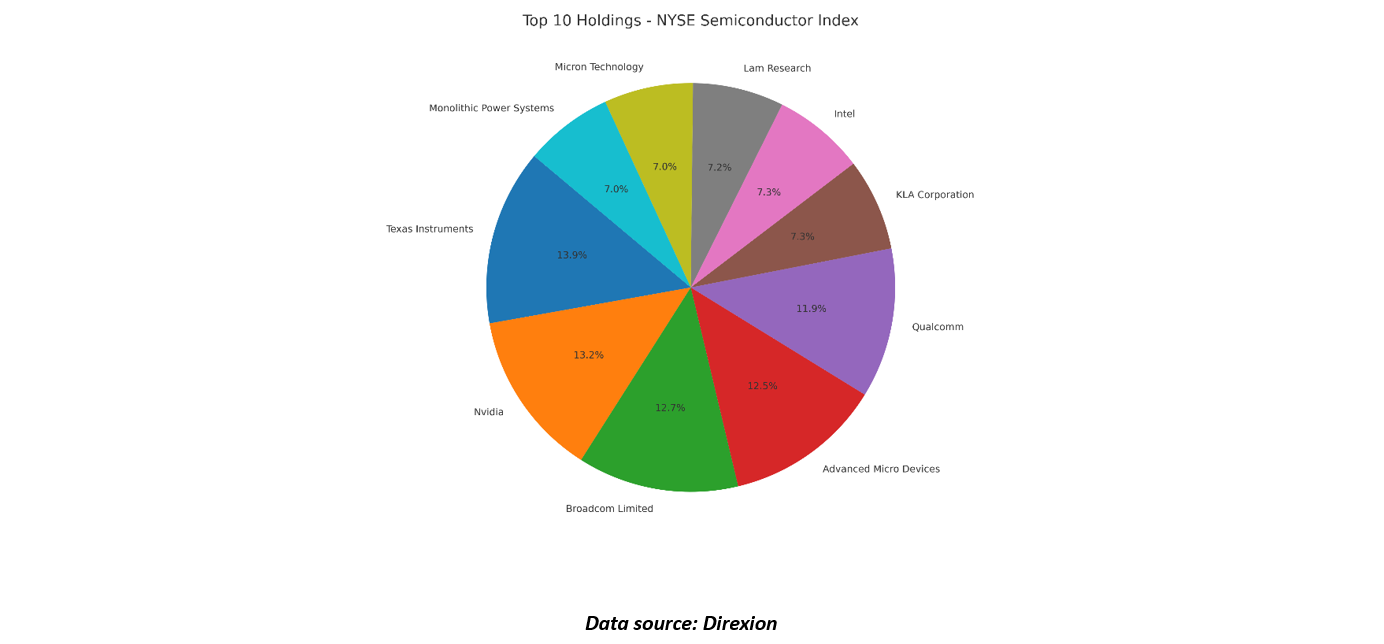
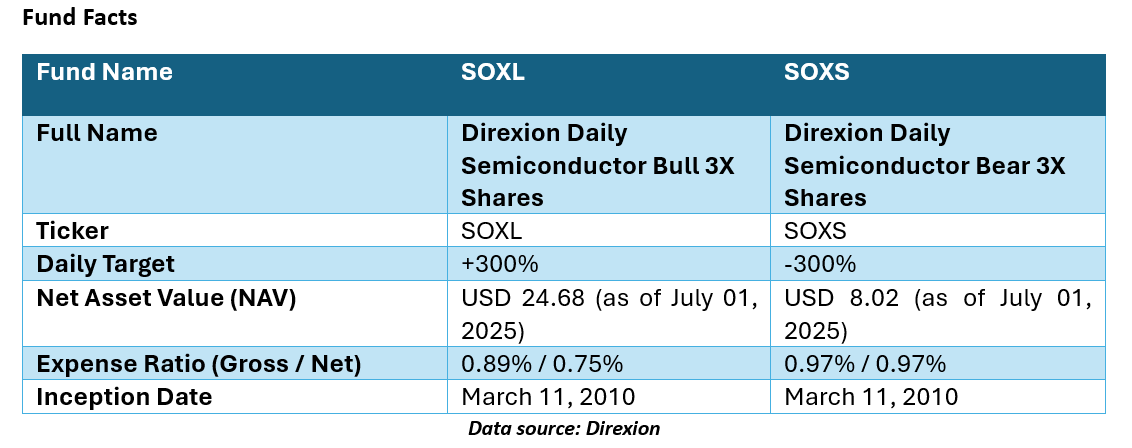
The semiconductor industry has experienced significant swings recently, driven by shifting demand in AI, consumer electronics, and geopolitical tensions affecting global supply chains.
Over the past month, SOXL has delivered a 32.90% NAV gain, underscoring the potential upside of leveraged products in fast-moving markets. Yet, this upside comes with risk; year-to-date, SOXL has fallen 40.52%, and over the past 12 months, it’s down 66.32%, highlighting the dangers of compounding losses when markets move against leveraged bets.
These funds are intended strictly for sophisticated market participants who fully understand the risks of leverage, daily compounding, and market volatility. Direxion itself emphasizes that these products are not suitable for buy-and-hold investors, as they are designed to capture single-day moves rather than longer-term trends.
It's important to remember that past performance is not a reliable indicator of future results. When selecting an ETF, it's essential to consider individual sector preferences, risk tolerance, and the specific performance of the underlying index.
Download Free Report – Explore 3 Stock Ideas & Industry Insights
Unlock 3 stock ideas and key industry insights in our free report. This information is general in nature and does not consider your personal objectives, financial situation, or needs. It is not financial advice.
All investments involve risk—consider independent advice before making any investment decisions.
View 3 Research Reports
Disclaimer:
This report (“Report”) has been issued by Kalkine New Zealand Limited (FSP691351) (NZBN:9429047678101) (“Kalkine”). Kalkine is a Financial Advice Provider (“FAP”) and is authorised by a Class 1 Financial Advice Provider Licence issued by Financial Markets Authority (“FMA”) to provide financial advice. Kalkine provides only general financial advice through its research reports following a person becoming a member. The reports contain buy/sell/hold and other recommendations in relation to equity securities, managed funds and other managed investment schemes and other financial advice products. The recommendations and opinions in this Report and on Kalkine website do not take into account any of your investment objectives, financial situation or needs. Before you make a decision about whether to acquire a financial product, you should obtain the Product Disclosure Statement from the product issuer. You should consider the appropriateness of advice taking into account your own objectives, financial situation and needs and seek independent financial advice before making any financial decisions. If you act on the advice in the research reports, you may have to pay fees, expenses or other amounts (but not to Kalkine).
The information in this Report and on the Kalkine website has been prepared from a wide variety of sources, which Kalkine, to the best of its knowledge and belief, considers accurate. Kalkine has made every effort to ensure the reliability of the information contained in its reports (including this Report), newsletters and websites. All information represents our views at the date of publication and may change without notice.
Kalkine does not issue, sell or deal in any financial products. The information in this Report does not constitute an offer to sell securities or other financial products or a solicitation of an offer to buy securities or other financial products. Our reports contain general recommendations to invest in securities and other financial products. Kalkine is not responsible for, and does not guarantee, the performance of, or returns on, any investments mentioned in this Report.
This Report may contain information on past performance of particular investments. Past performance is not a reliable indicator of future performance. Returns stated do not take into account transaction costs and taxes.
Further information about the complaints and dispute resolution process, as well as information about Kalkine’s duties are available on Kalkine’s website. Please read our Financial Advice Provider (FAP) disclosure statement and Complaints Handling Guide, which are available on the website.
Copyright 2026 Krish Capital Pty. Ltd. (ABN 61629651510). All Rights Reserved. No part of this Report, or its content, may be reproduced in any form without our prior consent.

 AU
AU
 UK
UK
 CA
CA
 US
US
 IND
IND

 NZ
NZ

 Share
Share
 X (Formerly Twitter)
 Whatsapp
 Facebook
 LinkedIn
 Telegram
 Email This Article
 Copy Link
 Summarize with AI
 Chat GPT
 Perplexity


 Apr 28, 2026

_12_18_2025_13_13_17_985559.png)

_11_27_2025_13_17_04_571639.png)
 Please wait processing your request...