
 AU
AU
 UK
UK
 CA
CA
 US
US
 IND
IND

 NZ
NZ

 Share
Share
 X (Formerly Twitter)
 Whatsapp
 Facebook
 LinkedIn
 Telegram
 Email This Article
 Copy Link
 Summarize with AI
 Chat GPT
 Perplexity
Image Source : Krish Capital Pty Ltd
Index Update: On 25th February 2025, the significant broad-based sell-off impacted the NZ market. Also, strong selling momentum was witnessed in the materials sector. On the same day, S&P/NZX 50 Index witnessed a decline of 1.79% to close at 12,307.270 and S&P/NZX 20 Index fell by 1.65% to 7,385.980. Also, S&P/NZX 10 Index encountered a decline of 1.69% and S&P/NZX All Materials fell by 5.96%. However, S&P/NZX All Consumer Staples rose by 1.40%.
Macro Update: The trade balance for the January 2025 month was a deficit of $486 Mn, as per Stats NZ. In January 2024 month, the deficit stood at $1.1 billion. Notably, the total exports amounted to $6.2 Bn in January 2025, reflecting an increase of $1.4 billion as compared with January 2024. The imports were valued at $6.7 Bn, demonstrating a rise of $787 million over the same period. The narrowing of the deficit in January 2025 as compared to the same month last year was because of agricultural commodity exports.
Top Market Movers: Among top gainers, Marsden Maritime Holdings Limited (NZX: MMH) witnessed a rise of 61.11% to $5.22 per share. On the other hand, Ryman Healthcare Limited (NZX: RYM) fell by 21.03%.
Commodity Update: The dollar strengthened on Tuesday after hitting its lowest level two months earlier, supported by safe-haven flows following U.S. President Donald Trump’s announcement that tariffs on Mexico and Canada would proceed as planned. In commodity markets, gold remained steady at $2,964.80, while silver saw a slight increase of 0.52%, reaching $33.77. Copper fell by 0.02% to $9,487.50. Brent crude oil gained 0.51%, settling at $75.16, driven by fresh U.S. sanctions on Iran, raising concerns over potential supply disruptions. Investors are closely watching upcoming GDP data for further economic direction.
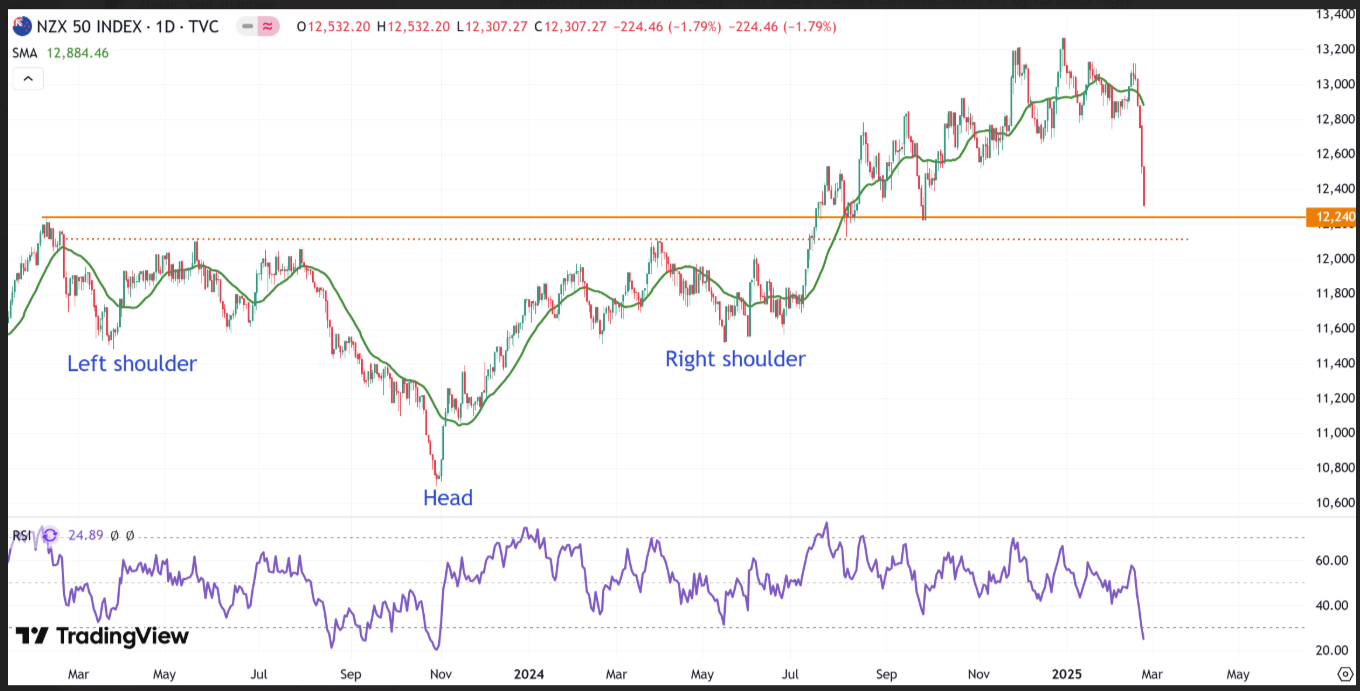
Source: Trading View, Analysis: Kalkine Group
In July 2024, S&P/NZX 50 index broke above both the neckline of a Head and Shoulders pattern on the daily chart and a crucial resistance level set by its 2023 high. This breakout suggests that the uptrend, which began in November 2023, is likely to continue and may drive the index toward its 2021 historical peak. Despite the ongoing pullback, the index remains above a key support level defined by the 2023 high and the pattern’s neckline, reinforcing expectations of a sustained uptrend. Additionally, the 14-day Relative Strength Index (RSI) is hovering near oversold territory, signaling a potential rebound in the near future.
Our Stance: It could be said that the NZ market was impacted by the broad-based sell-off on 25th February. RBNZ stated that a period of restrictive interest rates reduced the demand in the broader NZ economy and contributed to reduced inflation. Notably, subdued global economic activity, decline in net immigration, and reduced government consumption have resulted in slowness in domestic demand. Also elevated policy uncertainty related to global trade developments can decrease business investment.


 Jun 26, 2026




 Please wait processing your request...