
 AU
AU
 UK
UK
 CA
CA
 US
US
 IND
IND

 NZ
NZ

 Share
Share
 X (Formerly Twitter)
 Whatsapp
 Facebook
 LinkedIn
 Telegram
 Email This Article
 Copy Link
 Summarize with AI
 Chat GPT
 Perplexity
index Update: New Zealand stocks closed lower on 2 June 2026 as investors reacted to heightened geopolitical tensions. Rising energy prices and Inflation concerns tempered expectations for further interest-rate cuts. On the same day, S&Amp;P/NZX 50 Index witnessed a fall of 0.56% to end at 13,170.710 and S&P/NZX 20 Index declined by 0.46% to 7,473.860. Also, S&P/NZX 10 Index fell by 0.73%. Notably, strong sell-off was witnessed in the Communications Services sector, with S&P/NZX All Communications Services falling by 3.01%.
Macro Update: In the release dated 27 May 2026, RBNZ stated that the conflict in the Middle East is dampening economic activity while pushing near-term inflation higher. The Committee remains committed to preventing higher costs from translating into sustained inflation over the medium term, while also seeking to minimise unnecessary economic Volatility. The Committee observed that higher energy prices have contributed to an increase in headline inflation across many of New Zealand’s trading partners in recent months.
Market Movers: Among top gainers, Green Cross Health Limited (NZX: GXH) witnessed a rise of 36.00% to end at $2.04 per share. Heartland Group Holdings Limited (NZX: HGH) rose by 11.40%.
Commodity Update: The U.S. dollar remained steady on Tuesday as investors adopted a cautious stance amid ongoing Middle East peace discussions. Lebanon announced a limited ceasefire between Hezbollah and Israel, offering some relief to regional tensions, though broader geopolitical risks continued to weigh on market sentiment. Gold rose 0.26% to USD 4,518.10, silver gained 0.37% to USD 75.62, and copper advanced 0.43% to USD 13,878.90. Meanwhile, Brent Crude slipped 0.40% to USD 94.58 as the Strait of Hormuz remained closed, maintaining uncertainty over global energy Supply routes.
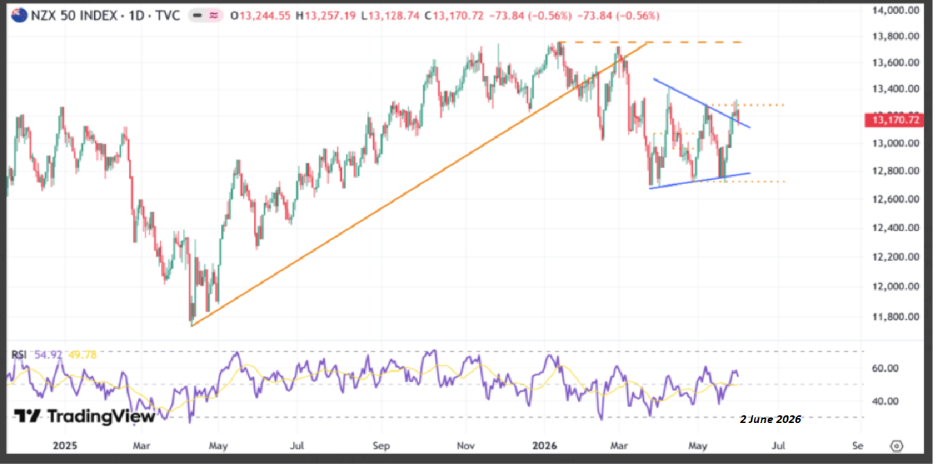
Source: Charts by TradingView, Analysis: Kalkine Group
The S&P/NZX 50 continued to retreat from its recent peak, declining 73.84 points, or 0.56%, to close at 13,170.72. From a technical standpoint, although short-term market sentiment has shifted from neutral to positive, the index was unable to reclaim its previous high and is showing signs of a potential bearish divergence against the Relative Strength Index (RSI), indicating persistent selling pressure and suggesting that an uptrend has not yet been confirmed.
Despite the recent improvement in sentiment, the broader downtrend from the January 2026 peak of 13,757.71 remains in place, as the benchmark continues to trade below the key resistance level at 13,282.97. Immediate support is located near 12,726.35, and a decisive break below this level would strengthen expectations of a continuation in the prevailing bearish trend. On the other hand, a sustained breakout above 13,282.97, supported by stronger trading Volume, would be needed to negate the negative outlook and signal the potential for a broader trend Reversal.
Our Stance: US markets have been showing a cautious but generally resilient trend, with volatility driven by shifting expectations around interest rates and inflation. Investors are rotating between growth and defensive sectors. Technology and AI-related stocks continue to support broader indices. Overall, sentiment is balanced between optimism about Earnings strength and concern over persistent macro uncertainty. New Zealand equities have been trading with a cautious tone, reflecting ongoing uncertainty in both domestic growth and global conditions. Investor sentiment has been sensitive to Interest Rate expectations, with rate-sensitive sectors remaining volatile.


 Jun 26, 2026




 Please wait processing your request...