
 AU
AU
 UK
UK
 CA
CA
 US
US
 IND
IND

 NZ
NZ

 Share
Share
 X (Formerly Twitter)
 Whatsapp
 Facebook
 LinkedIn
 Telegram
 Email This Article
 Copy Link
 Summarize with AI
 Chat GPT
 Perplexity
Image Source : Krish Capital Pty Ltd
Index Update: On 18th February 2025, the broader NZ market ended marginally in red, with S&P/NZX 50 Index witnessing a decline of 0.14% to end at 13,051.120 and S&P/NZX 20 Index declining 0.05% to 7,853.050. Also, S&P/NZX 10 Index encountered a fall of 0.33% to 13,029.840. On the same day, significant selling was witnessed in the energy sector and S&P/NZX All Energy encountered a decline of 2.02% to end at 1,680.960. Also, S&P/NZX All Consumer Staples witnessed an increase of 2.59%.
Macro Update: As per FEU dated 7th February 2025, despite the ongoing soft demand, the expectation that monetary policy would continue easing is helping the business confidence. The global growth momentum demonstrated signs of easing in January, which were led by softening services sector sentiment, but pointed to robust global growth. Notably, in the goods sector, the global Purchasing Managers Index reflected a pickup in activity.
Top Market Movers: Among top gainers, Synlait Milk Limited (NZX: SML) witnessed a rise of 10.87% to end at $1.02 per share. On the other hand, My Food Bag Group Limited (NZX: MFB) increased by 5.13% to $0.205 per share.
Commodity Update: The U.S. dollar remained near two-month lows on Tuesday, as traders evaluated tariff concerns and the potential for U.S. rate cuts. Meanwhile, the Australian dollar stayed near its highest level in two months despite market expectations of an imminent rate cut. Investor focus shifted to Wednesday's release of the Federal Reserve's January meeting minutes, to assess how policymakers are addressing risks of a broader tariff war linked to President Trump's trade policies. In commodities, gold rose 0.34% to $2921.15, silver climbed 0.11% to $32.91, and copper increased 0.02% to $9399.95. Brent oil fell 0.20% to $75.10 amid a Ukrainian drone attack and concerns over OPEC+ output plans.
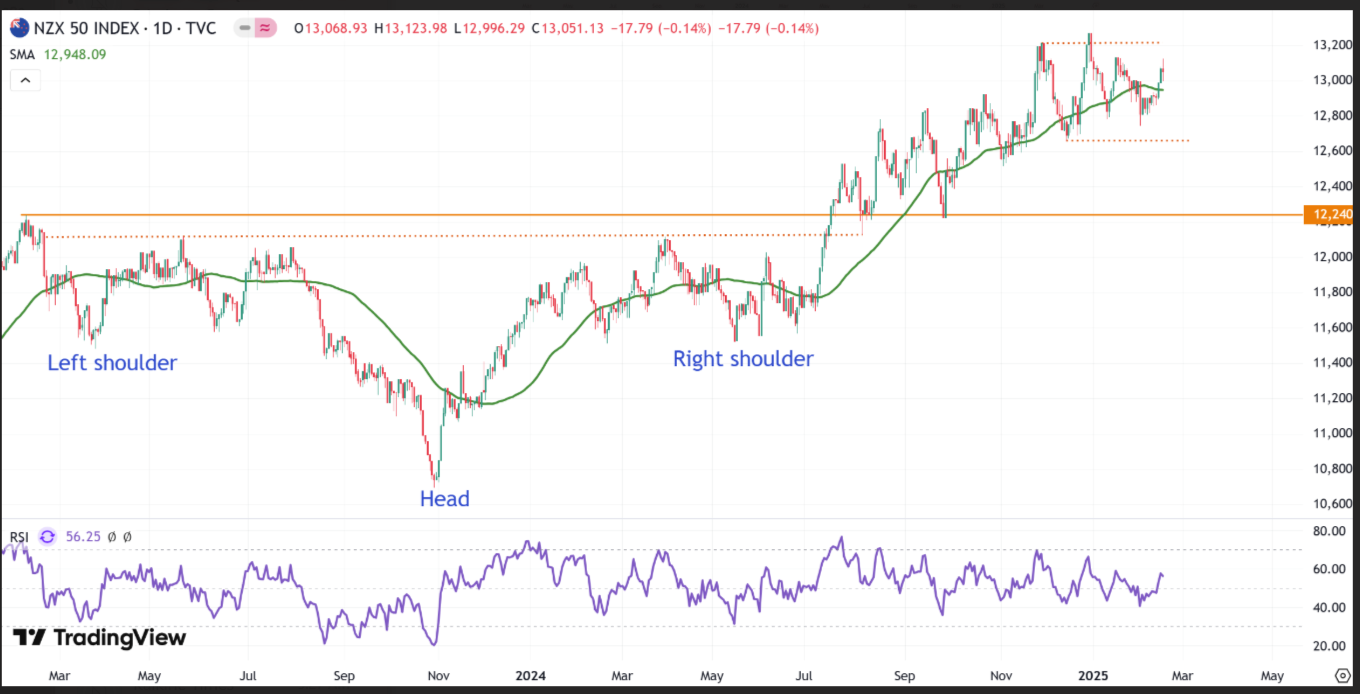
Source: Trading View, Analysis: Kalkine Group
In July 2024, the S&P/NZX 50 index surpassed both the neckline of a Head and Shoulders pattern on the daily chart and a key resistance level marked by its 2023 high. This breakout indicates that the uptrend, which started in November 2023, is likely to persist and could push the index toward its historical peak from 2021. Despite the ongoing correction, the index continues to establish higher highs and higher lows, confirming the prevailing uptrend. Meanwhile, the 14-day Relative Strength Index (RSI) is heading north from its midpoint, reflecting positive market sentiment in the short-term.
Our Stance: It could be said that the sell-off in energy sector somewhat impacted the broader NZ market on 18th February. Since there are some concerns related to trade and inflation, the market players are required to maintain a cautious stance when it comes to equity investments. Also, the market experts are looking for some clarity regarding the monetary policy. On 24th February, Stats NZ would be releasing data about retail trade survey (December 2024 quarter).


 Jun 26, 2026




 Please wait processing your request...