
 AU
AU
 UK
UK
 CA
CA
 US
US
 IND
IND

 NZ
NZ

 Share
Share
 X (Formerly Twitter)
 Whatsapp
 Facebook
 LinkedIn
 Telegram
 Email This Article
 Copy Link
 Summarize with AI
 Chat GPT
 Perplexity
Image Source : Krish Capital Pty Ltd
Index Update: On 7th March 2025, the broader NZ market ended lower amidst decline in the primary sector index. On the same day, S&P/NZX 50 Index encountered a fall of 0.23% to end at 12,399.780 and S&P/NZX 20 Index fell by 0.30% to close at 7,390.480. Also, S&P/NZX 10 Index witnessed a decline of 0.14% to 12,212.440. S&P/NZX Primary Sector Index witnessed a fall of 1.22% to 12,249.400. However, S&P/NZX All Consumer Discretionary increased by 1.10%.
Macro Update: In the Fortnightly Economic Update dated 21 February 2025, it was mentioned that housing market activity has been demonstrating signs of a gradual recovery. The REINZ House Price Index increased 0.2% in January (seasonally adjusted). There are expectations that housing activity would continue to recover over 2025 as and when the demand returns. Notably, the easing mortgage rates last year have likely helped the demand, although rates remain higher than pre-COVID, and net inward migration has gone through a large cycle.
Top Market Movers: Among top gainers, Santana Minerals Limited (NZX: SMI) witnessed a rise of 3.88% to end at $0.67 per share. On the other hand, Me Today Limited (NZX: MEE) declined by 7.14% to $0.065 per share.
Commodity Update: The U.S. dollar remained near a four-month low on Friday, pressured by ongoing tariff uncertainties and concerns about economic growth. Investors awaited key jobs data, with the outlook clouded by U.S. tariffs on Mexico and Canada. Despite a tariff reprieve from President Trump, the yen held near its strongest level against the dollar since October. In the commodities market, gold dropped 0.37% to $2,915.30, silver fell 0.24% to $33.24, and copper gained 0.26% to $9,683.10. Brent crude declined 0.19% to $69.59, and it has been on track for its largest weekly drop since October due to rising production and demand concerns.
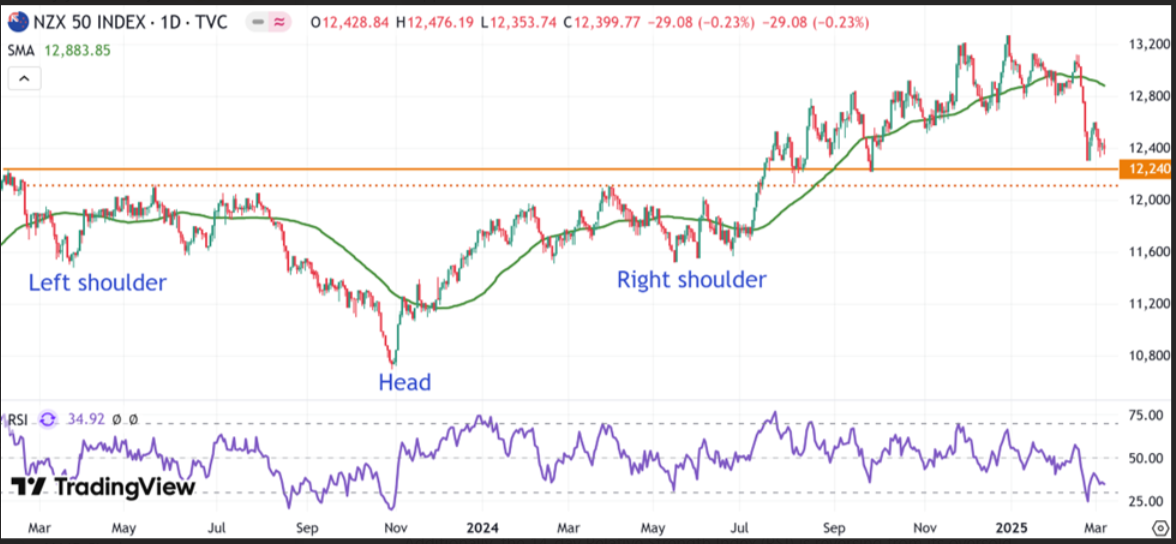
Source: Trading View, Analysis: Kalkine Group
In July 2024, the S&P/NZX 50 index broke above both the neckline of a Head and Shoulders pattern on the daily chart and a crucial resistance level set by its 2023 high. This breakout suggests that the uptrend, which began in November 2023, is likely to continue and may drive the index toward its 2021 historical peak. Despite the ongoing correction, the index is bouncing back above the key support level defined by the 2023 high and the pattern’s neckline, reinforcing expectations of a sustained uptrend. Additionally, the 14-day Relative Strength Index (RSI) is reversing from its oversold territory, signalling a potential rebound in the near future.
Our Stance: As per RBNZ, the period of restrictive interest rates has decreased the demand in NZ economy and contributed to reduced inflation. Notably, subdued global economic activity, lower net immigration, and lower government consumption have collectively reduced the domestic demand. Also, increased policy uncertainty related to the global trade developments can decrease business investment. RBNZ also believes that the headline inflation is anticipated to increase in the coming quarters but remain within the targeted range.


 Jun 26, 2026




 Please wait processing your request...