
 AU
AU
 UK
UK
 CA
CA
 US
US
 IND
IND

 NZ
NZ

 Share
Share
 X (Formerly Twitter)
 Whatsapp
 Facebook
 LinkedIn
 Telegram
 Email This Article
 Copy Link
 Summarize with AI
 Chat GPT
 Perplexity
Highlights
• A rising U.S. Dollar Index (USDX) reflects the strengthening of the U.S. dollar against major global currencies.
• Since the U.S. dollar serves as the world's dominant reserve currency, its appreciation influences global trade, commodity prices, inflation, debt markets, and capital flows.
• Emerging economies with significant U.S. dollar-denominated debt are particularly vulnerable during periods of dollar strength.
• Commodity-producing nations often face economic headwinds as stronger dollar conditions typically weigh on commodity prices.
• A strong dollar generally benefits American consumers through cheaper imports while creating challenges for U.S. exporters.
The U.S. dollar is more than just America's national currency, it is the foundation of the global financial system. As the world's primary reserve currency, it is extensively used in international trade, cross-border investments, commodity pricing, and sovereign debt issuance. Consequently, fluctuations in the U.S. Dollar Index (USDX), which measures the dollar's strength against a basket of major currencies, have far-reaching implications for economies worldwide. While a stronger dollar often reflects confidence in the U.S. economy and benefits American consumers through increased purchasing power, it can simultaneously create significant challenges for exporters, commodity producers, and emerging-market economies. Understanding how a strong dollar influences global trade, capital flows, inflation, and debt markets is essential for assessing its broader impact on the world economy.
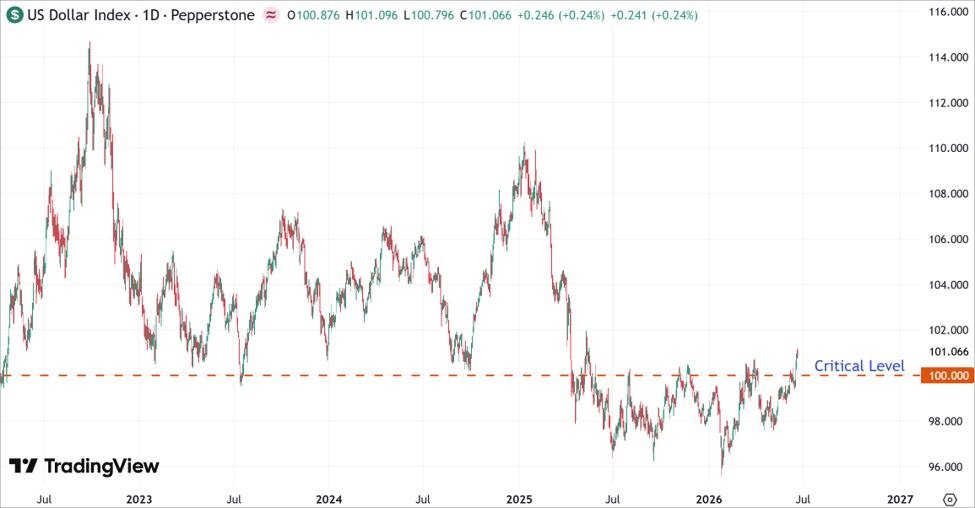
USDX’s Daily Price Chart (at the market price of 22/06/2026). Source: Charts by TradingView
The U.S. Dollar's Central Role in the Global Financial System
• The U.S. Dollar Index (USDX), commonly referred to as the DXY, measures the value of the U.S. dollar relative to a basket of major international currencies. As the world's most widely used reserve currency and settlement medium for international trade, the U.S. dollar occupies a unique position within the global financial system. Consequently, movements in the USDX can have far-reaching implications for economies around the world.
• One of the most significant channels through which a stronger dollar affects the global economy is international trade. When the dollar appreciates, goods produced in the United States become more expensive for overseas buyers. This can reduce export competitiveness and place pressure on American manufacturers and exporters. At the same time, foreign goods become relatively cheaper for U.S. consumers, encouraging imports and potentially widening the U.S. trade deficit.
• Outside the United States, currency depreciation against the dollar can temporarily improve export competitiveness. Countries such as Japan, Germany, and South Korea may benefit from stronger export demand as their products become relatively less expensive in global markets. However, these gains can be offset by rising import costs, particularly for products priced in U.S. dollars.
• Commodity markets are another major transmission mechanism. Most internationally traded commodities, including crude oil, gold, copper, wheat, and natural gas, are denominated in U.S. dollars. As the dollar strengthens, commodities become more expensive for buyers using other currencies, often reducing demand and placing downward pressure on prices.
• For commodity-exporting countries, lower commodity prices can reduce export revenues and weaken economic growth prospects. Nations heavily dependent on resource exports, including Brazil, South Africa, Chile, and several Middle Eastern economies, may experience deteriorating trade balances and fiscal challenges during prolonged periods of dollar appreciation.
• The impact is often even more pronounced in debt markets. Many governments and corporations around the world have borrowed extensively in U.S. dollars. When local currencies weaken against the dollar, the cost of servicing and repaying these obligations increases substantially.
• For example, an emerging-market company generating revenues in local currency may suddenly require significantly more domestic earnings to meet the same dollar-denominated debt payments. This dynamic can reduce corporate profitability, limit investment activity, and increase default risks. Governments face similar pressures, particularly when external debt levels are elevated.
• Financial markets also tend to respond strongly to a rising USDX. Investors frequently shift capital toward U.S. assets during periods of dollar strength, attracted by higher interest rates and the perceived safety of the American financial system. As capital flows into the United States, emerging markets often experience outflows, currency depreciation, and rising borrowing costs.
• These developments can create difficult policy decisions for central banks worldwide. To stabilize currencies and control inflation, policymakers may be forced to raise interest rates despite weak domestic economic conditions. Such actions can slow economic growth and increase financial stress.
• Inflation dynamics are also affected. Countries with weakening currencies often experience higher import costs, particularly for energy, food, and manufactured goods. This imported inflation can erode purchasing power and reduce consumer spending. Conversely, a stronger dollar helps moderate inflation within the United States by lowering the cost of imported products.
• Although dollar strength can create significant challenges globally, it often reflects confidence in the U.S. economy and financial markets. During periods of geopolitical uncertainty or economic instability, investors tend to view the dollar as a safe-haven asset, reinforcing its role as the cornerstone of the international monetary system.
Summary
The U.S. dollar's unique position in global finance means that movements in the USDX have consequences far beyond American borders. A strong dollar influences trade competitiveness, commodity prices, debt sustainability, inflation, and international capital flows. While U.S. consumers often benefit from increased purchasing power, exporters, commodity producers, and emerging markets frequently face significant challenges. As a result, sustained dollar strength remains one of the most important factors shaping global economic performance.


 Jun 26, 2026
_06_26_2026_00_22_44_548169.jpg)
_06_26_2026_00_04_17_865685.jpg)



 Please wait processing your request...