
 AU
AU
 UK
UK
 CA
CA
 US
US
 IND
IND

 NZ
NZ

 Share
Share
 X (Formerly Twitter)
 Whatsapp
 Facebook
 LinkedIn
 Telegram
 Email This Article
 Copy Link
 Summarize with AI
 Chat GPT
 Perplexity
Index Update: On 13th February, the broader NZ market closed the trading session in red amidst significant selling in the healthcare sector. On the same day, S&P/NZX 50 Index witnessed a fall of 2.46% to end at 13,198.180 and S&P/NZX 20 Index declined 2.49% to close at 7,509.660. Also, S&P/NZX 10 Index was down by 3.14% to 12,600.220. Notably, strong selling pressure was witnessed in the healthcare sector, with S&P/NZX All Health Care falling by 5.55%.
Macro Update: As per Stats NZ’s provisional estimates, NZ had a net migration gain of 14,200 in 2025, reflecting a fall from the net gain of 23,800 in 2024. The net migration gain in 2025 was the lowest for any calendar year since the year 2013 (excluding 2021 during the pandemic). The decline in net migration in 2025 on the YoY basis was because of 6% fewer migrant arrivals, with migrant departures increasing 1% to the provisional record for the calendar year.
Market Movers: Among top gainers, Promisia Healthcare Limited (NZX: PHL) witnessed a rise of 6.67% to end at $0.48 per share. On the other hand, ikeGPS Group Limited (NZX: IKE) fell by 10.58%.
Commodity Update: The Japanese yen headed for its strongest weekly performance in nearly 15 months, supported by confidence after Prime Minister Sanae Takaichi’s election victory eased fiscal concerns. In commodities, gold rose 1.12% to USD 5,004.30, silver gained 1.62% to USD 76.90, and copper added 0.75% to USD 12,985. Brent crude advanced 0.40% to USD 67.55 but remained on track for a second weekly decline amid easing Iran-related supply risks.
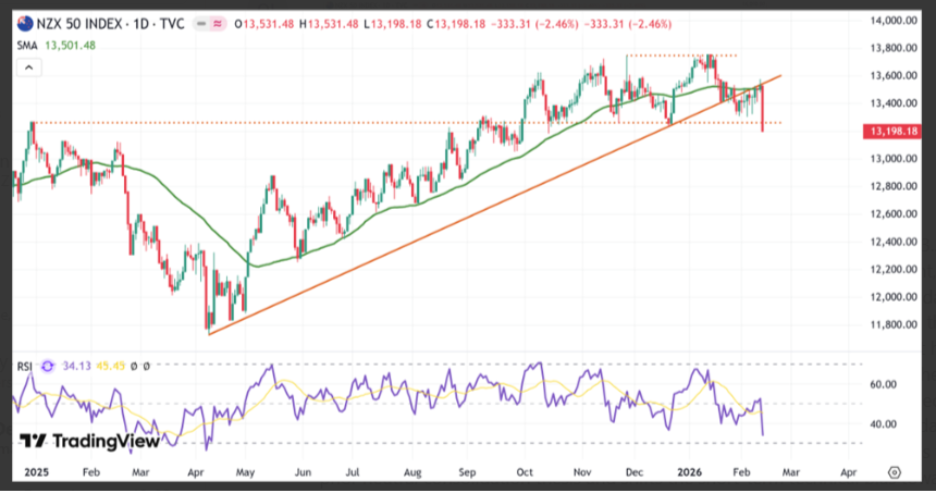
Source: Trading View, Analysis: Kalkine Group
The S&P/NZX 50 Index declined decisively in the latest session, plunging 333.31 points, or 2.46%, to settle at 13,198.18. The session was technically significant, printing a textbook Bearish Marubozu candlestick, signalling persistent intraday selling pressure and a lack of meaningful countertrend demand. Technically, the decline indicates the benchmark failed to retest the ascending trendline that has underpinned price action since April 2025. More critically, the selloff drove the index below a previously well-defined horizontal support zone derived from the December 2024 peak, a level that had acted as a demand floor throughout the consolidation phase of recent months. The breach of this confluence support area weakens the prior neutral consolidation thesis and shifts the short-term technical bias toward a more corrective posture. Currently, immediate support is now identified around the 12,880 region, where renewed buying interest may emerge and potentially trigger a rebound attempt.
Our Stance: As of now, the broader US markets are being impacted by the AI fears, with market players worrying that it could result in higher unemployment. What’s more worrying is that the Big Tech companies are also being impacted by the current sell-off. This sell-off had an impact on NZ equities also as there was a broad-based downturn on February 13. The NZ arkets remain sensitive to the external risk and investor sentiments. Considering the external shocks, the investors are required to maintain a cautious stance.


 Jun 29, 2026




 Please wait processing your request...