
 AU
AU
 UK
UK
 CA
CA
 US
US
 IND
IND

 NZ
NZ

 Share
Share
 X (Formerly Twitter)
 Whatsapp
 Facebook
 LinkedIn
 Telegram
 Email This Article
 Copy Link
 Summarize with AI
 Chat GPT
 Perplexity
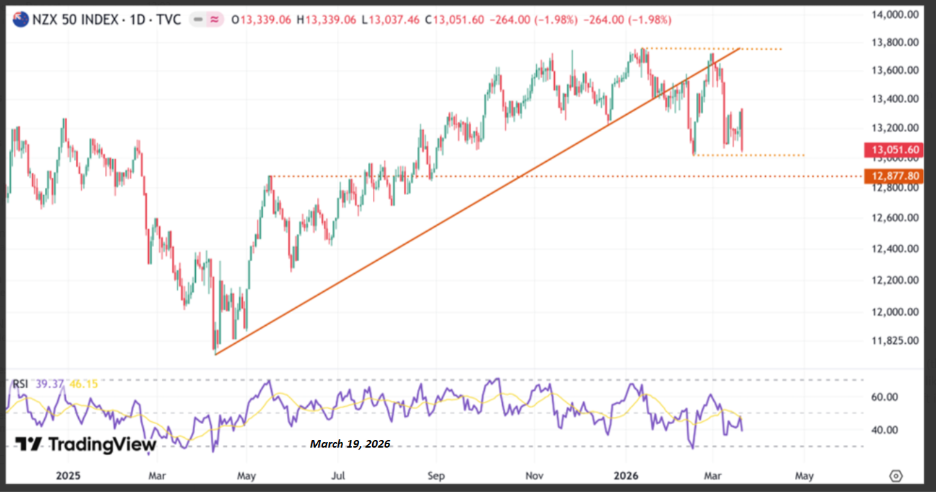
Index Update: On 19th March, the broader NZ market closed lower amidst sell-off in the healthcare index. On the same day, S&P/NZX 50 Index witnessed a fall of 1.98% to end at 13,051.610 and S&P/NZX 20 Index declined by 2.35% to 7,358.460. Also, S&P/NZX 10 Index encountered a fall of 2.62%. Notably, S&P/NZX All Health Care encountered a decline of 3.42% to 2,826.770.
Macro Update: As per Stats NZ, New Zealand’s GDP grew by 0.2% in the December 2025 quarter, down from a 0.9% rise in the September 2025 quarter. This marks the first annual economic growth since the year ending September 2024, with most industries seeing increased activity in the December 2025 quarter.
Market Movers: Among top gainers, PGG Wrightson Limited (NZX: PGW) witnessed a rise of 5.24% to end at $2.21 per share. On the other hand, Rua Gold Inc (NZX: RUA) declined by 5.56% to $1.70 per share.
Commodity Update: The U.S. dollar held steady after the Federal Reserve kept rates unchanged, highlighting uncertainty from rising oil prices. Fed Chair Jerome Powell said higher energy costs will likely push inflation higher. Gold fell 0.70% to USD 4,862.50, silver dropped 1.34% to USD 76.54, and copper declined 1.12% to USD 12,275.00. Meanwhile, Brent crude surged 4.52% to USD 112.26 after Iran struck key energy facilities following the South Pars attack, escalating Middle East tensions and supply risks.
Source: Charts by TradingView, Analysis: Kalkine Group
The S&P/NZX 50 Index dropped sharply by 264 points, or 1.98%, in the latest session amid heightened geopolitical risk, closing at 13,051.60. The move generated a short-term bearish signal, as the index opened higher but finished below the closes of the prior six sessions. From a technical standpoint, however, the broader structure remains intact. Price action continues to hold above the most recent trough, maintaining the consolidation range defined by resistance at 13,757.71 (the previous peak) and support at 13,022.30 (the prior low). Overall, this configuration suggests that range-bound trading is likely to persist in the near term. That said, the Relative Strength Index (RSI) is turning lower from its midpoint, indicating a shift in momentum from neutral toward a more negative bias.
Our Stance: As of now, U.S. markets are experiencing mixed trends driven by rising producer prices, signaling persistent inflation pressures. The Federal Reserve’s cautious stance on rate cuts is keeping Treasury yields elevated, impacting equities. Geopolitical tensions have pushed energy prices higher, adding riskoff sentiment in sensitive sectors. Coming to the NZ equities, they are experiencing volatility due to rising oil prices, geopolitical tensions, and weaker-than-expected GDP growth. Moving forward, investor sentiment will likely respond to inflation trends, interest rate expectations, and property market activity.


 Jun 29, 2026




 Please wait processing your request...