
 AU
AU
 UK
UK
 CA
CA
 US
US
 IND
IND

 NZ
NZ

SkyCity Entertainment Group Limited (NZX: SKC) is a tourism, leisure, and entertainment company, based in New Zealand. It operates in the gaming, entertainment, hotel, convention, hospitality and tourism sectors. Burger Fuel Group Limited (NZX: BFG) is involved in the restaurants business and is a franchisor of gourmet burger. It operates 3 brands: Shake Out, BurgerFuel and Winner Winner. Kalkine’s Sector Report covers the Investment Highlights, Key Financial Metrics, Risks, Technical Analysis along with the Valuation, Target Price, Outlook and Recommendation on the stocks.
I. Sector Landscape and Outlook
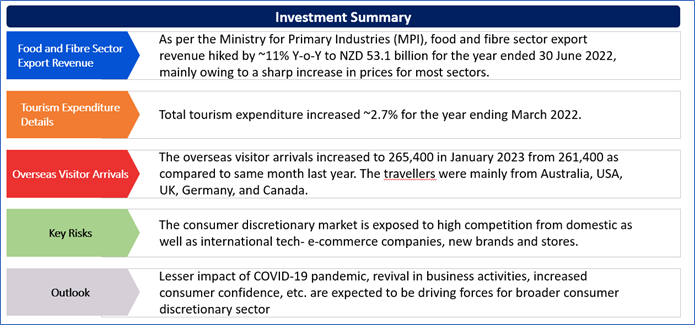
As per the Ministry for Primary Industries (MPI), food and fibre sector export revenue hiked by ~11% Y-o-Y to NZD 53.1 billion for the year ended 30 June 2022, mainly owing to a sharp increase in prices for most sectors. As per its positive performance amidst the domestic and international challenges, export revenue is forecasted to increase by ~4% to a record high of NZD 55.0 billion in 2022/23. The forecasted percentage has been an upgrade from previous judgement, primarily because of sector’s performance in the market and steep fall in the New Zealand dollar (NZD).
Dairy products’ overseas weakened demand and ~2% (estimated) decline in milk production creates a situation of selling previous year’s inventory. Still, the dairy export revenue is forecasted to increase by ~6% to reach NZD 23.3 billion in the year to 30 June 2023, owing to the weak NZD. Though the farmgate milk price of NZD 8.95 per kilogram of milk-solids seems to be relatively on a higher side, the margins are expected to be subdued due to higher input costs.
The overseas visitor arrivals increased to 265,400 in January 2023 from 261,400 as compared to same month last year. The travellers were mainly from Australia, USA, UK, Germany, and Canada.
Food Price Index for the month of February 2023
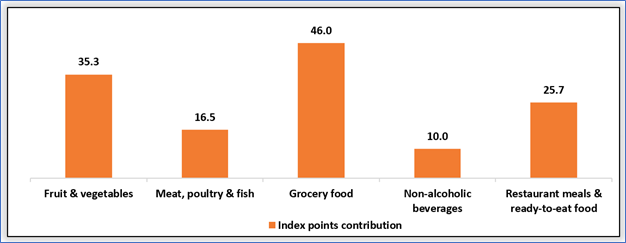
As per Stats.NZ, after the seasonal adjustment, food prices increased ~2.1% in February as compared to January 2023. Notably, fruits and vegetables rose the most i.e., 6.0%, meat, poultry, and fish prices were slightly higher and rose to 0.6% and grocery food prices to 1.0%. The restaurant meals and ready-to-eat food prices also rose 0.4 %.
Exhibit 1: Annual Index Points Contribution to FPI (by subgroup) – February 2023
Data Source: This work is based on/includes Stats NZ’s data which are licensed by Stats NZ for reuse under the Creative Commons Attribution 4.0 International Licence; Chart Created by Kalkine Group
Tourism Expenditure Details
Total tourism expenditure increased ~2.7% for the year ending March 2022. The largest changes in tourism expenditure included a decrease of NZD 732 Mn (33.2%) in accommodation services and an increase of NZD 219 Mn (13.4%) in air passenger transport.
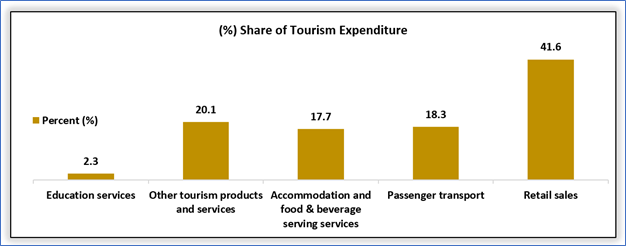
The main products tourists purchased were retail sales and passenger transport, which contributed 41.6 % and 18.3%, respectively. Tourists spent 17.7% percent of their budget on accommodation, and food and beverage services. The largest decrease in household tourism expenditure was in accommodation services, down $1.1 billion impacted by both Managed Isolation and Quarantine (MIQ), and the use of traditional accommodation providers for emergency housing, primarily during lockdowns.
Exhibit 2: (%) Share of Tourism Expenditure (by type of product) - year end March 2022
Data Source: This work is based on/includes Stats NZ’s data which are licensed by Stats NZ for reuse under the Creative Commons Attribution 4.0 International Licence; Chart Created by Kalkine Group
Key Risks and Challenges:
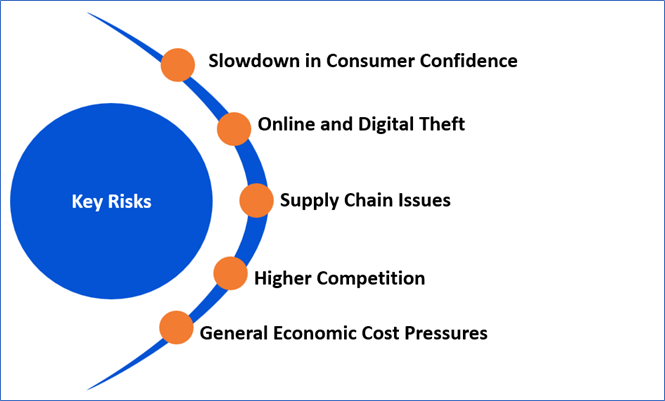
The consumer discretionary market is exposed to high competition from domestic as well as international tech- e-commerce companies, new brands and stores. This could create significant pressure on margins. Notably, the broader consumer discretionary sector is exposed to supply chain costs, labour shortages and higher hourly rates as well as the general economic cost pressures. Apart from these challenges, COVID-19 pandemic has had a major impact on several businesses operating in New Zealand in the same industry. Also, such challenges might arise in the future which could impact the margins of the companies and demand for the products. Short-term effects on prices, choice and availability of discretionary items, etc. are some of the risks.
At a global level, there are various challenges faced like a weaker global economy due to high levels of inflation. As a result, this causes increase in the cost of living in many countries, destabilization of the global economy caused by Russia’s conflict with Ukraine and a COVID-19 influenced slowdown in economic growth in China.
Exhibit 3. Key Risks in Consumer Discretionary Sector:
Source: Analysis by Kalkine Group
Outlook:
Driven from increasing global demand, sector’s in-market work, a strengthening United States dollar (USD) and high commodity prices, export revenue is expected to rise ~4% to NZD 54.95 billion. Despite the forecast increases in the export revenue for all the sectors in 2022/23, the margins would be affected for most sectors due to high input costs.
Export revenue for Processed food and other products sector was recorded as NZD 3,226 Mn as of 30th June 2022, contributing ~6% of total export revenue. The same is forecasted to reach NZD 3.3 Bn in the year to 30 June 2023, which is up ~3% on a pcp basis, mainly owing to innovative processed foods and cereal products. Live animal exports will be affected because of the impending ban on live cattle exports via sea as of 30 April 2023, which will mainly be reflected in the 2023/24 forecast revenue.
Apart from the sector-specific factors, an analysis of 2 NZX-listed companies is provided. This report covers their insights, outlook, performance, and potential as expected to be delivered in the near to medium term.
1) SkyCity Entertainment Group Limited (Recommendation: Speculative Buy, Potential Upside: Low Double-Digit) (M-Cap: NZD 1.85 billion, Annual Dividend Yield (TTM)1: 3.44%)
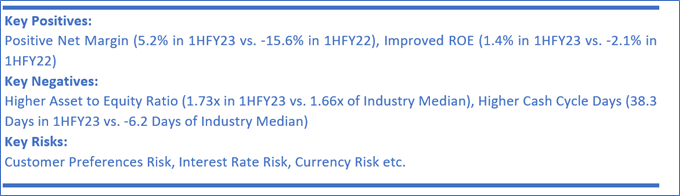
Outlook:
The group expects its performance to continue the trend, as witnessed by January FY23 performance without any recessionary environment. However, it also anticipates subdued table games performance and international business. On the account of recruitment, operational ramp-up costs and investment in compliance and regulatory functions in 1HFY23, SKC expects escalation of costs in 2HFY23. The group is estimating its normalized EBITDA to be within the range of NZD 305 Mn- NZD 320 Mn (excl. upside from the Auckland car park) for FY23.
Fundamental Valuation:
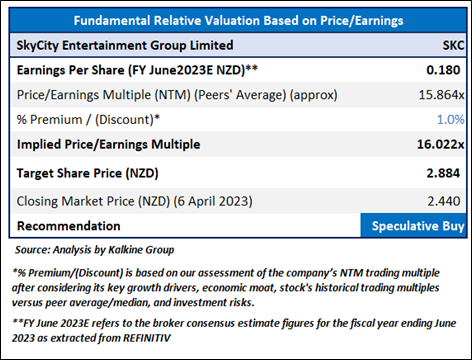
P/E Multiple Based Relative Valuation
Technical Overview:
Daily Price Chart
Technical Commentary
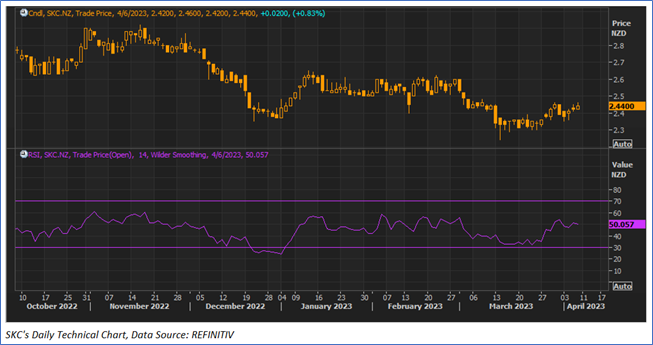
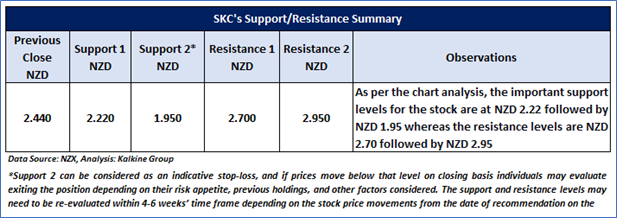
On the daily chart, SKC prices are trading above the falling trendline support level and taking support from the trendline. Moreover, the momentum oscillator RSI (14-period) is showing a reading of ~50.057 level. Further, the prices are trading above the trend-following indicators 21-period SMA, which may act as a support zone. An important support level for the stock is placed at NZD 2.22 while the key resistance level is placed at NZD 2.70.
Stock Recommendation
Considering the aforementioned factors, and undervaluation as indicated by the relative valuation, a ‘Speculative Buy’ is given on the stock at the closing market price of NZD 2.440, up by ~0.83%, as of 6 April 2023.
2) Burger Fuel Group Limited (Recommendation: Speculative Buy, Potential Upside: Low Double-Digit) (M-Cap: NZD 14.09 million)
Outlook:
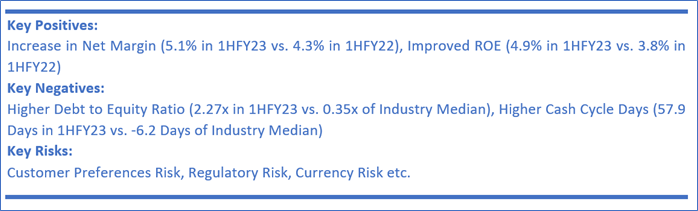
With the execution of the Development Agent (DA) Agreement for the MENA region, the group seems to be optimistic in having control once again in the entire MENA region post exit from UAE Licensee Agreement with AKI Group. However, it is confident about its main brand BurgerFuel, as its strength was validated in times of tough times – COVID19. With the cash reserves of NZD7.4 million as on 30 September 2022, BFG will continue to invest in its brands’ development - Winner Winner & Shake Out New Zealand.
Technical Overview:
Daily Price Chart
Source: REFINITIV, Note: Purple color line reflects Relative Strength Index (14-Period)
Technical Commentary:
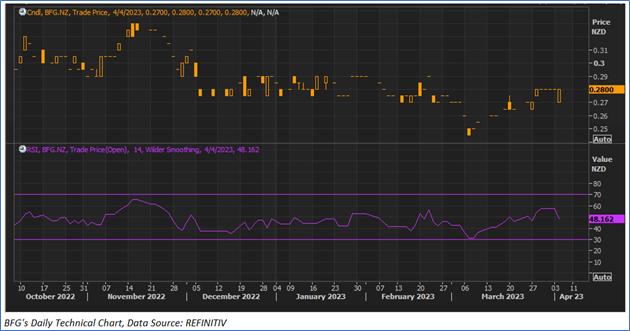
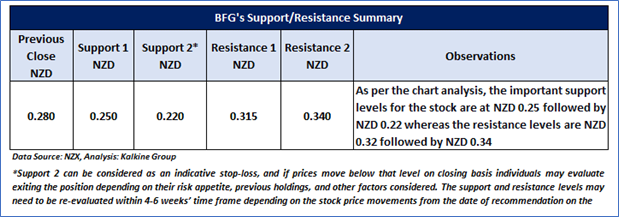
On the daily chart, BFG prices are hovering around the falling trendline support level. Moreover, the momentum oscillator RSI (14-period) is showing a reading of ~48.162 level. Further, the prices are trading above the trend-following indicators 21-period SMA, which may act as a support zone. An important support level for the stock is placed at NZD 0.25 while the key resistance level is placed at NZD 0.315.
Stock Recommendation
On a TTM basis, the stock of BFG is trading at an EV/Sales multiple of 1.6x compared to the industry (Hotels & Entertainment Services) median of 2.4x, and thus seems undervalued.
The group opened its 60th NZ BurgerFuel store in Rolleston, Christchurch, on 31 October 2022, and it targets to open another store in Dunedin before the end of FY23.
Considering the facts above and undervaluation as indicated by the TTM valuation, a ‘Speculative Buy’ recommendation on the stock has been provided at the closing market price of NZD 0.280 per share as of 4 April 2023.
Markets are trading in a highly volatile zone currently due to certain macro-economic issues and geopolitical tensions prevailing. Therefore, it is prudent to follow a cautious approach while investing.
Note 1: Past performance is neither an indicator nor a guarantee of future performance.
Note 2: The reference data in this report has been partly sourced from REFINITIV.
Note 3: Investment decisions should be made depending on an individual's appetite for upside potential, risks, holding duration, and any previous holdings. An 'Exit' from the stock can be considered if the Target Price mentioned as per the Valuation and or the technical levels provided has been achieved and is subject to the factors discussed above.
Note 4: Annual Dividend Yield is on a Trailing Twelve Month (TTM1) basis and are subject to change based on factors such as company performance, stock price changes, etc.
Technical Indicators Defined: -
Support: A level at which the stock prices tend to find support if they are falling, and a downtrend may take a pause backed by demand or buying interest. Support 1 refers to the nearby support level for the stock and if the price breaches the level, then Support 2 may act as the crucial support level for the stock.
Resistance: A level at which the stock prices tend to find resistance when they are rising, and an uptrend may take a pause due to profit booking or selling interest. Resistance 1 refers to the nearby resistance level for the stock and if the price surpasses the level, then Resistance 2 may act as the crucial resistance level for the stock.
Stop-loss: It is a level to protect further losses in case of unfavourable movement in the stock prices.
Disclaimer
Kalkine New Zealand Limited is a Financial Advice Provider (“FAP”) and is authorised by a Class 1 Financial Advice Provider Licence issued by Financial Markets Authority (“FMA”) to provide financial advice. Kalkine provides only general financial advice through its research reports following a person becoming a member. The reports contain buy/sell/hold and other recommendations in relation to equity financial products. The recommendations and opinions [on this website] / [in this report] do not take into account any of your investment objectives, financial situation or needs. Before you make a decision about whether to acquire a financial product, you should obtain the Product Disclosure Statement from the product issuer. You should consider the appropriateness of advice taking into account your own objectives, financial situation and needs and seek independent financial advice before making any financial decisions. If you act on the advice in the research reports, you may have to pay fees, expenses or other amounts (but not to Kalkine). Further information about the complaints and dispute resolution process, as well as information about Kalkine’s duties are available on Kalkine’s website. Please read our Financial Advice Provider (FAP) disclosure statement and Complaints Handling Guide, which are available on the website.
Past performance is not a reliable indicator of future performance.
 Please wait processing your request...