
 AU
AU
 UK
UK
 CA
CA
 US
US
 IND
IND

 NZ
NZ

I. Sector Landscape and Outlook
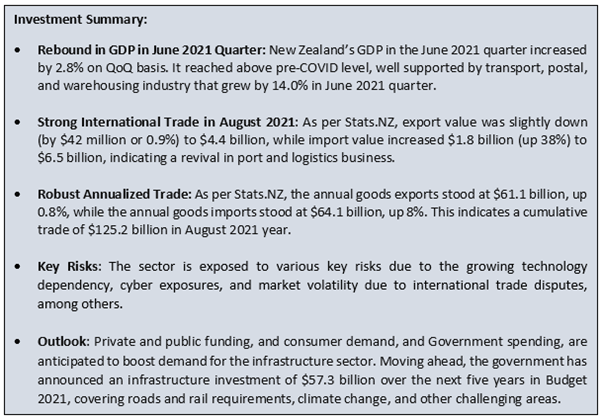
Building international-level infrastructure is a prime element of the government's growth and innovation landscape. As per the New Zealand Treasure department, the Crown infrastructure investment for the coming four years totalled at $57.3 billion. The government has already committed for record $42 billion of infrastructure investment over the next four years in roads and rail, schools and hospitals, housing, and energy generation. Further, the government also provided funding for three Future Rail initiatives that support the procurement of 60 new locomotives and 1,900 new wagons to restore a resilient and reliable rail network.
Transport, Postal, and Warehousing Industry Reported Growth in June 2021 Quarter
The New Zealand GDP increased by 2.8% in the June 2021 quarter over March 2021 quarter, where primary industry increased by 5.0%, followed by the rise in service industries by 2.8%, and a rise in goods-producing industries by 1.3%. GDP per capita increased by 2.6% and real gross disposable national income per capita rose by 3.4%. The size of the economy is $340 billion at current prices in the year ended June 2021.
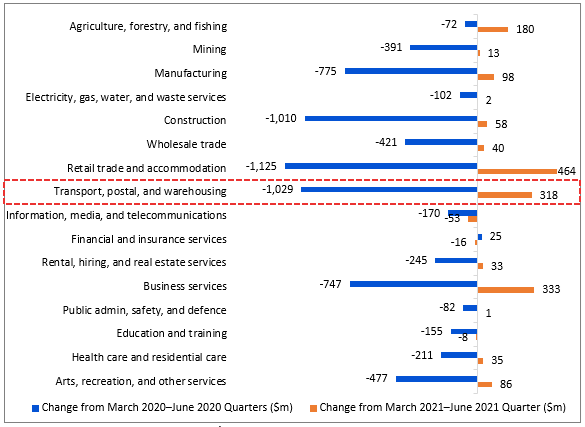
Transport, postal, and warehousing increased by 14.0%, driven by improved activity in air transport and transport support services. Meanwhile, services exports were led by an increase in other services, travel services, and transport services. The lack of the usual seasonal decrease in the international visitor numbers in the June 2021 quarter was a supporting factor in the seasonally adjusted rise in travel and transport services exports. The opening of quarantine-free travel with Australia on 19 April 2021 also added to rising momentum in both travel and transport services exports.
Exhibit 1: GDP by industry – Change from March 2021 Quarter–June 2021 Quarter
Data Source: This work is based on/includes Stats NZ’s data which are licensed by Stats NZ for reuse under the Creative Commons Attribution 4.0 International Licence; Chart Created by Kalkine Group
Rebound in International Trade, Supporting Port and Related Businesses: August 2021
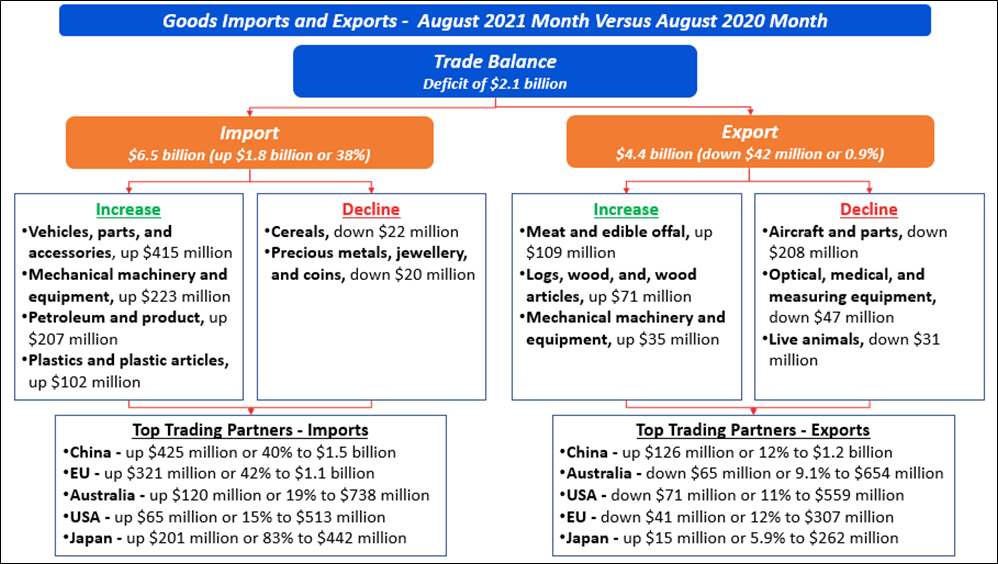
As per Stats.NZ, the overseas merchandise trade, which indicates information on the exchange of merchandise goods between New Zealand and other countries, reported that the goods exported by New Zealand were little changed (down $42 million or 0.9%) to $4.4 billion, while the goods imported by New Zealand increased $1.8 billion (up 38%) to $6.5 billion. Therefore, the August 2021 monthly trade balance was a deficit of $2.1 billion. Further, it was reported that New Zealand and China continue to trade strongly on top of other trade partners. As per the New Zealand Foreign Affairs & Trade, China is New Zealand’s biggest trading partner, with exports and imports of goods and services exceeding NZ$33 billion.
Exhibit 2: Overseas Merchandise Trade of August 2021
Data Source: This work is based on/includes Stats NZ’s data which are licensed by Stats NZ for reuse under the Creative Commons Attribution 4.0 International Licence; Chart Created by Kalkine Group
Trend in Merchandise Trade Remained Higher than Jan-Feb 2021 Levels
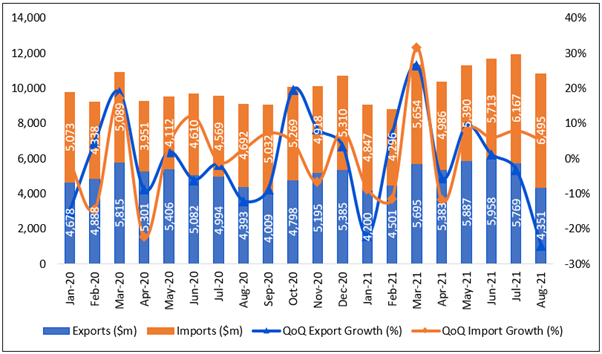
As per Stats.NZ, the annual goods exports stood at $61.1 billion, a rise of $499 million or 0.8%, while the annual goods imports stood at $64.1 billion, a rise of $4.8 billion or 8%. Therefore, the annual goods trade balance (Export less Import) was a deficit of $2.9 billion. However, in the year ended August 2020, the trade balance was a $1.4 billion surplus. As per New Zealand Foreign Affairs & Trade, New Zealand exports to China totalled $20.1 billion, a cumulative of $16.7 billion in goods and $3.4 billion in services, while New Zealand imports from China totalled $13.3 billion, a cumulative of $12.5 billion in goods and $800 million in services. China being the world’s second-biggest economy in the world and most populous country, its growing middle class offers phenomenal opportunities for New Zealand exporters and investors.
Exhibit 3: Trend in Merchandise Trade Since January 2020 to August 2021
Data Source: This work is based on/includes Stats NZ’s data which are licensed by Stats NZ for reuse under the Creative Commons Attribution 4.0 International Licence; Chart Created by Kalkine Group
Index Performance:
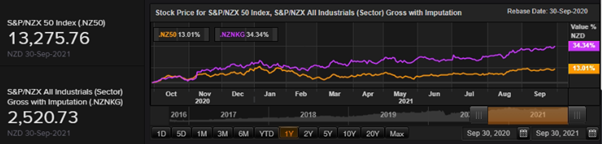
The S&P/NZX All Industrials (Sector) Index generated a 1-year return of ~34.34% versus ~13.01% by the S&P/NZX 50 Index. Therefore, NZX All Industrials Index overperformed NZX50 Index by ~21.33% in 1 year.
Exhibit 4: S&P/NZX All Industrials (Sector) vs S&P/NZX50 Index
Source: REFINITIV
Key Risks and Challenges:
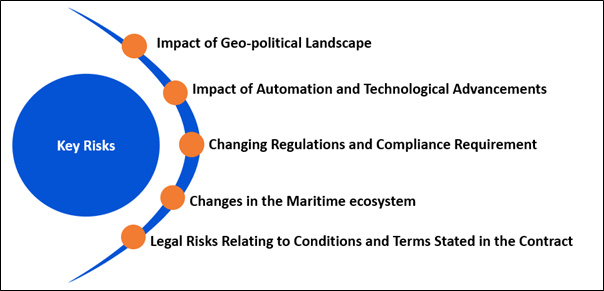
In the Government Policy Statement on land transport 2021 (GPS), the government has sets four big challenges comprising preventing deaths and serious injuries, decarbonisation, better transport choices for New Zealanders and better freight connections. The transport solution adds nearly 20% of the greenhouse gas emissions, which government is planning to reduce in a planned manner and eventually reach the target of net-zero carbon by 2050. The challenge is to speed up the transition with affordable cost. Shifting more freight by rail and coastal shipping, and better connectivity between transport and land use, is expected to decrease the greenhouse gas emissions from the transport sector.
Beyond intellectual property concerns, the logistic and infrastructure sector face the risks of competitiveness, complexities of the supply chain, growing manufacturing skills gap, technology and cybercrime, business interruption, and compliance risk, among others. Meanwhile, the world including New Zealand, is experiencing the impacts of climate change on transport network. Being ready to cover this risk requires the systematic coordination and collaboration of multiple stakeholders in the supply chain.
Besides, the existing momentum in the domestic economy is anticipated to be disruptive on supply chains sphere, with COVID-19 restrictions, shipping constraints, port closures and congestion is anticipated to impact the overall import and export of goods from New Zealand. Also, the inflationary burden is now looking more constant, with rising wage costs and the continuous challenge of driver shortages in the transport industry.
Exhibit 5. Key Risks in Logistics and Transport Sector:
Sources: Analysis by Kalkine Group
Outlook:
As per the Treasury Department of New Zealand, the government has assigned $300 million for Green Investment Finance to invest in support of climate change mitigation, with a special focus on decarbonizing public transport, waste, and plastics. Moving ahead the government is planning to focus on land transport funding and management system with a long-term view. These initiatives include facilitating regional councils to invest, own and operate public transport infrastructure and services, innovation in the field of electronic collection of road user charges, encouraging public private partnerships, adding more tolling on new roads, development in alternatives to roads.
Further, the Government is boosting the multi-year capital allowance from $8 billion to $12 billion over the estimated period, as per the Budget 2021. Particularly, in the rail initiative, the government has assigned $1.3 billion to cover operating and capital cost requirement. Specially, the government has assigned funding for three Future of Rail initiatives to boost the purchase of 60 new locomotives and 1,900 new wagons.
Also, the government has provided a top-up to the National Land Transport Fund to restore a resilient and reliable rail network and offer working capital for KiwiRail so that it maintenances freight, tourism, property, and ICT assets.
Apart from the sector-specific factors, we have also analysed four NZX-listed companies operating in the same sector. This report covers their insights, outlook, performance and potential as expected to be delivered in the near to medium term.
1) Napier Port Holdings Limited (Recommendation: Buy, Potential Upside: Low Double-Digit) (M-Cap: NZ$629.61 million, Gross Dividend Yield: 3.439%)
Business Description:
Napier Port Holdings Limited (NZX: NPH) offers shipping connections services, marine services, cargo handling services, cruise, crane driver training, and port tech solutions.
Outlook
On 30 August 2021, the company stated that it has decided comprehensive sustainability strategy and action plan, extends out to a 10-year time horizon. As per the release dated 25 August 2021, the management announced that there will be no change to the guidance shared earlier for an underlying result from operating activities for FY21 of between $39-$42 million. The company does not see cruise ship visits in the 2021/22 cruise season. Meanwhile, revenue for 9MFY21 increased 8.4% YoY to $83.0 million and Bulk cargo revenue grew 38.1% YoY to $30.8 million driven by a 36.1% YoY increase in log exports to 2.24 million tonnes.
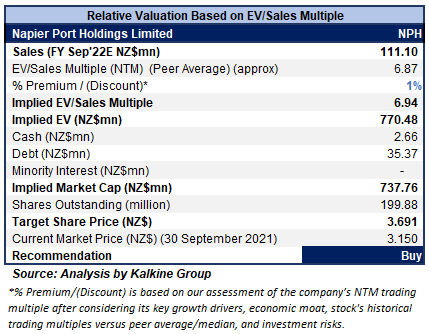
Valuation Methodology: EV/Sales Based Relative Valuation (Illustrative)
Technical Overview
Daily Price Chart
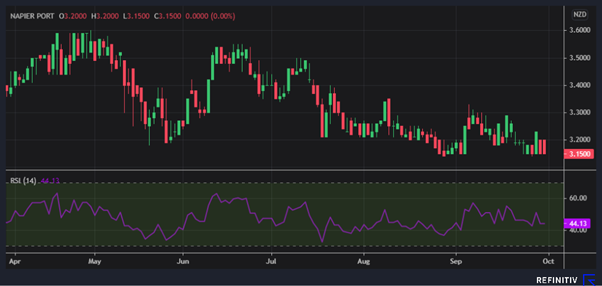
Source: REFINITIV, Note: Purple color line reflects Relative Strength Index (14-Period)
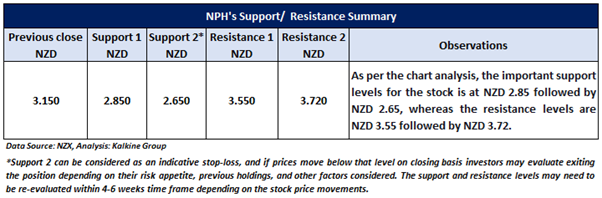
Stock Recommendation
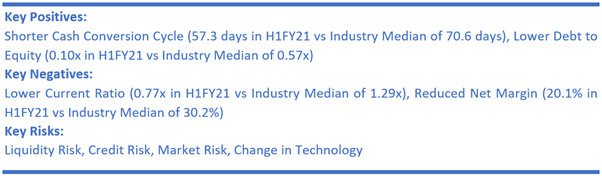
The stock has been valued using an EV/Sales multiple-based illustrative relative valuation method and arrived at a target price of low double-digit (in percentage terms). The company might trade at a slight premium to its peers’ average, considering no change in guidance and strong 9MFY21 results.
For the valuation purpose, we have taken peers such as Port of Tauranga Ltd. (POT.NZ), Freightways Ltd. (FRE.NZ), and Qube Holdings Ltd. (QUB.AX) to name a few.
Considering the aforesaid facts, current trading level, and risks associated with the stock we give a “Buy” recommendation on the stock at the current market price of $3.15 per share, as on 30th September 2021.
2) MOVe Logistics Group Limited (Recommendation: Speculative Buy, Potential Upside: Low Double-Digit) (M-Cap: NZ$135.91 million)
Business Description:
MOVe Logistics Group Limited (NZX: MOV) offers freight services, logistics & warehousing services, international services, specialised lifting and transport, and fuel services.
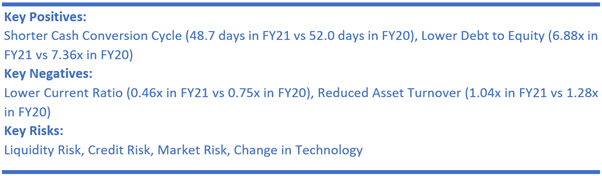
Outlook
The company released its annual report on 30 September 2021 where it highlighted that the Capex is expected to increase in FY22 as the company resumes sustaining capital expenditure, and an investment into fleet development and technology. To accomplish this, fresh financing arrangements are in place for the FY22 with ANZ Bank and UDC Finance, providing favorable terms and tenure.
Broadly, the prime focus will continue to be margin improvement and growing shareholder value. The current drive in the NZ economy is anticipated to improve, with some limitation on supply and capacity in the short run. However, in the long run, the market dynamics are expected to accelerate with anticipated growth in the economy. Some disruption is anticipated on supply chains from Covid-19 in FY22, with lockdowns, shipping constraints and Port closures.
Technical Overview
Daily Price Chart
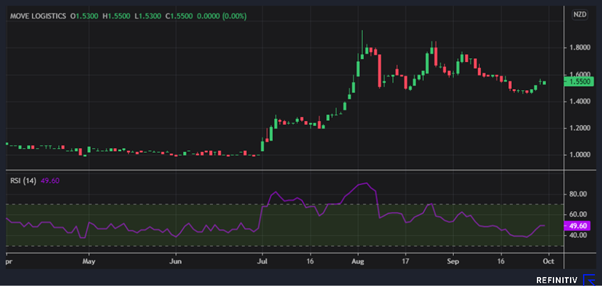
Source: REFINITIV, Note: Purple color line reflects Relative Strength Index (14-Period)
Stock Recommendation:
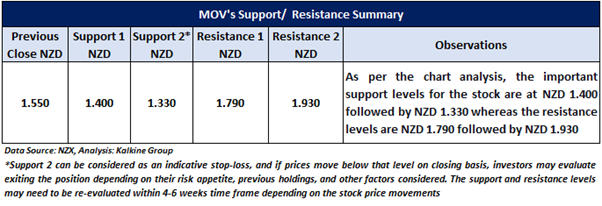
Considering existing momentum in the NZ market, growth revival in the international market, and risk associated with the business, we give a “Speculative Buy” recommendation on the stock at the current market price of $1.55 per share, as of 30th September 2021.
3) Auckland International Airport Limited (Recommendation: Hold, Potential Upside: Low Double-Digit) (M-Cap: NZ$11.52 billion)
Business Description:
Auckland International Airport Limited (NZX: AIA) is the third busiest international airport in Australasia. The airport plays a significant role in supporting New Zealand businesses.
Outlook
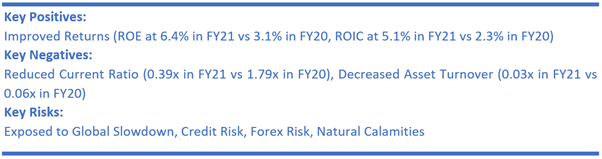
The management has extended its conservative planning forecast for future period on the back of continuing COVID-19 related circumstances. As per the company, full recovery in the sector may take longer time horizon. Broadly, the financial movement is proportionately linked to an uptick in passenger volumes, hence the recovery in the financial performance of the company will be highly influenced by the return of domestic and international travel and liberal in border settings. Meanwhile, large vaccination programmes are signalling a steady recovery in the aviation. Due to uncertainty in the market, hence, the company is unable to provide underlying earnings guidance for FY22.
Valuation Methodology: EV/Sales Based Relative Valuation (Illustrative)
Technical Overview
Daily Price Chart
Source: REFINITIV, Note: Purple color line reflects Relative Strength Index (14-Period)
Stock Recommendation
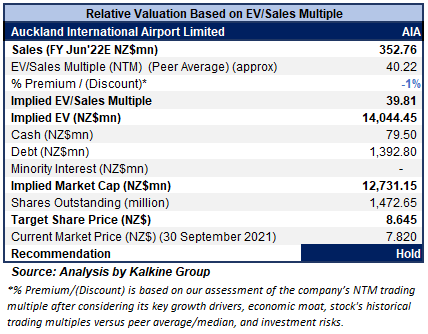
The stock has been valued using an EV/Sales multiple-based illustrative relative valuation method and arrived at a target price of low double-digit (in percentage terms). The company might trade at a slight discount to its peers’ average, considering a longer cash conversion cycle at 34.5 days in FY21 versus -4.0 days in FY20 and a lower fixed asset turnover at 0.04x in FY21 versus 0.09x in FY20.
For the valuation purpose, we have taken peers such as Atlas Arteria Group. (ALX.AX), and Sydney Airport. (SYD.AX) to name a few.
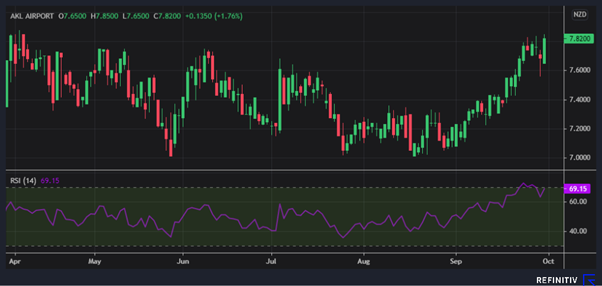
Considering the aforesaid facts, we give a “Hold” recommendation on the stock at the current market price of $7.82 per share, up 1.76%, as of 30th September 2021.
4) Air New Zealand Limited (Recommendation: Hold, Potential Upside: Low Double-Digit) (M-Cap: NZ$1.83 billion)
Business Description:
Air New Zealand Limited (NZX: AIR) is a flagship carrier airline of New Zealand. It provides air passenger services and cargo transport services to, from and within New Zealand.
Outlook
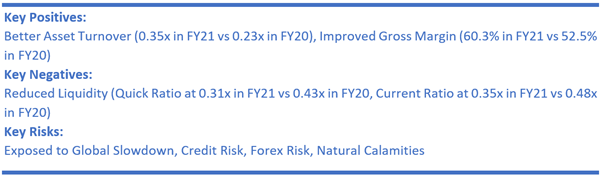
The management is focused to provide sustainable level of earnings through the cycle, followed by its plan to invest in cargo to improve the service to the customers and support long-haul international flying. Also, it continues to seek sustainable aviation fuel (SAF) and zero emissions aircraft technologies to reach the decarbonisation targets. Amid, uncertainty in the current system due to COVID-19 related circumstances and uncertainty regarding the level of demand as these restrictions lift, the company has suspended FY22 earnings guidance.
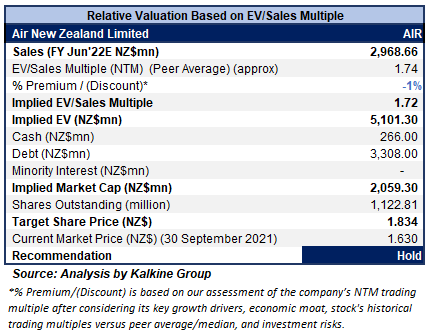
Valuation Methodology: EV/Sales Based Relative Valuation (Illustrative)
Technical Overview
Daily Price Chart
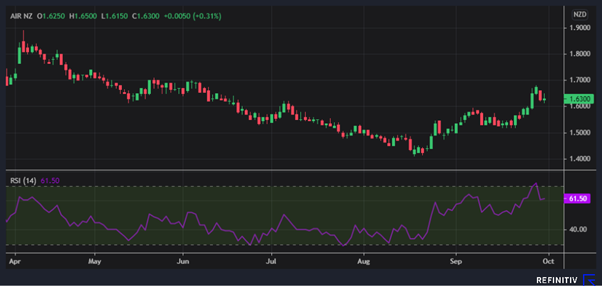
Source: REFINITIV, Note: Purple color line reflects Relative Strength Index (14-Period)
Stock Recommendation
The stock has been valued using an EV/Sales multiple-based illustrative relative valuation method and arrived at a target price of low double-digit (in percentage terms). The company might trade at a slight discount to its peers’ average, considering an increase in debt to equity to 2.99x in FY21 versus 2.81x in FY20 and a rise in negative net margin at -11.5% in FY21 versus -9.4% in FY20.
For the valuation purpose, we have taken peers such as Freightways Ltd. (FRE.NZ), Tourism Holdings Ltd. (THL.NZ), and Mainfreight Ltd. (MFT.NZ) to name a few.
Considering the aforesaid facts, we give a “Hold” recommendation on the stock at the current market price of $1.63 per share, up 0.31%, as of 30th September 2021.
Note 1: The reference data in this report has been partly sourced from REFINITIV.
Note 2: Investment decisions should be made depending on the investors’ appetite on upside potential, risks, holding duration, and any previous holdings. Investors can consider exiting from the stock if the Target Price mentioned as per the analysis has been achieved and subject to the factors discussed above alongside support levels provided.
Technical Indicators Defined: -
Support: A level where-in the stock prices tend to find support if they are falling, and downtrend may take a pause backed by demand or buying interest.
Resistance: A level where-in the stock prices tend to find resistance when they are rising, and uptrend may take a pause due to profit booking or selling interest.
Stop-loss: It is a level to protect further losses in case of unfavourable movement in the stock prices.
Disclaimer
Kalkine New Zealand Limited is authorised to provide general advice only. The information on this website does not take into account any of your investment objectives, financial situation or needs. Before you make a decision about whether to acquire a financial product, you should obtain the Product Disclosure Statement from the product issuer. You should consider the appropriateness of advice taking into account your own objectives, financial situation and needs and seek independent financial advice before making any financial decisions.
Past performance is not a reliable indicator of future performance.
 Please wait processing your request...