
 AU
AU
 UK
UK
 CA
CA
 US
US
 IND
IND

 NZ
NZ

I. Sector Landscape and Outlook
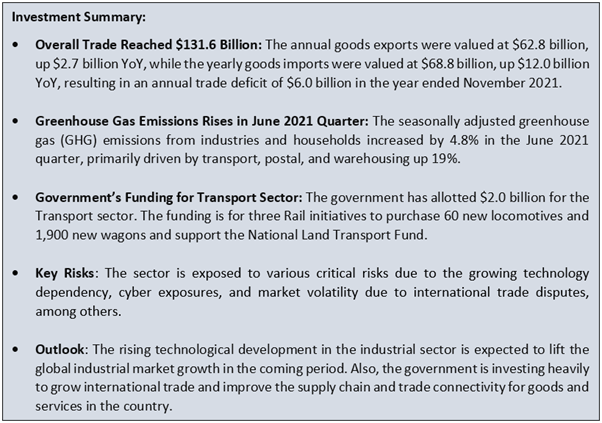
As per the Government Policy Statement on land transport (GPS), the government has strategized four key challenges: preventing deaths and serious injuries, decarbonization, better transport choices and improving freight connections. Prioritizing these elements would accelerate growth in infrastructure and related sectors, thereby resulting in a buoyant economy. Further, the government has announced a crown infrastructure investment of $57.3 billion for the next four years. The government has already recorded $42 billion of infrastructure investment in progress for roads and rail, schools and hospitals, housing and energy generation.
International Trade Reported Deficit in November 2021
As per Stats.NZ, the goods exports increased $668 million (up 13%) to $5.9 billion while goods imports increased $1.8 billion (up 37%) to $6.7 billion, resulting in a deficit trade balance of $864 million in November 2021 over November 2020. Broadly, China continued to trade firmly on top of other trade partners. China leads NZ export which is up by $262 million (13% to $2.3 billion), driven by rises in milk powder (up $229 million) and beef (up $23 million). However, milk, cereals, flour, and starch preparations fell $84 million (38%). China led NZ's imports which are up by $552 million (45%) to $1.8 billion, driven by rise in mechanical machinery and equipment (up $97 million), vehicles, parts, and accessories (up $64 million), furniture (up $59 million), and iron and steel articles (up $53 million).
NZ Traded $131.6 Billion Of Goods with International Market
As per Stats.NZ, the annual goods exports were valued at $62.8 billion, up $2.7 billion YoY. In comparison, the yearly goods imports were valued at $68.8 billion, up $12.0 billion YoY, resulting in an annual trade deficit of $6.0 billion in the year ended November 2021. However, in the year ended November 2020, NZ reported a surplus trade balance of $3.3 billion. A similar level of trade deficit was also seen between December 2018-February 2019.
Exhibit 1: Overseas Merchandise Trade of November 2021
.png)
Data Source: This work is based on/includes Stats NZ’s data which are licensed by Stats NZ for reuse under the Creative Commons Attribution 4.0 International Licence; Chart Created by Kalkine Group
Greenhouse Gas Emissions Rises in June 2021 Quarter
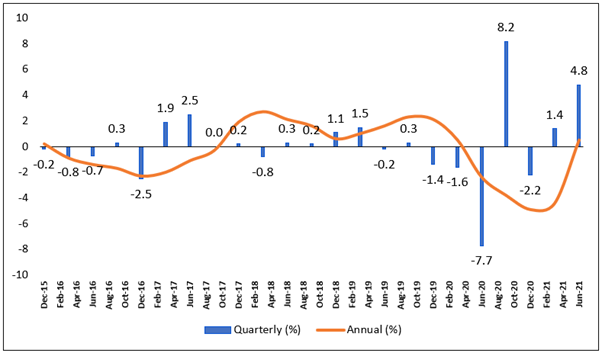
As per Stats.NZ, seasonally adjusted greenhouse gas (GHG) emissions from industries and households increased by 4.8% in the June 2021 quarter, following a 1.4% increase in the March 2021 quarter. The most significant industry contributors to this rise were:
The electricity, gas, water, and waste services industry climbed a record quarterly level of 2,927 kilotonnes of GHG emissions (seasonally adjusted), up 412 kilotonnes on the March 2021 quarter. Manufacturing and household transport recorded the largest fall in June 2021 quarter, down 2.6% (73 kilotonnes) and 0.2% (6 kilotonnes) respectively.
Exhibit 2: Trend in Percentage Change in Total CO2-e Emissions
Data Source: This work is based on/includes Stats NZ’s data which are licensed by Stats NZ for reuse under the Creative Commons Attribution 4.0 International Licence; Chart Created by Kalkine Group
Government’s Funding for Transport Sector to Improve Connectivity
As per the ‘Wellbeing Budget 2021, released by Treasury.govt.nz, the government has allotted $2.0 billion for the Transport sector. The funding is for three Rail initiatives to purchase 60 new locomotives and 1,900 new wagons and support the National Land Transport Fund. This would restore the rail network and offer working capital requirements for KiwiRail to ensure the maintenance of core freight, tourism, property, and ICT assets. In addition, the government has parked $1.3 billion as an operating and capital fund.
Index Performance:
The S&P/NZX All Industrials (Sector) Index generated a 1-year return of ~7.00% versus ~-9.90% by the S&P/NZX 50 Index. Therefore, NZX All Industrials Index overperformed NZX50 Index by ~16.9% in 1-year.
Exhibit 3: S&P/NZX All Industrials (Sector) vs S&P/NZX50 Index
.png)
Source: REFINITIV
Key Risks and Challenges:
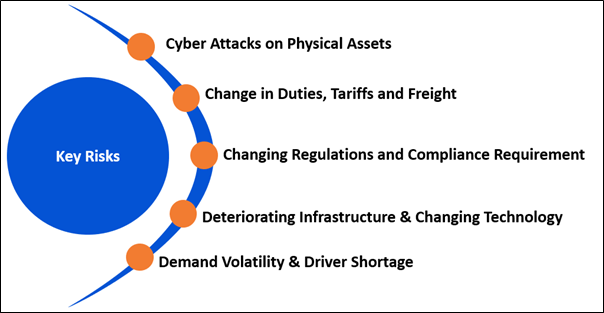
The pandemic created boundaries for the industrial sector. Supply chains were interrupted, rail, road, and air cargo service providers battled to transit essential goods, labor shortages became relentless, and factories and warehouses closed or mirrored operational challenges. Further, the world, including NZ, is experiencing the impacts of climate change (like more frequent severe storm events, flooding, and coastal inundation) on the transport network. Being ready to cover this risk requires the systematic coordination and collaboration of multiple stakeholders in the supply chain.
Exhibit 4. Key Risks in Industrials Sector:
Sources: Analysis by Kalkine Group
Outlook:
As per the ‘Auckland Transport Alignment Project (ATAP) 2021-31’, $31 billion has been allocated for critical transport infrastructure and services in Auckland. This programme invests phenomenally to reduce emissions, which is expected to decrease by 13% by 2031 and public transport trips increase by 91%.
As per New Zealand Foreign Affairs & Trade, the ‘Organisation for Economic Cooperation and Development (OECD)’ released its latest Global Economic Outlook, projecting to return to pre-pandemic activity levels earlier than expected. New Zealand’s economic performance versus other OECD economies remained strong as the GDP contraction was just 1.1% in 2020, among the smallest in the OECD. Further, NZ’s growth is expected to grow by 3.5% in 2021 and by 3.8% in 2022, primarily driven by domestic and international trade.
Apart from the sector-specific factors, we have also analysed four NZX-listed companies operating in the same sector. This report covers their insights, outlook, performance and potential as expected to be delivered in the near to medium term.
1) Port of Tauranga Limited (Recommendation: Buy, Potential Upside: Low Double-Digit) (M-Cap: NZ$4.42 billion, Gross Dividend Yield: 2.885%)
Business Description:
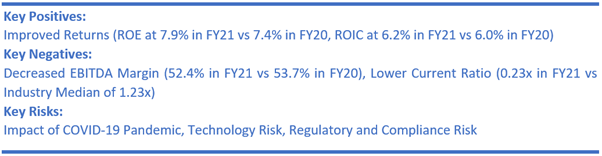
Port of Tauranga Limited (NZX: POT) is New Zealand’s largest port and international freight gateway. The location of the port is central to key export commodity sources.
Outlook
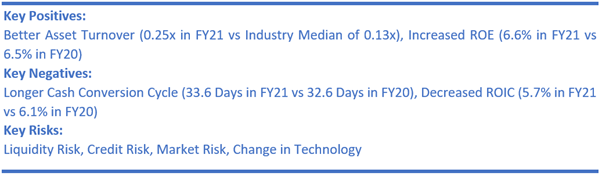
The company mentioned that international shipping capacity is in hot demand as well as the costs for the shippers have skyrocketed. Within this context, POT proved to be robust as well as resilient. POT’s diversity of cargoes provides resilience in terms of revenue, and its long-term freight agreements with the key customers give certainty of the cargo volumes.
The press release dated 29 October 2021 the company announced a 6.9% rise in total trade to 6.8 million tonnes in Q1FY22. The exports grew 5.3% to 4.3 million tonnes, and imports grew 9.8% to 2.5 million tonnes. Container volumes surged 8.1% to 310,997 TEUs. Log export volumes grew 2.4% to 1.6 million tonnes. Direct dairy exports grew 6.7% in volume, and kiwifruit exports increased 7.1% YoY.
On 18 November 2021, the company announced an institutional bookbuild for its offer of Seven Year Fixed Rate Notes, $100 million of bonds allocated to participants that BNZ arranged. The interest rate has been set at 3.552% per annum.
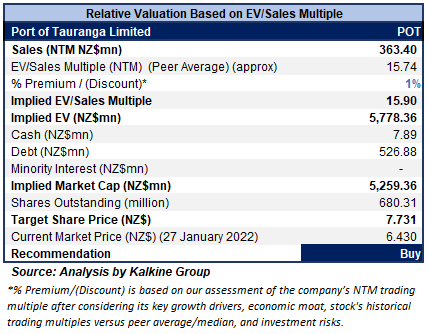
Valuation Methodology: EV/Sales Multiple Based Relative Valuation (Illustrative)
Technical Overview:
Daily Price Chart
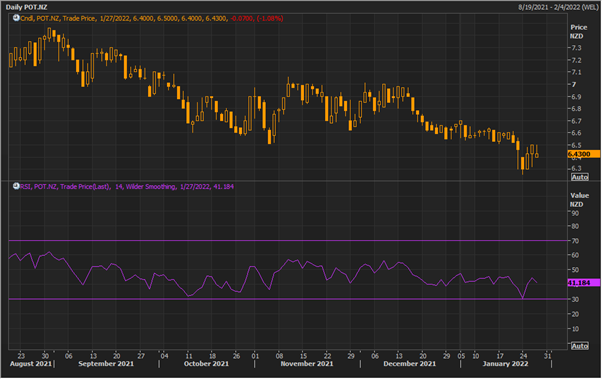
Source: REFINITIV, Note: Purple color line reflects Relative Strength Index (14-Period)
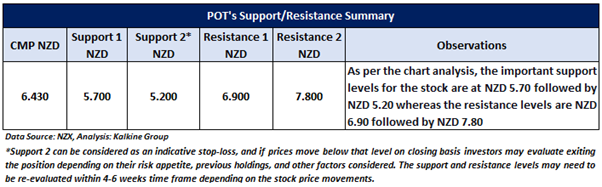
Stock Recommendation
The stock has been valued using an EV/Sales multiple-based illustrative relative valuation, and the target price so arrived reflects a rise of low double-digit (in % terms). A slight premium has been applied to EV/Sales Multiple (NTM) (Peer Average), considering POT’s diversity of cargoes as well as decent outlook.
For the valuation purpose, we have taken peers such as Auckland International Airport Ltd (AIA.NZ), Napier Port Holdings Ltd (NPH.NZ), and Transurban Group (TCL.AX), to name a few.
Considering the facts above and the recent update, we give a “Buy” recommendation on the stock at the current market price of NZ$6.43 per share (New Zealand Time: 4:45 PM (GMT +12)) as of 27th January 2022.
2) Napier Port Holdings Limited (Recommendation: Buy, Potential Upside: Low Double-Digit) (M-Cap: NZ$585.88 million, Gross Dividend Yield: 3.580%)
Business Description:
Napier Port Holdings Limited (NZX: NPH) is New Zealand’s fourth-largest port by container volume. It is the main gateway for Hawke’s Bay and lower North Island’s exports.
Outlook
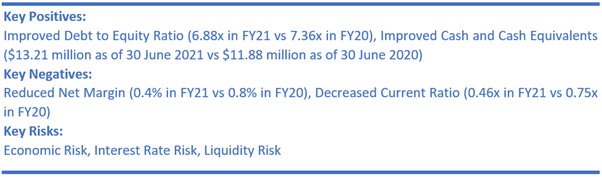
As per the base, the volume forecast for log exports in FY22 will be in-line with FY2021. The company is looking forward to delivering its strategic capital investments in FY22, including the earlier than contracted completion of 6 Wharf in 2HFY22. It expects them to contribute to the group's new financial year. Considering this contribution, the base-case forecast for log volumes, and assuming a continuation of current market conditions, the underlying result from operating activities is expected to increase by ~10% in FY22.
On 20 January 2022, the company announced the trade volume data for Q1FY22. The trade volumes grew 3.4% for bulk cargo, led by higher log exports. Containerised cargo volume fell by 7.7% primarily due to less container repositioning activity and continued container shipping schedule disruption.
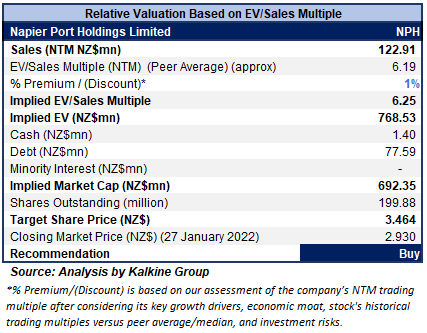
Valuation Methodology: EV/Sales Multiple Based Relative Valuation (Illustrative)
Technical Overview:
Daily Price Chart
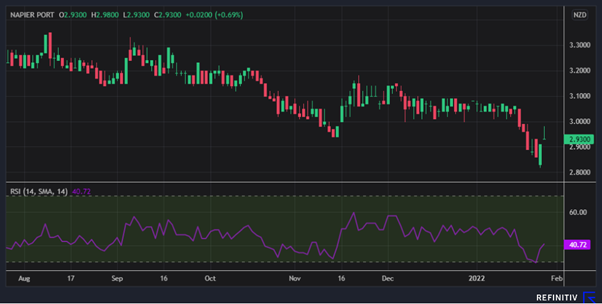
Source: REFINITIV, Note: Purple color line reflects Relative Strength Index (14-Period)
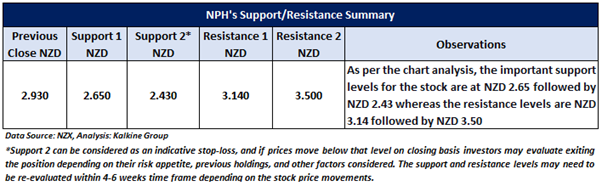
Stock Recommendation:
The stock has been valued using EV/Sales based relative valuation (on an illustrative basis), and the target price reflects a rise of low double-digit (in % terms). A premium has been applied to EV/Sales Multiple (NTM) (Peer Average),considering the diversity of trades that passes across NPH’s wharves and protects the company from container-based supply chain and COVID-19 disruptions.
For the valuation purpose, we have taken peers such as Port of Tauranga Ltd (POT.NZ), Freightways Ltd (FRE.NZ), and Qube Holdings Ltd (QUB.AX), to name a few.
Considering the facts above and a decent outlook, we give a “Buy” recommendation on the stock at the closing market price of NZ$2.93 per share, up by 0.69% as of 27th January 2022.
3) Move Logistics Group Limited (Recommendation: Speculative Buy, Potential Upside: Low Double-Digit) (M-Cap: NZ$173.35 billion)
Business Description:
Move Logistics Group Limited (NZX: MOV) is among the leading domestic freight and logistics players in New Zealand. It is engaged in providing freight transporting and warehousing services. It also coordinates offshore freight movements through international alliances.
Outlook
The company has successfully finished the capital raising initiatives, and it will utilise the raised proceeds towards lowering debt, strengthening its balance sheet and executing its new strategy. On 20 September 2021, the company updated that the impact of Covid-19 restrictions, mainly the continuing level 4 lockdown in the Auckland region, has significantly hurt its trading in H1FY22. Its fuel division is adversely impacted by the fall in economic activity, resulting in a decline in consumer demand. Lower goods impact the Freight division in the overall system due to lesser economic activity. Therefore, it expects the H1FY22 earnings to be affected by the difficult trading conditions. In its FY21 result press release, the company stated its priority is to improve its margins and grow shareholder value.
Technical Overview:
Daily Price Chart
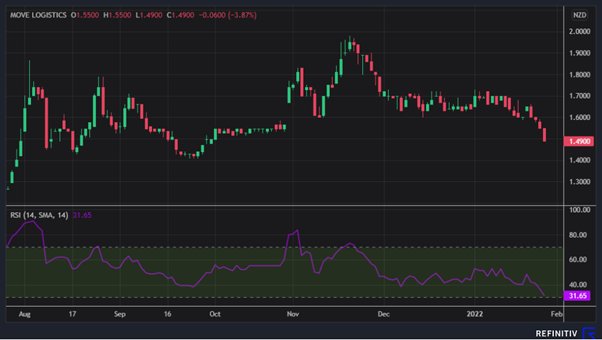
Source: REFINITIV, Note: Purple color line reflects Relative Strength Index (14-Period)
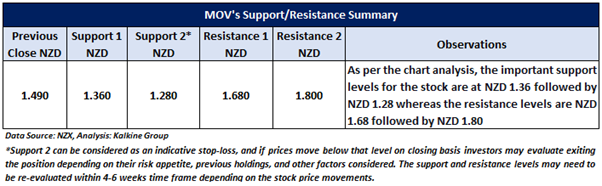
Stock Recommendation
Considering the facts above, we give a “Speculative Buy” recommendation on the stock at the closing market price of $1.49 per share, down 3.87% as of 27th January 2022.
4) Mainfreight Limited (Recommendation: Hold, Potential Upside: Low Double-Digit) (M-Cap: NZ$8.63 billion, Gross Dividend Yield: 1.606%)
Business Description:
Mainfreight Limited (NZX: MFT) is a complete end-to-end supply chain logistic solution provider across Asia, Europe, Australia, New Zealand, and The Americas. It offers a wide range of services and specialized packaged solutions.
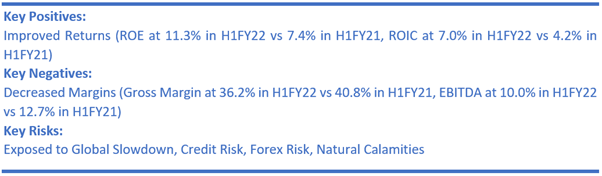
Outlook
The exposure in 26 countries across five regions provides a phenomenal competitive advantage. The network intensification continues to grow the regional coverage in most countries. However, the unprecedented supply chain disruption and demand have extended delivery expectations.
In H2FY22, the volume trends have been positive, at times significantly ahead of the last year. The company remains optimistic on current activity levels and expects the growth to continue across the global network for the remainder of FY22 and into the following year.
The company will release its financial results for FY22 on 26 May 2022 and provide a nine-month trading update in mid-February 2022.
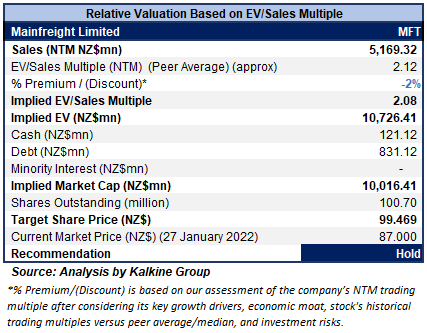
Valuation Methodology: EV/Sales Based Relative Valuation (Illustrative)
Technical Overview:
Daily Price Chart
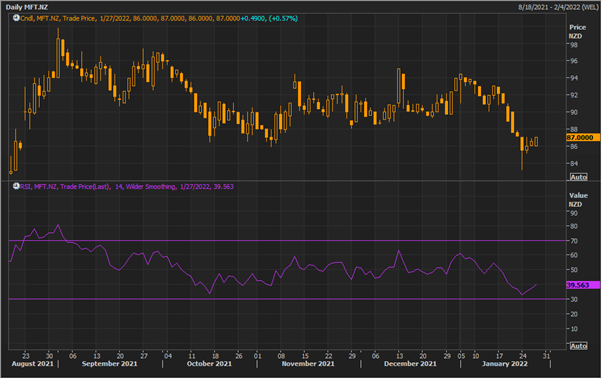
Source: REFINITIV, Note: Purple color line reflects Relative Strength Index (14-Period)
Stock Recommendation
The stock has been valued using an EV/Sales multiple based relative valuation (on an illustrative basis), and the target price so arrived reflects a rise of low double-digit (in % terms). In addition, a slight discount has been applied to EV/Sales Multiple (NTM) (Peer Average), considering the unprecedented supply chain congestion and macro-economic factor in the regions of operations.
For the valuation purpose, we have taken peers such as Freightways Ltd. (FRE.NZ), Wiseway Group Ltd. (WWG.AX), and Duratec Ltd. (DUR.AX), to name a few.
Considering the facts above, we give a “Hold” recommendation on the stock at the current market price of $87.00 per share as of 27th January 2022 (New Zealand Time: 12:22 PM (GMT +12)).
Note 1: The reference data in this report has been partly sourced from REFINITIV.
Note 2: Investment decisions should be made depending on the investors’ appetite on upside potential, risks, holding duration, and any previous holdings. Investors can consider exiting from the stock if the Target Price mentioned as per the analysis has been achieved and subject to the factors discussed above alongside support levels provided.
Technical Indicators Defined: -
Support: A level where-in the stock prices tend to find support if they are falling, and downtrend may take a pause backed by demand or buying interest.
Resistance: A level where-in the stock prices tend to find resistance when they are rising, and uptrend may take a pause due to profit booking or selling interest.
Stop-loss: It is a level to protect further losses in case of unfavourable movement in the stock prices.
Disclaimer
Kalkine New Zealand Limited is authorised to provide general advice only. The information on this website does not take into account any of your investment objectives, financial situation or needs. Before you make a decision about whether to acquire a financial product, you should obtain the Product Disclosure Statement from the product issuer. You should consider the appropriateness of advice taking into account your own objectives, financial situation and needs and seek independent financial advice before making any financial decisions.
Past performance is not a reliable indicator of future performance.
 Please wait processing your request...