
 AU
AU
 UK
UK
 CA
CA
 US
US
 IND
IND

 NZ
NZ

Company Overview: Move Logistics Group Limited (NZX: MOV) is NZ's largest end-to-end logistics experts, freight forwarders as well as warehousing providers. Just Life Group Limited (NZX: JLG) is NZ based provider of products and services focused on the homes market sectors. It provides filtered water solutions through Just Water and natural health supplements through About Health, Intenza and Natural Solutions. Kalkine’s Sector Report covers the Key Financial Metrics, Risks, Outlook, Technical Analysis along with the Valuation, Target Price, and Recommendation on the stock.
1. Sector Landscape and Outlook
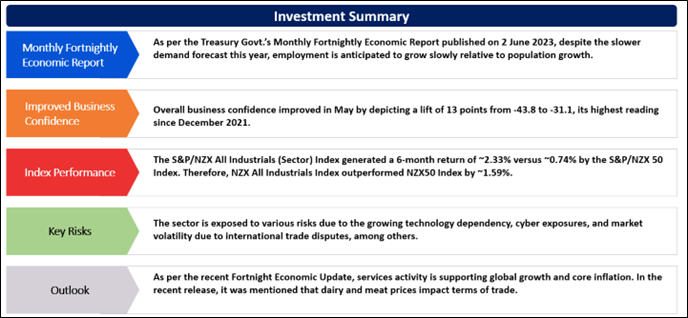
As per the Treasury Govt.’s Monthly Fortnightly Economic Report published on 2 June 2023, despite the slower demand forecast this year, employment is anticipated to grow slowly relative to population growth. Filled jobs increased by 0.6% in April. On an adjusted basis, filled jobs in the Primary industries rose 0.2%, the Goods-producing industries rose 0.7%, and Services industries increased 0.5%.
Employment growth has partly continued from high net migration, with 65,000 new arrivals in the past year. Consequently, overall business confidence improved in May by depicting a lift of 13 points from -43.8 to -31.1, its highest reading since December 2021.
Globally, central banks continue to tighten policy as activity and labour markets show resilience and core inflation persists at elevated levels. Still, the end of the tightening cycle appears to be near. As expected by the market, the Reserve Bank (RBNZ) increased its policy interest rate by 25bps to 5.5% and left its projections for the peak unchanged at 5.5%. The Bank’s forecasts assume that if it remains at 5.5% until late 2024, settings will be tight enough to bring the inflation back to the target.
Trend in Retail Sales Volumes- A Brief Look
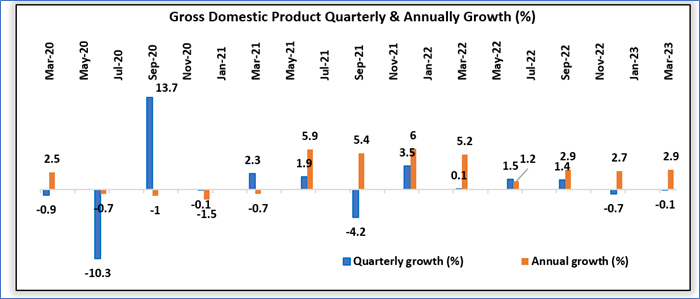
As per ANZ-Roy Morgan Consumer survey, the industry faces consumers’ uncertainty related to future, and a lack of appetite for large purchases. The purchase plans subcomponent fell from -31 to -34 in May and the overall consumer confidence was flat. However, the sentiment around current conditions improved, but future conditions deteriorated. Retail sales volumes was down by -1.4%, in the March quarter, which adds to the risk that 1Q GDP growth is expected to be weaker than the Treasury’s Budget forecast of 0.2%. With GDP falling in 4Q, a fall in 1Q would signal a technical recession. The RBNZ forecasts GDP to contract by 0.1% in the year to June 2024.
Exhibit 1: NZ’s GDP Growth over the Period (March’20-March’23)
Data Source: This work is based on/includes Stats NZ’s data which are licensed by Stats NZ for reuse under the Creative Commons Attribution 4.0 International Licence; Chart Created by Kalkine Group
Employment by Industry
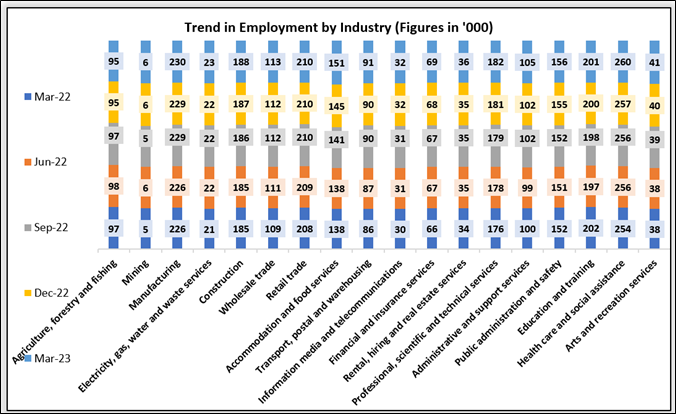
As per Stats NZ, total actual filled jobs (employment) increased from 2.19 Mn to 2.26 Mn from March 2022 to March 2023, and total gross earnings were up by 8.8% (NZD 12.9 billion). If March 2023 quarter was compared with the December 2022 quarter, total seasonally adjusted filled jobs were up by 1.1% (24,363 jobs) on a Q-o-Q basis.
At an industry level, the largest changes in seasonally adjusted filled jobs on a Q-o-Q basis were in accommodation and food services, which was up 3.9% (5,708 jobs), and administrative and support services, up by 2.9% (2,964 jobs), followed by health care and social assistance. And at a regional level, the largest changes were seen in Auckland and Canterbury, up 1.3% (9,597 jobs) and up 1.0% (2,932 jobs), respectively.
Exhibit: 2 Seasonally Adjusted Employment by Industry (Quarterly values)
Data Source: This work is based on/includes Stats NZ’s data which are licensed by Stats NZ for reuse under the Creative Commons Attribution 4.0 International Licence; Chart Created by Kalkine Group
Index Performance:
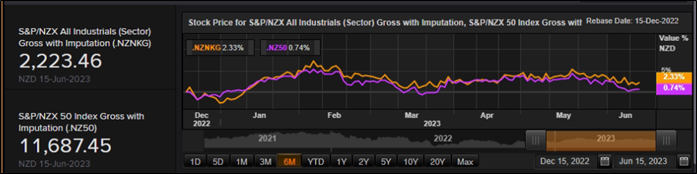
The S&P/NZX All Industrials (Sector) Index generated a 6-month return of ~2.33% versus ~0.74% by the S&P/NZX 50 Index. Therefore, NZX All Industrials Index outperformed NZX50 Index by ~1.59%.
Exhibit 3: S&P/NZX All Industrials (Sector) vs S&P/NZX50 Index
Source: REFINITIV
Key Risks and Challenges:
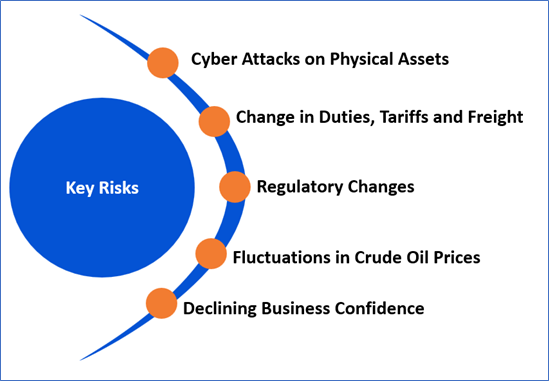
The softer demand outlook, higher inflation, tight monetary policies, fluctuations in the crude oil prices, and weak business confidence, among others, are some of the critical challenges to be faced by the industrials sector.
The broader logistics industry is exposed to risks such as economic conditions like increasing inflationary pressure, driver shortages, higher absenteeism due to Covid and the impact of adverse weather on customers across a range of sectors, including agriculture and infrastructure.
Exhibit 4. Key Risks in Industrials Sector:
Source: Analysis by Kalkine Group
Outlook:
As per the recent Fortnight Economic Update, services activity is supporting global growth and core inflation. In the recent release, it was mentioned that dairy and meat prices impact terms of trade. The merchandise terms of trade declined 1.5% in March quarter as export as well as import prices saw significant falls of 6.9% and 5.4% respectively. Import volumes witnessed a growth of 6.7%, their highest rate of growth since June 2021, reflecting that demand for imports remains more robust than expected.
Notably, the divergence between weakness in the manufacturing sector and expanding services sector widened further, casting doubt on whether monetary policy is restrictive enough to lower sticky services inflation.
As per Resources & Energy Quarterly report by the Australian Govt., global steel consumption is expected to grow by 1.6% annually to 2028, including nearly 140 Mn tonnes from new capacity, which remains planned or underway over the next few years. Although the global economic slowdown is expected to persist in 2023, the reopening of the Chinese economy may bolster the global steel demand.
Moreover, global construction activity edged up as the year turned, and it is forecasted to maintain momentum in 2023. Global manufacturing activity entered the expansionary territory in February 2023 as per the JP Morgan Global Manufacturing PMI reading of 50.0.
Apart from the sector-specific factors, an analysis on 2 NZX-listed companies is provided. This report covers their insights, outlook, performance and potential as expected to be delivered in the near to medium term.
1) Move Logistics Group Limited (Recommendation: Speculative Buy, Potential Upside: Low Double-Digit) (M-Cap: NZD 98.927 million)
Business Description:
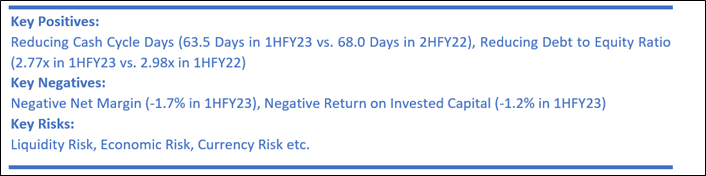
Move Logistics Group Limited (NZX: MOV) is NZ's largest end-to-end logistics experts, freight forwarders as well as warehousing providers.
Outlook:
MOV renewed its fuel business partnership with Z Energy and focuses on providing the customers with ongoing security of supply through a focus on good company’s performance, regardless of logistical challenges such as road access and recent weather events. Keeping in mind the expected moderation in customer activity due to wet weather implications, MOV is focused on strengthening the business foundation and investing into resources, capability, and technology.
The company’s primary focus is on freight reset, gain from which will improve company’s financial returns. Another focus area remains on Oceans operations. Moreover, Contract Logistics and International are performing the expectations with good demand and margins.
Technical Commentary
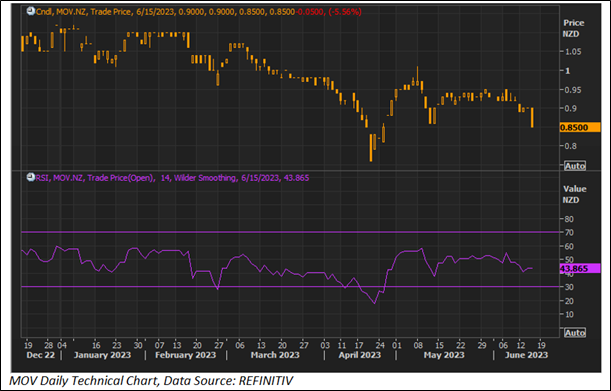
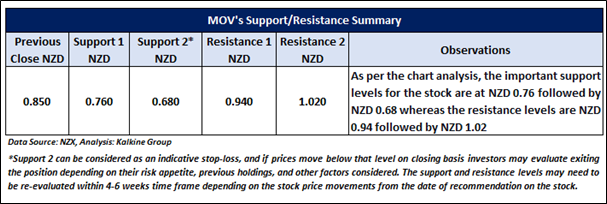
On the daily chart, MOV prices are sustaining above the falling trendline support zone. Moreover, the momentum oscillator RSI (14-period) is showing a reading of ~43.865 level. However, the prices are trading below the trend-following indicators 21-period SMA, which may act as a resistance zone. An important support level for the stock is placed at NZD 0.76 while the key resistance level is placed at NZD 0.94
Daily Price Chart
Stock Recommendation
On TTM basis, the company is trading at an EV/Sales multiple of 0.9x as compared to 1.1x (Industrials) of industry median. Considering the aforementioned factors, a ‘Speculative Buy’ rating is given on the stock at the closing market price of NZD 0.850, down by ~5.56% as of 15 June 2023.
2) Just Life Group Limited (Recommendation: Speculative Buy, Potential Upside: Low Double-Digit) (M-Cap: NZD 25.873 million, Annual Dividend Yield (TTM)1: 10.150%)
Business Description:
Just Life Group Limited (NZX: JLG) is NZ based provider of products and services focused on the homes market sectors. It provides filtered water solutions through Just Water and natural health supplements through About Health, Intenza and Natural Solutions.
Outlook:
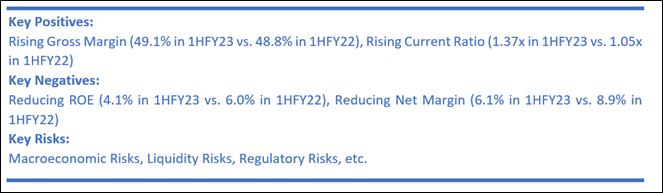
To ensure that the company’s growth continues, the directors continue to monitor the trend in economic conditions and continuously search for innovative opportunities within the Group’s business. In terms of priorities, management is focused on improving gross margin, reduction of inventory built up as a buffer against the international supply chain constraints, cash flow management and reducing operating expenses.
Technical Commentary
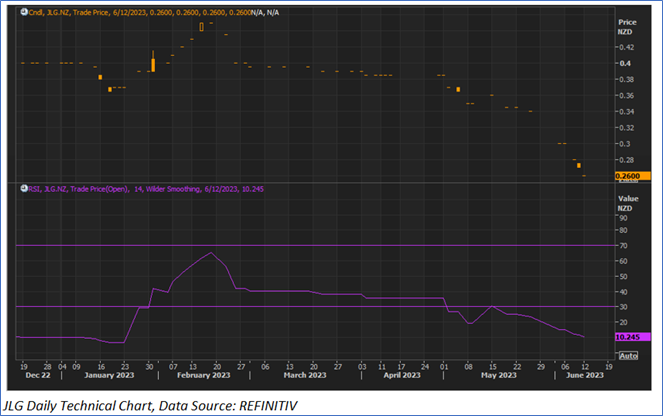
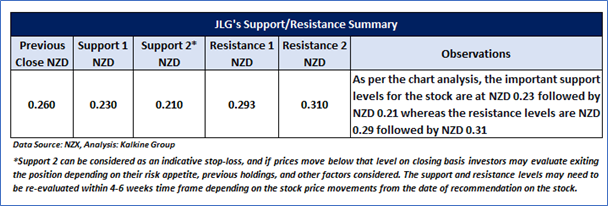
On the daily chart, JLG prices are trading near the horizontal trendline support zone. Moreover, the momentum oscillator RSI (14-period) is showing a reading of ~10.245 level. However, the prices are trading below the trend-following indicators 21-period SMA, which may act as a resistance zone. An important support level for the stock is placed at NZD 0.23 while the key resistance level is placed at NZD 0.293.
Daily Price Chart
Stock Recommendation
On TTM basis, the company is trading at an EV/Sales multiple of 1.3x as compared to 1.9x (Materials, Tools, Heavy Vehicles, Trains & Ships) of Industry Median, hence undervalued. Considering the undervaluation through TTM and the outlook, a ‘Speculative Buy’ recommendation is given on the stock at the closing market price of NZD 0.260 as of 12 June 2023.
Markets are trading in a highly volatile zone currently due to certain macro-economic issues and geopolitical tensions prevailing. Therefore, it is prudent to follow a cautious approach while investing.
Note 1: Past performance is neither an indicator nor a guarantee of future performance.
Note 2: The reference data in this report has been partly sourced from REFINITIV.
Note 3: Investment decisions should be made depending on an individual's appetite for upside potential, risks, holding duration, and any previous holdings. An 'Exit' from the stock can be considered if the Target Price mentioned as per the Valuation and or the technical levels provided has been achieved and is subject to the factors discussed above.
Note 4: Annual Dividend Yield is on a Trailing Twelve Month (TTM1) basis and are subject to change based on factors such as company performance, stock price changes, etc.
Technical Indicators Defined: -
Support: A level at which the stock prices tend to find support if they are falling, and a downtrend may take a pause backed by demand or buying interest. Support 1 refers to the nearby support level for the stock and if the price breaches the level, then Support 2 may act as the crucial support level for the stock.
Resistance: A level at which the stock prices tend to find resistance when they are rising, and an uptrend may take a pause due to profit booking or selling interest. Resistance 1 refers to the nearby resistance level for the stock and if the price surpasses the level, then Resistance 2 may act as the crucial resistance level for the stock.
Stop-loss: It is a level to protect further losses in case of unfavourable movement in the stock prices.
Disclaimer
Kalkine New Zealand Limited is a Financial Advice Provider (“FAP”) and is authorised by a Class 1 Financial Advice Provider Licence issued by Financial Markets Authority (“FMA”) to provide financial advice. Kalkine provides only general financial advice through its research reports following a person becoming a member. The reports contain buy/sell/hold and other recommendations in relation to equity financial products. The recommendations and opinions [on this website] / [in this report] do not take into account any of your investment objectives, financial situation or needs. Before you make a decision about whether to acquire a financial product, you should obtain the Product Disclosure Statement from the product issuer. You should consider the appropriateness of advice taking into account your own objectives, financial situation and needs and seek independent financial advice before making any financial decisions. If you act on the advice in the research reports, you may have to pay fees, expenses or other amounts (but not to Kalkine). Further information about the complaints and dispute resolution process, as well as information about Kalkine’s duties are available on Kalkine’s website. Please read our Financial Advice Provider (FAP) disclosure statement and Complaints Handling Guide, which are available on the website.
Past performance is not a reliable indicator of future performance.
 Please wait processing your request...