
 AU
AU
 UK
UK
 CA
CA
 US
US
 IND
IND

 NZ
NZ

I. Sector Landscape and Outlook
As per the Ministry of Business, Innovation and Employment (MBIE), the energy intensity bettered in the calendar year 2020. It fell 4.6% (A fall in the indicator is considered an improvement) in 2020. Earlier to 2020, the national average energy intensity was falling on an average of 1.4% per annum since 1990. This growth in 2020 was primarily led by continued economic growth in the commercial sector, which is comparatively less energy-intensive than other economies as it is service-based. In addition, the renewable energy share of the Total Primary Energy Supply (TPES) was ~39% in 2019, and now it is expected to increase to 46% by 2035.
Further, the government forecasts transport energy consumption to rebound by 7.8% in 2021, followed by a growth of 3.8% and 1.3% in 2022 and 2023, respectively. After that, demand for transport energy is forecasted to plateau for the next four years as the uptake of EVs (Electric Vehicles) increases.
Petrol Price Continue to Rise in December 2021 Quarter
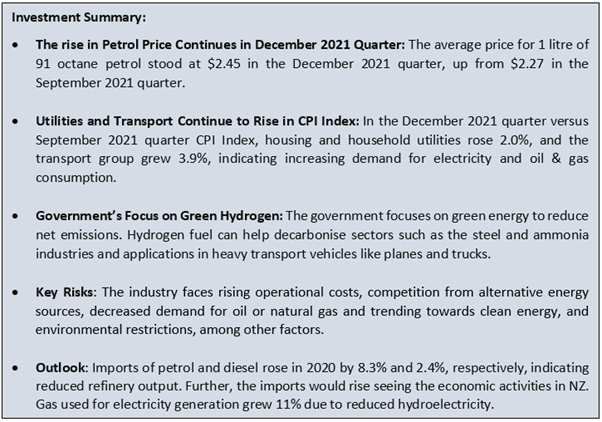
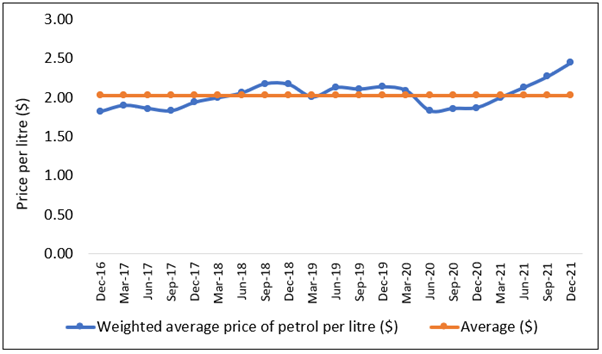
As per Stats, the average price for 1 litre of 91 octane petrol stood at $2.45 in the December 2021 quarter, up from $2.27 in the September 2021 quarter and up from $1.87 in the December 2020 quarter. The global revival in oil prices indicates rising demand for these commodities as economies emerge from lockdowns, travel restrictions, and stringent supply constraints driven by reduced oil production.
As per MBIE, the total oil and condensate reserves stood at 62.5 million barrels, and natural gas reserves stood at 2074 PJ as of 1 January 2021. Pohokura remains the largest natural gas field, and continued investment and development in existing fields increased natural gas reserves in Maui, Turangi and Mangahewa. The largest three oil field reserves in 2020 were Turangi, Maui and Pohokura. Continuous field development rose the reserves in Turangi, which has the largest condensate reserve.
Exhibit 1: Trend in Weighted Average Price of Petrol Per Litre ($)
Data Source: This work is based on/includes Stats NZ’s data which are licensed by Stats NZ for reuse under the Creative Commons Attribution 4.0 International Licence; Chart Created by Kalkine Group
Growing Demand for Electricity and Energy Commodities
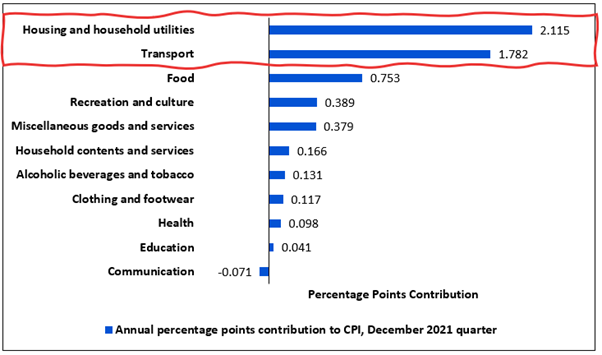
As per Stats.NZ, in the December 2021 quarter versus September 2021 quarter CPI Index, housing and household utilities increased 2.0%, contributed by higher prices for home ownership (up 4.6%) and actual rentals for housing (up 1.2%). Further, the transport group increased 3.9%, contributed by private transport supplies and services (up 5.4%) and purchase of vehicles (up 1.9%). The rise in utilities and transportation group indicates growing demand for electricity and oil & gas consumption.
In the December 2021 quarter versus the December 2020 quarter, the housing and household utilities rose 7.6%, with home ownership up 16%. Further, the transport rose 15%, with private transport supplies and services up 21%.
Exhibit 2: Trend in Utilities and Transportation Groups in December 2021 Quarter CPI Index
Data Source: This work is based on/includes Stats NZ’s data which are licensed by Stats NZ for reuse under the Creative Commons Attribution 4.0 International Licence; Chart Created by Kalkine Group
Government Focusing on Green Hydrogen to Decrease NZ’s Net Emissions
As per MBIE, electrolysis produces green hydrogen, which uses electricity to split water into hydrogen and oxygen. Further, the electricity generating hydrogen must come from renewable energy sources. Hydrogen fuel can help decarbonise sectors such as the steel and ammonia industries and applications in heavy transport vehicles. Few hydrogen projects include:
Rise in Average Residential Expenditure on Electricity
As per MBIE, the average residential expenditure on electricity increased 6.3% YoY to $696 in September 2021 quarter, driven by a rise in electricity consumption per household by 3.5% YoY to 2,386 kWh. The nominal residential cost of electricity (including GST) increased 2.7% YoY to 29.16 c/kWh, contributed by a rise in lines component and energy & other components. This uptick in electricity consumption and pricing indicates economic recovery is on its way, driven by a revival in demand.
Index Performance:
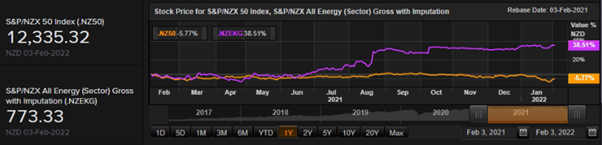
The S&P/NZX All Energy (Sector) Index generated a 1-year return of ~38.51% versus ~-5.77% by the S&P/NZX 50 Index. Therefore, NZX All Energy Index overperformed NZX50 Index by ~44.28% in 1-year.
Exhibit 3: S&P/NZX All Energy (Sector) vs S&P/NZX50 Index
Source: REFINITIV
Key Risks and Challenges:
The Government is considering measures to control climate change. One of the measures was banning new low and medium-temperature coal-fired boilers and connecting with the private sector to help it transition away from fossil fuels. This measure will reduce NZ’s emissions profile and provide a phenomenal boost to the clean energy sector. The Government is also planning to phase out coal boilers by 2037. In line with this, attention is on how to phase out other fossil fuels in existing sites through re-consenting processes and best practice requirements in a National Environment Standard.
Exhibit 4. Key Risks in Utilities & Energy Sector:

Sources: Analysis by Kalkine Group
Outlook:
As per the government, the operators anticipate a fall in oil production soon, followed by a gradual decline. In addition, operators expect a sharp rise in gas production soon, reaching a peak in 2024, mainly led by drilling campaigns at Pohokura in 2022/23 and Maui and the continuing developments at Turangi, Mangahewa and Maui. Further, the privately-owned renewable energy company Lodestone stated plans to roll out 229 megawatts of solar capacity in the next 4-year at a project cost of $300 million. This project is forecasted to generate up to 400 gigawatt-hours per year and sell directly into the wholesale market.
Apart from the sector-specific factors, we have also analysed four NZX-listed companies operating in the same sector. This report covers their insights, outlook, performance and potential as expected to be delivered in the near to medium term.
1) Meridian Energy Limited (Recommendation: Buy, Potential Upside: Low Double-Digit) (M-Cap: NZ$12.00 billion, Gross Dividend Yield: 4.903%)
Meridian Energy Limited (NZX: MEL) is engaged in generating 100% renewable energy from renewable sources - wind, water, and sun. It supplies electricity to its customers from the electricity grid, which combines electricity supplied from renewable and non-renewable sources.
Outlook
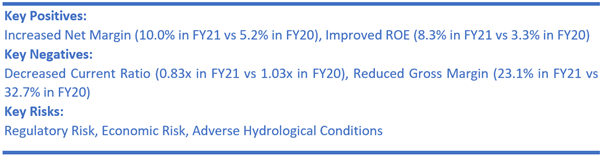
The company highlighted that the underlying drivers of future business value stayed robust, specifically the growth in customer sales and its commitment to developing the Harapaki wind farm. Importantly, it has guided that it will absorb the first full year of NZAS exit pricing in FY22.
On 1 February 2022, the company advised that it completed the sale of its Australian business to the consortium of Shell Energy Operations Pty Ltd and Infrastructure Capital Group (ICG) for A$740 million.
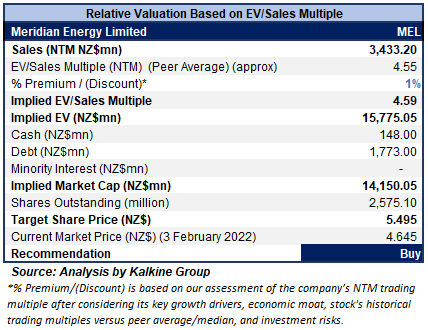
Valuation Methodology: EV/Sales Based Relative Valuation (Illustrative)
Technical Overview:
Daily Price Chart
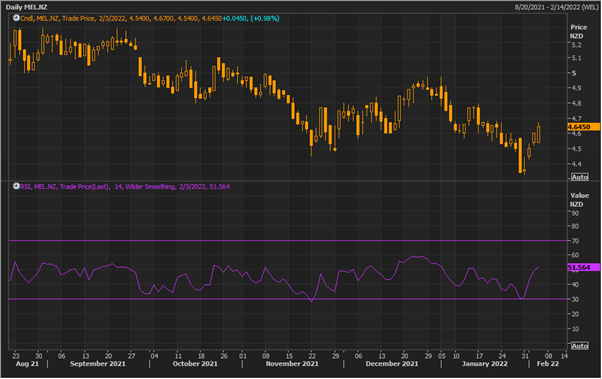
Source: REFINITIV, Note: Purple color line reflects Relative Strength Index (14-Period)
Stock Recommendation
The stock has been valued using an EV/Sales multiple-based illustrative relative valuation, and the target price so arrived reflects a rise of low double-digit (in % terms). Accordingly, a slight premium has been applied to EV/Sales Multiple (NTM) (Peer Average), considering continued growth in customer sales and its focus on developing the Harapaki wind farm.
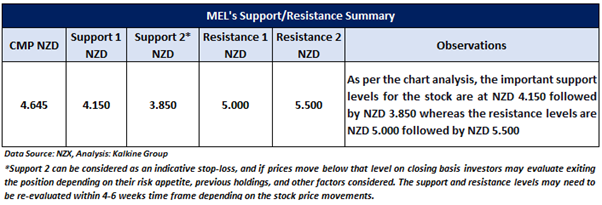
Considering the factors above, the current trading levels, and the associated business risks, we give a “Buy” recommendation on the stock at the current market price of $4.645 per share as of 3rd February 2022 (New Zealand Time: 2:36 PM (GMT +12)).
2) Genesis Energy Limited (Recommendation: Buy, Potential Upside: Low Double-Digit) (M-Cap: NZ$3.04 billion, Gross Dividend Yield: 8.005%)
Business Description:
Genesis Energy Limited (NZX: GNE) is a New Zealand based diversified energy company that sells LPG, electricity, and reticulated natural gas via the retail brands of Energy Online and Genesis Energy.
Outlook
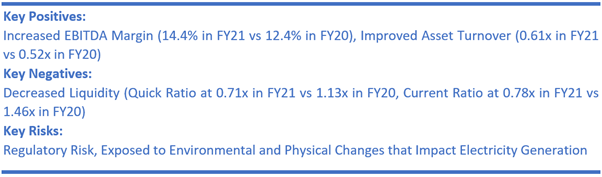
The company has guided achieving EBITDA in the range of $420-$440 million for FY22. The company estimates its capital expenditure to remain up to $95 million for FY22. It has signed 20-year PPA with Tilt Renewables for a 75 MW wind farm in Northland, which is expected to be completed by early 2024.
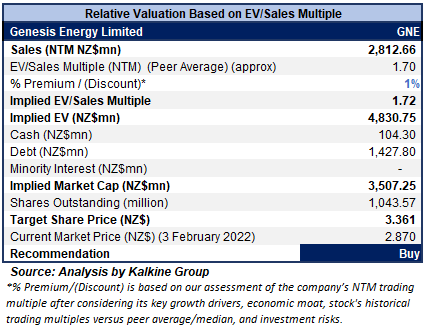
Valuation Methodology: EV/Sales Based Relative Valuation (Illustrative)
Technical Overview:
Daily Price Chart
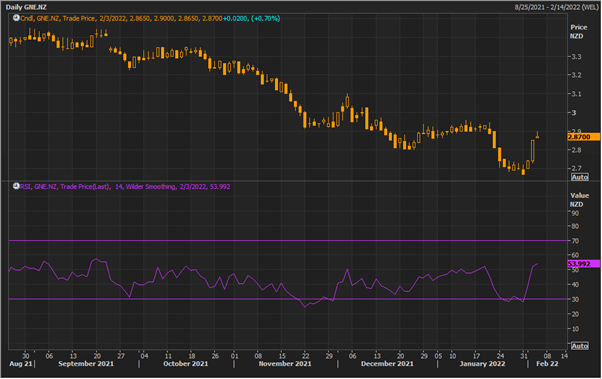
Source: REFINITIV, Note: Purple color line reflects Relative Strength Index (14-Period)
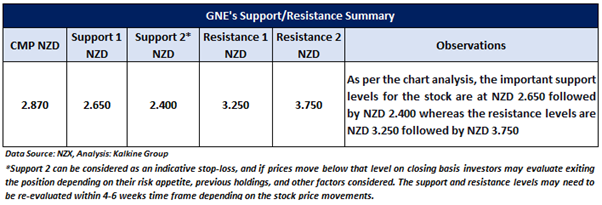
Stock Recommendation
The stock has been valued using an EV/Sales multiple-based illustrative relative valuation, and the target price so arrived reflects a rise of low double-digit (in % terms). Accordingly, a slight premium has been applied to EV/Sales Multiple (NTM) (Peer Average), considering EBITDA guidance between $420-$440 million for FY22 and committed to co-develop 500 MW of solar.
Considering the factors above, the current trading levels, and the associated business risks, we give a “Buy” recommendation on the stock at the current market price of $2.87 per share as of 3rd February 2022 (New Zealand Time: 12:19 PM (GMT +12)).
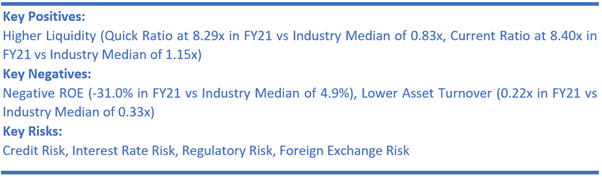
3) New Zealand Oil & Gas Limited (Recommendation: Speculative Buy, Potential Upside: Low Double-Digit) (M-Cap: NZ$76.46 million)
Business Description:
New Zealand Oil & Gas Limited (NZX: NZO) is an exploration and production company. It has subsurface expertise, exploration interests in New Zealand, Australia and Indonesia, and a controlling interest in ASX-listed Cue Energy. Its operating segment includes Kupe oil and gas field (Kupe), oil & gas exploration and Cue Energy Resources Limited (Cue).
Outlook
On 28 January 2022, the company released its quarterly cashflow and activities reports for the three months ended 31 December 2021, where revenue stood at $20.3 million, up 123% YoY. The company completed Amadeus Basin assets acquisition where growth activities are underway. The Kupe well project was completed in the second half of 2021, with the wells producing at or near plateau during the third and fourth quarters. Cash stood at NZ$33.4 million as of 31 December 2021 was lower $33.0 million on the prior quarter, primarily due to cash paid to acquire the Amadeus assets.
On 26 January 2022, the company stated that the planning continues for the Q1FY22 Palm Valley and Dingo exploration well drilling program. Due to Buru Energy’s ongoing operations, Ensign has indicated that there will be a month's delay to the rig's mobilisation date and would be location until late February 2022.
Technical Overview:
Daily Price Chart
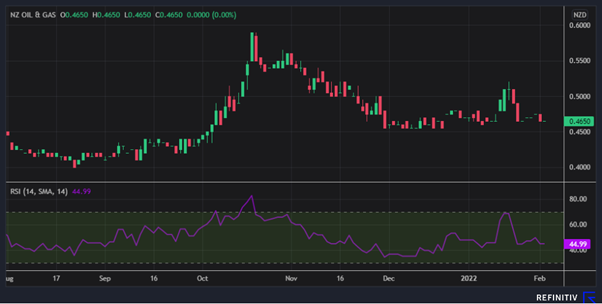
Source: REFINITIV, Note: Purple color line reflects Relative Strength Index (14-Period)
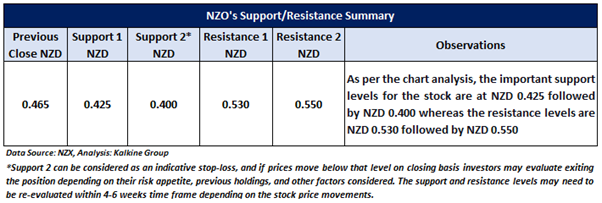
Stock Recommendation:
The company’s revenues have remained steady throughout FY21 despite considerable disruption. NZO’s portfolio is dominated by gas and connected to pipeline markets with long-term contracts.
Considering the factors above, we give a “Speculative Buy” recommendation on the stock at the closing market price of NZ$0.465 per share as of 3rd February 2022.
4) The New Zealand Refining Company Limited (Recommendation: Hold, Potential Upside: Low Double-Digit) (M-Cap: NZ$361.06 million)
Business Description:
The New Zealand Refining Company Limited (NZX: NZR) is engaged in the oil refining business. It is one of the major suppliers of refined petroleum products viz; petrol, diesel, aviation fuel, and other products.
Outlook
On 24 January 2022, the company released an operational update for November-December 2021. The processing fee revenue stood at NZ$23.6 million, including Fee Floor adjustments, NZ$27.2 million before adjustments. December’s net debt stood at NZ$184 million, following the equity raise in December of c.$48.5 million. The company continues to operate cash neutral operations at the Fee Floor.
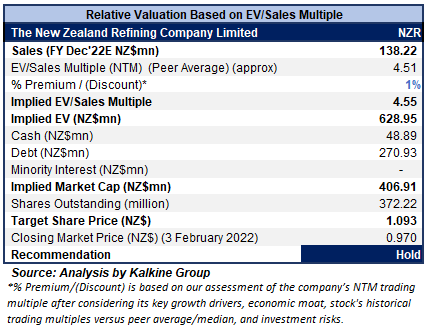
Valuation Methodology: EV/Sales Based Relative Valuation (Illustrative)
Technical Overview:
Daily Price Chart
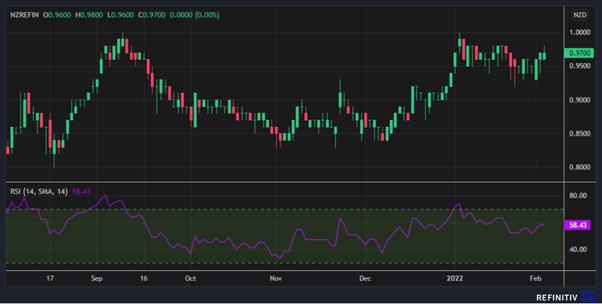
Source: REFINITIV, Note: Purple color line reflects Relative Strength Index (14-Period)
Stock Recommendation
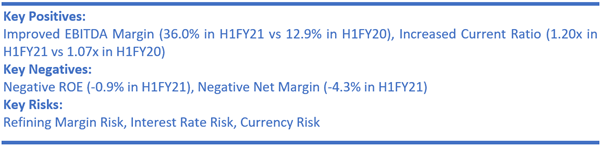
The stock has been valued using an EV/Sales multiple-based illustrative relative valuation, and the target price so arrived reflects a rise of low double-digit (in % terms). A slight premium has been applied to EV/Sales Multiple (NTM) (Peer Average), considering its significant improvement in EBITDA margin in H1FY21 that stood at 36.0% compared to 12.9% in H1FY20 and higher current ratio that stood at 1.20x in H1FY21 against 1.07x in H1FY20.
Considering the factors above and the closing trading levels, we give a “Hold” recommendation on the stock at the closing market price of NZ$0.97 per share as of 3rd February 2022.
Note 1: The reference data in this report has been partly sourced from REFINITIV.
Note 2: Investment decisions should be made depending on the investors’ appetite on upside potential, risks, holding duration, and any previous holdings. Investors can consider exiting from the stock if the Target Price mentioned as per the analysis has been achieved and subject to the factors discussed above alongside support levels provided.
Technical Indicators Defined: -
Support: A level where-in the stock prices tend to find support if they are falling, and downtrend may take a pause backed by demand or buying interest.
Resistance: A level where-in the stock prices tend to find resistance when they are rising, and uptrend may take a pause due to profit booking or selling interest.
Stop-loss: It is a level to protect further losses in case of unfavourable movement in the stock prices.
Disclaimer
Kalkine New Zealand Limited is authorised to provide general advice only. The information on this website does not take into account any of your investment objectives, financial situation or needs. Before you make a decision about whether to acquire a financial product, you should obtain the Product Disclosure Statement from the product issuer. You should consider the appropriateness of advice taking into account your own objectives, financial situation and needs and seek independent financial advice before making any financial decisions.
Past performance is not a reliable indicator of future performance.
 Please wait processing your request...