
 AU
AU
 UK
UK
 CA
CA
 US
US
 IND
IND

 NZ
NZ

Company Overview: Michael Hill International Limited (NZX: MHJ) is an Australian-based company which is engaged in the retail sale of jewelry and related services. Cooks Coffee Company Limited (NZX: CCC) is a New Zealand-based company that operates in the food and beverage industry. It was formerly known as Cooks Global Foods Ltd, and its segments include Global franchising & design; UK franchising & retail; Ireland franchising & retail, and Supply. Kalkine’s Sector Report covers the Investment Highlights, Key Financial Metrics, Risks, Technical Analysis along with the Valuation, Target Price, and Recommendation on the stock.
I. Sector Landscape and Outlook
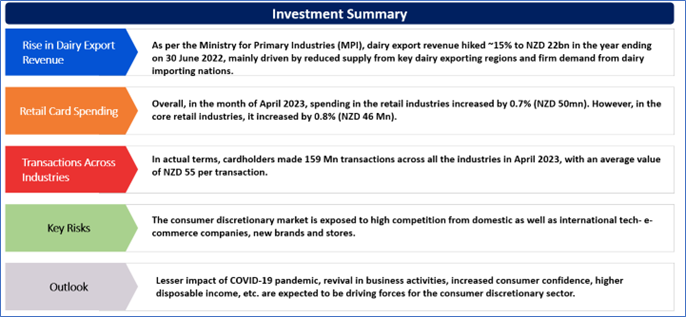
As per the Ministry for Primary Industries (MPI), dairy export revenue hiked ~15% to NZD 22bn in the year ending on 30 June 2022, mainly driven by reduced supply from key dairy exporting regions and firm demand from dairy importing nations. Food and fibre sector export revenue exceeded expectations in the year to 30 June 2022, up by 11% to NZD 53.1bn, driven by strong global demand and tight global supplies. The recent drop in dairy, meat and forestry prices in overseas markets from record highs has been largely offset by a weaker NZD.
The growing middle class are considered one of the most important megatrends which will determine the market structure and trade requirements for the global economy over the next two decades (National Intelligence Council, 2012). The global middle class spent USD 33 trillion in 2015. Looking forward to 2030, the global middle class population is anticipated to reach 5.4 billion with total spending of US$63 trillion.
Difference in Retail Card Spending Between March-April 2023
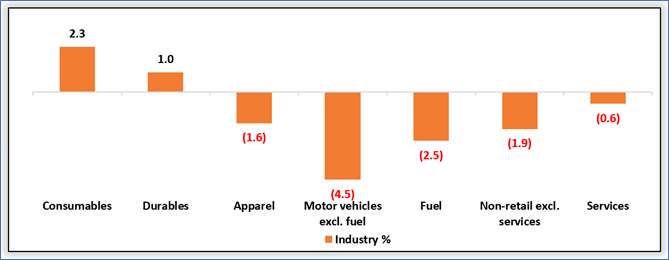
Overall, in the month of April 2023, spending in the retail industries increased by 0.7% (NZD 50mn). However, in the core retail industries, it increased by 0.8% (NZD 46 Mn). The retail card spending in March was NZD 6,686,736,000, which increased to NZD 6,736,861,000 in April 2023. While spending on consumables was up by NZD 60mn, on the contrary, the motor vehicles (excluding fuel) went down by NZD 9.9mn. In actual terms, cardholders made 159 Mn transactions across all the industries in April 2023, with an average value of NZD 55 per transaction. The total amount spent using electronic cards was NZD 8.8 Bn.
Exhibit 1: % Change in Card Transaction Values by Industry (March–April 2023, seasonally adjusted)
Data Source: This work is based on/includes Stats NZ’s data which are licensed by Stats NZ for reuse under the Creative Commons Attribution 4.0 International Licence; Chart Created by Kalkine Group
Consumers Price Index Annual Summary
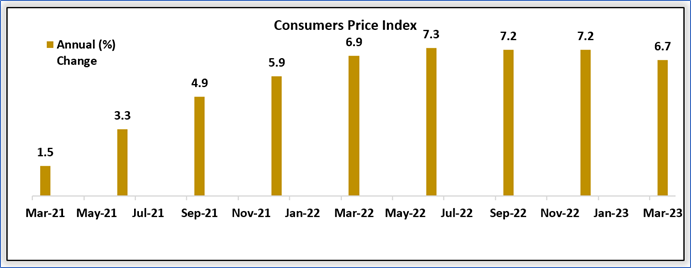
The annual upward contribution towards CPI was from the department related to the construction of new dwellings (1.10% points), grocery food (0.76% points) and passenger transport services (0.68% points). On the other hand, private transport supplies and services (0.24% points) and telecommunications equipment (0.04% points) contributed negatively.
Purchasing of new housing, which makes up 9.8% of the CPI, increased ~11.5% annually in the March quarter of 2023. Also, petrol price, which makes up 4.9% of CPI, reduced by 8.3% annually for the same period.
Exhibit 2: Annual Percentage Change in CPI, (March 2021–March 2023 quarters)
Data Source: This work is based on/includes Stats NZ’s data which are licensed by Stats NZ for reuse under the Creative Commons Attribution 4.0 International Licence; Chart Created by Kalkine Group
Key Risks and Challenges:
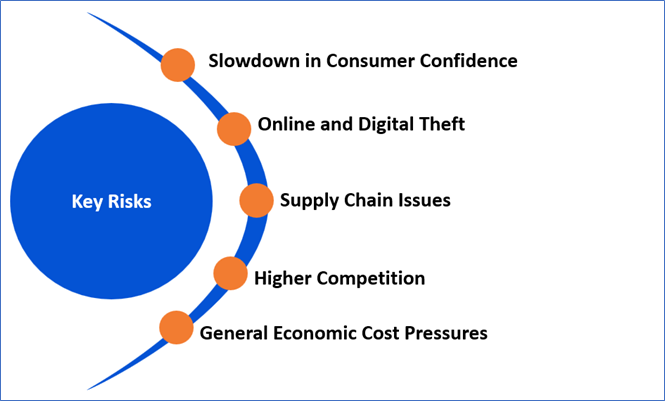
The consumer discretionary market is exposed to high competition from domestic as well as international tech- e-commerce companies, new brands and stores. This could create significant pressure on margins. Notably, the broader consumer discretionary sector is exposed to supply chain costs, labour shortages and higher hourly rates, as well as general economic cost pressures. Apart from these challenges, the COVID-19 pandemic has had a major impact on several businesses operating in New Zealand in the same industry. Also, such challenges might arise in the future, which could impact the margins of the companies and demand for the products. Short-term effects on prices, choice and availability of discretionary items, etc., are some of the risks.
At a global level, there are various challenges faced, like a weaker global economy due to high levels of inflation. As a result, this caused an increase in the cost of living in many countries, destabilization of the global economy caused by Russia’s conflict with Ukraine and a COVID-19-influenced slowdown in economic growth in China.
Exhibit 3. Key Risks in Consumer Discretionary Sector:
Source: Analysis by Kalkine Group
Outlook:
Mainly due to increasing global demand, the sector’s in-market work, a strengthening United States dollar (USD) and high commodity prices, total export revenue is expected to rise ~4% to NZD 54.95 billion. Despite the forecast increases in the export revenue for all the sectors in 2022/23, the margins would be affected for most sectors due to high input costs. Dairy products’ overseas weakened demand and ~2% (estimated) decline in milk production creates a situation of selling the previous year’s inventory. Still, the Dairy export revenue is forecasted to increase by ~6% to reach NZD 23.3 billion in the year to 30 June 2023, owing to the weakened NZD. Though the farmgate milk price of NZD 8.95 per kilogram of milk solids seems relatively higher, the margins are expected to be subdued due to higher input costs.
In order to combat inflation, the Federal Reserve (US) raised benchmark interest rates in September by 0.75% points; the European Central Bank also raised its key interest rate to 1.50% from 0.75% in late October. Moreover, the Reserve Bank of New Zealand has been consistently lifting its official cash rate, from a record low of 0.25% last October to 3.5% in October 2022. Tighter global monetary and financial conditions will aid the economy by weighing down the demand and gradually reducing inflation.
Apart from the sector-specific factors, an analysis of 2 NZX-listed companies is provided. This report covers their insights, outlook, performance, and potential as expected to be delivered in the near to medium term.
1) Michael Hill International Limited (Recommendation: Buy, Potential Upside: Low Double-Digit) (M-Cap: NZD 402.47 million, Annual Dividend Yield (TTM)1: 11.208%)
Business Description:
Michael Hill International Limited (NZX: MHJ) is an Australian-based company which is engaged in the retail sale of jewelry and related services.
Outlook:
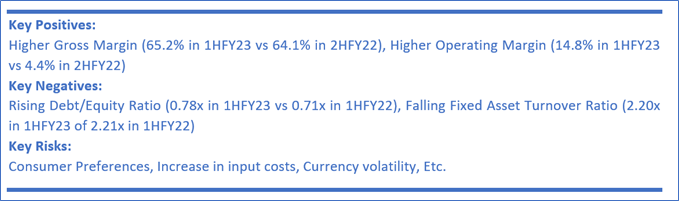
The recent acquisition-related binding agreement with Bevilles is expected to be immediately EPS accretive and will be a catalyst for EBITDA enhancement and growth opportunities. The said transaction is anticipated to be completed in the June quarter. Bevilles is expected to generate NZD 60-65mn in sales and adjusted underlying EBITDA (preAASB16) of NZD 7.5-8.5mn for FY23.
Fundamental Valuation:
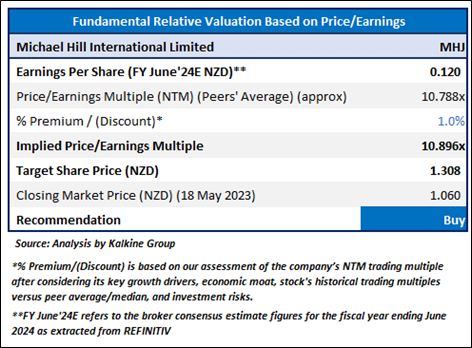
P/E Multiple Based Relative Valuation
Technical Overview:
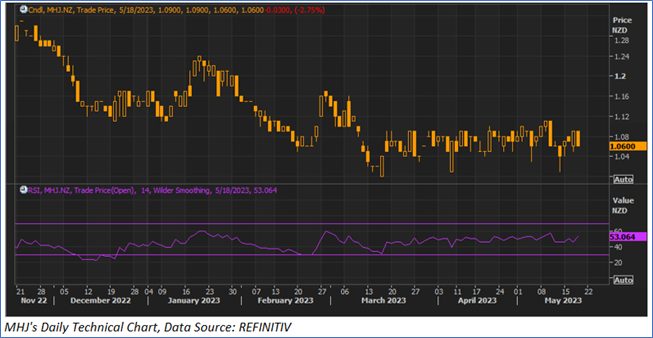
Daily Price Chart
Technical Commentary
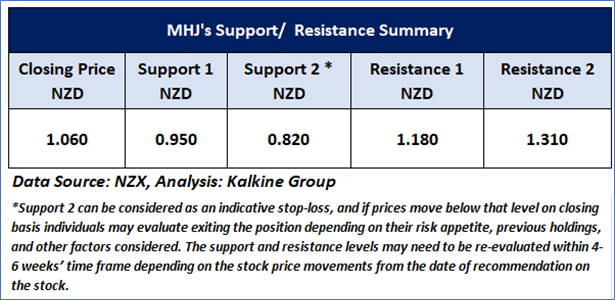
On the daily chart, MHJ prices are trading above the horizontal trendline support level and taking support from the trendline. Moreover, the momentum oscillator RSI (14-period) is showing a reading of ~53.064 level. However, the prices are trading below the trend-following indicators 21-period SMA, which may act as a resistance zone. An important support level for the stock is placed at NZD 0.95 while the key resistance level is placed at NZD 1.18
Stock Recommendation
Considering the FY23 outlook, expected synergies from the recent acquisition, expected accretive EPS, the aforementioned factors, and undervaluation as indicated by the relative valuation, a ‘Buy’ rating is given on the stock at the closing market price of NZD 1.060, down by ~2.75% as of 18 May 2023.
2) Cooks Coffee Company Limited (Recommendation: Speculative Buy, Potential Upside: Low Double-Digit) (M-Cap: NZD 17.56 million)
Business Description:
Cooks Coffee Company Limited (NZX: CCC) is a New Zealand-based company that operates in the food and beverage industry. It was formerly known as Cooks Global Foods Ltd, and its segments include Global franchising & design; UK franchising & retail; Ireland franchising & retail, and Supply.
Outlook:
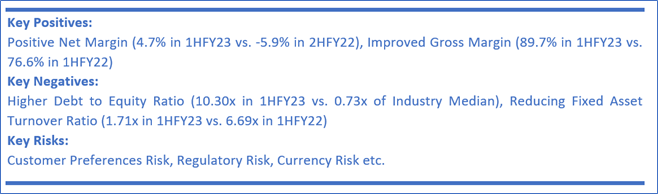
CCC reported the robust sales performance for the year ended 31 December 2022 - with UK sales up 41% on 2021 as well as store sales in Ireland up by 91%. CCC always had a focus on putting its efforts into driving sales volumes through its existing estate before working on a store expansion program. Since the start of 2023, its Esquires brand has opened a new outlet in Brackley, Northamptonshire. The Triple Two brand also seeks expansion opportunities, with three new stores planning to be opened in London and Southern England in the same period.
Technical Overview:
Daily Price Chart
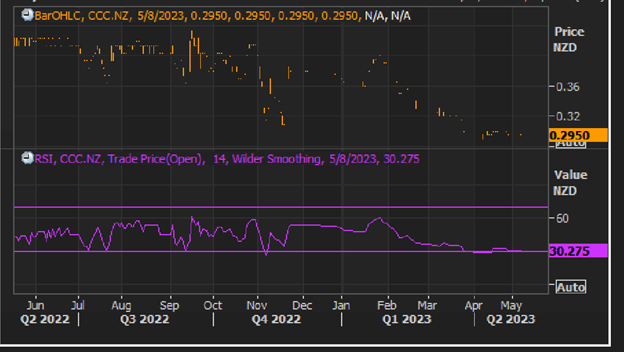
Source: REFINITIV, Note: Purple color line reflects Relative Strength Index (14-Period)
Technical Commentary:
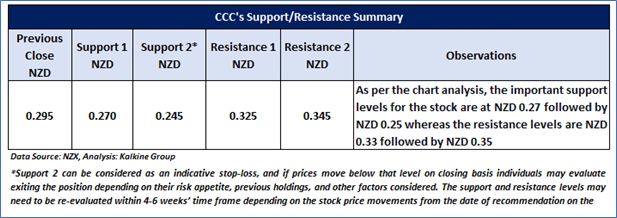
On the daily chart, CCC prices are sustaining above the falling trendline support zone. Moreover, the momentum oscillator RSI (14-period) is showing a reading of ~30.275. level. However, the prices are trading above the trend-following indicators 21-period SMA, which may act as a resistance zone. An important support level for the stock is placed at NZD 0.270 while the key resistance level is placed at NZD 0.325.
Stock Recommendation
On a TTM basis, the stock of CCC is trading at an EV/Sales multiple of 6.2x compared to the industry (Consumer Cyclicals) mean of 11.4x, and thus seems undervalued.
Considering the facts above and undervaluation as indicated by the TTM valuation, a ‘Speculative Buy’ recommendation on the stock has been provided at the closing market price of NZD 0.295 per share as of 8 May 2023.
Markets are trading in a highly volatile zone currently due to certain macro-economic issues and geopolitical tensions prevailing. Therefore, it is prudent to follow a cautious approach while investing.
Note 1: Past performance is neither an indicator nor a guarantee of future performance.
Note 2: The reference data in this report has been partly sourced from REFINITIV.
Note 3: Investment decisions should be made depending on an individual's appetite for upside potential, risks, holding duration, and any previous holdings. An 'Exit' from the stock can be considered if the Target Price mentioned as per the Valuation and or the technical levels provided has been achieved and is subject to the factors discussed above.
Note 4: Annual Dividend Yield is on a Trailing Twelve Month (TTM1) basis and are subject to change based on factors such as company performance, stock price changes, etc.
Technical Indicators Defined: -
Support: A level at which the stock prices tend to find support if they are falling, and a downtrend may take a pause backed by demand or buying interest. Support 1 refers to the nearby support level for the stock and if the price breaches the level, then Support 2 may act as the crucial support level for the stock.
Resistance: A level at which the stock prices tend to find resistance when they are rising, and an uptrend may take a pause due to profit booking or selling interest. Resistance 1 refers to the nearby resistance level for the stock and if the price surpasses the level, then Resistance 2 may act as the crucial resistance level for the stock.
Stop-loss: It is a level to protect further losses in case of unfavourable movement in the stock prices.
Disclaimer
Kalkine New Zealand Limited is a Financial Advice Provider (“FAP”) and is authorised by a Class 1 Financial Advice Provider Licence issued by Financial Markets Authority (“FMA”) to provide financial advice. Kalkine provides only general financial advice through its research reports following a person becoming a member. The reports contain buy/sell/hold and other recommendations in relation to equity financial products. The recommendations and opinions [on this website] / [in this report] do not take into account any of your investment objectives, financial situation or needs. Before you make a decision about whether to acquire a financial product, you should obtain the Product Disclosure Statement from the product issuer. You should consider the appropriateness of advice taking into account your own objectives, financial situation and needs and seek independent financial advice before making any financial decisions. If you act on the advice in the research reports, you may have to pay fees, expenses or other amounts (but not to Kalkine). Further information about the complaints and dispute resolution process, as well as information about Kalkine’s duties are available on Kalkine’s website. Please read our Financial Advice Provider (FAP) disclosure statement and Complaints Handling Guide, which are available on the website.
Past performance is not a reliable indicator of future performance.
 Please wait processing your request...