
 AU
AU
 UK
UK
 CA
CA
 US
US
 IND
IND

 NZ
NZ

I. Sector Landscape and Outlook
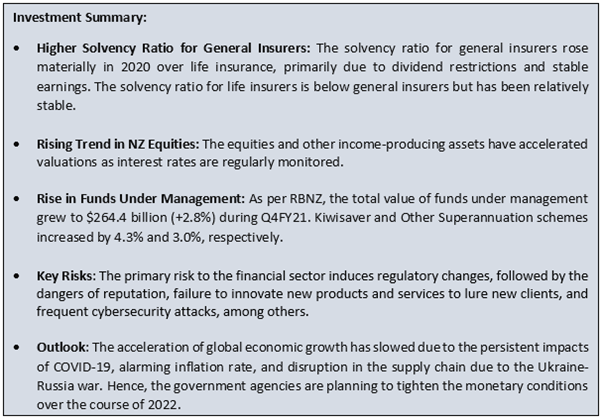
NZ’s financial system has been resilient and extends its support to households and businesses in managing their way through the pandemic. The banking system’s earnings have grown over the past year. Amid dividend restrictions and lower risk-weighted asset growth, it has increased banks’ capital ratios to their highest levels since the current risk-based approach to capital regulations was introduced. Banks are in a decent position to fulfil higher requirements arising due to capital review and to grasp any impacts from Alert Level restrictions that have been in place since August 2021.
Solvency Ratio for General Insurers Increased Materially
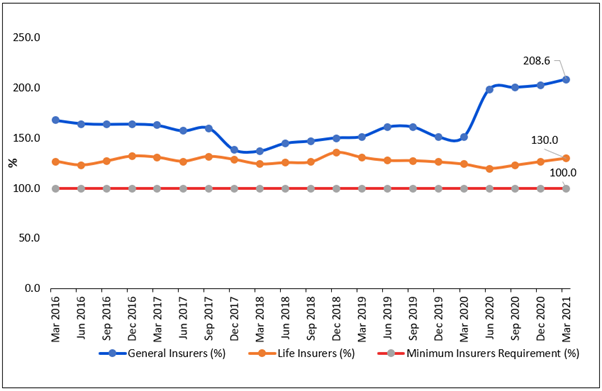
The solvency ratio for general insurers grew materially in 2020 over life insurance, primarily driven by dividend restrictions and stable earnings. The solvency ratio for life insurers is below general insurers but has been relatively stable. Meanwhile, the solvency ratio for health insurers continues to report above 300%. These solvency ratios indicate stress testing, mitigating actions, and understanding potential vulnerabilities to adverse scenarios. The data indicates insurers’ reliance on reinsurance arrangements and volatile insurance market in NZ in case of any disruption.
Exhibit 1: Trend in Solvency Ratios of Life and General Insurers
Data Source: This work is based on/includes rbnz data which are licensed by rbnz.govt for reuse under the Creative Commons Attribution 4.0 International Licence; Chart Analysis by Kalkine Group
NZ Equities Trading Strong Driven by Fiscal and Monetary Support
As per RBNZ, equities and other income-producing assets have reported acceleration in valuations as interest rates are monitored regularly. However, mismatches between asset prices and their corresponding long-term growth potential continue to provide volatility and risk. Vulnerability to a sharp correction continue to provide nervousness into the system. Meanwhile, the monetary conditions are continuing to support the economy, but financial levels are anticipated to tighten as the OCR is increased, weighing on gross domestic product (GDP) growth.
Rise in Funds Under Management Continues
As per RBNZ, the total value of funds under management grew to $264.4 billion (+2.8%) during Q4FY21. Kiwisaver and Other Superannuation schemes increased by 4.3% and 3.0%, respectively. Fund holdings by asset class reported a rise in shares (6.0%) and units in trusts (+9.2%), while short term debt holdings plunged (-7.0%). Fund holdings by-product increased in retail unit trusts (+5.1%) and private wealth (+4.1%) during Q4FY21.
Exhibit 2: Trend in Total Funds Under Management

Data Source: This work is based on/includes rbnz data which are licensed by rbnz.govt for reuse under the Creative Commons Attribution 4.0 International Licence; Chart Analysis by Kalkine Group
Index Performance:
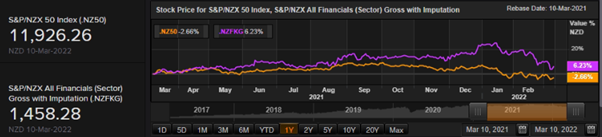
The S&P/NZX All Financials Index generated a 1-year return of ~6.23% versus ~-2.66% by the S&P/NZX 50 Index. Therefore, S&P/NZX All Financials Index overperformed S&P/NZX 50 Index by ~8.89% in 1-year.
Exhibit 3: S&P/NZX All Financials Index vs S&P/NZX 50 Index
Source: REFINITIV
Key Risks and Challenges:
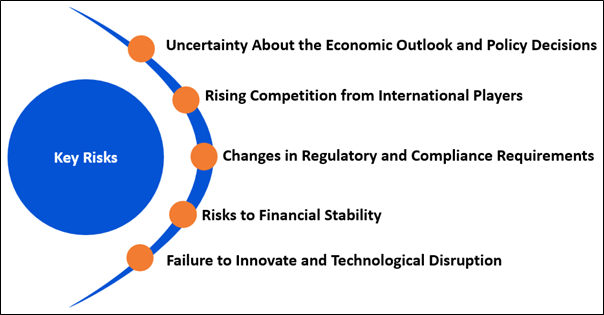
Annual CPI inflation reached three decades high at 5.9% in the December 2021 quarter, well above the target band of 1-3%. This rise was partially driven by global developments that have resulted in a sudden price rise for some commodities and imported goods like petrol prices that grew significantly, pushing annual tradables inflation to 6.9% in the December 2021 quarter. Annual petrol price inflation jumped to 30.5% in the last quarter. Increased wage growth, pressure on available domestic resources, restriction to global supply chains and rise in international prices for imported goods, among other factors, have contributed to the increase in annual consumer price inflation to 5.9% in the December 2021 quarter, slightly higher than the expectation of 5.7%.
Exhibit 4. Key Risks in Financial Sector:
Source: Analysis by Kalkine Group
Outlook:
Amid current and expected strength in the labour market and elevated inflationary pressure from global and domestic sources, the central forecast indicates that the OCR could be increased to reach economic objectives. However, the underlying strength remains in the economy, driven by aggregate household and business balance sheet performance, supportive fiscal policy, and continued strong export returns.
Despite high-capacity pressures, business investment is anticipated to be muted in the near term due to COVID-19 related circumstances globally. After that, business investment is projected to increase with capacity pressures.
Apart from the sector-specific factors, we have also analysed four NZX-listed companies operating in the same sector. This report covers their insights, outlook, performance and potential as expected to be delivered in the near to medium term.
1) Henderson Far East Income Limited (Recommendation: Buy, Potential Upside: Low Double-Digit) (M-Cap: NZ$874.55, Gross Dividend Yield: 8.107%)
Business Description:
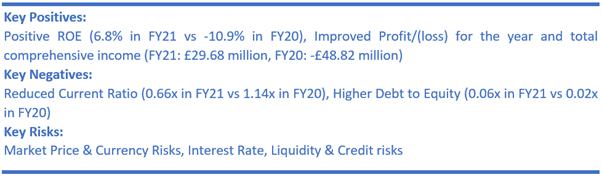
Henderson Far East Income Limited (NZX: HFL) aims to provide shareholders with a growing total annual dividend per share, as well as capital appreciation from a diversified portfolio of investments from the Asia Pacific region, excluding Japan.
Outlook:
The company is optimistic about the Asia Pacific region's medium to long-term outlook as per the reports. However, it is a little nervous about the outlook for equity markets in general for 2022. Inflationary pressures, from rising input prices, and the potential for economic support measures to be withdrawn, doesn't bode well for equity markets trading at relatively rich multiples; therefore, the earnings momentum, which has been so strong off a low base in 2021, will be difficult to improve upon in 2022.
NAV Update:
On 8 March 2022, the unaudited net asset value per share, calculated by the AIC formula (including current financial year revenue items), was 287.4p. The unaudited net asset value per share (excluding current financial year revenue items) was 286.8p.
Technical Overview:
Daily Price Chart
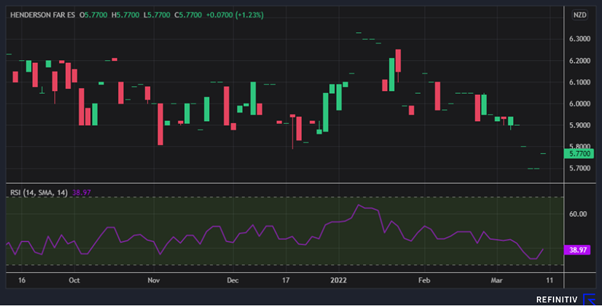
Source: REFINITIV, Note: Purple color line reflects Relative Strength Index (14-Period)
Stock Recommendation:
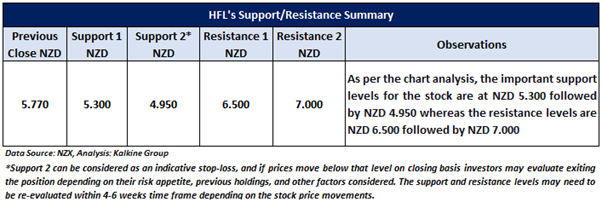
Considering the factors above, we give a “Buy” recommendation on the stock at the closing market price of NZ$5.77 per share, up 1.23% as of 10th March 2022.
2) Kingfish Limited (Recommendation: Buy, Potential Upside: Low Double-Digit) (M-Cap: NZ$554.17 million, Gross Dividend Yield: 8.610%)
Business Description:
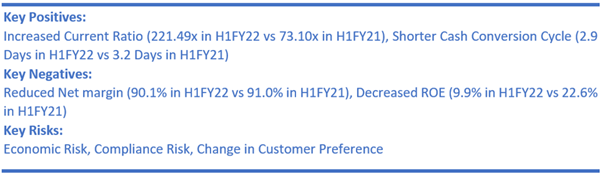
Kingfish Limited (NZX: KFL) is an investment company focusing on growing investors’ capital through portfolio management and offering regular dividends.
Outlook
During the first six months of FY22, certain extensive portfolio positions significantly outperformed the market. KFL’s strategy of actively selecting a concentrated portfolio of high-quality companies delivered a robust performance. However, the valuations are slightly elevated, suggesting lower investment returns prompting companies to make active decisions. Besides, the company believes that the recent issue of KFL warrants will be valuable to shareholders at the exercise date in November next year.
The undiluted ex-div NAV as of 9 March 2022 stood at $1.5375. The NAV per share is after removing an accrual for a 3.55 cents per share dividend planned to be paid on 25 March 2022.
On 9 March 2022, the company released February 2022 performance where gross performance return was down (0.6%), and the adjusted NAV return was down (0.6%).
Technical Overview:
Daily Price Chart
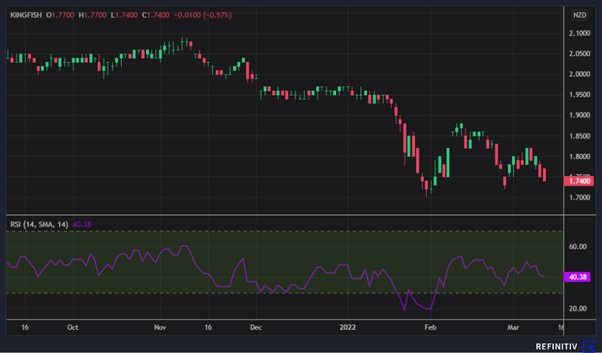
Source: REFINITIV, Note: Purple color line reflects Relative Strength Index (14-Period)
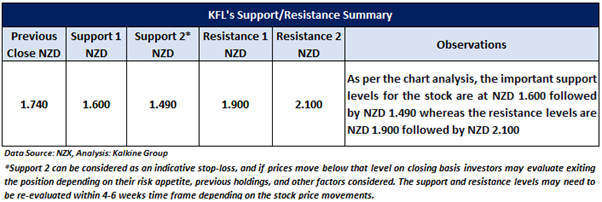
Stock Recommendation
Considering the factors above, we give a “Buy” recommendation on the stock at the closing market price of $1.74 per share, down 0.57% as of 10th March 2022.
3) NZX Limited (Recommendation: Buy, Potential Upside: Low Double-Digit) (M-Cap: NZ$405.62 million, Gross Dividend Yield: 6.139%)
Business Description:
NZX Limited (NZX: NZX) operates New Zealand’s equity, debt, derivatives, and energy markets. It also provides clearing, trading, depository, settlement, and data services.
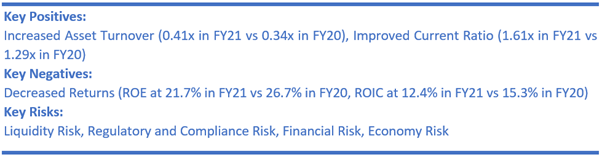
Outlook
NZX’s strategy involves growing the scale of its businesses and the synergies between its business units. The NZX Board expects operating earnings for FY22 to be in the range of $33.5 million to $38 million.
On 22 February 2022, the company announced the opening of its fully underwritten Retail Entitlement Offer to raise ~NZ$44 million.
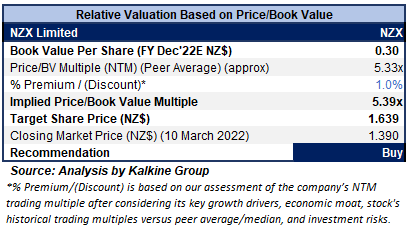
Valuation Methodology: Price/Book Value Based Relative Valuation (Illustrative)
Technical Overview:
Daily Price Chart
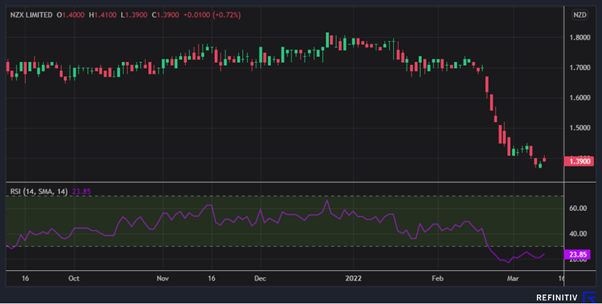
Source: REFINITIV, Note: Purple color line reflects Relative Strength Index (14-Period)
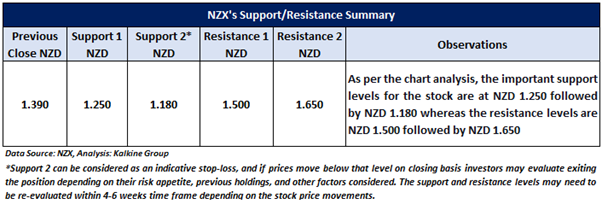
Stock Recommendation
The stock has been valued using a P/B multiple-based illustrative relative valuation, and the target price so arrived reflects a rise of low double-digit (in % terms). A slight premium has been applied to P/B Multiple (NTM) (Peer Average), considering significant progress in the company’s strategy to re-engineer the NZX Group for future growth.
Considering the factors above, we give a “Buy” recommendation on the stock at the closing market price of $1.39 per share, up 0.72% as of 10th March 2022.
4) Tower Limited (Recommendation: Hold, Potential Upside: Low Double-Digit) (M-Cap: NZ$267.54 million, Gross Dividend Yield: 7.072%)
Business Description:
Tower Limited (NZX: TWR) is primarily engaged in general insurance. The company operates in New Zealand, with some operations based in the Pacific Islands region.
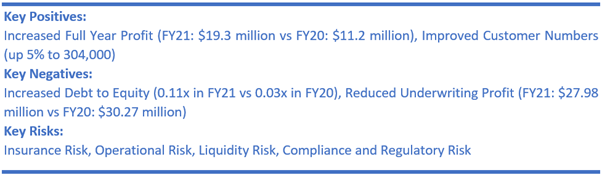
Outlook
The company is delivering on its planned strategies of innovation and growth. Its flagship Tower Direct business and the well-established partnership distribution capability provide strength. Further, the digitization designed for Pacific business is expected to improve efficiency and competitiveness. FY21 Guidance: The company anticipates underlying net profit after tax, excluding large events, to be in the range of $35.4-$39.4 million for FY22, Underlying NPAT in the range of $21.0-$25.0 million for FY22 and dividend ~ 5 cents per share.
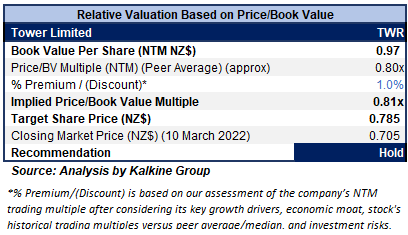
Valuation Methodology: Price/Book Value Based Relative Valuation (Illustrative)
Technical Overview:
Daily Price Chart
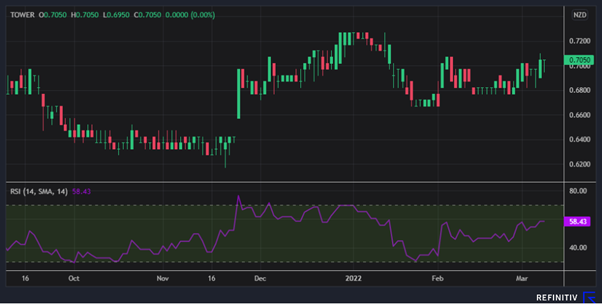
Source: REFINITIV, Note: Purple color line reflects Relative Strength Index (14-Period)
Stock Recommendation:
The stock has been valued using a P/B multiple-based illustrative relative valuation, and the target price so arrived reflects a rise of low double-digit (in % terms). A slight premium has been applied to P/B Multiple (NTM) (Peer Average), considering the company's technological partnerships to respond to challenges and capitalize on opportunities.
Considering the fact above, we give a “Hold” recommendation on the stock at the closing market price of NZ$0.705 per share as of 10th March 2022.
Markets are trading in a highly volatile zone currently due to certain macro-economic issues and geopolitical tensions prevailing. Therefore, it is prudent to follow a cautious approach while investing.
Note 1: The reference data in this report has been partly sourced from REFINITIV.
Note 2: Investment decisions should be made depending on the investors’ appetite on upside potential, risks, holding duration, and any previous holdings. Investors can consider exiting from the stock if the Target Price mentioned as per the analysis has been achieved and subject to the factors discussed above alongside support levels provided.
Technical Indicators Defined: -
Support: A level where-in the stock prices tend to find support if they are falling, and downtrend may take a pause backed by demand or buying interest.
Resistance: A level where-in the stock prices tend to find resistance when they are rising, and uptrend may take a pause due to profit booking or selling interest.
Stop-loss: It is a level to protect further losses in case of unfavourable movement in the stock prices.
Disclaimer
Kalkine New Zealand Limited is authorised to provide general advice only. The information on this website does not take into account any of your investment objectives, financial situation or needs. Before you make a decision about whether to acquire a financial product, you should obtain the Product Disclosure Statement from the product issuer. You should consider the appropriateness of advice taking into account your own objectives, financial situation and needs and seek independent financial advice before making any financial decisions.
Past performance is not a reliable indicator of future performance.
 Please wait processing your request...