
 AU
AU
 UK
UK
 CA
CA
 US
US
 IND
IND

 NZ
NZ

Company Overview:
Restaurant Brands New Zealand Ltd (NZX: RBD) is the corporate franchisee which specialises in managing multi-site branded food retail chains. Burger Fuel Group Limited (NZX: BFG) is the New Zealand-based company, which operates as a franchisor of gourmet burger as well as chicken restaurants. Kalkine’s Sector Report covers the Investment Highlights, Key Financial Metrics, Risks, Outlook, Technical Analysis along with the Valuation, Target Price, and Recommendation on the stock.
I. Sector Landscape and Outlook
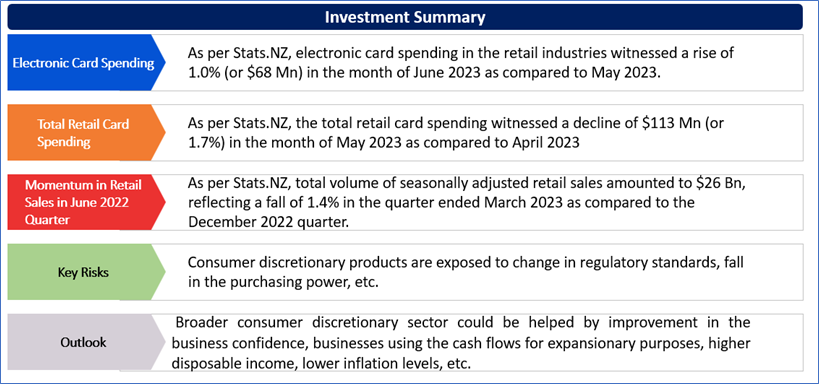
As per Stats.NZ, electronic card spending in the retail industries witnessed a rise of 1.0% (or $68 Mn) in the month of June 2023 as compared to May 2023. Notably, the spending in the core retail industries remained unchanged. With respect to the spending category, fuel was up $20 Mn (or 3.8%), durables were up $8.2 Mn (or 0.5%) as well as motor vehicles (excluding fuel) was up $5.1 Mn (or 2.4%). In the month of June 2023, the non-retail (excluding services) category rose by $60 Mn (or 2.8%) as compared to May 2023. This category consists of medical and other health care, travel and tour arrangement, postal and courier delivery and other non-retail industries. The services category rose $5.0 Mn (or 1.4%). This category consists of repair and maintenance, and personal care, funeral and other personal services.
The total value of electronic card spending, including the 2 non-retail categories (services and other non-retail) rose from May 2023, exhibiting a rise of $119 Mn (or 1.3%). In actual terms, the cardholders made 161 Mn transactions throughout all the industries in June 2023, with an average value of $55 per transaction. Notably, the total amount spent using electronic cards amounted to $8.9 Bn.
Retail Card Spending Witnesses a Decline
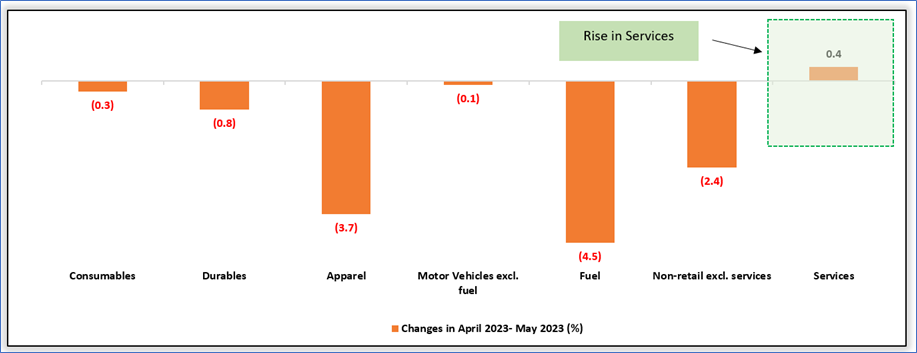
As per Stats.NZ, the total retail card spending witnessed a decline of $113 Mn (or 1.7%) in the month of May 2023 as compared to April 2023 after adjusting for the seasonal effects. The seasonally adjusted card spending declined throughout all the retail industries (such as consumables, durables, apparel, fuel, as well as motor vehicles), and the non-retail excluding services category. Notably, the services was the only industry which encountered a rise, increasing $1.4 Mn (or 0.4%) as compared to April 2023.
The biggest contributor to the decline in retail card spending was fuel, which was down $25 Mn (or 4.5%), followed by apparel, reflecting a fall of $13 Mn (or 3.7%). Notably, the total value of electronic card spending, which includes 2 non-retail categories, fell $174 Mn (or 1.9%) in the month of May 2023.
Exhibit 1: Percentage change in seasonally adjusted card transaction values by industry, April 2023–May 2023
Data Source: This work is based on/includes Stats NZ’s data which are licensed by Stats NZ for reuse under the Creative Commons Attribution 4.0 International Licence; Chart Created by Kalkine Group
Continued Momentum in Retail Sales in June 2022 Quarter
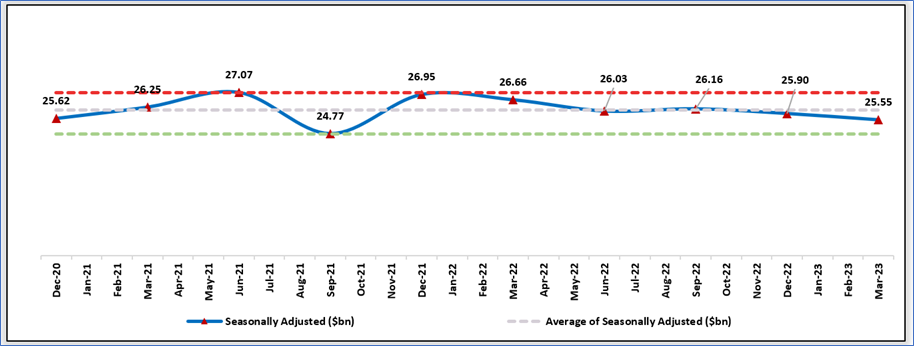
As per Stats.NZ, total volume of seasonally adjusted retail sales amounted to $26 Bn, reflecting a fall of 1.4% in the quarter ended March 2023 as compared to the December 2022 quarter. Over the same time period, the total value of seasonally adjusted retail sales stood at $30 Bn, down 0.3% (or $77 Mn) as well as 9 of the 16 regions witnessed lower seasonally adjusted sales values. Also, the total actual volume of retail sales fell 4.1% as compared to the March 2022 quarter.
The total actual value of stock as at 31 March 2023 amounted to $9.8 Bn, reflecting a rise of 5.2% (or $486 Mn) as compared to 31 March 2022. Also, 9 out of 15 industries witnessed lower seasonally adjusted sales volumes in the March 2023 quarter as compared to the December 2022 quarter.
Exhibit 2: Trend in Total Retail Trade Sales ($bn), Volumes
Data Source: This work is based on/includes Stats NZ’s data which are licensed by Stats NZ for reuse under the Creative Commons Attribution 4.0 International Licence; Chart Created by Kalkine Group
Rise in Retail Trade and Accommodation
As per Stats.NZ, total sales in retail trade and accommodation category stood at $30 Bn, reflecting a fall of $77 Mn (or 0.3%) from the December 2022 quarter. The actual purchases increased by $798 Mn (or 3.5%), and salaries and wages increased $339 Mn (or 8.9%) in the quarter ended March 2023 as compared to the quarter ended March 2022.
With respect to construction, total sales in the category stood at $24 Bn, reflecting a fall of $902 Mn (or 3.7%) from the quarter ended December 2022. Notably, actual purchases increased $388 Mn (or 2.5%), and salaries and wages increased $408 Mn (or 11%) in the March 2023 quarter as compared to March 2022 quarter.
Key Risks and Challenges:
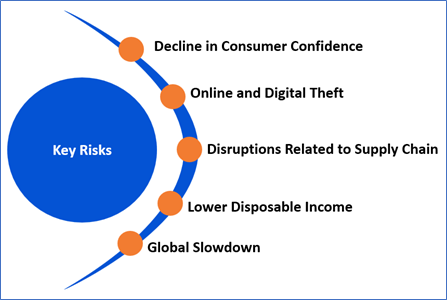
The consumer discretionary market is exposed to increased competition from the domestic as well as international tech- e-commerce companies, launch of brands and stores. The broader consumer discretionary sector is exposed to disruptions in the supply chain, increased labour shortages as well as higher hourly rates and the general economic cost pressures. Apart from these challenges, COVID-19 restrictions and decline in the purchasing power of consumers could potentially impact the companies operating in the consumer discretionary sector.
Broader inflationary pressures as well as increased financing costs could impact the profit margins of the consumer discretionary companies. Most of the companies might witness increase in the wage costs because of the minimum wage increases, general inflationary pressures as well as low unemployment.
Exhibit 3. Key Risks in Retail & Consumer Sector:
Source: Analysis by Kalkine Group
Outlook:
As per the report by Commerce Commission New Zealand, the best way to witness the improvement in the competition in the retail grocery sector is via the measures which could improve the conditions for entry as well as expansion. Improvement in the conditions for entry and expansion might be beneficial for the consumers because this enables the greater range of grocery retailers to provide convenient one-stop shopping option. Over the long term, actual entry or expansion could be greatest driver of competition.
According to RBNZ, the quicker increase in the debt servicing costs has been testing the cash flows of some households. In particular, for those which have borrowed at high debt-to-income (or DTI) multiples when the interest rates were low. Most of such borrowers have been repricing to interest rates above those at which the servicing capacity was examined by the lending institutions. This sort of trend, and higher cost of living, means that cash flow stresses have been growing amongst the group.
The interest coverage ratios of property operators have fallen with the increased interest rates. This has decreased the buffer available to deal with tenant stress as well as still meet requirements of debt servicing. Banks are ready to work with stressed customers, analysing where the property sales could be made to reduce the debt, and where discretionary spending could be reduced so that the borrowers’ ability to service debt could be improved. Broader consumer discretionary sector could be helped by improvement in the business confidence, businesses using the cash flows for expansionary purposes, higher disposable income, lower inflation levels, etc.
Apart from the sector-specific factors, an analysis on two NZX-listed companies is provided. This report covers their insights, outlook, performance and potential as expected to be delivered in the near to medium term.
1) Restaurant Brands New Zealand Ltd (Recommendation: Buy, Potential Upside: Low Double-Digit) (M-Cap: NZD 792.2 million, Annual Dividend Yield (TTM)1: 3.5%)
Business Description:
Restaurant Brands New Zealand Ltd (NZX: RBD) is the corporate franchisee which specialises in managing multi-site branded food retail chains.

Outlook:
The company is fully expecting store EBITDA margins to improve as the year progresses. Therefore, RBD is expecting that it would deliver the much stronger H2. The company is focussed towards the long-term growth strategies as well as it is expecting that, despite the short term challenges, the business has robust track record in delivering improved outcomes in the long term.
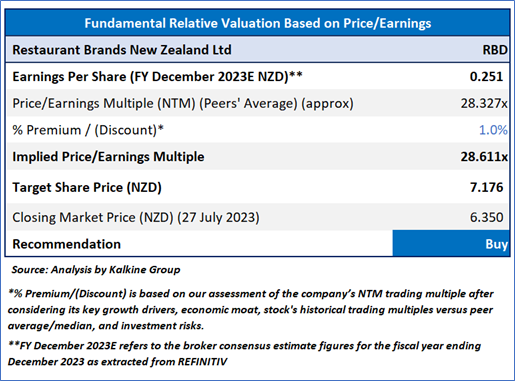
Valuation Methodology: Price/Earnings Per Share Based Relative Valuation (Illustrative)
Technical Overview:
Daily Price Chart
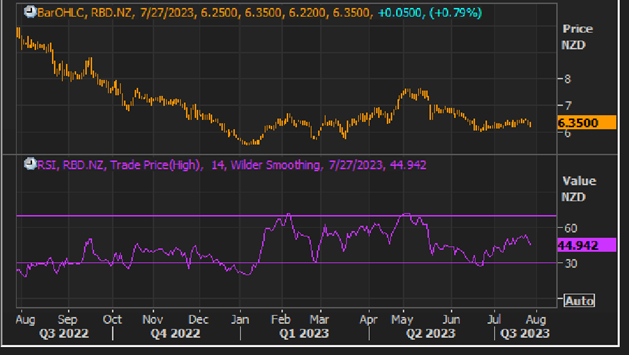
Source: REFINITIV, Note: Purple color line reflects Relative Strength Index (14-Period)
Technical Commentary:
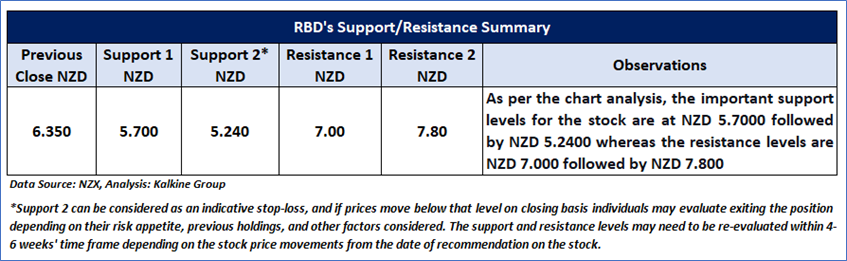
On the daily chart, RBD prices are trading above the falling trendline support zone. Moreover, the momentum oscillator RSI (14-period) is showing a reading of ~44.942 level. Further, the prices are trading above the trend-following indicators 21-period SMA, which may act as a support zone. An important support level for the stock is placed at NZD 5.70 while the key resistance level is placed at NZD 7.0
Stock Recommendation
The stock has been valued using P/E multiple-based illustrative relative valuation, and the target price so arrived reflects a rise of low double-digit (in % terms). A slight premium has been applied to P/E Multiple (NTM) (Peer Average) considering the decent outlook.
Considering the facts above, a ‘Buy’ recommendation on the stock has been provided at the closing market price of NZD 6.35 per share, up by 0.79% as on 27 July 2023.
2) Burger Fuel Group Limited (Recommendation: Speculative Buy, Potential Upside: Low Double-Digit) (M-Cap: NZD 12.3 million)
Business Description:
Burger Fuel Group Limited (NZX: BFG) is the New Zealand-based company, which operates as a franchisor of gourmet burger as well as chicken restaurants.

Outlook:
The performance over the upcoming 12 months is uncertain considering the current worsening economic conditions. However, the recent sales growth is promising, as is the proposed trial of the delivery service for selected BurgerFuel outlets. BFG is expecting growth in new stores to be modest with perhaps the few new stores throughout all the brands taking place in FY 2024.
Technical Overview:
Daily Price Chart
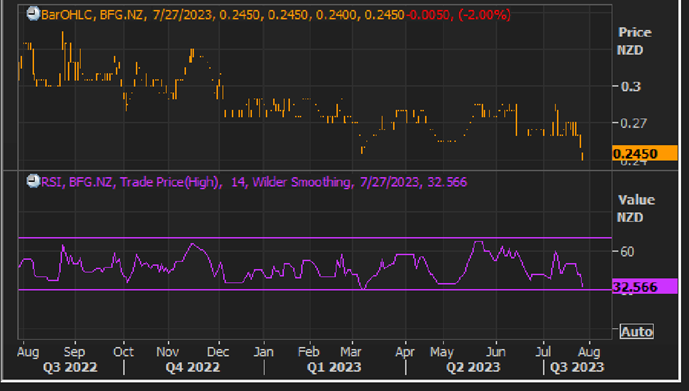
Source: REFINITIV, Note: Purple color line reflects Relative Strength Index (14-Period)
Technical Commentary:
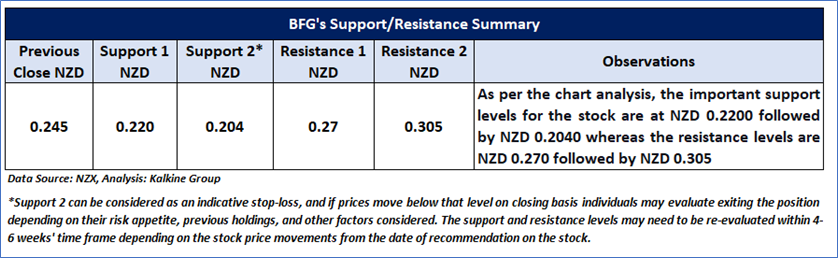
On the daily chart, BFG prices are trading above the horizontal trendline support zone and taking support from the trendline. Moreover, the momentum oscillator RSI (14-period) is showing a reading of ~32.566 level. However, the prices are trading below trend-following indicator 21-period SMA, which may act as a resistance level. An important support level for the stock is placed at NZD 0.220 while the key resistance level is placed at NZD 0.27.
Stock Recommendation
Considering the facts above, a ‘Speculative Buy’ recommendation on the stock has been provided at the closing market price of NZD 0.245 per share, down by 2% in 27 July 2023.
Markets are trading in a highly volatile zone currently due to certain macro-economic issues and geopolitical tensions prevailing. Therefore, it is prudent to follow a cautious approach while investing.
Note 1: Past performance is not a reliable indicator of future performance.
Note 2: The reference date for all price data, currency, technical indicators, support, and resistance levels is July 27, 2023. The reference data in this report has been partly sourced from REFINITIV.
Note 3: Investment decisions should be made depending on an individual's appetite for upside potential, risks, holding duration, and any previous holdings. An 'Exit' from the stock can be considered if the Target Price mentioned as per the Valuation and or the technical levels provided has been achieved and is subject to the factors discussed above.
Note 4: Annual Dividend Yield is on a Trailing Twelve Month (TTM1) basis and are subject to change based on factors such as company performance, stock price changes, etc.
Technical Indicators Defined: -
Support: A level at which the stock prices tend to find support if they are falling, and a downtrend may take a pause backed by demand or buying interest. Support 1 refers to the nearby support level for the stock and if the price breaches the level, then Support 2 may act as the crucial support level for the stock.
Resistance: A level at which the stock prices tend to find resistance when they are rising, and an uptrend may take a pause due to profit booking or selling interest. Resistance 1 refers to the nearby resistance level for the stock and if the price surpasses the level, then Resistance 2 may act as the crucial resistance level for the stock.
Stop-loss: It is a level to protect further losses in case of unfavourable movement in the stock prices.
Disclaimer
Kalkine New Zealand Limited is a Financial Advice Provider (“FAP”) and is authorised by a Class 1 Financial Advice Provider Licence issued by Financial Markets Authority (“FMA”) to provide financial advice. Kalkine provides only general financial advice through its research reports following a person becoming a member. The reports contain buy/sell/hold and other recommendations in relation to equity financial products. The recommendations and opinions [on this website] / [in this report] do not take into account any of your investment objectives, financial situation or needs. Before you make a decision about whether to acquire a financial product, you should obtain the Product Disclosure Statement from the product issuer. You should consider the appropriateness of advice taking into account your own objectives, financial situation and needs and seek independent financial advice before making any financial decisions. If you act on the advice in the research reports, you may have to pay fees, expenses or other amounts (but not to Kalkine). Further information about the complaints and dispute resolution process, as well as information about Kalkine’s duties are available on Kalkine’s website. Please read our Financial Advice Provider (FAP) disclosure statement and Complaints Handling Guide, which are available on the website.
Past performance is not a reliable indicator of future performance.
 Please wait processing your request...