
 AU
AU
 UK
UK
 CA
CA
 US
US
 IND
IND

 NZ
NZ

1. Sector Landscape and Outlook
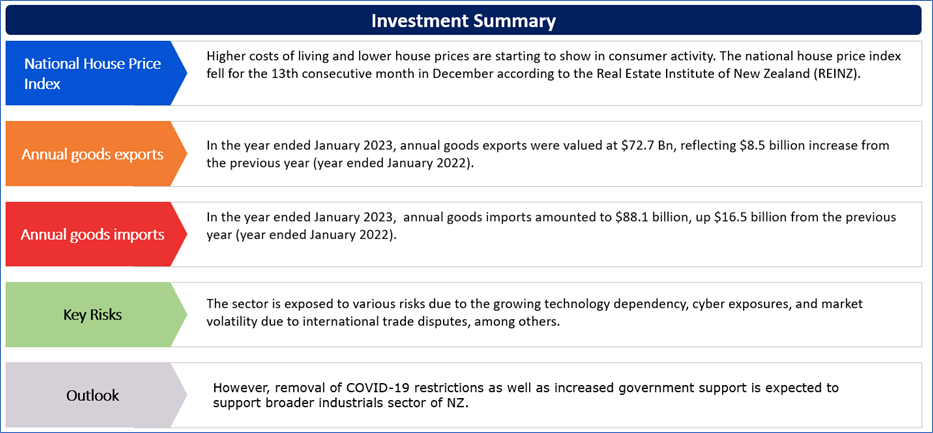
As per the ‘Fortnightly Economic Update’ released by The Treasury on 20th January 2023, domestic demand has been easing as a result of increased interest rates as well as increased consumer prices. As per the release, annual consumer price inflation is expected to remain more than 7% in the December quarter. Amidst the challenges, China’s reopening is expected to provide a boost. Despite the weak sentiment reported from the construction sector, some data shows optimism. Building consents witnessed a bounce back in November after the significant fall in October. Overall, demand has been holding up for multi-unit as well as standalone dwellings. This was witnessed despite weaker house prices as well as selling activity. Notably, consents for multi-unit dwellings in Auckland are making up one-third of all the building consents over the previous year.
Overseas merchandise trade
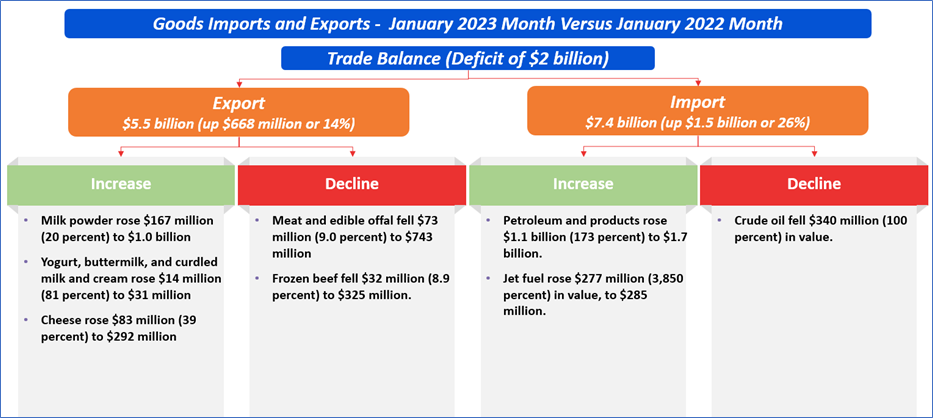
As per release by Stats.NZ dated 22 February 2023, in January 2023, goods exports witnessed a rise of $668 Mn (or 14%) to $5.5 Bn as compared to January 2022 and goods imports increased $1.5 Bn (or 26%) to $7.4 Bn. Notably, China has led the monthly exports rise. South Korea was NZ's 5th largest import partner (ranked by total annual goods imports). Therefore, it has surpassed Japan. Talking about the exports, milk powder, butter, and cheese (the largest export commodity group) was the biggest contributor to the increase, reflecting a rise of $406 Mn (or 25%) to $2.0 Bn.
Milk powder increased $167 Mn (or 20%) to $1.0 Bn and the quantity exported witnessed an increase of 20%. The average price per kilogram declined 0.3%. Cheese increased $83 Mn (or 39%) to $292 Mn and the quantity exported rose 14%. Notably, the average price per kilogram increased 22%.
Exhibit 1: Goods Exports and Imports
Data Source: This work is based on/includes Stats NZ’s data which are licensed by Stats NZ for reuse under the Creative Commons Attribution 4.0 International Licence; Chart Created by Kalkine Group
Trends Witnessed in Imports
As mentioned, goods imports increased $1.5 billion (or 26%) to $7.4 Bn in the month of January 2023 as compared to January 2022. Petroleum and products increased $1.1 billion (or 173%) to $1.7 Bn. Jet fuel witnessed a rise of $277 Mn (or 3,850%) in value to $285 Mn. The quantity imported witnessed a rise of 2,364% and the average unit value increased 60%. Automotive diesel increased $726 Mn (or 682%) in value to $832 Mn.
Index Performance:
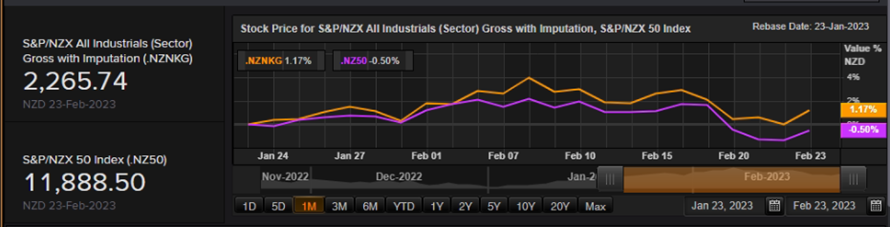
The S&P/NZX All Industrials (Sector) Index generated a 1-month return of ~1.17% versus ~-0.50% by the S&P/NZX 50 Index. Therefore, NZX All Industrials Index overperformed NZX50 Index by ~1.67% in 1 month.
Exhibit 2: S&P/NZX All Industrials (Sector) vs S&P/NZX50 Index
Source: REFINITIV
Key Risks and Challenges:
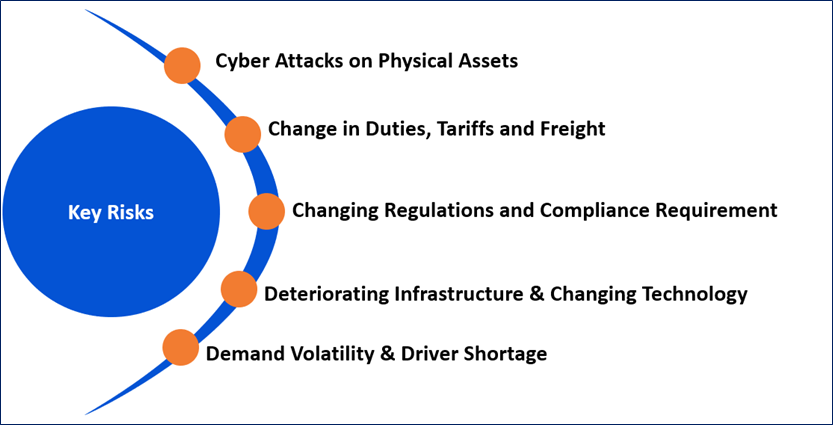
Globally, the geopolitical tensions, elevated inflation as well as sluggish growth indicate a challenging environment. Further, persistent nervousness among businesses driven by lacklustre demand for products as well as services keeps expansion plans away from regular growth strategies of the company.
Exhibit 3. Key Risks in Industrials Sector:
Source: Analysis by Kalkine Group
Outlook:
Labour market shortages might ease as annual net migration in November 2022 became positive for the first time since March 2021. This is because backlog in visa applications were processed to address the critical labour shortages. Tourism is looking positive and edges closer to pre-COVID19 levels, with increased visitor arrivals.
A key uncertainty for the 2023 Australian outlook is extent of slowdown in spending from households because of increased interest rates as well as declining real income from high inflation. However, there have been signs that monetary policy tightening has been weighing on spending.
However, retail sales rose strongly in November, reflecting a rise of 1.4% from October, while October’s figures were also revised up. Notably, the strength in retail sales contrasts strongly with the sentiments of consumers. However, removal of COVID-19 restrictions as well as increased government support is expected to support broader industrials sector of NZ.
Apart from the sector-specific factors, an analysis on 2 NZX-listed companies is provided. This report covers their insights, outlook, performance and potential as expected to be delivered in the near to medium term.
1 ) Serko Limited (Recommendation: Speculative Buy, Potential Upside: Low Double-Digit) (M-Cap: NZD283.04 billion)
Business Description:
Serko Limited (NZX: SKO) is a travel management and expense technology company headquartered in New Zealand.

Outlook
Serko Limited announced an upgrade to revenue guidance for the FY2023 year, after stronger than expected revenue performance across the primary markets. Its total income is anticipated to be between $42 million to $47 million. The guidance range for total income reflects an increase of between 123% and 149% respectively on total income of $18.9 million for the 12 months ended 31 March 2022.
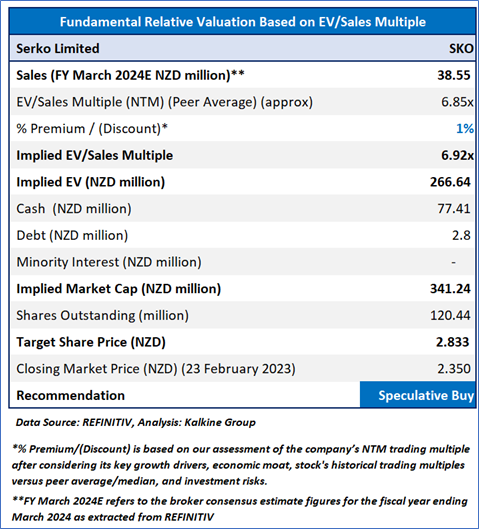
Valuation Methodology: EV/Sales Multiple Based Relative Valuation (Illustrative)
Technical Overview:
Daily Price Chart
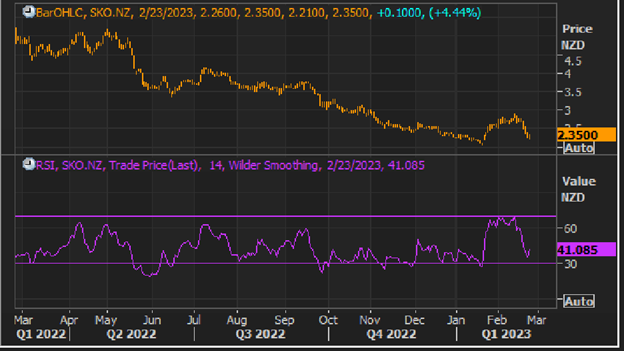
SKO Daily Technical Chart, Data Source: REFINITIV
Technical Commentary
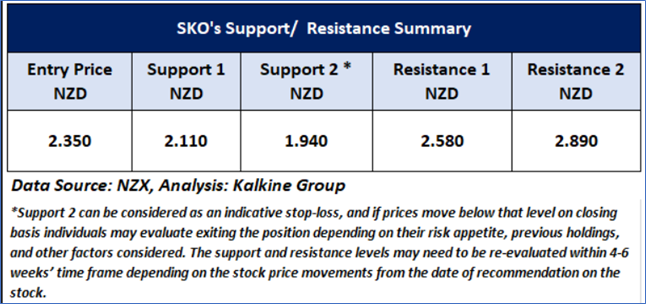
The stock of SKO showed some consolidation close to NZD 2.15 levels and bounced sharply, reaching the recent high of NZD 2.89. From there the prices corrected and traded above the previous consolidation levels of NZD 2.15. The momentum indicator, RSI, shows a reading of ~41.085 and holds the capacity of moving towards the north. The near-term support is placed around NZD 2.11 and the near-term resistance is marked around NZD 2.58.
Stock Recommendation
The stock has been valued using an EV/Sales multiple-based illustrative relative valuation, and the target price so arrived reflects a rise of low-double-digit (in % terms). A slight premium has been applied to EV/Sales Multiple (NTM) (Peer Average) considering the decent outlook for FY 2023.
Considering the aforementioned factors, a ‘Speculative Buy’ recommendation has been assigned on the stock at the closing market price of NZD2.350 per share, up 4.44% as of 23 February 2022.
2 )Move Logistics Group Limited (Recommendation: Speculative Buy, Potential Upside: Low Double-Digit) (M-Cap: NZD116.38 million)
Business Description:
Move Logistics Group Limited (NZX: MOV) is among the leading domestic freight and logistics players in New Zealand. It is engaged in providing freight transporting and warehousing services. It also coordinates offshore freight movements through international alliances.

Outlook
The company is on a journey to position itself as the solutions-driven transport as well as logistics business and the leader in the industry. Deployment towards growth initiatives like digital transformation as well as the new trans-Tasman shipping service reflects the changing mindset.
Technical Overview:
Daily Price Chart
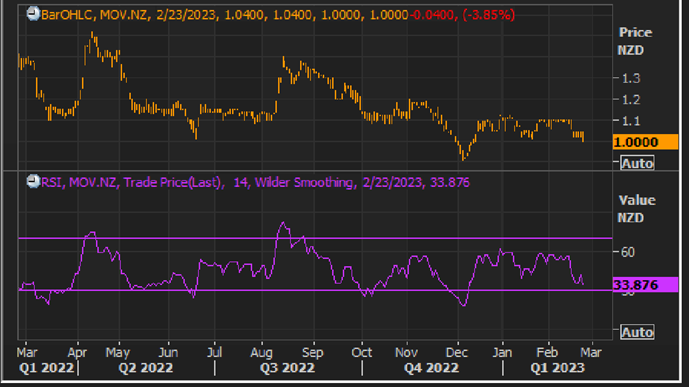
MOV Daily Technical Chart, Data Source: REFINITIV
Technical Commentary:
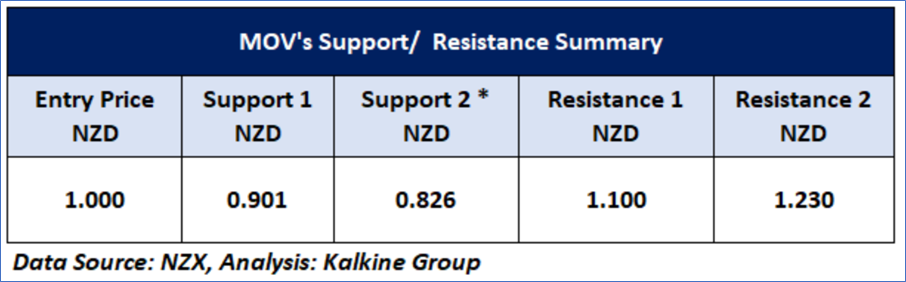
The stock price of MOV bounced after hitting the near-term lows of NZD 0.91 which acted as a strong support zone from the previous price consolidation. Currently, the prices are trading within the range of NZD 1.11 and NZD 0.96. for the momentum indicator, RSI, is currently showing a reading of ~33.876 which is above the oversold zone. The near-term support is placed at NZD 0.901, whereas the near-term resistance is market at NZD 1.10 levels.
Stock Recommendation:
Considering the aforementioned factors, a ‘Speculative Buy’ recommendation has been assigned on the stock at the closing market price of NZD1.000 per share, down by 3.85% as of 23 February 2023.
Markets are trading in a highly volatile zone currently due to certain macro-economic issues and geopolitical tensions prevailing. Therefore, it is prudent to follow a cautious approach while investing.
Note 1: Past performance is not a reliable indicator of future performance.
Note 2: The reference date for all price data, currency, technical indicators, support, and resistance levels is February 23, 2022. The reference data in this report has been partly sourced from REFINITIV.
Note 3: Investment decisions should be made depending on an individual's appetite for upside potential, risks, holding duration, and any previous holdings. An 'Exit' from the stock can be considered if the Target Price mentioned as per the Valuation and or the technical levels provided has been achieved and is subject to the factors discussed above.
Technical Indicators Defined: -
Support: A level at which the stock prices tend to find support if they are falling, and a downtrend may take a pause backed by demand or buying interest. Support 1 refers to the nearby support level for the stock and if the price breaches the level, then Support 2 may act as the crucial support level for the stock.
Resistance: A level at which the stock prices tend to find resistance when they are rising, and an uptrend may take a pause due to profit booking or selling interest. Resistance 1 refers to the nearby resistance level for the stock and if the price surpasses the level, then Resistance 2 may act as the crucial resistance level for the stock.
Stop-loss: It is a level to protect further losses in case of unfavourable movement in the stock prices.
Disclaimer
Kalkine New Zealand Limited is a Financial Advice Provider (“FAP”) and is authorised by a Transitional FAP license issued by Financial Markets Authority (“FMA”) to provide financial advice. Kalkine provides only general financial advice through its research reports following a person becoming a member. The reports contain buy/sell/hold and other recommendations in relation to equity financial products. The recommendations and opinions [on this website] / [in this report] do not take into account any of your investment objectives, financial situation or needs. Before you make a decision about whether to acquire a financial product, you should obtain the Product Disclosure Statement from the product issuer. You should consider the appropriateness of advice taking into account your own objectives, financial situation and needs and seek independent financial advice before making any financial decisions. If you act on the advice in the research reports, you may have to pay fees, expenses or other amounts (but not to Kalkine). Further information about the complaints and dispute resolution process, as well as information about Kalkine’s duties are available on Kalkine’s website. Please read our Financial Advice Provider (FAP) disclosure statement and Complaints Handling Guide, which are available on the website.
Past performance is not a reliable indicator of future performance.
 Please wait processing your request...