
 AU
AU
 UK
UK
 CA
CA
 US
US
 IND
IND

 NZ
NZ

Overview:
Kingfish Limited (NZX: KFL) is a listed investment company that invests in growing New Zealand companies. Heartland Group Holdings Limited (NZX:HGH) is a financial services group with operations in New Zealand and Australia. Kalkine’s Sector Report covers the Key Financial Metrics, Risks, Outlook, Technical Analysis along with the Valuation, Target Price, and Recommendation on the stock.
1. Sector Landscape and Outlook
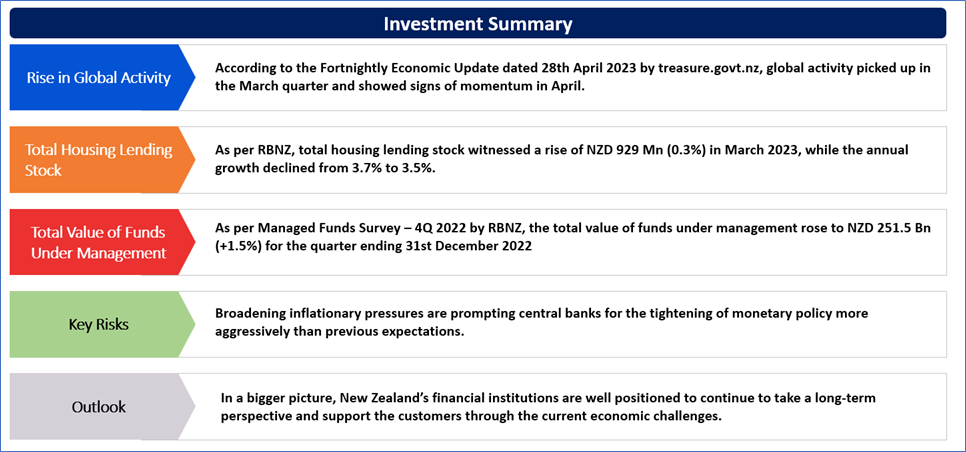
According to the Fortnightly Economic Update dated 28th April 2023 by treasure.govt.nz, global activity picked up in the March quarter and showed signs of momentum in April. Inflation rate seemed to have passed its peak and now is at 6.7% from a cycle high of 7.3% in the June 2022 quarter, and 7.2% in the December quarter. However, the effects of past monetary tightening and financial market stress are anticipated to increasingly evident in the coming months. Despite the easing in headline inflation, the Official Cash Rate (OCR) is widely expected to hike by 25 basis points to 5.5% in coming months, but it can be considered as the final hike in this cycle.
March proved as a steady point for Housing Market, supported by an increment in sales and declines in some longer-term mortgage rates, and the annual rate decline recovered to 13.1% from 14.2% in February. Housing demand rose due to rapidly rising immigration, while the Reserve Bank’s proposal to ease loan-to-value restrictions in June could also add to demand. It looks like the trough of the cycle is close as the prices are 16% down from their peak.
Lending Stock Trend March 2023
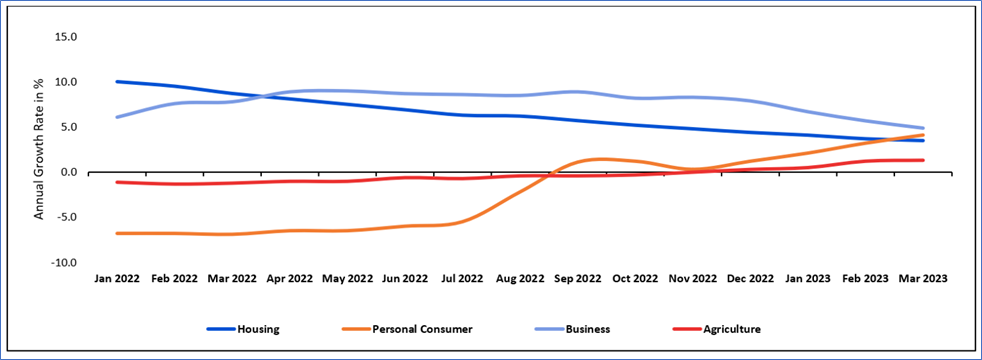
As per RBNZ, total housing lending stock witnessed a rise of NZD 929 Mn (0.3%) in March 2023, while the annual growth declined from 3.7% to 3.5%. A total of NZD 3,47,474mn of housing lending was done in total in the month of March 2023. The personal consumer lending stock and business lending stock both witnessed a fall of NZD 69 Mn (-0.5%) and NZD 575 Mn (-0.4%), respectively in the same period. The annual growth in rate in personal consumer lending rose from 3.2% to 4.1%, highest rate since September 2018. Moreover, Agriculture lending stock increased by NZD 68 Mn (0.1%) in March 2023, totalling to NZD 62,323 Mn. The annual growth rate rose from 1.2% to 1.3%, maintaining its positive movement since November 2022.
Exhibit 1: Lending Pattern Since Jan 2022 – Registered Banks and Non-bank lending institutions (NBLIs)
Data Source: This work is based on/includes rbnz data which are licensed by rbnz.govt.nz for reuse under the Creative Commons Attribution 4.0 International Licence; Chart Created by Kalkine Group
Total Funds Under Management (FUM) Quarterly Update
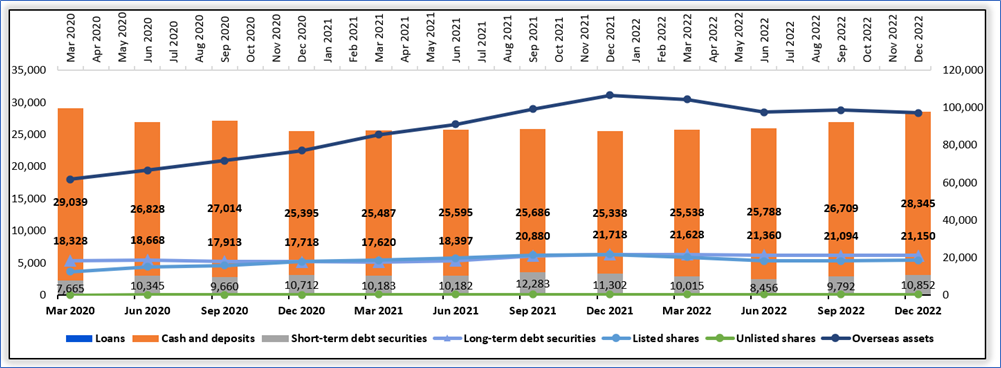
As per Managed Funds Survey – 4Q 2022 by RBNZ, the total value of funds under management rose to NZD 251.5 Bn (+1.5%) for the quarter ending 31st December 2022 but remains below the record high of NZD 264.3 Bn in December 2021. Annually, total FUM declined by 4.9%, the third consecutive annual decline on a quarter-to-quarter basis.
On a Q-o-Q basis, short term debt securities recorded an increase of 32.1% to NZD 19.6 Bn in Q4 FY 2022 and recorded an annual increase of 14.5%. However, cash also increased 5.3% from NZD 35.0 Bn to NZD 36.9 Bn in the same period. Total industry holdings of listed shares stayed flat for the quarter, going down by 0.9% from NZD 113.1 Bn to NZD 112.1 Bn. Overall FUM for the quarter remained NZD 2,51,502 Mn as at 31stDecember 2022 vs. NZD 2,47,830 Mn in the last quarter.
Exhibit 2: Trend of FUM by Asset Class (NZD’ Mn)
Data Source: This work is based on/includes rbnz data which are licensed by rbnz.govt.nz for reuse under the Creative Commons Attribution 4.0 International Licence; Chart Analysis by Kalkine Group
Index Performance:
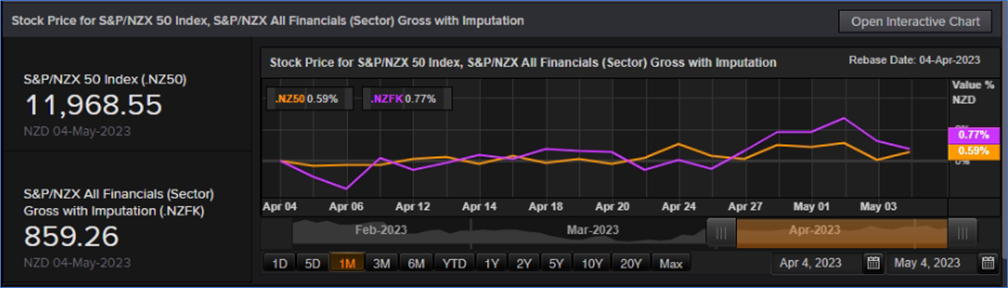
The S&P/NZX All Financials Index generated a 1-month return of ~0.77% versus ~0.59% by the S&P/NZX 50 Index. Therefore, S&P/NZX All Financials Index overperformed S&P/NZX 50 Index by ~0.18% in 1 month.
Exhibit 3: S&P/NZX All Financials Index vs S&P/NZX 50 Index
Source: REFINITIV
Key Risks and Challenges:
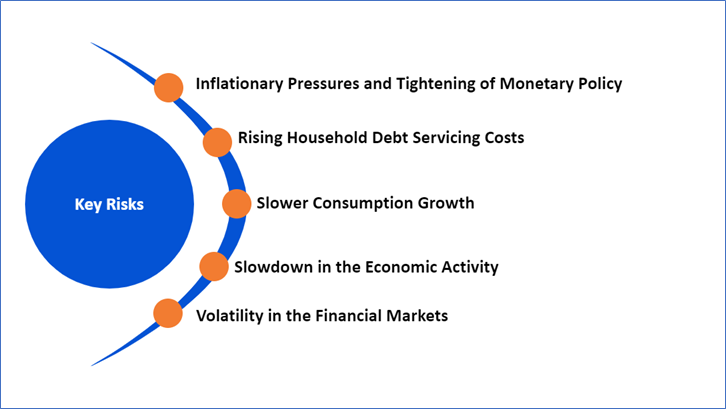
The factors impacting the financial market are primarily driven by elevated inflation, higher interest-rate policy, a strong dollar and the disruptions caused by the Ukraine-Russia war. Meanwhile, on 5th April 2023, the Monetary Policy Committee of NZ increased the Official Cash Rate (OCR) to 5.25% from 4.75% to fight against elevated inflation. It plans to make similar decisions to maintain price stability and sustainable employment.
As per treasury, even though there is a relief in inflation rate, the banking sector seems to be still fragile. Banking sector remains at risk on the account of uncertainty around the sale of assets by the US bank First Republic, in the absence of government support that witnessed decline in the share price. Central banks have slowed monetary policy tightening pace in the recent months as they evaluate the effects of prior interest rate increases on demand and the outlook for inflation. Higher interest rate is making agriculture sector and commercial property operators most vulnerable, given their higher average levels of debt, and the impacts of the North Island flooding and cyclone events.
Exhibit 4. Key Risks in Financial Sector:
Source: Analysis by Kalkine Group
Outlook:
There has been a proposal to ease NZ’s Loan-to-value-ratio (LVR) settings which reflects the fact that current lending activity presents fewer risks to the financial system and household resilience compared to that of the past couple of years. New Zealand’s financial system is well positioned to handle domestic and international pressures. Its banking system’s capital and liquidity positions are well placed, with profitability and asset quality remaining at good levels. New Zealand banks are not substantially exposed to the interest rate risks that have been realised in banks overseas. Though the insurers possess considerable reinsurance related to the recent weather events but claims for these events might drop in their profitability for near time and will increase reinsurance costs for New Zealand.
The outlook for annual inflation is expected to slow to about 6% in the June quarter, mainly led by lower fuel prices. Overall, consumer and business confidence remain low, pointing to a weaker outlook for household consumption and business investment, and reflecting the dampening effects of higher debt servicing costs.
However, household as well as business borrowers have been gradually adjusting to significantly higher debt servicing costs. For households with mortgages, there are expectations that in aggregate the share of their disposable income dedicated to interest costs would rise from the low point of 9% to ~22% by the end of this year. The house prices seem to be closer to the sustainable levels than has been the case in recent years. In a bigger picture, New Zealand’s financial institutions are well positioned to continue to take a long-term perspective and support the customers through the current economic challenges.
Apart from the sector-specific factors, an analysis on two NZX-listed companies is provided. This report covers their insights, outlook, performance and potential as expected to be delivered in the near to medium term.
1 ) Heartland Group Holdings Limited (Recommendation: Buy, Potential Upside: Low Double-Digit) (M-Cap: NZD 1.114 billion, Annual Dividend Yield (TTM)1: 9.731%)
Business Description:
Heartland Group Holdings Limited (NZX: HGH) is a financial services company based in New Zealand. The Company’s segments include Motor, Reverse mortgages, Personal lending, Business, Rural, StockCo Australia and Australia.

Outlook:
Among the ongoing economic challenges in New Zealand and Australia, HGH showed product portfolio resilience during 1HFY23 and expects similar results in 2HFY23. With the increased demand for reverse mortgages, growth is anticipated in Motor and Asset Finance. HGH aims to focus on growing its top line, thereby enhancing its CTI ratio during 2HFY22. NIM is expected to stabilise at its current level as the company continues to manage portfolio pricing and margin in competitive markets proactively. For FY23, the company expects NPAT to be in the range of NZD 109-114mn, excluding any impacts of fair value changes on equity investments held and the impact of the de-designation of derivatives.
Fundamental Valuation:
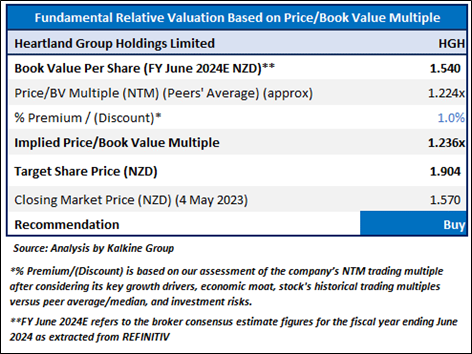
P/BV Multiple Based Relative Valuation
Technical Overview:
Daily Price Chart
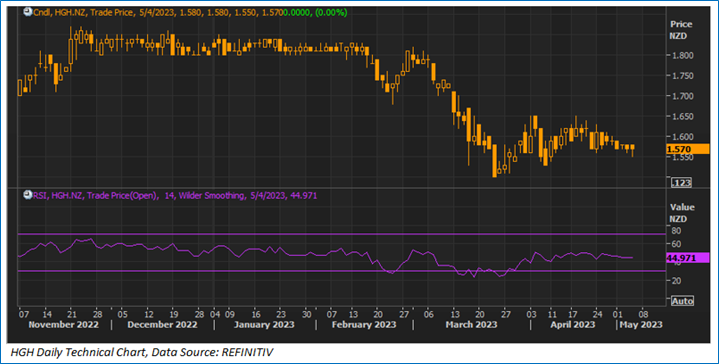
Source: REFINITIV, Note: Purple color line reflects Relative Strength Index (14-Period)
Technical Commentary:
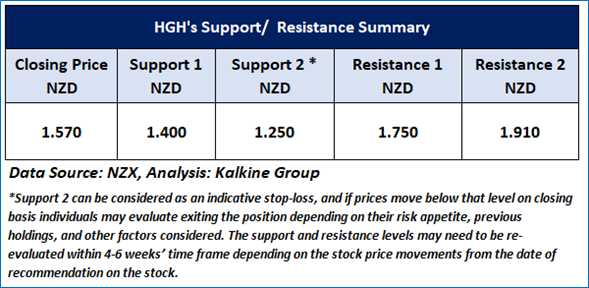
On the daily chart, HGH prices are sustaining above the horizontal trendline support zone. Moreover, the momentum oscillator RSI (14-period) is showing a reading of ~44.971 level. However, the prices are trading below the trend-following indicators 21-period SMA, which may act as a resistance zone. An important support level for the stock is placed at NZD 1.40 while the key resistance level is placed at NZD 1.75.
Stock Recommendation
Considering the facts above, a ‘Buy’ recommendation on the stock has been provided at the closing price of NZD 1.570 per share as on 4 May 2023.
2 ) Kingfish Limited (Recommendation: Buy, Potential Upside: Low Double-Digit) (M-Cap: NZD 432.34 Mn, Annual Dividend Yield (TTM) 1: 9.429%)
Business Description:
Kingfish Limited (NZX: KFL) is a New Zealand based investment company. It invests in various sectors, such as industrials, healthcare, utilities, consumer staples and information technology.

Outlook:
In March Quarter 2023, KFL delivered gross performance return (portfolio) of 4.1% and adjusted NAV return of 3.9%, as compared to 3.6% from S&P/NZX50G gross index’s return. Over three years, the company has delivered 10.3% shareholder’s return while the index gave 6.7% in the same period. The company has made portfolio adjustments over the last 6 months and is confident in the prospects for its portfolio of high-quality growth companies moving forward. Moreover, under its quarterly distribution policy, a dividend of 2.79 cents per share was paid to the shareholders on 24th March 2023. As per the recent update, KFL’s NAV stood at NZD 1.395 per share as at 3rd May 2023.
Technical Overview:
Daily Price Chart
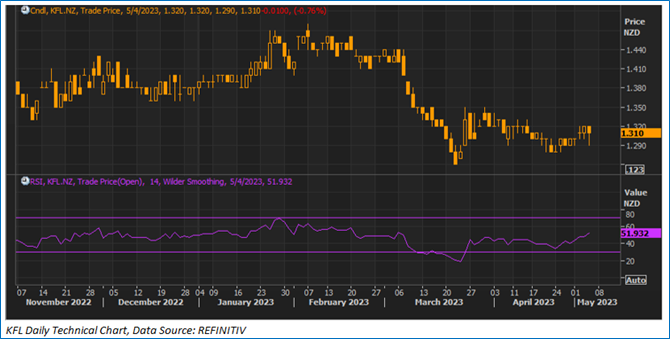
Source: REFINITIV, Note: Purple color line reflects Relative Strength Index (14-Period)
Commentary:
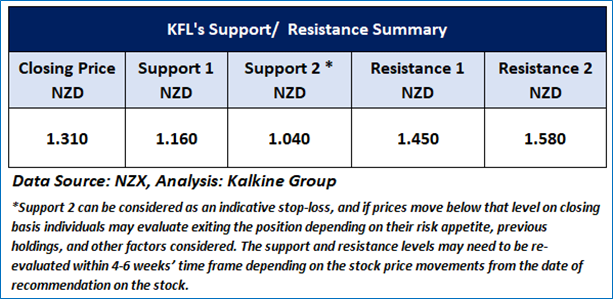
On the daily chart, KFL prices are trading above the falling trendline support zone and taking support from the trendline. Moreover, the momentum oscillator RSI (14-period) is showing a reading of ~51.932 level. However, the prices are trading below the trend-following indicators 50-period SMA, which may act as a resistance zone. An important support level for the stock is placed at NZD 1.16 while the key resistance level is placed at NZD 1.45.
Stock Recommendation
As per TTM Valuation, the company is trading at Price/Book Value multiple of 1.0x, lower than the industry mean at 1.3x (Financials). Considering the aforementioned factors, a ‘Buy’ recommendation has been assigned on the stock at the closing market price of NZD 1.310 per share, down by 0.76% as of 4 May 2023.
Markets are trading in a highly volatile zone currently due to certain macro-economic issues and geopolitical tensions prevailing. Therefore, it is prudent to follow a cautious approach while investing.
Note 1: Past performance is neither an indicator nor a guarantee of future performance.
Note 2: The reference date for all price data, currency, technical indicators, support, and resistance levels is May 4, 2023. The reference data in this report has been partly sourced from REFINITIV.
Note 3: Investment decisions should be made depending on an individual's appetite for upside potential, risks, holding duration, and any previous holdings. An 'Exit' from the stock can be considered if the Target Price mentioned as per the Valuation and or the technical levels provided has been achieved and is subject to the factors discussed above.
Note 4: Annual Dividend Yield is on a Trailing Twelve Month (TTM1) basis and are subject to change based on factors such as company performance, stock price changes, etc.
Technical Indicators Defined: -
Support: A level at which the stock prices tend to find support if they are falling, and a downtrend may take a pause backed by demand or buying interest. Support 1 refers to the nearby support level for the stock and if the price breaches the level, then Support 2 may act as the crucial support level for the stock.
Resistance: A level at which the stock prices tend to find resistance when they are rising, and an uptrend may take a pause due to profit booking or selling interest. Resistance 1 refers to the nearby resistance level for the stock and if the price surpasses the level, then Resistance 2 may act as the crucial resistance level for the stock.
Stop-loss: It is a level to protect further losses in case of unfavourable movement in the stock prices.
Disclaimer
Kalkine New Zealand Limited is a Financial Advice Provider (“FAP”) and is authorised by a Class 1 Financial Advice Provider Licence issued by Financial Markets Authority (“FMA”) to provide financial advice. Kalkine provides only general financial advice through its research reports following a person becoming a member. The reports contain buy/sell/hold and other recommendations in relation to equity financial products. The recommendations and opinions [on this website] / [in this report] do not take into account any of your investment objectives, financial situation or needs. Before you make a decision about whether to acquire a financial product, you should obtain the Product Disclosure Statement from the product issuer. You should consider the appropriateness of advice taking into account your own objectives, financial situation and needs and seek independent financial advice before making any financial decisions. If you act on the advice in the research reports, you may have to pay fees, expenses or other amounts (but not to Kalkine). Further information about the complaints and dispute resolution process, as well as information about Kalkine’s duties are available on Kalkine’s website. Please read our Financial Advice Provider (FAP) disclosure statement and Complaints Handling Guide, which are available on the website.
Past performance is not a reliable indicator of future performance.
 Please wait processing your request...