
 AU
AU
 UK
UK
 CA
CA
 US
US
 IND
IND

 NZ
NZ

Company Overview:
Chatham Rock Phosphate Limited (NZX: CRP) is an exploration and development company which is focused towards becoming a diversified phosphate developer and trader. Genesis Energy Limited (NZX: GNE) is a New Zealand-owned energy company.
Kalkine’s Sector Report covers the Investment Highlights, Key Financial Metrics, Risks, Outlook, Technical Analysis along with the Valuation, Target Price, and Recommendation on the stock.
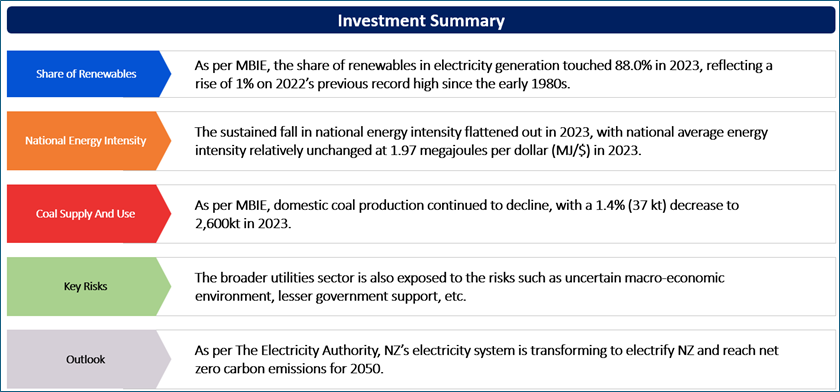
As per MBIE (or Ministry of Business, Innovation and Employment), the share of renewables in electricity generation touched 88.0% in 2023, reflecting a rise of 1% on 2022’s previous record high since the early 1980s. This increase was because of increased levels of electricity generation from hydro, wind, and solar, leading to less reliance on coal and gas-fired generation to meet demand. The share of renewables in total final consumption fell marginally from 2022’s record high, down 0.8 percentage points to 30.1% in 2023. Contributing to this was rises in the consumption of refined oil products (like petrol and aviation fuels) offsetting the increase in the use of renewable electricity. The share of renewables in total primary energy supply declined slightly, down 0.7 percentage points to 42.8%. This was because of an increase in the supply of oil products, and a fall in the supply of woody biomass.
The sustained fall in national energy intensity flattened out in 2023, with national average energy intensity relatively unchanged at 1.97 megajoules per dollar (MJ/$) in 2023. This was mainly because of slowing of in gross domestic product (GDP) growth, notably in the commercial sector. The fall in national average energy intensity over the last decade was driven by the commercial sector, which is relatively less energy intensive than other parts of the economy (as it is service based) as well as is a large contributor to national GDP.
Exhibit 1: Quarterly Electricity Generation
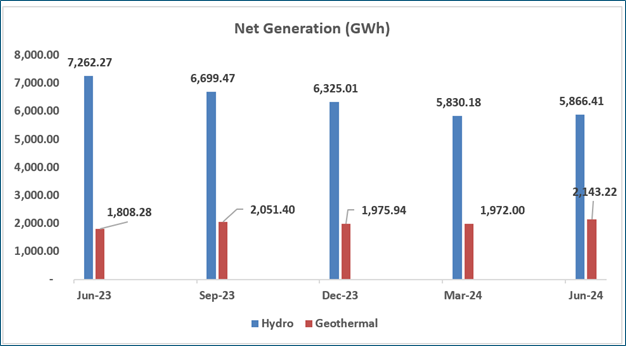
Data Source: This work is owned by the Ministry of Business, Innovation and Employment on behalf of the Crown which are licensed for reuse under the Creative Commons Attribution 4.0 International Licence; Chart Created by Kalkine Group
Coal Supply And Use
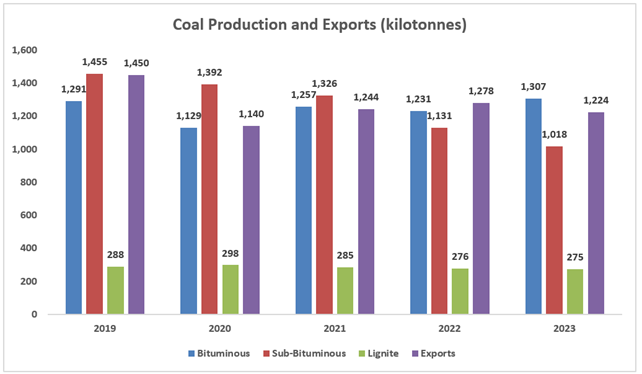
As per MBIE, domestic coal production continued to decline, with a 1.4% (37 kt) decrease to 2,600kt in 2023. At 2023 end, thirteen mines were operating in NZ compared to 18 at the 2020 end. 2023’s coal exports fell by 4% (54 kt) on 2022 figures, totalling 1,224 kt in 2023. Both production as well as exports have steadily fallen over the past decade, with a small uptick between 2017 and 2019.
Coal imports have varied in recent years in response to requirements for domestic electricity generation along with movements in international coal prices. Coal imports in 2021 touched highest level on record and exceeded exports for the first time, as low hydro levels drove higher demand for coal for electricity generation. Coal imports fell in 2023, down 487 kt (or 67%) to 240 kt. Contributing to this was companies drawing on high onshore stock levels, a result of high imports between 2019 and 2022.
Exhibit 2: Coal Production and Exports from 1990 to 2023 (kilotonnes)
Data Source: This work is owned by the Ministry of Business, Innovation and Employment on behalf of the Crown which are licensed for reuse under the Creative Commons Attribution 4.0 International Licence; Chart Created by Kalkine Group
Renewable Production And Usage
The total supply of renewable energy declined to 363.8 PJ in 2023, reflecting a 2.6 PJ drop from 2022. This was driven by the decline in the wood processing sector, which offset increases in hydro, geothermal, solar, wind, and liquid biofuel supply. Solid biofuel use declined by 13% (6.7 PJ) to 44.4 PJ in 2023. In February 2023, Cyclone Gabrielle caused significant damage to several key wood processing and forestry sites. The Pan Pac mill at Whirinaki was closed for much of the 2023 calendar year to repair silt damage. Along with other impacted sites, this meant a decline in electricity and wood energy demand for the sector.
Key Risks and Challenges:
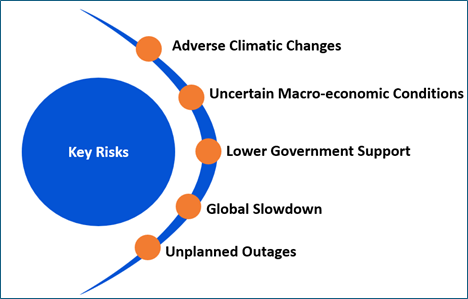
The companies operating in the energy sector might face risks including increased generation costs, unplanned outages, etc. Notably, fluctuation in the fuel costs might also pose a challenge for the broader utilities sector. Apart from these risks, the higher fuel costs and emissions are other additional risks. The broader utilities sector is also exposed to the risks such as uncertain macro-economic environment, lesser government support, etc.
Exhibit 3. Key Risks in Utilities Sector:
Source:- Analysis: Kalkine Group
Outlook:
As per The Electricity Authority, NZ’s electricity system is transforming to electrify NZ and reach net zero carbon emissions for 2050. The electricity market is shifting to more renewable intermittent generation (such as wind and solar), with new and many technological advancements, distributed energy resources (such as rooftop solar panels and battery storage), mass participation and two-way power flows. Electricity demand is expected to rise by up to 82% by 2050 (baseline 2013). The future would witness consumers have more control over their electricity use, widespread use of EVs, battery storage and smart chargers to help stabilise the grid, and communities which are increasingly resilient in the face of significant weather events and natural disasters.
The changes occurring need proactive and fit-for-purpose regulation so consumers can take the advantages of innovation and competition at least cost, while receiving a reliable electricity supply. The Electricity Authority has a multi-year plan to improve security of supply, investment and innovation, with a focus towards boosting competition and efficiency in the electricity market to put downward pressure on prices and increase affordability for consumers.
Apart from the sector-specific factors, an analysis on two NZX-listed companies is provided. This report covers their insights, outlook, performance and potential as expected to be delivered in the near to medium term.
1) Genesis Energy Limited (Recommendation: Hold, Potential Upside: Low Double-Digit) (M-Cap: NZD 2.43 billion, Annual Dividend Yield (TTM)1: 8.72%)
Business Description:
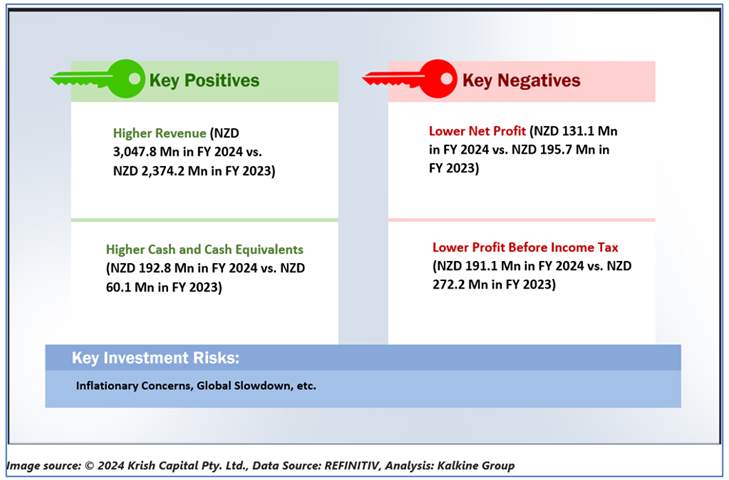
Genesis Energy Limited (NZX: GNE) is a New Zealand-owned energy company
Outlook:
GNE purchased 65% of NZ’s leading EV charging infrastructure operator, Chargenet. The investment is a key enabler to secure a 30% share of the emerging EV value pool under the Gen35 strategy. The company is targeting an IRR of ~15% from the investment. The development and delivery of the Huntly 100 MW/200 MWh battery and the Edgecumbe solar farm continued in line with expectations. The company’s new customer billing platform is making good progress with the Frank build complete and on track for go-live in Q4 FY 2025.
Technical Overview:
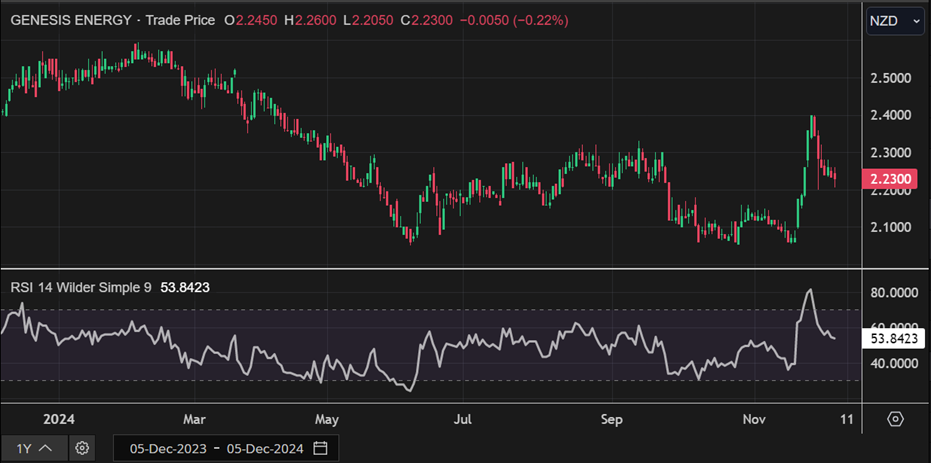
GNE Daily Technical Chart, Data Source: REFINITIV
Technical Commentary:
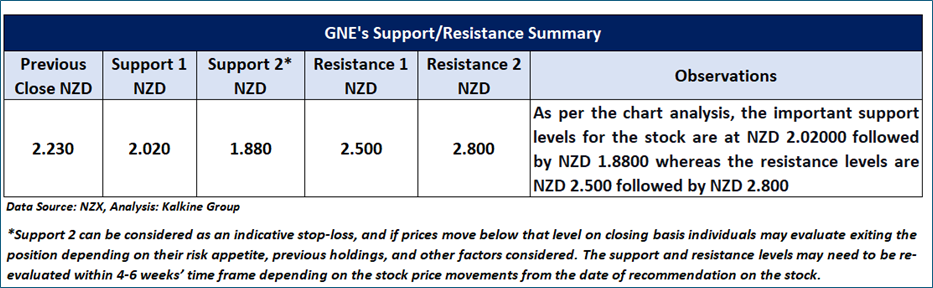
On the daily chart, GNE’s stock prices are forming a trading range characterized by identical highs and lows, implying that the current sideways period in the stock might continue to remain intact. Additionally, the momentum oscillator RSI (14-period) is hovering near its midpoint, providing more support for the previous observation. Prices trading between its previous peak and trough, which might function as dynamic resistance and support levels for the stock, respectively. An important support level for the stock is placed at NZD 2.02, while key resistance level is situated at NZD 2.50.
Fundamental Valuation:
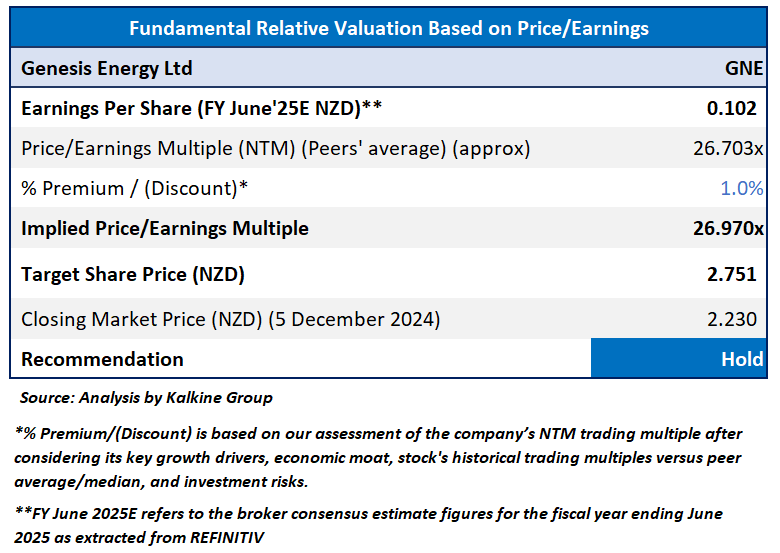
Price/EPS Based Relative Valuation
Stock Recommendation
Considering the facts above, a ‘Hold’ recommendation on the stock has been provided at the closing market price of NZD 2.230 per share, down by 0.22% as on 5 December 2024.
2) Chatham Rock Phosphate Limited (Recommendation: Speculative Buy, Potential Upside: Low Double-Digit) (M-Cap: NZD 10.6 Mn)
Business Description:
Chatham Rock Phosphate Limited (NZX: CRP) is an exploration and development company focused towards becoming diversified phosphate developer and trader.
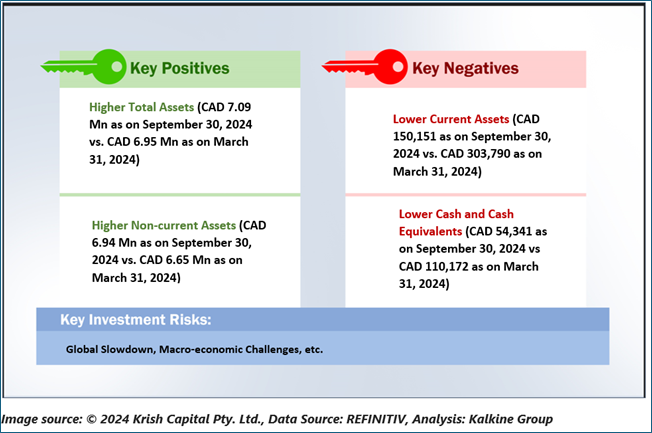
Outlook:
Chatham (NZ) is progressing the Chatham Rise Project towards mining whilst also examining other high quality phosphate projects featuring strong grades, meaningful size, mining-friendly locales near significant markets. Chatham (NZ) remains confident that its phosphate deposit places it in a robust position globally to deliver an essential ingredient to the agriculture industry, where the demand for food remains a growth market in turbulent economic times.
Technical Overview:
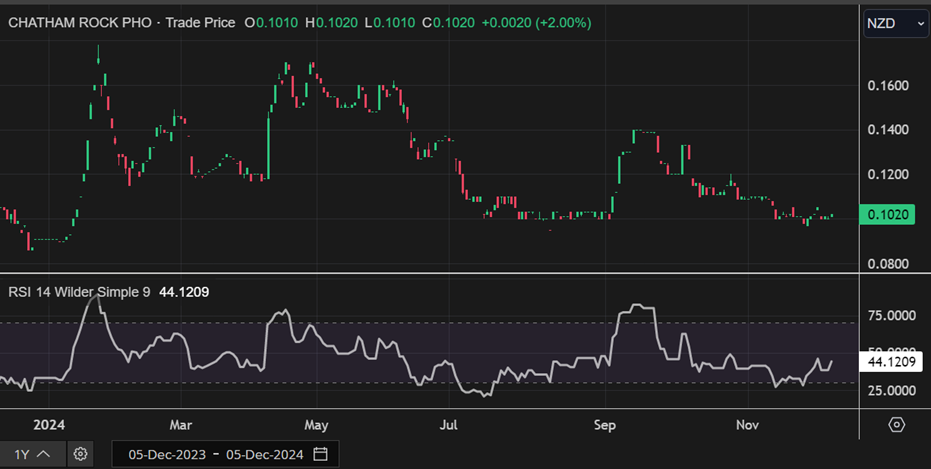
CRP Daily Technical Chart, Data Source: REFINITIV
Technical Commentary
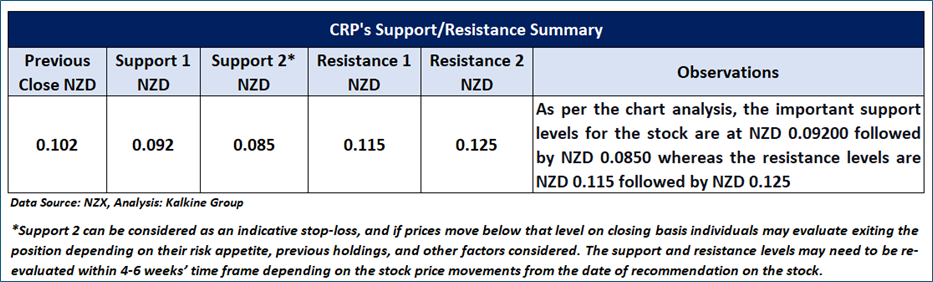
On the daily chart, CRP’s stock prices are establishing a trading range characterized by lower highs and higher lows, suggesting that the current sideways period in the stock might continue to remain in place in the near future. Moreover, the momentum oscillator RSI (14-period) is trading near the midpoint, providing more support to the previous observation. Prices fluctuating between its previous peak and trough, which might function as dynamic resistance and support levels for the stock, respectively. A significant support level for the stock is positioned at NZD 0.092, while critical resistance level is located at NZD 0.115.
Stock Recommendation
Considering the aforementioned factors, a “Speculative Buy” rating is given on the stock at the closing market price of NZD 0.102 per share as on 5 December 2024.
Markets are trading in a highly volatile zone currently due to certain macro-economic issues and geopolitical tensions prevailing. Therefore, it is prudent to follow a cautious approach while investing.
Note 1: Past performance is neither an indicator nor a guarantee of future performance.
Note 2: The reference date for all price data, currency, technical indicators, support, and resistance levels is 5 December 2024. The reference data in this report has been partly sourced from REFINITIV.
Note 3: Investment decisions should be made depending on an individual's appetite for upside potential, risks, holding duration, and any previous holdings. An 'Exit' from the stock can be considered if the Target Price mentioned as per the Valuation and or the technical levels provided has been achieved and is subject to the factors discussed above.
Technical Indicators Defined: -
Support: A level at which the stock prices tend to find support if they are falling, and a downtrend may take a pause backed by demand or buying interest. Support 1 refers to the nearby support level for the stock and if the price breaches the level, then Support 2 may act as the crucial support level for the stock.
Resistance: A level at which the stock prices tend to find resistance when they are rising, and an uptrend may take a pause due to profit booking or selling interest. Resistance 1 refers to the nearby resistance level for the stock and if the price surpasses the level, then Resistance 2 may act as the crucial resistance level for the stock.
Stop-loss: It is a level to protect further losses in case of unfavourable movement in the stock prices.
Disclaimer This report has been issued by Kalkine New Zealand Limited (FSP691351) (NZBN:9429047678101) (“Kalkine”). Kalkine is a Financial Advice Provider (“FAP”) and is authorised by a Class 1 Financial Advice Provider Licence issued by Financial Markets Authority (“FMA”) to provide financial advice. Kalkine provides only general financial advice through its research reports following a person becoming a member. The reports contain buy/sell/hold and other recommendations in relation to equity securities, managed funds and other managed investment schemes and other financial advice products. The recommendations and opinions in this report and on Kalkine website do not take into account any of your investment objectives, financial situation or needs. Before you make a decision about whether to acquire a financial product, you should obtain the Product Disclosure Statement from the product issuer. You should consider the appropriateness of advice taking into account your own objectives, financial situation and needs and seek independent financial advice before making any financial decisions. If you act on the advice in the research reports, you may have to pay fees, expenses or other amounts (but not to Kalkine). Further information about the complaints and dispute resolution process, as well as information about Kalkine’s duties are available on Kalkine’s website. Please read our Financial Advice Provider (FAP) disclosure statement and Complaints Handling Guide, which are available on the website.
Past performance is not a reliable indicator of future performance.
 Please wait processing your request...