
 AU
AU
 UK
UK
 CA
CA
 US
US
 IND
IND

 NZ
NZ

Company Overview: Sanford Limited (NZX: SAN) is engaged in the fishing as well as aquaculture farming business. It is focused towards farming, harvesting, processing, storage as well as marketing seafood products and investments in related activities. Cooks Coffee Company Limited (NZX: CCC) owns the international intellectual property as well as master franchising rights to the Esquires Coffee brand globally (excluding Australia and New Zealand). Kalkine’s Sector Report covers the Investment Highlights, Key Financial Metrics, Risks, Technical Analysis along with the Valuation, Target Price, and Recommendation on the stock.

1. Sector Landscape and Outlook
As per Ministry for Primary Industries, the food and fibre sector continues to power NZ’s economy as the top export earner. Following on from the record revenue in 2022, there are expectations of food and fibre export revenue to hit new heights this year as well, reaching a record $56.2 Bn in the year ended 30th June 2023, reflecting a rise of 6% on the YoY basis. The result is impressive after the difficult start to 2023, including the North Island weather events as well as other challenges as the world emerges from the COVID-19.
Looking out to 2027, there are expectations to witness the sector’s steady growth continue, and the export revenue is expected to touch a new high of $62 Bn. Through Budget 2023, deployments of further $35.4 Mn are expected to tackle health as well as safety issues, protect animal health and welfare and support communities in Hawke’s Bay and Gisborne Tairāwhiti. Another $10.2 Mn is supporting to clean up woody debris. Notably, the focus is towards the core infrastructure needs of rural NZ – the economy’s backbone. Budget 2023 witnessed $6 Bn deployed towards the National Resilience Plan that includes future-proofing critical infrastructure. Through Budget 2023, the government committed to building the new state-of-the-art Plant Health and Environment Laboratory in order to import new plant varieties as well as species essential for ongoing export growth and adaptability in the horticulture, arable and forestry sectors.
Overseas merchandise trade: May 2023
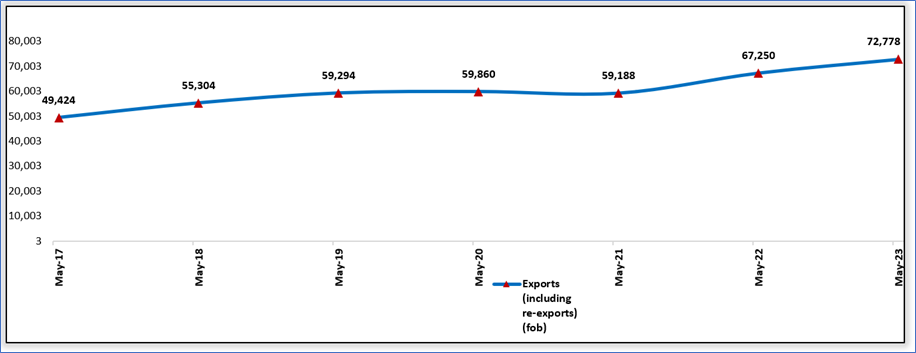
As per Stats.NZ, goods exports witnessed a rise of $189 Mn (or 2.8%) to $7.0 Bn in May 2023 as compared to May 2022 as well as goods imports increased $292 Mn (or 4.4%) to $6.9 Bn. Therefore, the monthly trade balance was the surplus of $46 Mn. Milk powder, butter, and cheese (the largest export commodity group) increased $336 Mn (or 21%) to $1.9 Bn. The milk powder increased $156 million (or 18%) in value to $1.0 Bn and the quantity exported increased 51%. Notably, the average unit price declined 21%.
Exhibit 1: Overseas Merchandise Trade $(million) (Year Ended)
Data Source: This work is based on/includes Stats NZ’s data which are licensed by Stats NZ for reuse under the Creative Commons Attribution 4.0 International Licence; Chart Created by Kalkine Group
Seafood Export Revenue- An Analysis
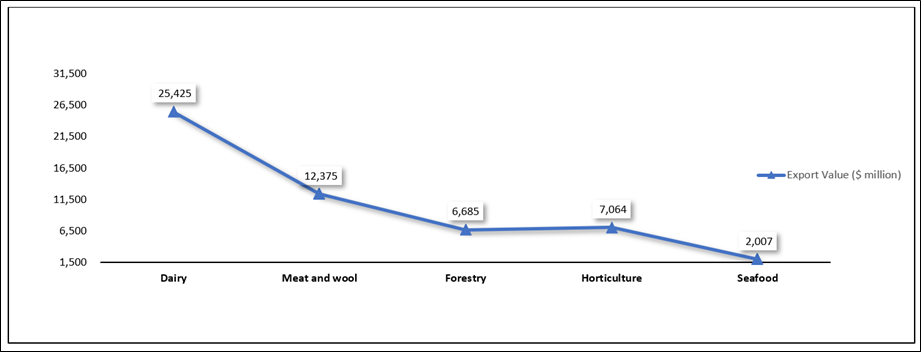
As per MPI, the seafood industry has been demonstrating success with the 2nd consecutive year of growth. The export revenue is anticipated to rise to $2.1 Bn for the year ended 30 June 2023. Despite the decline in export volumes, growth is supported by increased prices throughout the range of seafood species. Notably, average seafood prices are forecasted to rise 18% to $8.65 per kilogram supported by the factors such as tight global supply as well as increased demand. Seafood export volumes are forecast to decline 8% to nearly 239,900 tonnes because of various challenges to production and processing including weather, supply chain and workforce issues.
Exhibit 2: Year to 31 March 2023, NZ$ Million
Data Source: This work is based on/includes the Ministry for Primary Industries data which are licensed under Crown for reuse under the Creative Commons Attribution 4.0 International Licence; Chart Created by Kalkine Group
Climate Situation
The 2022/23 season was a very difficult year for NZ weatherwise. The dominant La Niña weather pattern affected climatic conditions, bringing frequent rainfall to the North Island. The weather pattern is conducive to higher cyclonic activity in the tropics, leading to NZ being affected by low-pressure systems in summer as well as early autumn, including Cyclones Hale and Gabrielle. The exceptionally wet conditions over winter as well as spring led to the large drop in spring milk production. A very wet year in the North Island led to reduced cereal yields and posed challenges for maize growers.
Based on the weather patterns and trends towards warmer than average sea temperatures, there are expectations that variable temperatures would persist in the near term. The forecast for the next 3 months reflects rainfall to be more likely normal or above normal in the northern and western parts. For the same period, normal rainfall is forecast in the east of the North Island and below or near normal in the east of the South Island.
Key Risks and Challenges:
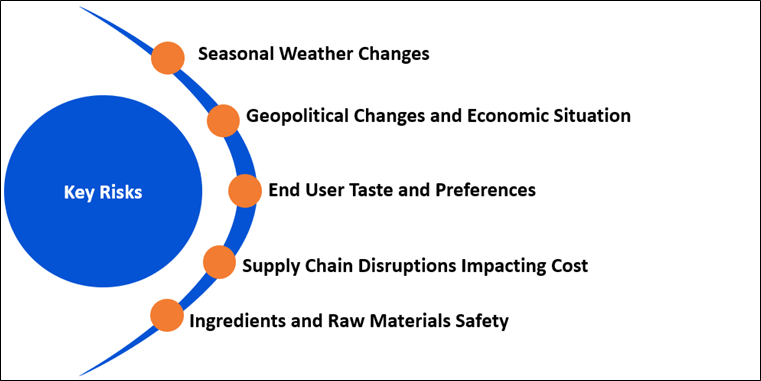
Farmers, growers, and fishers have been challenged by rapid changes in climate, disrupting the operations and the quality of output. As compared to other economic regions, the euro area was susceptible to the economic fallout because of Russia’s conflict with Ukraine. The conflict with Ukraine impacted the agriculture markets. The conflict led to decline in food exports from Ukraine and Russia, resulting in the substantial rise in prices of commodities like wheat, maize and sunflower oil. It also caused reduction in fertiliser exports, resulting in the upward pressure to fertiliser prices, which have also been affected by increased energy costs.
Exhibit 3. Key Risks in Consumer Staples Sector:
Source: Analysis by Kalkine Group
Outlook:
As per MPI, the dairy export revenue is anticipated to rise by 14% to reach $25.1 Bn for the year ended 30 June 2023 despite an estimated fall in the milk production of 0.2%. This rise in export revenue is supported by the high-priced forward-contracted products from previous season being exported (shipped) this year, a weaker NZD against the USD as well as surge in exports of higher value products.
Forestry export revenue is anticipated to fall 1% to $6.5 Bn for the year ended 30 June 2023. This is driven by falling volumes offsetting higher prices, which were helped by the weaker NZD against the USD. Log export value, that forms ~50% of total forestry export values is anticipated to decline 5% due to continued soft demand in China.
Seafood export revenue is anticipated to rise 8% to reach $2.1 Bn for the year ended 30 June 2023. Seafood exports have witnessed positive momentum with food service reopening as well as demand rebounding and have been supported by tight supplies. Growth was because of export revenue increases for rock lobster, hoki and squid categories. However, freight issues as well as uncertainty regarding the accessibility of key markets remain a challenge in the short term.
Apart from the sector-specific factors, an analysis on two NZX-listed companies is provided. This report covers their insights, outlook, performance and potential as expected to be delivered in the near to medium term.
1 ) Sanford Limited (Recommendation: Speculative Buy, Potential Upside: Low Double-Digit) (M-Cap: NZD375.8 Mn, Annual Dividend Yield (TTM)1: 2.06%)
Business Description:
Sanford Limited (NZX: SAN) is engaged in the fishing as well as aquaculture farming business. It is focused towards farming, harvesting, processing, storage as well as marketing seafood products and investments in related activities.

Outlook:
Overall, SAN witnessed significant performance improvements in H1 FY 2023, but the company is focused towards achieving more as well as mitigating or eliminating the issues that have held back a more rapid return to desired profitability. With the restructure underway and projects such as Bioactives progressing, the company is expecting to witness the benefits in H2.
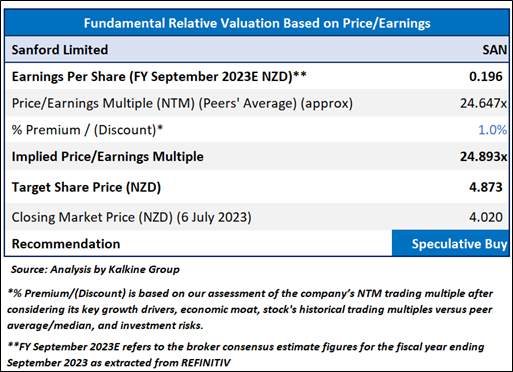
Valuation Methodology: Price/Earnings Per Share Based Relative Valuation (Illustrative)
Technical Overview:
Daily Price Chart
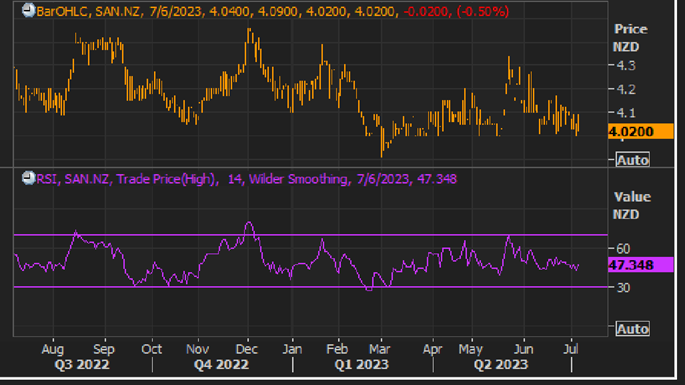
Source: REFINITIV, Note: Purple color line reflects Relative Strength Index (14-Period)

Technical Commentary:
On the daily chart, SAN prices are trading above the horizontal trendline support zone. Moreover, the momentum oscillator RSI (14-period) is showing a reading of ~47.348 level. However, the prices are trading below the trend-following indicators 21-period SMA, which may act as a resistance zone. An important support level for the stock is placed at NZD 3.58 while the key resistance level is placed at NZD 4.50.
Stock Recommendation
The stock has been valued using P/E multiple-based illustrative relative valuation and the target price so arrived reflects a rise of low double-digit (in % terms). A slight premium has been applied to P/E Multiple (NTM) (Peer Average) considering decent outlook of the company.
Considering the facts above, a ‘Speculative Buy’ recommendation on the stock has been provided at the closing market price of NZD4.02 per share, down by 0.50% as of 6 July 2023.
2 ) Cooks Coffee Company Limited (Recommendation: Speculative Buy, Potential Upside: Low Double-Digit) (M-Cap: NZD13.7 million)
Business Description:
Cooks Coffee Company Limited (NZX: CCC) owns the international intellectual property as well as master franchising rights to the Esquires Coffee brand globally (excluding Australia and New Zealand).

Outlook:
Several planned store openings during the year were delayed until the current financial year because of the effects of supply chain disruptions in Q3 and Q4 of FY 2023. However, these factors seem to be easing in FY 2024 and, with the robust pipeline of prospective franchisees, CCC is expecting to witness good new store growth in the current financial year to build on its position as the 4th largest coffee focused café chain in the UK.
Technical Overview:
Daily Price Chart
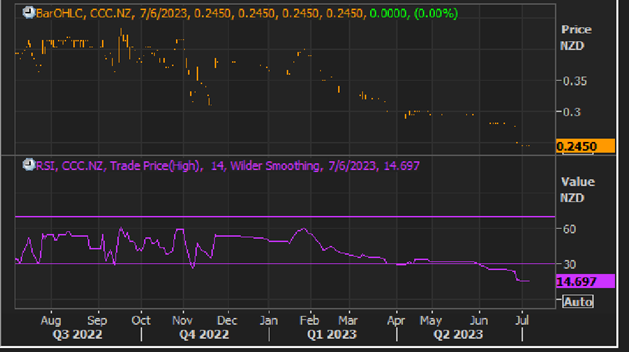
Source: REFINITIV, Note: Purple color line reflects Relative Strength Index (14-Period)
Technical Commentary:
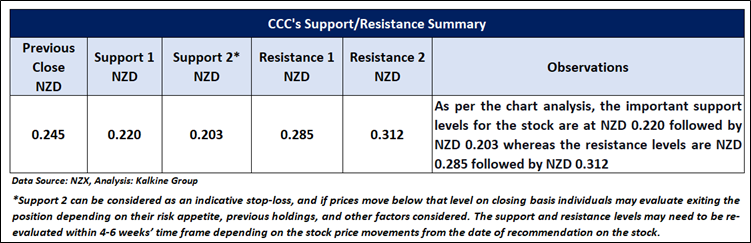
On the daily chart, CCC prices are trading near the falling trendline support zone. Moreover, the momentum oscillator RSI (14-period) is showing a reading of ~14.697 level. However, the prices are trading below the trend-following indicators 21-period SMA, which may act as a resistance zone. An important support level for the stock is placed at NZD 0.22 while the key resistance level is placed at NZD 0.285.
Stock Recommendation
Considering the facts above, a ‘Speculative Buy’ recommendation on the stock has been provided at the closing market price of NZD 0.245 per share as of 6th July 2023.
Markets are trading in a highly volatile zone currently due to certain macro-economic issues and geopolitical tensions prevailing. Therefore, it is prudent to follow a cautious approach while investing.
Note 1: Past performance is not a reliable indicator of future performance.
Note 2: The reference date for all price data, currency, technical indicators, support, and resistance levels is July 6, 2023. The reference data in this report has been partly sourced from REFINITIV.
Note 3: Investment decisions should be made depending on an individual's appetite for upside potential, risks, holding duration, and any previous holdings. An 'Exit' from the stock can be considered if the Target Price mentioned as per the Valuation and or the technical levels provided has been achieved and is subject to the factors discussed above.
Note 4: Annual Dividend Yield is on a Trailing Twelve Month (TTM1) basis and are subject to change based on factors such as company performance, stock price changes, etc.
Technical Indicators Defined: -
Support: A level at which the stock prices tend to find support if they are falling, and a downtrend may take a pause backed by demand or buying interest. Support 1 refers to the nearby support level for the stock and if the price breaches the level, then Support 2 may act as the crucial support level for the stock.
Resistance: A level at which the stock prices tend to find resistance when they are rising, and an uptrend may take a pause due to profit booking or selling interest. Resistance 1 refers to the nearby resistance level for the stock and if the price surpasses the level, then Resistance 2 may act as the crucial resistance level for the stock.
Stop-loss: It is a level to protect further losses in case of unfavourable movement in the stock prices.
Disclaimer
Kalkine New Zealand Limited is a Financial Advice Provider (“FAP”) and is authorised by a Class 1 Financial Advice Provider Licence issued by Financial Markets Authority (“FMA”) to provide financial advice. Kalkine provides only general financial advice through its research reports following a person becoming a member. The reports contain buy/sell/hold and other recommendations in relation to equity financial products. The recommendations and opinions [on this website] / [in this report] do not take into account any of your investment objectives, financial situation or needs. Before you make a decision about whether to acquire a financial product, you should obtain the Product Disclosure Statement from the product issuer. You should consider the appropriateness of advice taking into account your own objectives, financial situation and needs and seek independent financial advice before making any financial decisions. If you act on the advice in the research reports, you may have to pay fees, expenses or other amounts (but not to Kalkine). Further information about the complaints and dispute resolution process, as well as information about Kalkine’s duties are available on Kalkine’s website. Please read our Financial Advice Provider (FAP) disclosure statement and Complaints Handling Guide, which are available on the website.
Past performance is not a reliable indicator of future performance.
 Please wait processing your request...