
 AU
AU
 UK
UK
 CA
CA
 US
US
 IND
IND

 NZ
NZ

I. Sector Landscape and Outlook
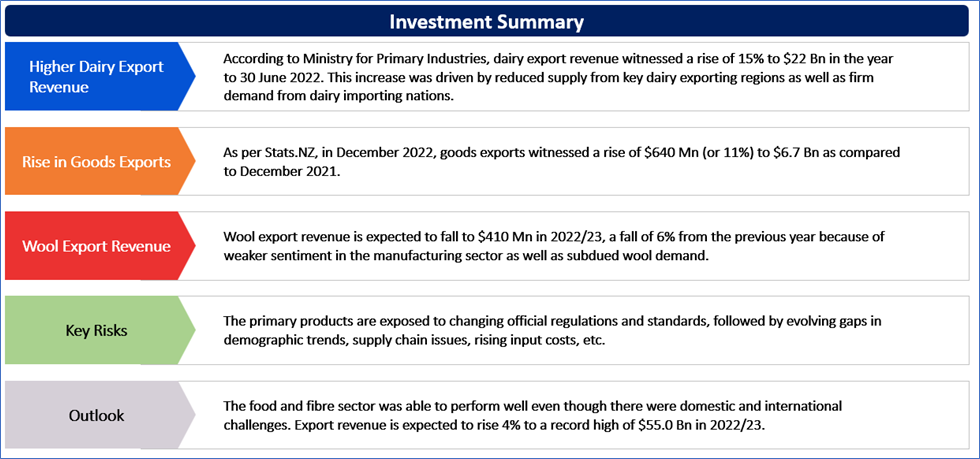
According to Ministry for Primary Industries, dairy export revenue witnessed a rise of 15% to $22 Bn in the year to 30 June 2022. This increase was driven by reduced supply from key dairy exporting regions as well as firm demand from dairy importing nations. For the year ended 30th June 2023, dairy exports are expected to rise 6% to $23.3 billion. This is because of weak New Zealand dollar, the previous season's inventories being sold in the current year as well as reduced supply from key dairy exporting regions.
Notably, meat and wool export revenue rose 18% to reach $12.3 Bn in the year ended 30 June 2022, because of tight supply, demand rebounding as well as higher prices. Meat and wool export revenue for the year ended 30 June 2023 is expected to rise by 1% to $12.4 billion as a result of higher production, despite weaker demand placing downwards pressure on prices.
Rise in Goods Exports in December 2022
As per Stats.NZ, in December 2022, goods exports witnessed a rise of $640 Mn (or 11%) to $6.7 Bn as compared to December 2021. Goods imports increased $125 Mn (or 1.8%) to $7.2 billion. Notably, the monthly trade balance was a deficit of $475 Mn. The United States of America led the monthly exports as well as imports rise.
Coming to the monthly exports rise, Milk powder, butter, and cheese (the largest export commodity group) was the biggest contributor to the rise, up $358 Mn (or 17%) to $2.4 Bn. Milk powder increased $10 Mn (or 0.8%) to $1.2 Bn; the quantity exported declined 4.9%. Notably, the average price per kilogram increased 6.1%.
Exhibit 1: Merchandise trade values, exports and imports, December months, 2012–2022
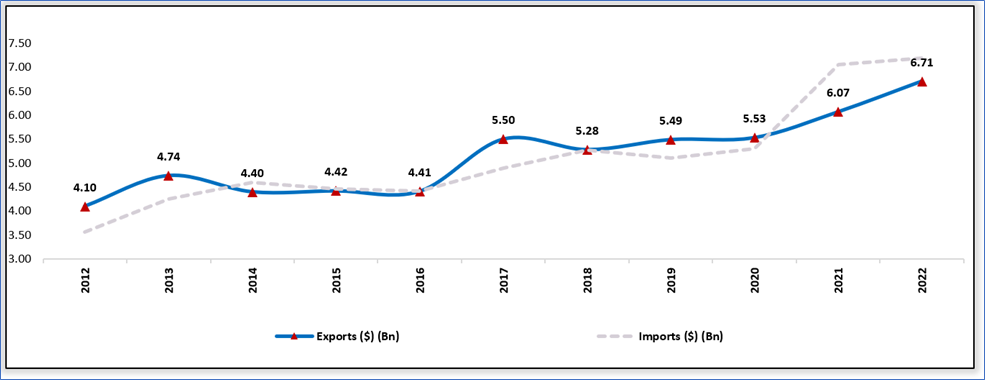
Data Source: This work is based on/includes Stats NZ’s data which are licensed by Stats NZ for reuse under the Creative Commons Attribution 4.0 International Licence; Chart Created by Kalkine Group
Expectations of Rise in Horticulture Export Revenue
As per MPI, horticulture export revenue for the year ended 30th June 2022 rose 2% to $6.8 Bn. As per the release, the forecast to June 2023 is for the further 5% increase to $7.1 Bn as a result of high yields from the 2022 grape vintage, an anticipated recovery in apple exports as well as forecast export price increases for wine, avocados and onions. Notably, kiwifruit was affected by fruit quality issues (2022 crop) and frost (2023 crop), which impacted export volumes and revenue.
Meat and Wool
As per MPI, export revenue is expected to rise 1% to $12.4 Bn in 2022/23 as a result of the combination of increased production lifting export volumes as well as weaker demand depressing prices. Beef, lamb and mutton prices are expected to decline because of downward pressure as a result of higher living costs in critical markets.
Notably, softer demand for meat is being partially offset by the tight global meat supplies as well as depreciation of the NZD against the USD. Farm profitability is expected to continue to be under pressure because of higher input costs.
Wool export revenue is expected to fall to $410 Mn in 2022/23, a fall of 6% from the previous year because of weaker sentiment in the manufacturing sector as well as subdued wool demand. The combination of higher shearing prices and muddy conditions might reduce the amount of wool supplied.
Index Performance:
The S&P/NZX All Consumer Staples Index generated a 6-month return of ~16.63% versus ~3.11% by the S&P/NZX 50 Index. Therefore, S&P/NZX All Consumer Staples Index overperformed S&P/NZX 50 Index by ~13.52% in 6 months
Exhibit 2: S&P/NZX All Consumer Staples Index vs S&P/NZX All Index
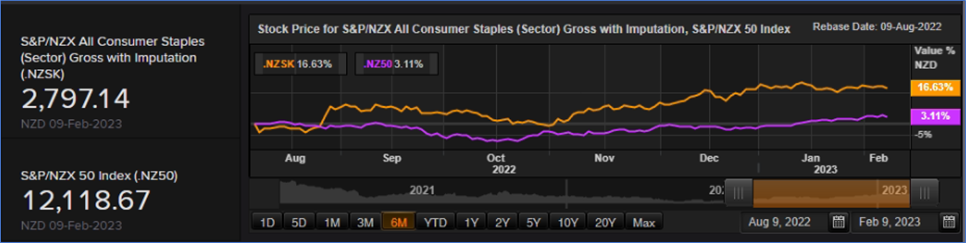
Source: REFINITIV
Key Risks and Challenges:
Farmers, growers, and fishers might face challenges because of rapid changes in climate, which could disrupt the operations as well as quality of output. Further, the pandemic resulted in some of the toughest challenges in the sector, such as supply chain issues, workforce challenges as well as increased input costs and other production costs. However, these were further exacerbated by the floods and drought.
Even though supply chain issues are easing for most exporters, labour supply as well as rising input costs are headwinds for the sector.
Exhibit 3. Key Risks in Consumer Staples Sector:
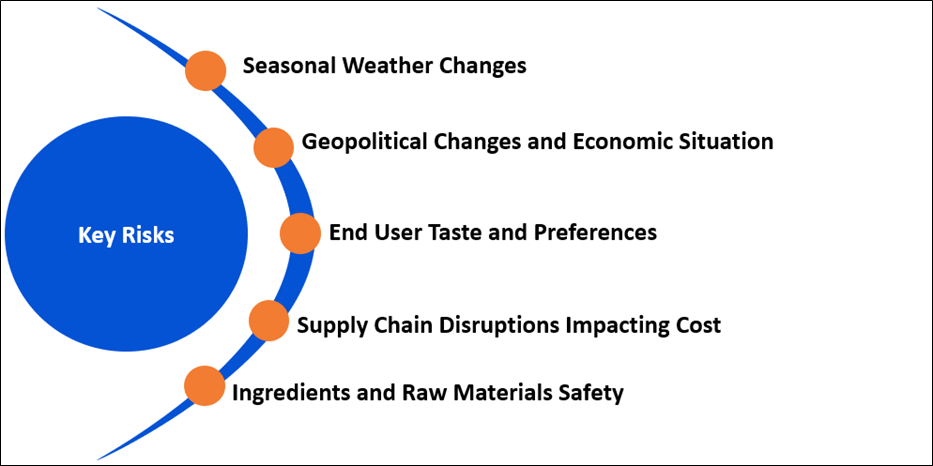
Source: Analysis by Kalkine Group
Outlook:
The food and fibre sector made up 81.4% of NZ’s merchandise exports in the year ended 30th June 2022. Primary industry export growth was able to exceed that of non-primary industries for 8 of the previous 10 years.
As per Ministry for Primary Industries, food and fibre sector export revenue rose 11% to $53.1 Bn in the year ended 30th June 2022 because of the sharp rise in prices for most sectors. The food and fibre sector was able to perform well even though there were domestic and international challenges. Export revenue is expected to rise 4% to a record high of $55.0 Bn in 2022/23. The figure has been revised upwards from the earlier forecast because of sector’s work in market and the steep fall in the New Zealand dollar (NZD). Export revenue is expected to rise for all the sectors.
Coming to the processed food and other products, export revenue is expected to reach $3.3 Bn in the year ended 30th June 2023, reflecting a rise of 3% from the past year. Notably, innovative processed foods and cereal products are the primary contributors to such growth.
Apart from the sector-specific factors, an analysis on 2 NZX-listed companies is provided. This report covers their insights, outlook, performance and potential as expected to be delivered in the near to medium term.
1) Marlborough Wine Estates Group Limited (Recommendation: Speculative Buy, Potential Upside: Low Double-Digit) (M-Cap: NZD48.4 million)
Business Description:
Marlborough Wine Estates Group Limited (NZX: MWE) owns as well as operates vineyards in Awatere Valley, Marlborough.

Outlook:
For FY 2023, the company is focusing towards further premiumization of MWE’s branded wines as well as towards expanding the market share by working closely with the distribution partners in all markets. The company is also focusing towards identifying opportunities to grow through acquisition, expansion of the supply and distribution channels.
Technical Overview:
Technical Commentary:
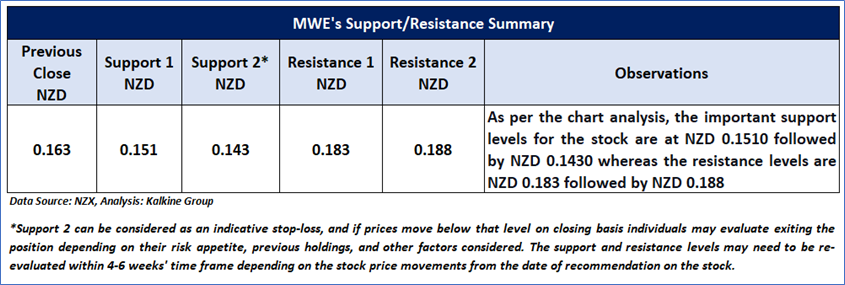
MWE prices are moving around its crucial support zone, and stock prices rebound after forming a base near the immediate support levels. The leading indicator RSI (14-period) hovers near the mid-point and shows a reading of ~49.961. An important support level for the stock is placed at NZD0.151, while the key resistance level is placed at NZD0.183.
Daily Price Chart
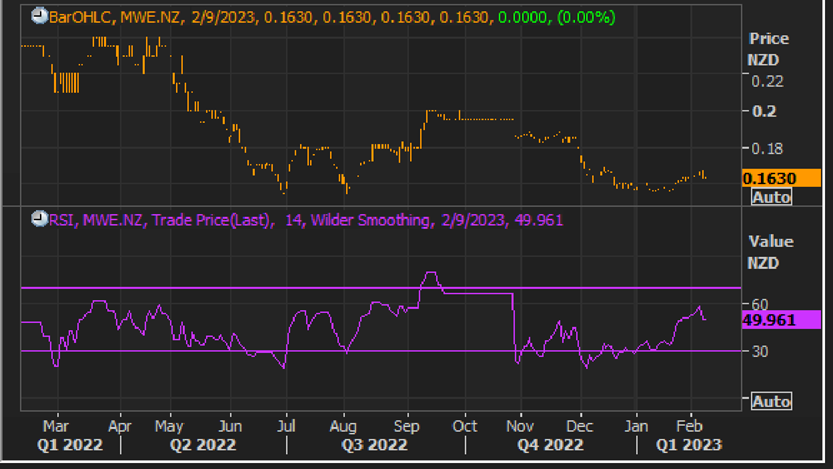
MWE Daily Technical Chart, Data Source: REFINITIV
Stock Recommendation
MWE is focused towards expansion of the international distributor network.
Considering the aforementioned factors, a ‘Speculative Buy’ recommendation has been assigned on the stock at the closing market price of NZD0.163 per share as on 9th February 2023.
2) PGG Wrightson Limited (Recommendation: Hold, Potential Upside: Low Double-Digit) (M-Cap: NZD332.88 million, Annual Dividend Yield (TTM)1: 9.45%)
Business Description:
PGG Wrightson Limited (NZX: PGW) is an agricultural services business which is operating across NZ.

Outlook:
PGW stated that positive run for most NZ agri-sectors looks likely to continue through the remainder of 2022 as well as into the coming year. The operating EBITDA for year ended 30th June 2023 is expected to be around $62 Mn. While the input prices are increasing, rising food prices could be beneficial overall for NZ’s agricultural sector in the export receipts.
Fundamental Valuation:
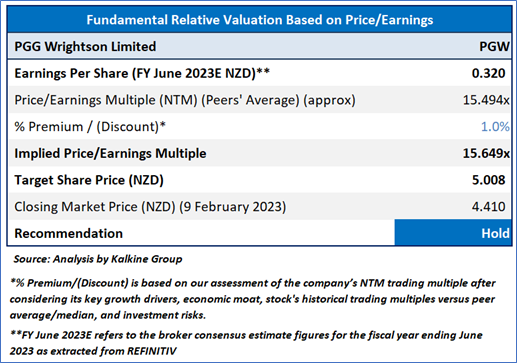
P/E Multiple Based Relative Valuation
Technical Overview:
Daily Price Chart
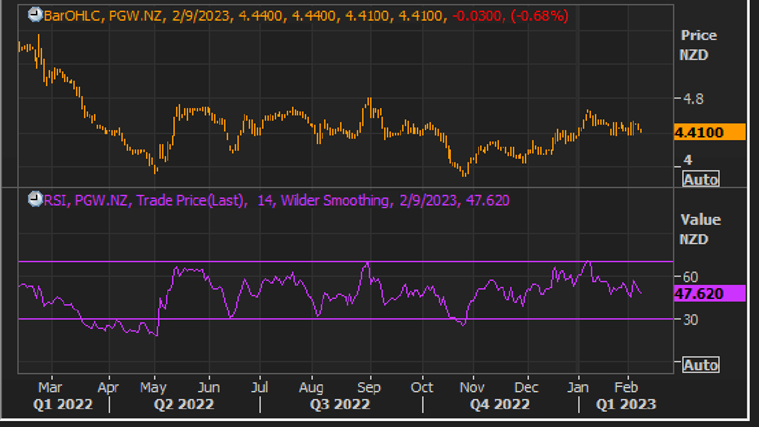
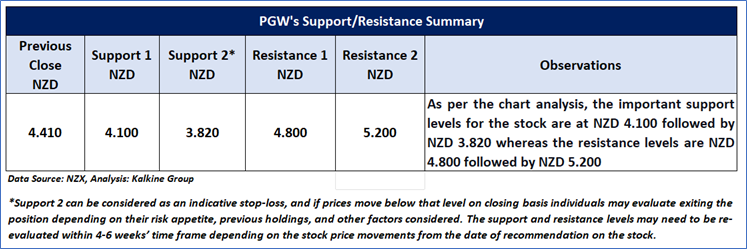
PGW Daily Technical Chart, Data Source: REFINITIV
Technical Commentary
PGW stock prices are in consolidating phase on the chart and trading above an upward-sloping trendline, indicating the possibility of further upside movement hereon. The leading indicator RSI (14-period) hovers near the mid-point and shows a reading of ~47.620. An important support level for the stock is placed at NZ$4.10, while the key resistance level is placed at NZ$4.80.
Stock Recommendation
Considering the facts above, a ‘Hold’ recommendation on the stock has been provided at the closing price of NZD4.410 per share, down by 0.68% as on 9 February 2023.
Markets are trading in a highly volatile zone currently due to certain macro-economic issues and geopolitical tensions prevailing. Therefore, it is prudent to follow a cautious approach while investing.
Note 1: Past performance is neither an indicator nor a guarantee of future performance.
Note 2: The reference date for all price data, currency, technical indicators, support, and resistance levels is February 9, 2023. The reference data in this report has been partly sourced from REFINITIV.
Note 3: Investment decisions should be made depending on an individual's appetite for upside potential, risks, holding duration, and any previous holdings. An 'Exit' from the stock can be considered if the Target Price mentioned as per the Valuation and or the technical levels provided has been achieved and is subject to the factors discussed above.
Note 4: Annual Dividend Yield is on a Trailing Twelve Month (TTM1) basis and are subject to change based on factors such as company performance, stock price changes, etc.
Technical Indicators Defined: -
Support: A level at which the stock prices tend to find support if they are falling, and a downtrend may take a pause backed by demand or buying interest. Support 1 refers to the nearby support level for the stock and if the price breaches the level, then Support 2 may act as the crucial support level for the stock.
Resistance: A level at which the stock prices tend to find resistance when they are rising, and an uptrend may take a pause due to profit booking or selling interest. Resistance 1 refers to the nearby resistance level for the stock and if the price surpasses the level, then Resistance 2 may act as the crucial resistance level for the stock.
Stop-loss: It is a level to protect further losses in case of unfavourable movement in the stock prices.
Disclaimer
Kalkine New Zealand Limited is a Financial Advice Provider (“FAP”) and is authorised by a Transitional FAP license issued by Financial Markets Authority (“FMA”) to provide financial advice. Kalkine provides only general financial advice through its research reports following a person becoming a member. The reports contain buy/sell/hold and other recommendations in relation to equity financial products. The recommendations and opinions [on this website] / [in this report] do not take into account any of your investment objectives, financial situation or needs. Before you make a decision about whether to acquire a financial product, you should obtain the Product Disclosure Statement from the product issuer. You should consider the appropriateness of advice taking into account your own objectives, financial situation and needs and seek independent financial advice before making any financial decisions. If you act on the advice in the research reports, you may have to pay fees, expenses or other amounts (but not to Kalkine). Further information about the complaints and dispute resolution process, as well as information about Kalkine’s duties are available on Kalkine’s website. Please read our Financial Advice Provider (FAP) disclosure statement and Complaints Handling Guide, which are available on the website.
Past performance is not a reliable indicator of future performance.
 Please wait processing your request...