
 AU
AU
 UK
UK
 CA
CA
 US
US
 IND
IND

 NZ
NZ

As per MPI.NZ, New Zealand signed a free trade deal with the United Kingdom to remove all tariffs on NZ exports, with duties removed on 99.5% of current trade from entry into force. This trade deal is expected to support NZ’s GDP to the tune of $700 million to $1 billion, and exporters would save ~$37 million per year on tariff removal. As per MFAT.NZ, government plans to work closely with Canada in multilateral trade settings with a prime focus on mutual benefit in close liaison. Further, the government is eyeing Toronto for NZ tech exports and Australia to strengthen the engagement with government and business leaders from both sides of the Tasman.
The United States Leads the Rise in Monthly Export and Import
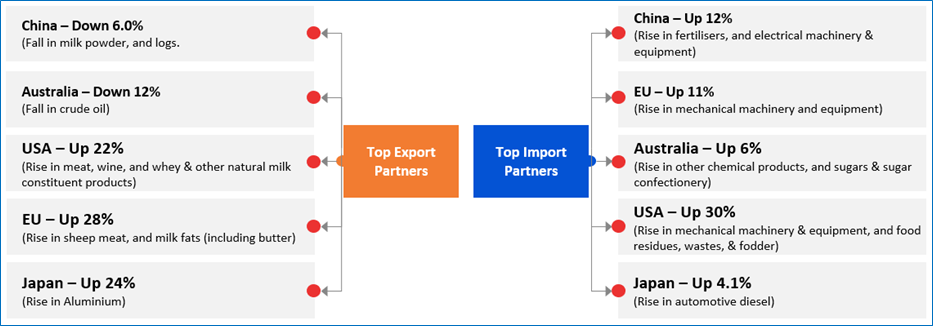
As per Stats.NZ, the monthly export to the USA from NZ grew by $126 million (22%) to $698 million, mainly driven by an increase in meat (up $24 million), wine (up $22 million), and whey and other natural milk constituent products (up $18 million). Meanwhile, imports from the USA to NZ grew by $156 million (30%) to $681 million, mainly driven by an increase in mechanical machinery and equipment (up $51 million) and food residues, wastes and fodder (up $37 million).
Exhibit 1: Top Export and Import Partners in June 2022 over June 2021
Data Source: This work is based on/includes Stats NZ’s data which are licensed by Stats NZ for reuse under the Creative Commons Attribution 4.0 International Licence; Chart Created by Kalkine Group
Import and Export of Goods in NZ Stood at $13.5 billion in June 2022
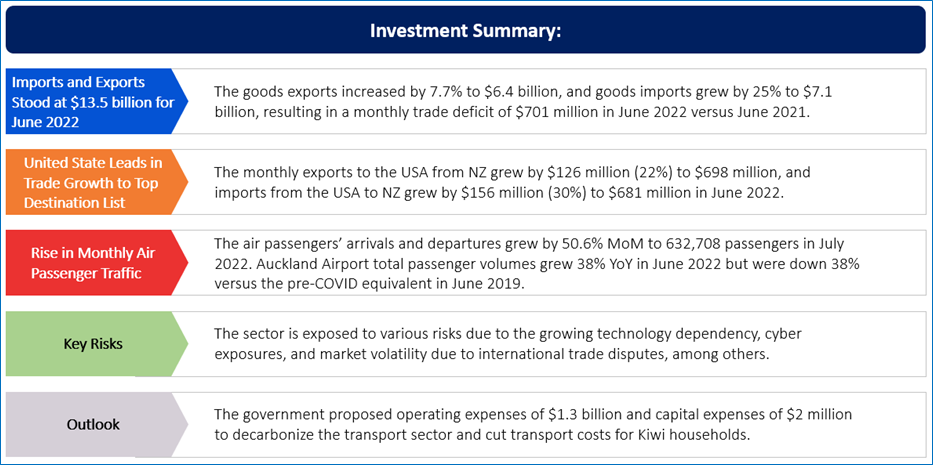
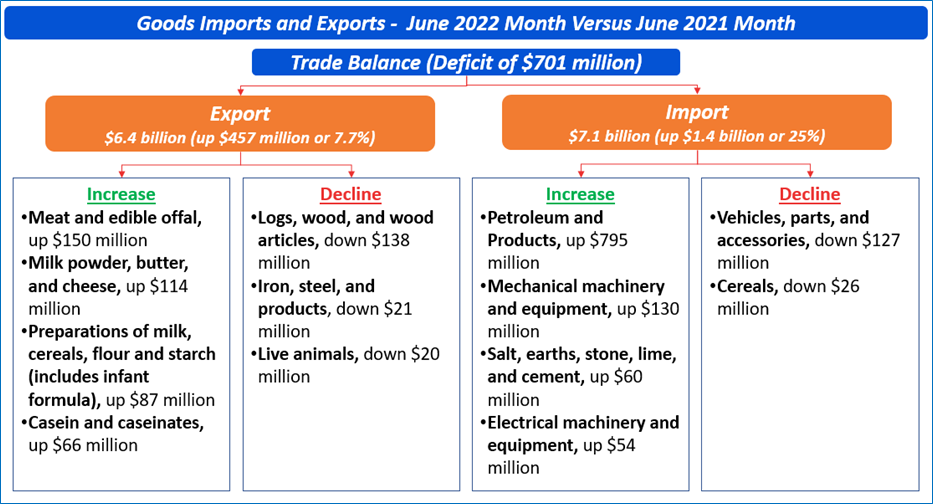
As per Stats.NZ, goods exports increased by 7.7% to $6.4 billion, and goods imports grew by 25% to $7.1 billion, resulting in a monthly trade deficit of $701 million in June 2022 versus June 2021. Meanwhile, the annual trade deficit was $10.5 billion in June 2022 as annual goods exports stood at $67.6 billion, up $7.2 billion from the previous year, and yearly goods imports stood at $78.1 billion, up $17.4 billion from the prior year.
Exhibit 2 Trend in Goods Export and Import in June 2022
Data Source: This work is based on/includes Stats NZ’s data which are licensed by Stats NZ for reuse under the Creative Commons Attribution 4.0 International Licence; Chart Created by Kalkine Group
Rise in Monthly Air Passenger Traffic
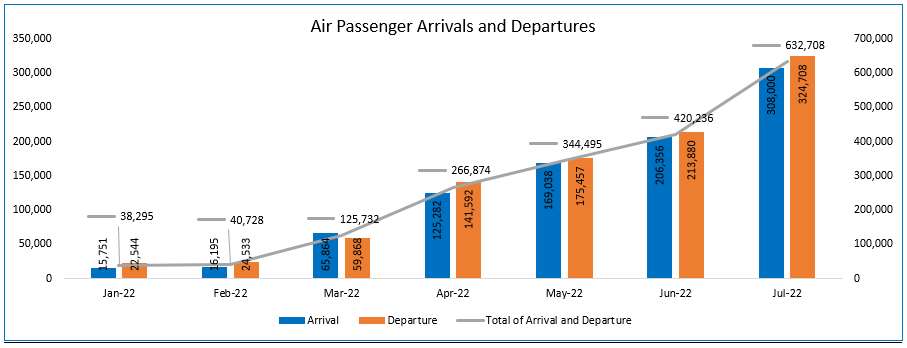
As per Customs.NZ, the air passengers’ arrivals and departures grew by 50.6% MoM to 632,708 passengers in July 2022, following a rise of 29.1% and 22.0% in May 2022 and June 2022, respectively. As per the June 2022 monthly traffic update and July 2022 preview by Auckland International Airport Limited on 15 August 2022, Auckland Airport total passenger volumes grew 38% YoY in June 2022. Still, they were down 38% versus the pre-COVID equivalent in June 2019. Meanwhile, the international passengers (excl. transits) grew 145% YoY in June 2022, transit passengers grew 3003% YoY, and domestic passengers were up by 9% YoY in June 2022.
Exhibit 3 Trend in Air Passenger Arrivals and Departures
Data Source: This work is based on/includes Customs NZ data which are licensed by Customs NZ for reuse under the Creative Commons Attribution 4.0 International Licence; Chart Created by Kalkine Group
Index Performance:
The S&P/NZX All Industrials (Sector) Index generated a 2-year return of ~30.00% versus ~-0.29% by the S&P/NZX 50 Index. Therefore, NZX All Industrials Index overperformed NZX50 Index by ~30.29% in 2-year.
Exhibit 4: S&P/NZX All Industrials (Sector) vs S&P/NZX50 Index

Source: REFINITIV
Key Risks and Challenges:
The ANZ business outlook survey for July 2022 indicates that the inflationary pressures are intense, and business activity appears to be fading, particularly in the Real Estate sector. Meanwhile, the uncertain business outlook has led the IMF to revise its global growth forecasts, and forthcoming data indicates a fading growth momentum. The IMF reduced its international growth projection to 3.2% for 2022 and 2.9% for 2023.
Exhibit 5. Key Risks in Industrials Sector:
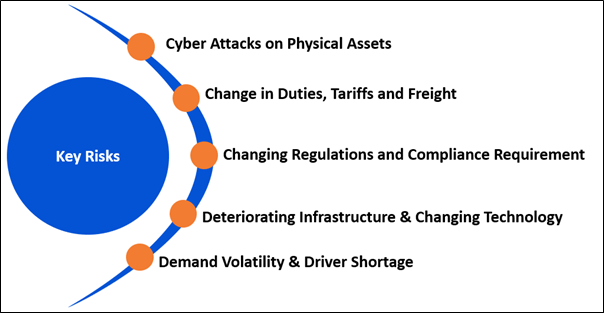
Source: Analysis by Kalkine Group
Outlook:
The government, in its Wellbeing Budget 2022, released on 19 May 2022, has announced an infrastructure investment of $61.9 billion over the next five years, to build improved foundations and reduce NZ's infrastructure deficit by investing in projects like Auckland Light Rail, water infrastructure, and rolling stock for rail. The Free Trade Agreement (FTA) is expected to unlock access to the UK market and accelerates New Zealand’s COVID-19 recovery. Once in force, this agreement is expected to limit costs for exporters and create opportunities for NZ businesses to grow and diversify their trade.
Apart from the sector-specific factors, an analysis of three NZX-listed companies operating in the same sector is conducted. This report covers their insights, outlook, performance and potential as expected to be delivered in the near to medium term.
1) Air New Zealand Limited (Recommendation: Buy, Potential Upside: Low Double-Digit) (M-Cap: NZ$2.27 billion)
Business Description:
Air New Zealand Limited (NZX: AIR) operates a global network that provides air passenger services and cargo transport services to, from, and within New Zealand.

Outlook
The company projects that it would generate a loss before other significant items and taxation of less than $750 million for FY22, driven by passenger booking activity on short-haul and international services due to the opening of the New Zealand border. Domestic passenger traffic improved to ~90% of pre-Covid levels. However, the macroeconomic environment continues to be under pressure with disruptions caused by elevated inflation, high commodity prices, and geopolitical unrest. It plans to release its FY22 results on 25 August 2022.
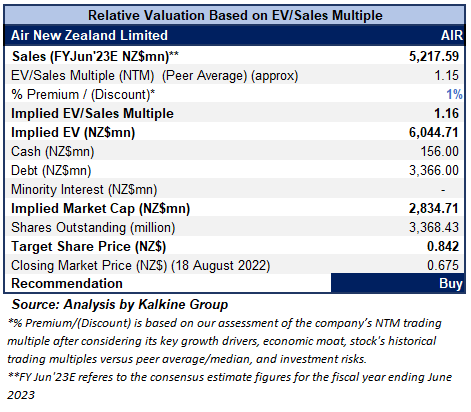
Valuation Methodology: EV/Sales Multiple Based Relative Valuation (Illustrative)
Technical Overview:
Daily Price Chart
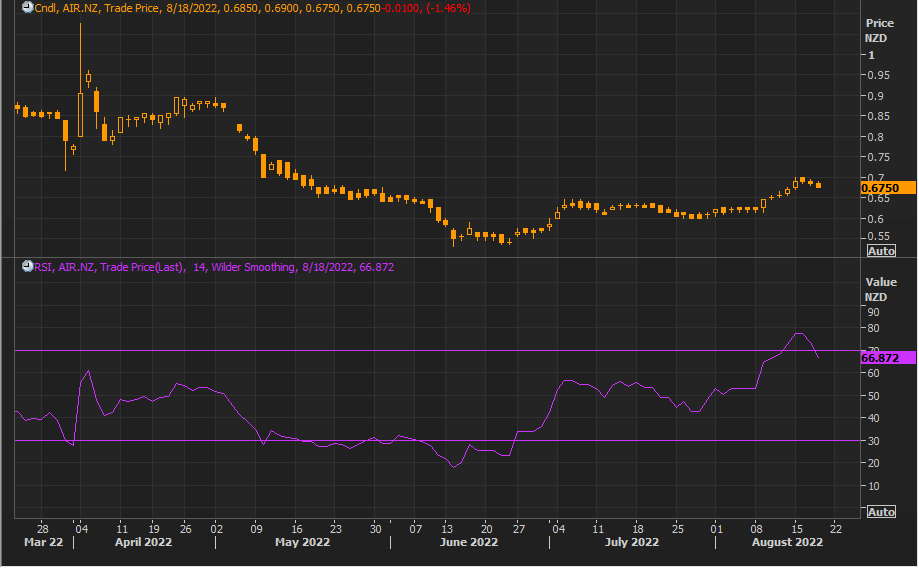
Source: REFINITIV, Note: Purple color line reflects Relative Strength Index (14-Period)
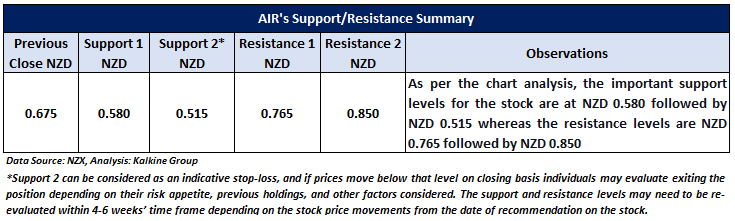
Stock Recommendation
The stock has been valued using an EV/Sales multiple-based illustrative relative valuation, and the target price so arrived reflects a rise of low-double-digit (in % terms). A slight premium has been applied to EV/Sales Multiple (NTM) (Peer Average), considering the decent outlook for FY22 and revival in domestic demand.
Considering the aforementioned factors, a ‘Buy’ recommendation has been assigned on the stock at the closing market price of $0.675 per share, down by 1.46% as of 18 August 2022.
2) Move Logistics Group Limited (Recommendation: Speculative Buy, Potential Upside: Low Double-Digit) (M-Cap: NZ$148.97 million)
Business Description:
Move Logistics Group Limited (NZX: MOV) is among the leading domestic freight and logistics players in New Zealand. It is engaged in providing freight transporting and warehousing services. It also coordinates offshore freight movements through international alliances.

Outlook
Considering the completion of Q3FY22 along with the trading and economic conditions, the company expects to achieve underlying EBITDA in the range of $53-$56 million in FY22. Further, the company remain assured of attaining substantial benefits of the re-alignment for the business in the coming 12 months and beyond. The sale of the Specialist division is part of its strategy to emphasise core business: Freight and Contract Logistics. It plans to release its FY22 results on 24 August 2022.
Technical Overview:
Daily Price Chart
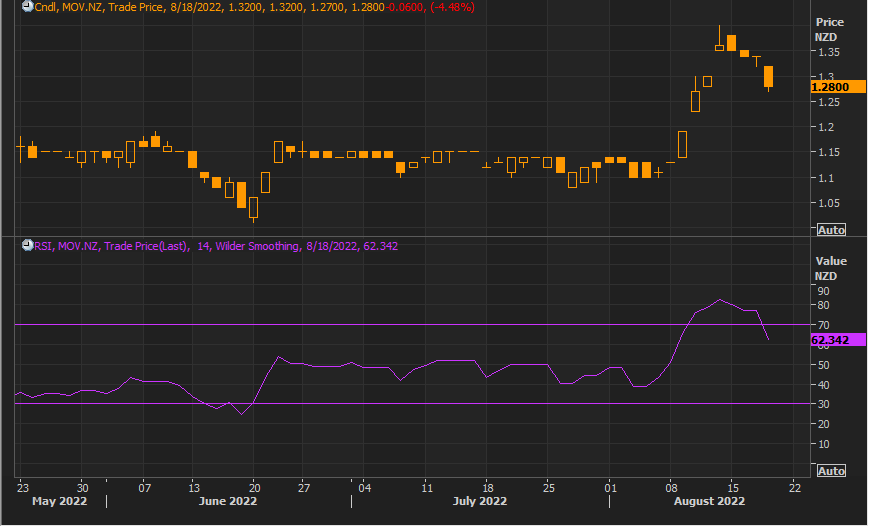
Source: REFINITIV, Note: Purple color line reflects Relative Strength Index (14-Period)
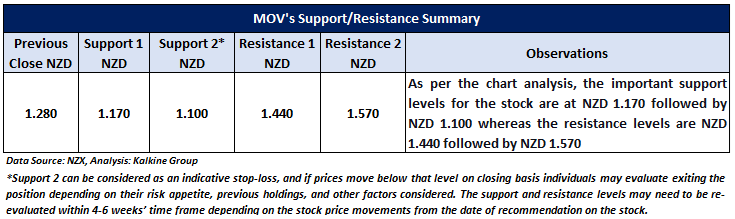
Stock Recommendation:
Considering the aforementioned factors, a ‘Speculative Buy’ recommendation has been assigned on the stock at the closing market price of $1.28 per share, down by 4.48% as of 18 August 2022.
3) 2Mainfreight Limited (Recommendation: Hold, Potential Upside: Low Double-Digit) (M-Cap: NZ$7.95 billion, Annual Dividend Yield (TTM)1: 2.48%)
Business Description:
Mainfreight Limited (NZX: MFT) is an end-to-end supply chain logistic solution provider across Asia, Europe, Australia, New Zealand, and The Americas. It offers a wide range of services and specialised packaged solutions.

Outlook
The supply chain congestion is expected to persist into the 2022 calendar year. Further, the Air and Ocean freight rates are expected to stay higher. Although trading has improved in the seven weeks since the financial year-end, the company believes the quantum of profit improvement of this past year to not reoccur in the short term. It is expected to revert to its regular revenue and profit growth levels.
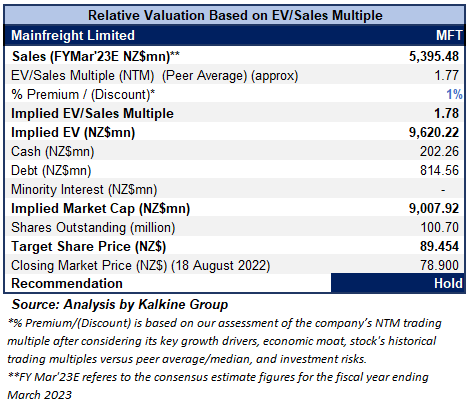
Valuation Methodology: EV/Sales Multiple Based Relative Valuation (Illustrative)
Technical Overview:
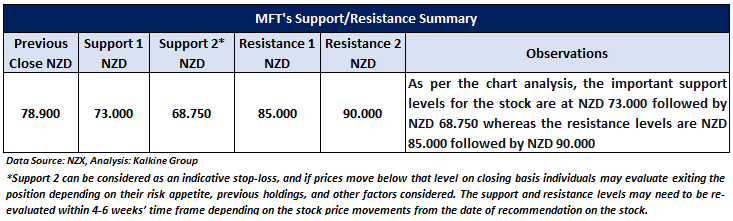
Daily Price Chart
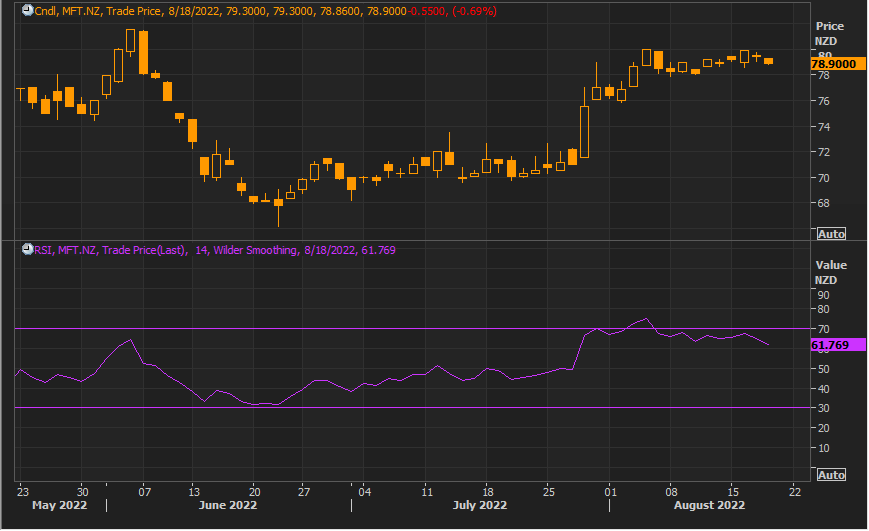
Source: REFINITIV, Note: Purple color line reflects Relative Strength Index (14-Period)
Stock Recommendation
The stock has been valued using an EV/Sales multiple-based illustrative relative valuation, and the target price so arrived reflects a rise of low-double-digit (in % terms). A slight premium has been applied to EV/Sales Multiple (NTM) (Peer Average), as the company is hopeful of achieving continued growth and performance improvement.
Considering the aforementioned factors, a ‘Hold’ recommendation has been assigned on the stock at the closing market price of $78.90 per share, down by 0.69% as of 18 August 2022.
Markets are trading in a highly volatile zone currently due to certain macro-economic issues and geopolitical tensions prevailing. Therefore, it is prudent to follow a cautious approach while investing.
Note 1: Past performance is not a reliable indicator of future performance.
Note 2: The reference date for all price data, currency, technical indicators, support, and resistance levels is August 18, 2022. The reference data in this report has been partly sourced from REFINITIV.
Note 3: Investment decisions should be made depending on an individual's appetite for upside potential, risks, holding duration, and any previous holdings. An 'Exit' from the stock can be considered if the Target Price mentioned as per the Valuation and or the technical levels provided has been achieved and is subject to the factors discussed above.
Note 4: Annual Dividend Yield is on a Trailing Twelve Month (TTM1) basis and are subject to change based on factors such as company performance, stock price changes, etc.
Technical Indicators Defined: -
Support: A level at which the stock prices tend to find support if they are falling, and a downtrend may take a pause backed by demand or buying interest. Support 1 refers to the nearby support level for the stock and if the price breaches the level, then Support 2 may act as the crucial support level for the stock.
Resistance: A level at which the stock prices tend to find resistance when they are rising, and an uptrend may take a pause due to profit booking or selling interest. Resistance 1 refers to the nearby resistance level for the stock and if the price surpasses the level, then Resistance 2 may act as the crucial resistance level for the stock.
Stop-loss: It is a level to protect further losses in case of unfavourable movement in the stock prices.
Disclaimer
Kalkine New Zealand Limited is authorised to provide general advice only. The information on this website does not take into account any of your investment objectives, financial situation or needs. Before you make a decision about whether to acquire a financial product, you should obtain the Product Disclosure Statement from the product issuer. You should consider the appropriateness of advice taking into account your own objectives, financial situation and needs and seek independent financial advice before making any financial decisions.
Past performance is not a reliable indicator of future performance.
 Please wait processing your request...