
 AU
AU
 UK
UK
 CA
CA
 US
US
 IND
IND

 NZ
NZ

This report is an updated version of the report published on 2 June 2022 at 6:18 PM (GMT +12)
I. Sector Landscape and Outlook
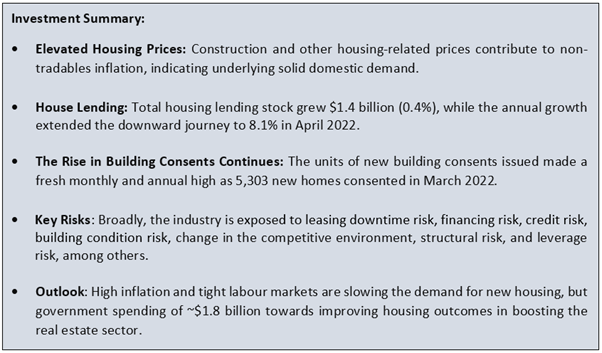
As per MBIE, the building and construction sector was reported as one of the most significant contributors to NZ’s economy. It contributed 6.7% of total GDP in FY19 and was the 4th most considerable employer, employing ~275,600 people in FY21. In June 2021, the sector was the second-fastest growing industry in terms of employment, with 11,014 additional filled jobs than in June 2020.
Amid tightening monetary policy, the house prices decreased 1.1% in April, 6.2% lower than the November level, indicating a steeper decline than projected in the Budget Update. The prices are projected to fall further as interest rates are at a higher level, softening broader housing market activity. Total house sales in April 2022 quarter fell 33% YoY.
Construction and Housing Prices Continue to Trade High
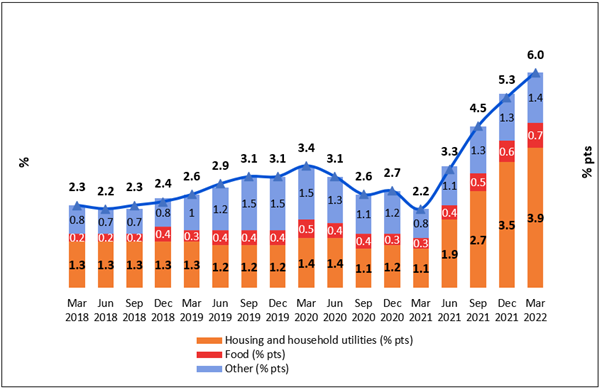
As per the Reserve Bank of New Zealand (RBNZ), in NZ, construction and other housing-related prices continue to make the most significant contribution to non-tradables inflation. These sectors' related prices also soared over and above the expectation a year ago, indicating stronger-than-expected domestic demand and shortages of labour and building materials. As per the ‘Monetary Policy Statement May 2022’, the activity in the construction sector continues to be at an elevated level, despite a shortage of materials and labour. As indicated in the 2022 Budget, government spending is driving the domestic demand.
Exhibit 1: Trend in Contribution to Non-Tradables Inflation
Data Source: This work is based on/includes rbnz data which are licensed by rbnz.govt for reuse under the Creative Commons Attribution 4.0 International Licence; Chart Analysis by Kalkine Group
Growth in House Lending Continued in April 2022
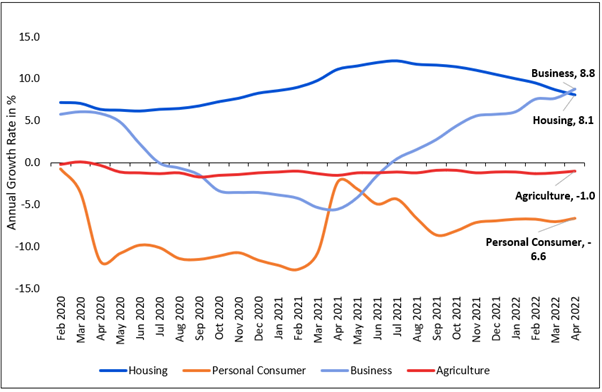
RBNZ's total housing lending stock grew by $1.4 billion (0.4%) in April 2022, decreasing the $1.6 billion (0.5%) rise reported in March 2022. However, the annual growth extended the downward journey to 8.1% in April 2022, falling further from 8.7% in March 2022. The total personal consumer lending stock grew by $96 million (break adjusted) (0.7%) in April 2022, a turnaround on the $234 million (-1.7%) decrease reported in March 2022. Further, the annual growth grew from -7.0% to -6.6%. The total business lending stock grew by $1.2 billion (0.9%) in April 2022, with its annual growth growing from 7.7% to 8.8%, which is the highest yearly growth rate since February 2009. The total agriculture lending stock fell by $60 million (-0.1%) in April 2022, while annual growth grew from -1.2% to -1.0%.
Exhibit 2: Rise in Lending Continues in April 2022 – Banks and NBLIs
Data Source: This work is based on/includes rbnz data which are licensed by rbnz.govt for reuse under the Creative Commons Attribution 4.0 International Licence; Chart Created by Kalkine Group
The Rise in Building Consents Continues
As per Treasury.govt, the units of new building consents issued made a fresh monthly, and annual high as 5,303 new homes were consented in March 2022, bringing yearly consents to 50,858. Further, the consents for multi-unit dwellings, comprising townhouses, flats, units, apartments, and retirement village units, were the primary driver of the yearly rise of 40% YoY. In the Budget Update, residential investment is projected to report robust growth over the coming year as the large pipeline of consents flows through. Meanwhile, due to material and labour shortages, the cost of building a house increased by 18% in the year ended March 2022.
Index Performance:
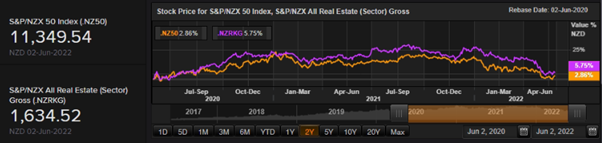
The S&P/NZX All Real Estate (Sector) Index generated a 2-year return of ~5.75% versus ~2.86% by the S&P/NZX 50 Index. Therefore, NZX All Real Estate Index overperformed NZX50 Index by ~2.89% in 2-year.
Exhibit 3: S&P/NZX All Real Estate (Sector) vs S&P/NZX50 Index
Source: REFINITIV
Key Risks and Challenges:
As per RBNZ, the solid demand for housing pushes price pressure and inflation, decreasing the number of new buyers and new construction activities. Further, the elevated inflation level in many advanced economies and tightened labour markets led central banks to formulate policies that would impact the growth outlook and affect investor sentiment. Meanwhile, house prices are projected to decrease by ~9% from the end of 2021 to mid-2024, towards more sustainable levels. Falling house prices slash household wealth and weigh on consumption.
Exhibit 4. Key Risks in Real-Estate Sector:
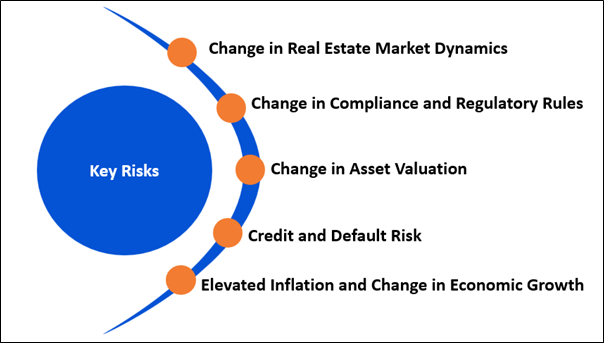
Source: Analysis by Kalkine Group
Outlook:
Inflation continues to impact the growth momentum in many economies. Still, the pace of increase has reduced, and attention is diverted to central bank policies to return inflation to its targets. Further, the labour markets are tight across geography, thereby resulting in inflationary pressures in the form of wage growth. Meanwhile, the demand for new housing is at all-time highs due to phenomenal house price growth over 2021 and regulatory changes to multi-unit dwellings. Construction activity in NZ continues at higher levels despite a shortage in material availability and labour. Moreover, the government plans to spend ~$1.8 billion on improving housing outcomes in the real estate sector.
Apart from the sector-specific factors, we have also analysed four NZX-listed companies operating in the same sector. This report covers their insights, outlook, performance and potential as expected to be delivered in the near to medium term.
1) Goodman Property Trust (Recommendation: Buy, Potential Upside: Low Double-Digit) (M-Cap: NZ$2.87 billion, Gross Dividend Yield: 3.103%)
Business Description:
Goodman Property Trust (NZX: GMT) is engaged in owning, developing, and managing industrial real estate globally, including logistics facilities, warehouses, and business parks.
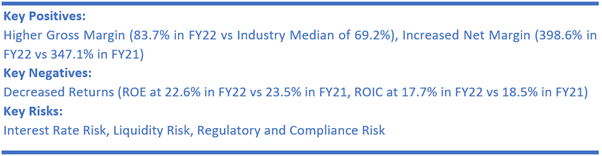
Outlook
The company took five acquisitions in FY22, including 34 hectares of land next to Villa Maria Winery in Mangere, totalling $250.6 million. Further, it increases its investment in strategic locations to absorb future demand. With a blend of greenfield and brownfield sites within the portfolio, the company reserves a robust development pipeline projected to total over 400,000 sqm of urban logistics space. With new capital and investment initiatives, alongside the focus on low-carbon property solutions, the company has solid business prospects and is projected to support sustainable long-term growth.
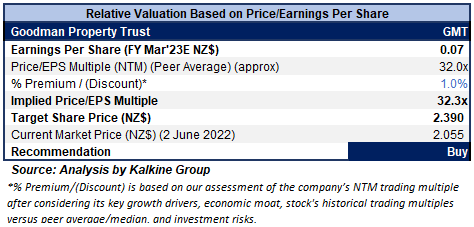
Valuation Methodology: Price/Earnings Per Share Based Relative Valuation (Illustrative)
Technical Overview:
Daily Price Chart
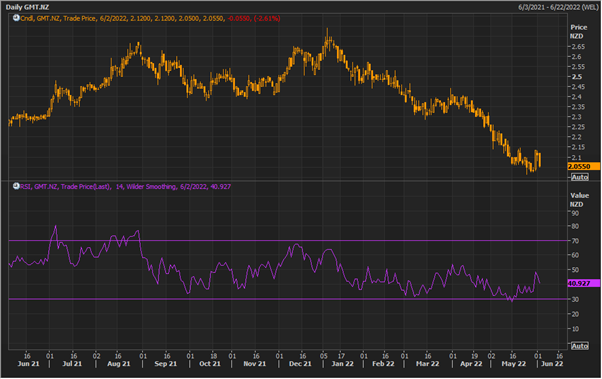
Source: REFINITIV, Note: Purple color line reflects Relative Strength Index (14-Period)
Stock Recommendation
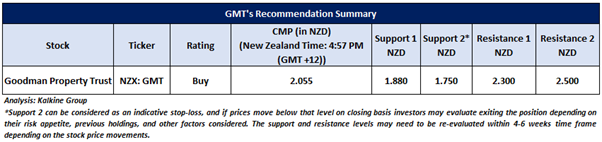
The stock has been valued using a P/E multiple-based illustrative relative valuation, and the target price so arrived reflects a rise of low double-digit (in % terms). A slight premium has been applied to P/E Multiple (NTM) (Peer Average), considering improved profitability in FY22 over FY21 and the benefit of the scale of its portfolio that offers future opportunities.
Considering the factors above, we give a “Buy” recommendation on the stock at the current market price of $2.055 per share as of 2 June 2022 (New Zealand Time: 4:57 PM (GMT +12)).
2) Precinct Properties New Zealand Limited (Recommendation: Buy, Potential Upside: Low Double-Digit) (M-Cap: NZ$2.24 billion, Gross Dividend Yield: 4.767%)
Business Description:
Precinct Properties New Zealand Limited (NZX: PCT) is the largest owner and developer of premium inner-city business space in Auckland and Wellington.
Outlook
Amid an uncertain 2022 outlook, the company continues to focus on the quality and resilience of its portfolio. The strategy is to build a high-quality portfolio of city centre assets, participate in opportunities, and drive higher returns from available capital. The Board anticipates FY22 dividend at 6.70 cps, indicating a 3.1% YoY growth in total cash dividends to shareholders. Due to the rental support, the FY22 dividend payout ratio could exceed 100% of AFFO.
On 17 May 2022, the company announced a Q3FY22 dividend at 1.675 cents per share that will be paid as per the record date of 27 May 2022, on 10 June 2022.
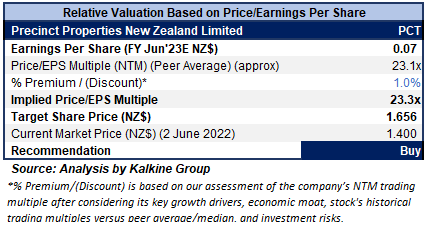
Valuation Methodology: Price/Earnings Per Share Based Relative Valuation (Illustrative)
Technical Overview:
Daily Price Chart
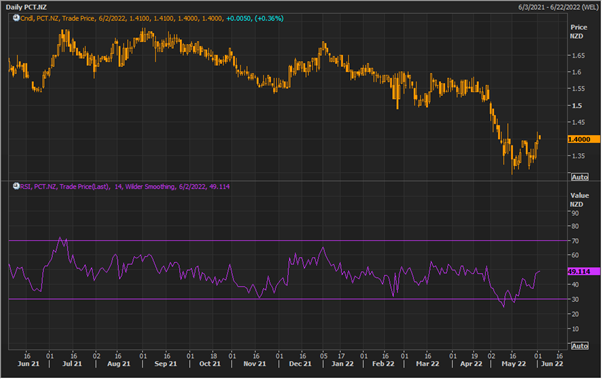
Source: REFINITIV, Note: Purple color line reflects Relative Strength Index (14-Period)
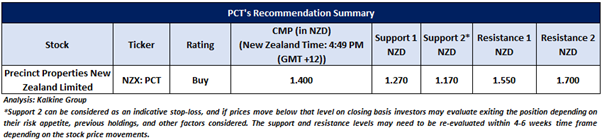
Stock Recommendation:
The stock has been valued using a P/E multiple-based illustrative relative valuation, and the target price so arrived reflects a rise of low double-digit (in % terms). A slight premium has been applied to P/E Multiple (NTM) (Peer Average), considering the project development pipeline, decent outlook, and balance sheet capacity.
Considering the fact above, we give a “Buy” recommendation on the stock at the current market price of NZ$1.40 per share as of 2 June 2022 (New Zealand Time: 4:49 PM (GMT +12)).
3) Kiwi Property Group Limited (Recommendation: Buy, Potential Upside: Low Double-Digit) (M-Cap: NZ$1.62 billion, Gross Dividend Yield: 6.821%)
Business Description:
Kiwi Property Group Limited (NZX: KPG) is investing in New Zealand real estate. The Company's primary assets are investment properties, and its reportable segments are Mixed-use, Retail, Office and Other.
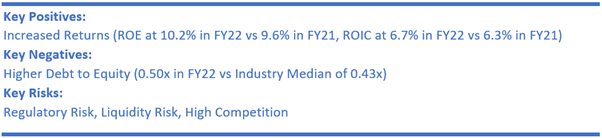
Outlook
The company made significant progress on its Sustainability Strategy in FY22 and constantly working to support well-being in the country, drive business value and create a brighter future. The focus area for FY23 will be to launch CBD office co-investment platform, progress well on the Sylvia Park BTR and 3 Te Kehu Way developments and manage its assets towards growth.
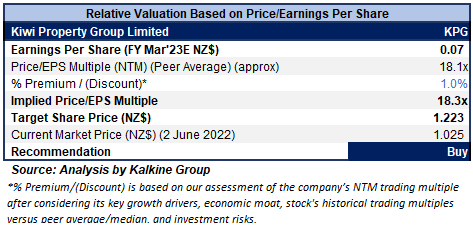
Valuation Methodology: Price/Earnings Per Share Based Relative Valuation (Illustrative)
Technical Overview:
Daily Price Chart
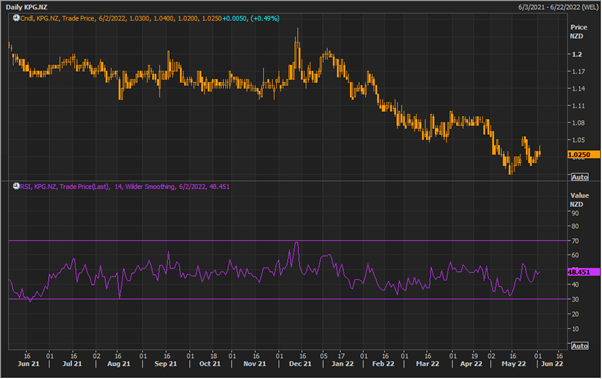
Source: REFINITIV, Note: Purple color line reflects Relative Strength Index (14-Period)
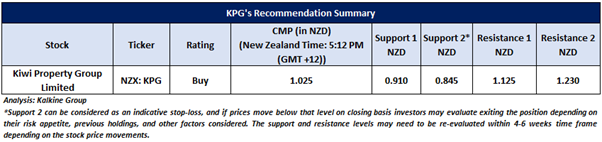
Stock Recommendation
The stock has been valued using a P/E multiple-based illustrative relative valuation, and the target price so arrived reflects a rise of low double-digit (in % terms). Accordingly, a slight premium has been applied to P/E Multiple (NTM) (Peer Average), considering diversifies revenue stream.
Considering the factors above, we give a “Buy” recommendation on the stock at the current market price of $1.025 per share as of 2 June 2022 (New Zealand Time: 5:12 PM (GMT +12)).
Markets are trading in a highly volatile zone currently due to certain macro-economic issues and geopolitical tensions prevailing. Therefore, it is prudent to follow a cautious approach while investing.
Note 1: The reference data in this report has been partly sourced from REFINITIV.
Note 2: Investment decisions should be made depending on the investors’ appetite on upside potential, risks, holding duration, and any previous holdings. Investors can consider exiting from the stock if the Target Price mentioned as per the analysis has been achieved and subject to the factors discussed above alongside support levels provided.
Technical Indicators Defined: -
Support: A level where-in the stock prices tend to find support if they are falling, and downtrend may take a pause backed by demand or buying interest.
Resistance: A level where-in the stock prices tend to find resistance when they are rising, and uptrend may take a pause due to profit booking or selling interest.
Stop-loss: It is a level to protect further losses in case of unfavourable movement in the stock prices.
Disclaimer
Kalkine New Zealand Limited is authorised to provide general advice only. The information on this website does not take into account any of your investment objectives, financial situation or needs. Before you make a decision about whether to acquire a financial product, you should obtain the Product Disclosure Statement from the product issuer. You should consider the appropriateness of advice taking into account your own objectives, financial situation and needs and seek independent financial advice before making any financial decisions.
Past performance is not a reliable indicator of future performance.
 Please wait processing your request...