
 AU
AU
 UK
UK
 CA
CA
 US
US
 IND
IND

 NZ
NZ

1. Sector Landscape and Outlook
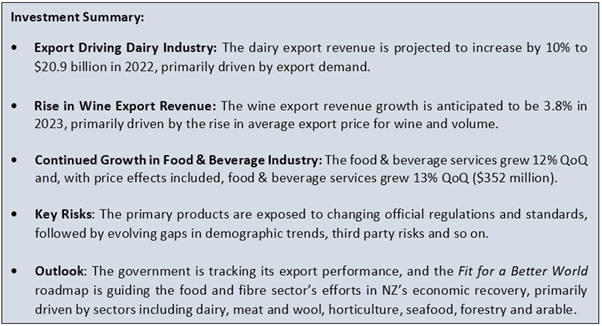
As per the Ministry for Primary Industries (MPI), food and fibre sector export revenue are expected to cross the $50 billion mark for the first time in FY22, up 6% YoY. The rise in total export revenue is projected for sectors like dairy, meat and wool, horticulture, seafood, forestry and arable. Meanwhile, the government is negotiating free trade agreement (FTA) with major exporting countries to open market opportunities, streamline processes, decrease costs, and create additional certainty and security for companies.
Export-Led Grow for Dairy Industry in 2022
As per MPI, dairy export revenue is projected to increase by 10% to $20.9 billion in 2022, primarily driven by export demand. Demand for dairy has been robust internationally, driven by rising demand for dairy imports from China. Other regions, mainly dairy importing nations in Asia, are also pushing the demand for milk. Recently, higher dairy imports (specifically skim milk powder and cheese) from African countries have further strengthened global demand.
Strong demand and sluggish supply have augmented high global dairy prices. Prices received by dairy cattle farming increased by 9.2% in the December 2021 quarter versus the September 2021 quarter. Similarly, the prices paid by dairy product manufacturing increased 7.7% for the said period.
Exhibit 1: Trend in Dairy Export Revenue 2017–23 (Year to 30 June, NZ$ million)
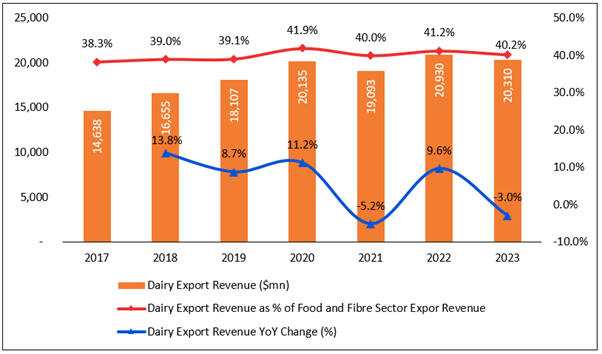
Data Source: This work is based on/includes the Ministry for Primary Industries data which are licensed under Crown for reuse under the Creative Commons Attribution 4.0 International Licence; Chart Created by Kalkine Group
Wine Export Revenue to Rise in 2023
As per MPI, the percentage of wine exported in bulk format has grown steadily since 2008, reaching 45% in the year to 30 June 2021, following the global trend for wine to be bottled. Further, the average export price for wine is expected to increase to $7.10/litre in 2022, providing some strength to the exporter. Meanwhile, the free trade deals with the UK will augment growth as wine is NZ's largest export to the UK. Also, the wine export revenue growth is anticipated to be 3.8% in 2023.
Exhibit 2: Trend in Wine Export Revenue 2017–23 (Year to 30 June, NZ$ million)

Data Source: This work is based on/includes the Ministry for Primary Industries data which are licensed under Crown for reuse under the Creative Commons Attribution 4.0 International Licence; Chart Created by Kalkine Group
Continued Growth in Food and Beverage Industry in December 2021
As per Stats.NZ's total retail sales volume grew 8.6%, and the total retail sales value (with price effects included) increased 10% ($2.6 billion) for the December 2021 quarter versus September 2021 quarter. In particular, food and beverage services increased 12% QoQ and with price effects included, food and beverage services grew 13% QoQ ($352 million). E-Retail has been a significant driver during the pandemic. Overall retail business growth indicates a positive direction in the overall macroeconomic scenario amid the economy's widening and easing of lockdown restrictions.
Index Performance:
The S&P/NZX All Consumer Staples Index generated a 10-year return of ~274.0% versus ~148.5% by the S&P/NZX All Index. Therefore, S&P/NZX All Consumer Staples Index overperformed S&P/NZX All Index by ~125.5% in 10-year.
Exhibit 3: S&P/NZX All Consumer Staples Index vs S&P/NZX All Index
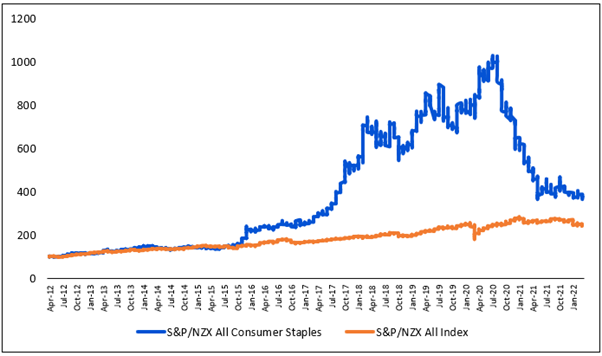
Source: REFINITIV, Chart Created by Kalkine
Key Risks and Challenges:
The changing international trends in food and agricultural ecosystems create a challenge for the suppliers and intermediaries. Further, climate change impacts disproportionately, exposing crop and livestock production. Additionally, the alcohol industry faces high competition from online sales to reach the consumer base with ease.
Exhibit 4. Key Risks in Consumer Staples Sector:
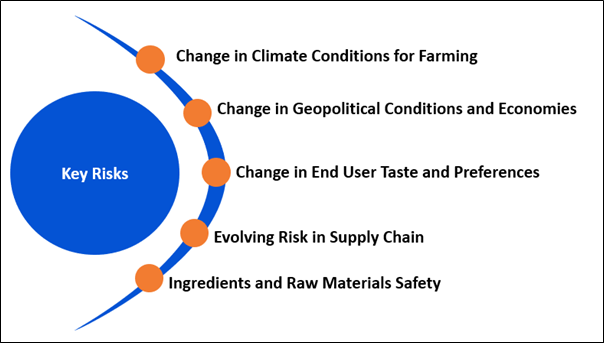
Source: Analysis by Kalkine Group
Outlook:
MPI reached a significant milestone in October 2021, agreeing in principle to the New Zealand-United Kingdom Free Trade Agreement (NZ-UK FTA) that will eliminate customs tariffs on food and fibre exports to the UK. The free trade deals with the UK reached an agreement, removing ~97% of tariffs on goods after the agreement. Wine, honey, onions and hoki will be the immediate beneficiaries of complete tariff reductions.
The government supports farmers and growers to capitalize on the opportunities as consumer values shift and helps drive recovery from the pandemic. Along with other projects, the government is streamlining new projects with support from the Sustainable Food and Fibre Futures (SFF Futures) fund. Since mid-2018, it has committed ~$160 million to approved SFF Futures programmes for a total investment of ~$355 million.
Apart from the sector-specific factors, we have also analysed four NZX-listed companies operating in the same sector. This report covers their insights, outlook, performance and potential as expected to be delivered in the near to medium term.
1. Fonterra Co-operative Group Limited (Recommendation: Buy, Potential Upside: Low Double-Digit (M-Cap: NZ$4.86 billion, Gross Dividend Yield: 6.645%)
Business Description:
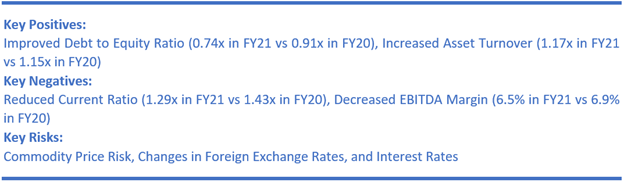
Fonterra Co-operative Group Limited (NZX: FCG) is a multinational dairy company that 13,000 NZ dairy farmers own.
Outlook:
As per the company, the impact of higher forecast Farmgate Milk Price will weigh on its margins in the consumer and foodservice businesses, while prices in its ingredients business remain promising for milk price and earnings at this stage. FCG remains comfortable with its earnings guided range of 25-35 cents per share for FY22.
Technical Overview:
Daily Price Chart
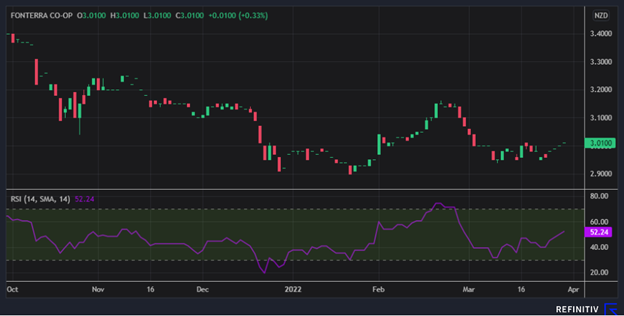
Source: REFINITIV, Note: Purple color line reflects Relative Strength Index (14-Period)
Stock Recommendation
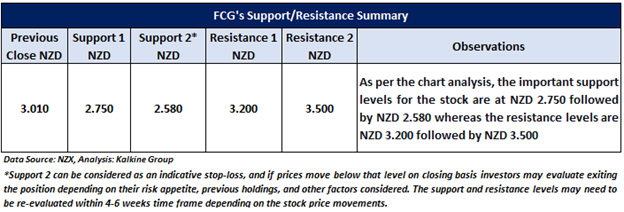
Considering the facts above, we give a “Buy” recommendation on the stock at the closing market price of $3.01 per share as of 31st March 2022.
2. Delegat Group Limited (Recommendation: Buy, Potential Upside: Low Double-Digit) (M-Cap: NZ$1.33 billion, Gross Dividend Yield: 2.129%)
Business Description:
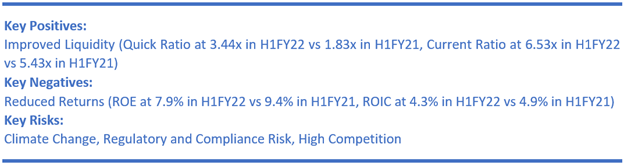
Based in New Zealand, Delegat Group Ltd (NZX: DGL) is the country’s leading player in the export of wine, with 20 vineyards and four wineries.
Outlook
As per the company, the vintage outcome will define better quality wines. Further, it has maintained sufficient inventories to achieve the 2022 forecast case sales. The company plans to increase sales by 25% to 3,976,000 cases in the next three years, primarily driven by Oyster Bay sales in North America. In FY22, it estimates to increase sales by 8% to 3,419,000 cases. It plans to achieve net operating profit after tax between $57-$61 million in FY22.
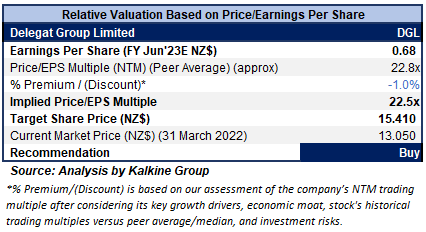
Valuation Methodology: Price/Earnings Per Share Based Relative Valuation (Illustrative)
Technical Overview:
Daily Price Chart
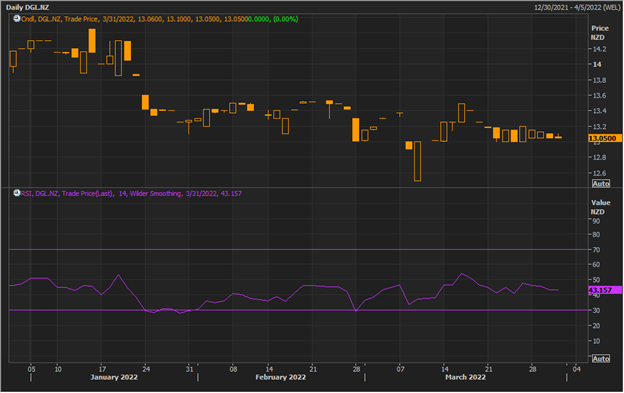
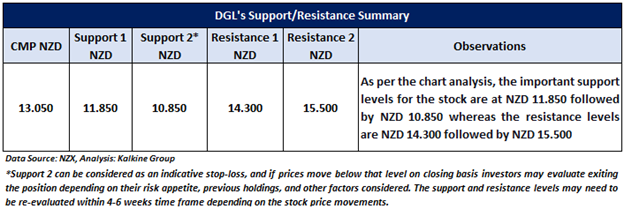
Source: REFINITIV, Note: Purple color line reflects Relative Strength Index (14-Period)
Stock Recommendation
The stock has been valued using P/E multiple-based illustrative relative valuation, and the target price so arrived reflects a rise of low double-digit (in % terms). Accordingly, a slight discount has been applied to P/E Multiple (NTM) (Peer Average), considering the fragile harvest anticipated in 2022 due to climate change.
Considering the facts above, we give a “Buy” recommendation on the stock at the current market price of $13.05 per share as of 31st March 2022 (New Zealand Time: 12:26 PM (GMT +12)).
3. Cooks Coffee Company Limited (Recommendation: Speculative Buy, Potential Upside: Low Double-Digit) (M-Cap: NZ$22.76 million)
Business Description:
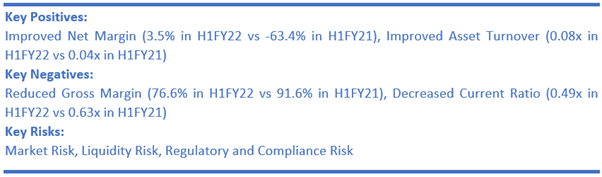
Cooks Coffee Company Limited (NZX: CCC), formerly known as Cooks Global Foods Limited (NZX: CGF), is engaged in the business of owning the intellectual property and master franchising rights to Esquires Coffee Houses worldwide (excluding New Zealand and Australia).
Outlook:
The company is hopeful of delivering better H2FY22 over H1FY22, despite COVID-19 restrictions and business risk. The Board expects the store opening program to sustain itself long-term. However, new store openings are projected to decrease in H2FY22. Concerning the shortfall placement of the rights issue, the company is looking at finalising contracts with lenders and creditors to convert further debt into shares and anticipates further advancement in 2022.
On 31 March 2022, the company released post consolidated shares (15 into one share) converted as the closing of 30 March 2022 price at 51,726,160 quoted shares and 1,333,333 non-voting shares issue.
Technical Overview:
Daily Price Chart
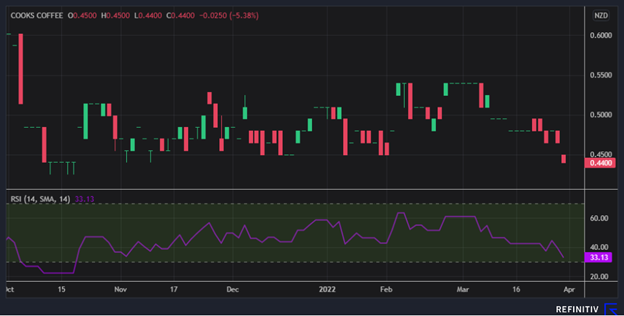
Source: REFINITIV, Note: Purple color line reflects Relative Strength Index (14-Period)
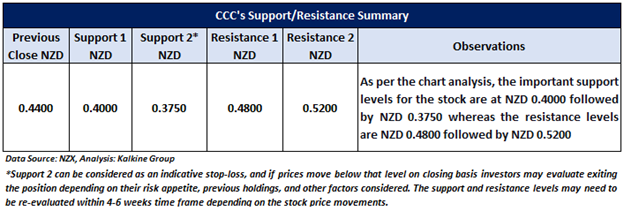
Stock Recommendation
Considering the facts above, we give a “Speculative Buy” recommendation on the stock at the closing market price of $0.44 per share, down 5.38% as of 31st March 2022.
Markets are trading in a highly volatile zone currently due to certain macro-economic issues and geopolitical tensions prevailing. Therefore, it is prudent to follow a cautious approach while investing.
Note 1: The reference data in this report has been partly sourced from REFINITIV.
Note 2: Investment decisions should be made depending on the investors’ appetite on upside potential, risks, holding duration, and any previous holdings. Investors can consider exiting from the stock if the Target Price mentioned as per the analysis has been achieved and subject to the factors discussed above alongside support levels provided.
Technical Indicators Defined:-
Support: A level where-in the stock prices tend to find support if they are falling, and downtrend may take a pause backed by demand or buying interest.
Resistance: A level where-in the stock prices tend to find resistance when they are rising, and uptrend may take a pause due to profit booking or selling interest.
Stop-loss: It is a level to protect further losses in case of unfavourable movement in the stock prices.
Disclaimer
Kalkine New Zealand Limited is authorised to provide general advice only. The information on this website does not take into account any of your investment objectives, financial situation or needs. Before you make a decision about whether to acquire a financial product, you should obtain the Product Disclosure Statement from the product issuer. You should consider the appropriateness of advice taking into account your own objectives, financial situation and needs and seek independent financial advice before making any financial decisions.
Past performance is not a reliable indicator of future performance.
 Please wait processing your request...