
 AU
AU
 UK
UK
 CA
CA
 US
US
 IND
IND

 NZ
NZ

This report is an updated version of the report published on 12th May 2022 at 4:56 PM (GMT +12)
I. Sector Landscape and Outlook
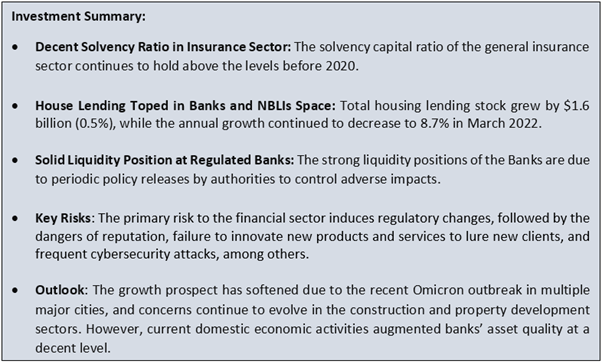
As per the Reserve Bank of New Zealand (RBNZ), the financial system remains solid in the country in the context of a significant global economic slowdown. In NZ, the reopening of borders and minimizing COVID-19 restrictions is expected to positively impact tourism and hospitality sectors. However, multiple other businesses will be tested in the post-COVID era as the broad level COVID-19 fiscal aid ends. The asset prices are cooling-off from their highs due to monetary measures taken to control inflation. Banks and insurers are in a solid position to augment the economy and offer financial services. Banks continue to be profitable and well-capitalized to provide financial liquidity.
Solvency Ratio Well Above 2020 Level
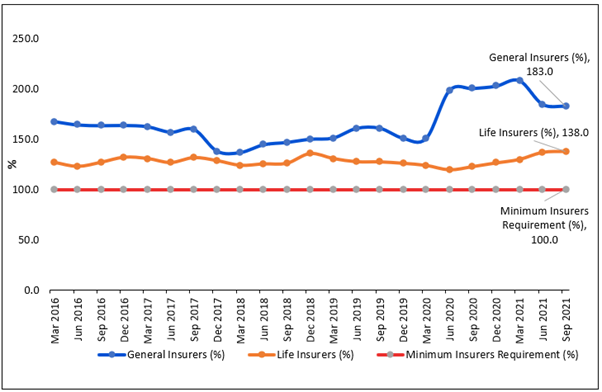
As per RBNZ, the solvency capital ratio of the general insurance sector fell in 2021; but is still higher than it was prior to 2020. The solvency ratio for the life insurance sector grew during 2021, while the fluctuation continues around previous levels for the health insurance sector. The sector remains resilient and well established in dealing with COVID-19 related issues. However, the new variant like Omicron and deferral of elective surgery and routine health screening due to COVID-19 related circumstances could ultimately lead to increased claim numbers.
Exhibit 1: Trend in Solvency Ratios of Life and General Insurers
Data Source: This work is based on/includes rbnz data which are licensed by rbnz.govt for reuse under the Creative Commons Attribution 4.0 International Licence; Chart Analysis by Kalkine Group
Continued Acceleration in Housing Lending in Banks and NBLIs Space
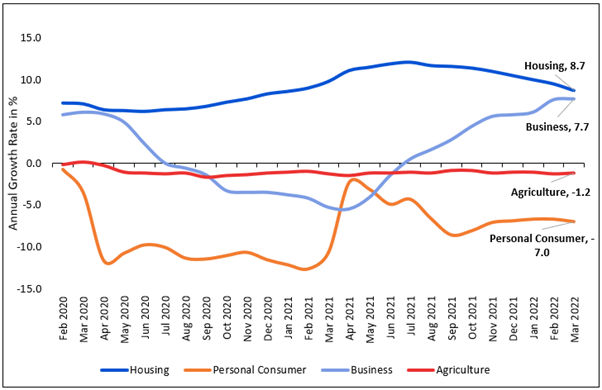
RBNZ's total housing lending stock grew by $1.6 billion (0.5%) in March 2022, higher than the $1.5 billion (0.4%) rise reported in February 2022. However, the annual growth continued to decrease to 8.7%, sliding further from 9.5% in February 2022. Additionally, the total personal consumer lending stock fell by $234 million (-1.7%) in March 2022, lower than the $69 million (-0.5%) decrease reported in February 2022. Accordingly, the annual growth fell to -7.0%. Meanwhile, the total business lending stock grew by $318 million (0.3%) in March 2022, with its annual growth rising from 7.6% to 7.7%, the highest annual growth rate reported since October 2016. The total agriculture lending stock was marginally down by $9 million (-0.01%) in March 2022, while annual growth grew from -1.3% to -1.2%.
Exhibit 2: Lending Pattern Since February 2020 – Banks and NBLIs
Data Source: This work is based on/includes rbnz data which are licensed by rbnz.govt for reuse under the Creative Commons Attribution 4.0 International Licence; Chart Created by Kalkine Group
Regulated Banks Continue to Enjoy Strong Liquidity Position
The registered banks in NZ have strong liquidity positions due to periodic policies released by authorities that require banks to hold adequate stock of liquid assets to cover customer withdrawals during a period of stress. Also, the banks are maintaining a minimum core funding ratio requirement, which has returned to 75% from 50% since January 2022. The monetary policies issued in the last two years provided the much-needed support to Banks, comprising the Large Scale Asset Purchase (LSAP) Programme and the Funding for Lending Programme (FLP), resulting in decreased interest rates and higher liquid assets in the banking system.
Index Performance:
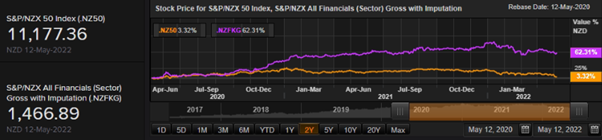
The S&P/NZX All Financials Index generated a 2-year return of ~62.31% versus ~3.32% by the S&P/NZX 50 Index. Therefore, S&P/NZX All Financials Index overperformed S&P/NZX 50 Index by ~58.99% in 2-year.
Exhibit 3: S&P/NZX All Financials Index vs S&P/NZX 50 Index
Source: REFINITIV
Key Risks and Challenges:
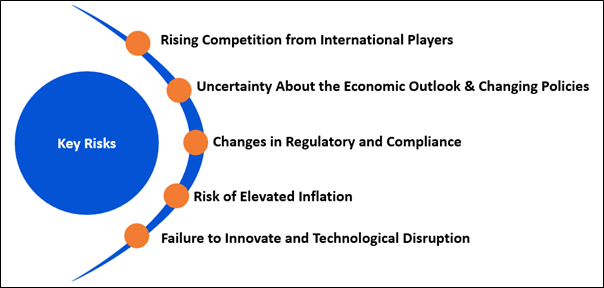
At the current junction, the global equity indices have decreased from their high because the increasing interest rates decreased the discounted value of future earnings and weakened the growth outlook. Risk aversion could re-emerge if geopolitical tensions accelerate, or the global growth prospect turns unfavourable. Inflation is at alarming levels across major economies, increasing anticipation of monetary policy tightening.
Exhibit 4. Key Risks in Financial Sector:
Source: Analysis by Kalkine Group
Outlook:
The growth prospect has softened due to the recent Omicron outbreak in multiple major cities, and concerns continue to evolve in the construction and property development sectors. The NZ house prices have moderated slightly but continued to remain high, increasing mortgage rates and the outlook for underlying demand and supply factors. Meanwhile, the banks’ capital positions grew well above the capital requirements over the past two years. Further, the recent domestic economic activities augmented banks’ asset quality at a decent level. Also, the non-performing loans and arrears remain at minimal levels, providing the banking sector’s ability to absorb losses and maintain lending in a downturn.
Apart from the sector-specific factors, we have also analysed four NZX-listed companies operating in the same sector. This report covers their insights, outlook, performance and potential as expected to be delivered in the near to medium term.
1) Heartland Group Holdings Limited (Recommendation: Buy, Potential Upside: Low Double-Digit) (M-Cap: NZ$1.33 billion, Gross Dividend Yield: 7.820%)
Business Description:
Heartland Group Holdings Limited (NZX: HGH) is a financial services group. In New Zealand, Heartland Bank Limited is a registered bank. Through Australian businesses, the company provides reverse mortgage loans and funding to small business and customer lending sectors.
Outlook:
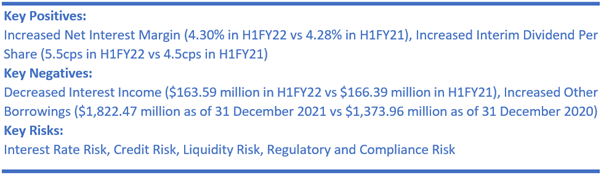
Despite sustained impacts of COVID-19 in addition to legislative disruption, Heartland surpassed its expectations for its H1FY22 NPAT. Meanwhile, the company expects growth in H2FY22 to slow in Motor and online Home Loans owing to CCCFA impact. The company anticipates the continued shift in portfolio mix toward higher quality and lower risk assets is likely to impact NIM in H2FY22. By increasing digitalization and automation, the company aims to increase the ability to pass cost savings to customers at market-leading or competitive rates, hence, decreasing the CTI ratio. Heartland expects NPAT for FY22 to be within the guidance range of $93 million to $96 million.
On 1 April 2022, the company stated that it signed conditional sale documentation for the acquisition of StockCo Holdings 2 Pty Ltd from StockCo Australia Holdings Limited (70%) and Elders Rural Service Australia Limited (Elders, ASX: ELD) (30%).
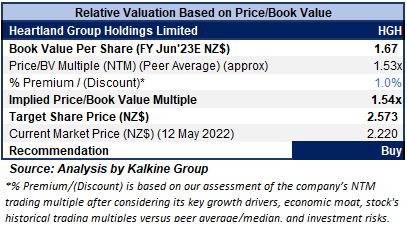
Valuation Methodology: Price/Book Value Based Relative Valuation (Illustrative)
Technical Overview:
Daily Price Chart
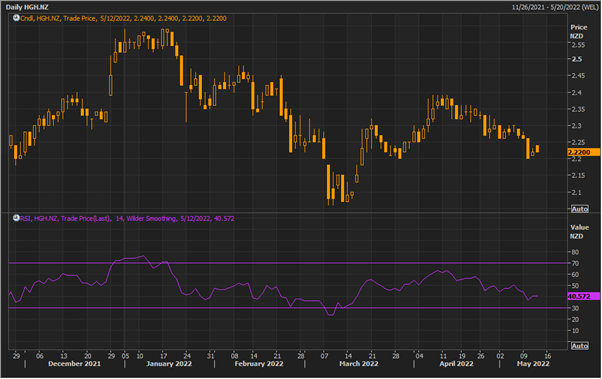
Source: REFINITIV, Note: Purple color line reflects Relative Strength Index (14-Period)
.png)
Stock Recommendation:
The stock has been valued using P/B value per share based on relative valuation (on an illustrative basis), and the target price so arrived reflects a rise of low double-digit (in % terms). A slight premium has been applied to the P/B value per share multiple (NTM) (Peer Average), considering the decent outlook and increased profitability and its strategic priorities towards expansion in Australia through potential acquisitions.
Considering the fact above, we give a “Buy” recommendation on the stock at the current market price of NZ$2.22 per share as of 12th May 2022 (New Zealand Time: 11:33 AM (GMT +12)).
2) NZX Limited (Recommendation: Buy, Potential Upside: Low Double-Digit) (M-Cap: NZ$403.17 million, Gross Dividend Yield: 6.724%)
Business Description:
NZX Limited (NZX: NZX) operates New Zealand’s equity, debt, derivatives, and energy markets. It also provides clearing, trading, depository, settlement, and data services.
Outlook
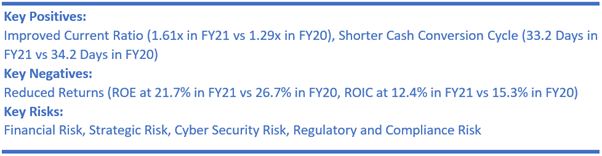
For FY22, the company is anticipating operating earnings of $33.5-$38.0 million. The COVID-19 pandemic materially stimulated and boosted financial activities in 2021, which is expected to be continued in FY22. The focus area would be strengthening core businesses and creating a solid platform for future growth. Further, the company plans to invest in growth opportunities areas like technology to ensure core capital markets’ infrastructure meets investor and regulator expectations. It aims to see the Smartshares and Wealth Technologies scale revenue growth into earnings.
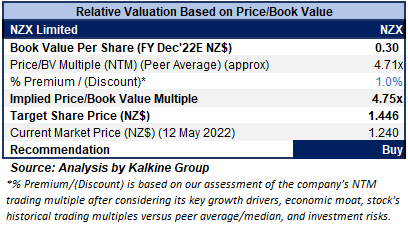
Valuation Methodology: Price/Book Value Based Relative Valuation (Illustrative)
Technical Overview:
Daily Price Chart
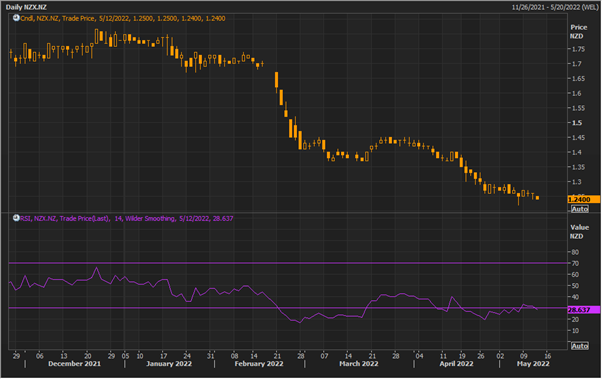
Source: REFINITIV, Note: Purple color line reflects Relative Strength Index (14-Period)
.png)
Stock Recommendation
The stock has been valued using a P/B multiple-based illustrative relative valuation, and the target price so arrived reflects a rise of low double-digit (in % terms). A slight premium has been applied to P/B Multiple (NTM) (Peer Average), considering significant progress in the company’s strategy to re-engineer the NZX Group for future growth.
Considering the factors above, we give a “Buy” recommendation on the stock at the current market price of $1.24 per share as of 12th May 2022 (New Zealand Time: 11:33 AM (GMT +12)).
3) Tower Limited (Recommendation: Hold, Potential Upside: Low Double-Digit) (M-Cap: NZ$259.95 million, Gross Dividend Yield: 7.226%)
Business Description:
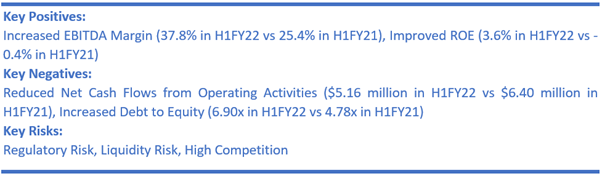
Tower Limited (NZX: TWR) is primarily engaged in general insurance. The company operates in New Zealand, with some operations based in the Pacific Islands region.
Outlook
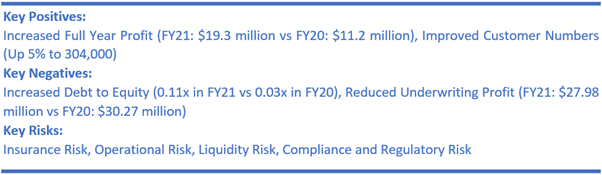
The company is continuously working on planned strategies for innovation and growth. Its flagship Tower Direct business and well-established partnership distribution capability continue to provide strength. Further, the digitization designed for Pacific business is expected to improve efficiency and competitiveness. FY21 Guidance: The company anticipates underlying net profit after tax, excluding significant events, to be in the range of $35.4-$39.4 million for FY22, Underlying NPAT in the range of $21.0-$25.0 million for FY22 and dividend ~5cps.
On 26 April 2022, the company stated that it plans to release its H1FY22 results on 26 May 2022.
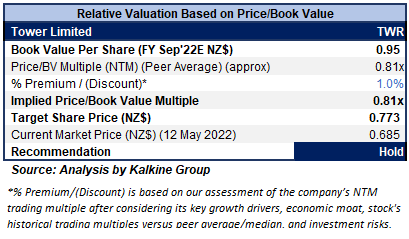
Valuation Methodology: Price/Book Value Based Relative Valuation (Illustrative)
Technical Overview:
Daily Price Chart
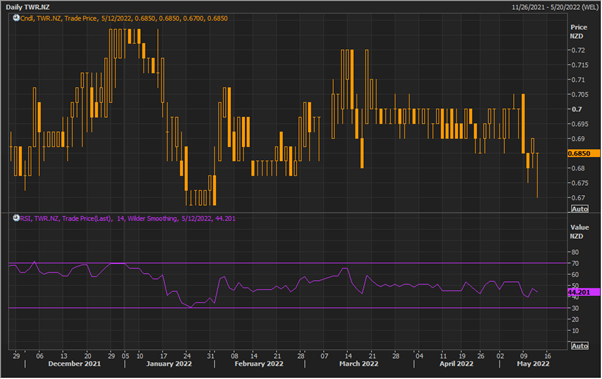
Source: REFINITIV, Note: Purple color line reflects Relative Strength Index (14-Period)
.png)
Stock Recommendation:
The stock has been valued using a P/B multiple-based illustrative relative valuation, and the target price so arrived reflects a rise of low double-digit (in % terms). A slight premium has been applied to P/B Multiple (NTM) (Peer Average), considering the company's technology partnerships to respond to challenges and capitalize on opportunities.
Considering the fact above, we give a “Hold” recommendation on the stock at the current market price of NZ$0.685 per share as of 12th May 2022 (New Zealand Time: 4:12 PM (GMT +12)).
4) General Capital Limited (Recommendation: Hold, Potential Upside: Low Double-Digit) (M-Cap: NZ$11.48 million)
Business Description:
General Capital Limited (NZX: GEN) is a financial services group listed on the NZX. The shares can be traded through any NZX participant, many Investment Advisers in New Zealand, and International Stock Brokers and advisors with New Zealand associates.
Outlook
The company has upgraded its earnings guidance for FY22. It now expects to achieve net profit after tax (NPAT) between $0.9-$1.10 million in FY22, a substantial rise from its previous NPAT guidance of $0.65-$0.85 million, reaffirmed in November 2021. Further, the company stated that the outlook is very positive, but the volatility will continue to drive markets. Notably, the company plans to focus on growth and profit.
Technical Overview:
Daily Price Chart
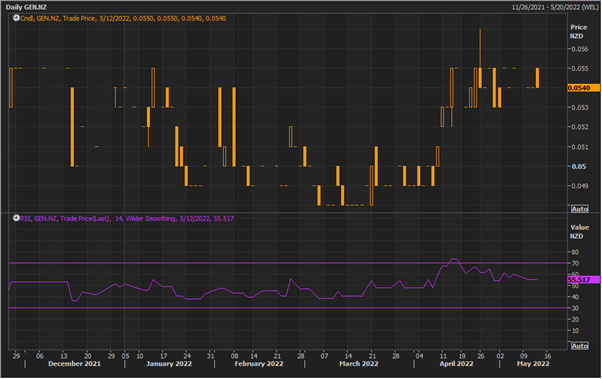
Source: REFINITIV, Note: Purple color line reflects Relative Strength Index (14-Period)
.png)
Stock Recommendation:
Considering the factors above and the positive outlook, we give a “Hold” recommendation on the stock at the current market price of $0.054 per share as of 12th May 2022 (New Zealand Time: 4:12 PM (GMT +12)).
Markets are trading in a highly volatile zone currently due to certain macro-economic issues and geopolitical tensions prevailing. Therefore, it is prudent to follow a cautious approach while investing.
Note 1: The reference data in this report has been partly sourced from REFINITIV.
Note 2: Investment decisions should be made depending on the investors’ appetite on upside potential, risks, holding duration, and any previous holdings. Investors can consider exiting from the stock if the Target Price mentioned as per the analysis has been achieved and subject to the factors discussed above alongside support levels provided.
Technical Indicators Defined: -
Support: A level where-in the stock prices tend to find support if they are falling, and downtrend may take a pause backed by demand or buying interest.
Resistance: A level where-in the stock prices tend to find resistance when they are rising, and uptrend may take a pause due to profit booking or selling interest.
Stop-loss: It is a level to protect further losses in case of unfavourable movement in the stock prices.
Disclaimer
Kalkine New Zealand Limited is authorised to provide general advice only. The information on this website does not take into account any of your investment objectives, financial situation or needs. Before you make a decision about whether to acquire a financial product, you should obtain the Product Disclosure Statement from the product issuer. You should consider the appropriateness of advice taking into account your own objectives, financial situation and needs and seek independent financial advice before making any financial decisions.
Past performance is not a reliable indicator of future performance.
 Please wait processing your request...