
 AU
AU
 UK
UK
 CA
CA
 US
US
 IND
IND

 NZ
NZ

This report is an updated version of the report published on 28 July 2022 at 5:48 PM (GMT +12)
I. Sector Landscape and Outlook
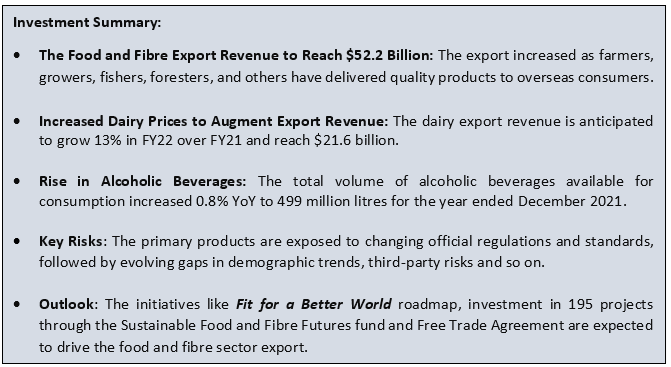
As per the Ministry for Primary Industries (MPI), food and fibre sector export revenue is projected to reach $52.2 billion by the end of 30 June 2022, driven by Dairy (41% of Food and Fibre Sector Export Revenue), Meat & wool (23%), Forestry (12%), Horticulture (13%), Seafood (4%), and Processed food and other (7%). Further, food and fibre export revenue is projected to reach $56.8 billion by 30 June 2026. Additionally, the government is pushing free trade agreement (FTA) with major exporting countries to grow its export market.
Exhibit 1: Top 10 Export Destinations (Year to 31 March 2022, NZ$ million)
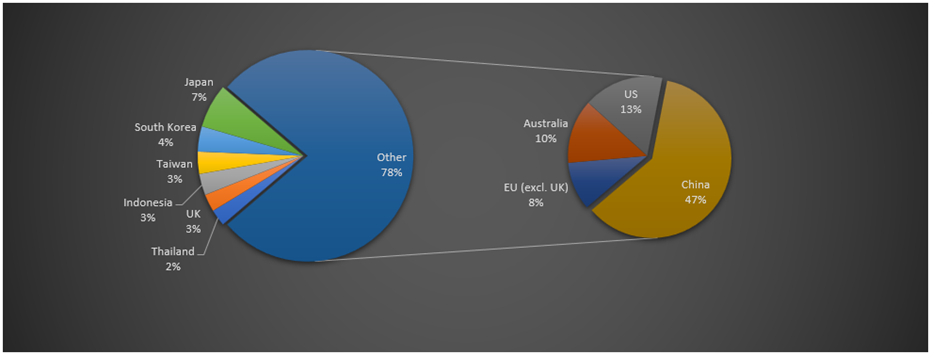
Data Source: This work is based on/includes the Ministry for Primary Industries data which are licensed under Crown for reuse under the Creative Commons Attribution 4.0 International Licence; Chart Created by Kalkine Group
The Rise in Demand for Dairy Products in International Market
As per MPI, the dairy export revenue is anticipated to increase 13% in FY22 over FY21 and reach $21.6 billion, primarily led by higher global demand and decreased supply from other key dairy exporting regions. Milk production for FY22 is anticipated to fall 4% and reach 1,869 million kilograms of milksolids because of unfavourable weather conditions, rising input costs and labour shortages. However, high global dairy prices are anticipated to drive the all-company average forecast farmgate payout to a record high of $9.30 for FY22, improving on-farm profitability. All dairy product categories, excluding infant formula, are projected to surpass their 5-year average in export revenue.
Exhibit 2: Trend in Dairy Export Revenue 2018–26 (Year to 30 June, NZ$ million)
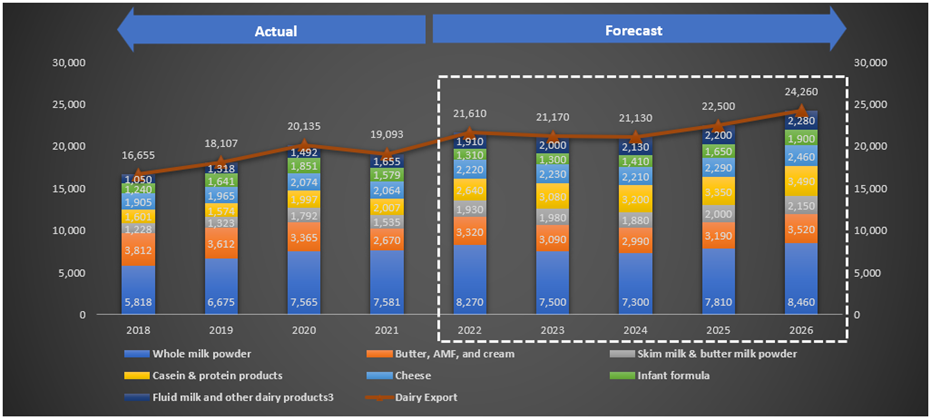
Data Source: This work is based on/includes the Ministry for Prismary Industries data which are licensed under Crown for reuse under the Creative Commons Attribution 4.0 International Licence; Chart Created by Kalkine Group
Volume of Alcoholic Beverages Available for Consumption Continued its Increasing Momentum
As per Stats.NZ, the total volume of alcoholic beverages available for consumption increased 0.8% YoY to 499 million litres for the year ended December 2021. The volume of spirits (including spirit-based drinks) increased 12% to 100 million litres. The equivalent total volume of pure alcohol in all alcoholic beverages grew 0.7% during the same period. Further, the volume of available alcohol, expressed in the number of equivalent standard drinks per person aged 18 years and over, was little changed, up 0.1% to 2.0 per person per day.
Exhibit 3: Trend in Volume of Alcohol Beverages for Consumption (million Litres), by Type, Year Ended December 2006–2021
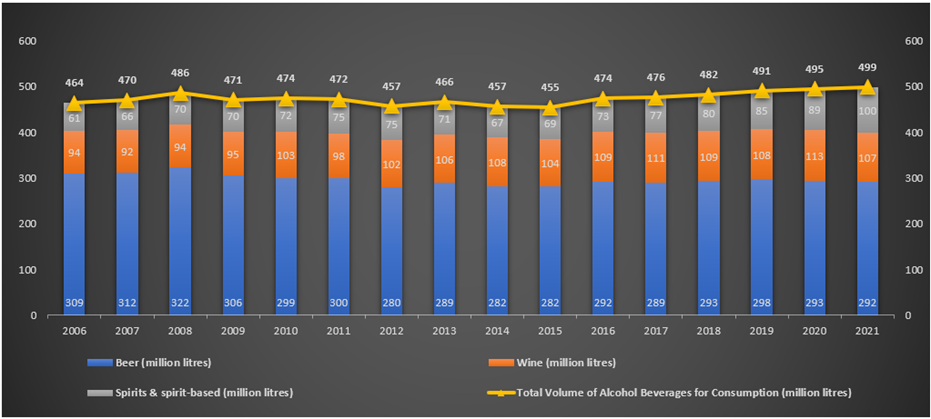
Data Source: This work is based on/includes Stats NZ’s data which are licensed by Stats NZ for reuse under the Creative Commons Attribution 4.0 International Licence; Chart Created by Kalkine Group
Index Performance:
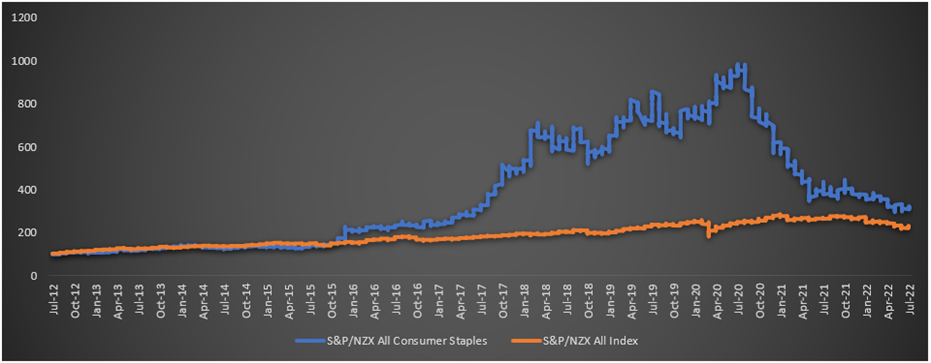
The S&P/NZX All Consumer Staples Index generated a 10-year return of ~213.3% versus ~129.4% by the S&P/NZX All Index. Therefore, S&P/NZX All Consumer Staples Index overperformed S&P/NZX All Index by ~83.8% in 10-year.
Exhibit 4: S&P/NZX All Consumer Staples Index vs S&P/NZX All Index
Source: REFINITIV, Chart Created by Kalkine
Key Risks and Challenges:
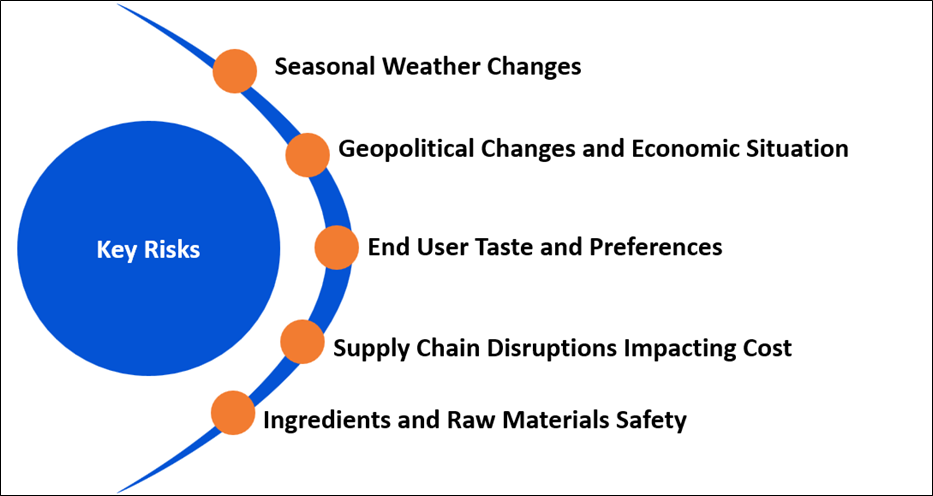
Harmful alcohol drinking can result in severe health and personal and social problems. Moreover, alcohol is one of the leading preventable risks causing several diseases, like cancer, mental health conditions and long-term conditions. Meanwhile, the vital parts of food ecosystems are becoming more capital-intensive, vertically integrated and concentrated in fewer hands. Also, crises and natural disasters are growing in number and intensity.
Exhibit 5. Key Risks in Consumer Staples Sector:
Source: Analysis by Kalkine Group
Outlook:
The food and fibre sector continues to drive the economic recovery for most New Zealanders, primarily driven by the number of initiatives taken by the government and sector roadmap Fit for a Better World. The government is focused on 195 projects through the Sustainable Food and Fibre Futures fund to deliver outcomes. Moreover, the momentum is building on trade partnerships like the historic FTA with the United Kingdom in March 2022, the ongoing implementation of the FTA with China (projected to drive savings of $180 million per annum at current export volumes), and ongoing progress in negotiating an FTA with the European Union (market with over 400 million consumers). The upgrade of FTA is expected to drive further growth and savings for exporters, driven by innovating and adapting to changing markets.
Apart from the sector-specific factors, we have also analysed three NZX-listed companies operating in the same sector. This report covers their insights, outlook, performance and potential as expected to be delivered in the near to medium term.
1) Delegat Group Limited (Recommendation: Buy, Potential Upside: Low Double-Digit (M-Cap: NZ$1.16 billion, Annual Dividend Yield (TTM)1: 2.45%)
Business Description:
Delegat Group Limited (NZX: DGL) is the country’s leading player in the export of wine with 20 vineyards and 4 wineries under its kitty.

Outlook:
With the fruitful completion of the renegotiation of its $333 million syndicated Senior Debt facilities on 7 December 2021, the Group is better placed to fund its growth. Further, the group is aiming at attaining global case sales of 3,419,000 for FY22, up 8% YoY. Based on the prevailing exchange rates and a similar trading environment, the Group expects the 2022 Operating Profit result to stay in line with market guidance between NZD57 million to NZD61 million. With the Marlborough and Hawke’s Bay growing season witnessed above average rainfall in 2022, the group expects the vintage outcome to produce excellent quality wines for its brands.
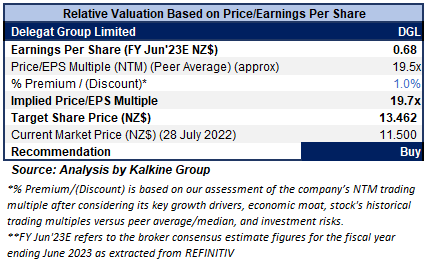
Valuation Methodology: Price/Earnings Per Share Based Relative Valuation (Illustrative)
Technical Overview:
Daily Price Chart
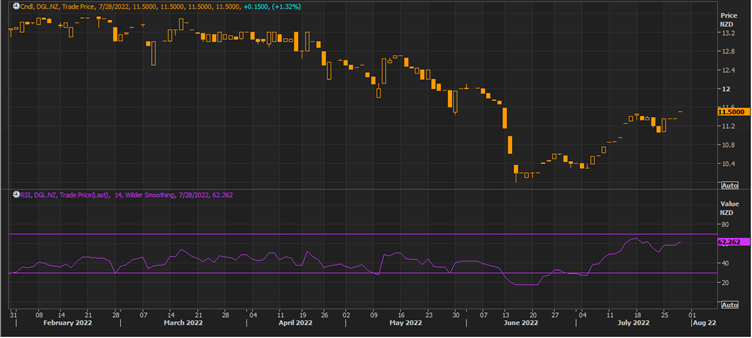
Source: REFINITIV, Note: Purple color line reflects Relative Strength Index (14-Period)
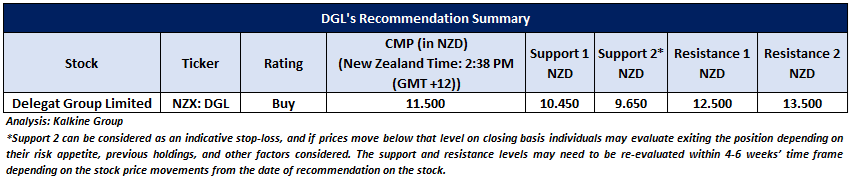
Stock Recommendation
The stock has been valued using P/E multiple-based illustrative relative valuation and the target price so arrived reflects a rise of low double-digit (in % terms). A slight premium has been applied to P/E Multiple (NTM) (Peer Average), considering its record global sales in H1FY22 as well as the guidance on global case sales for FY22.
Considering the facts above, a ‘Buy’ recommendation on the stock has been provided at the current market price of $11.50 per share, as of 28 July 2022 (New Zealand Time: 2:38 PM (GMT +12)).
2) Synlait Milk Limited (Recommendation: Speculative Buy, Potential Upside: Low Double-Digit) (M-Cap: NZ$681.98 million)
Business Description:
Synlait Milk Limited (NZX: SML) is engaged in producing a range of nutritional milk products for its global customers by combining expert farming with state-of-the-art processing.

Outlook
The company has reduced its forecast base milk price for the 2021/2022 season to $9.30/kgMS from $9.60/kgMS. Although, the dairy commodity prices declined over the past two months, however this milk price will be the highest ever paid by the company. Further, the company is witnessing a decent start to the 2022/2023 season as certain product were sold at historically high prices, and foreign exchange movements facilitating a robust milk price. It increased its forecast base milk price forecast for the 2022/2023 season to $9.50/kgMS from $9.00/kgMS.
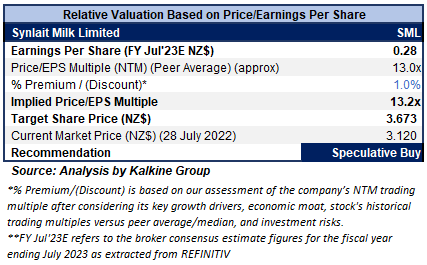
Valuation Methodology: Price/Earnings Per Share Based Relative Valuation (Illustrative)
Technical Overview:
Daily Price Chart
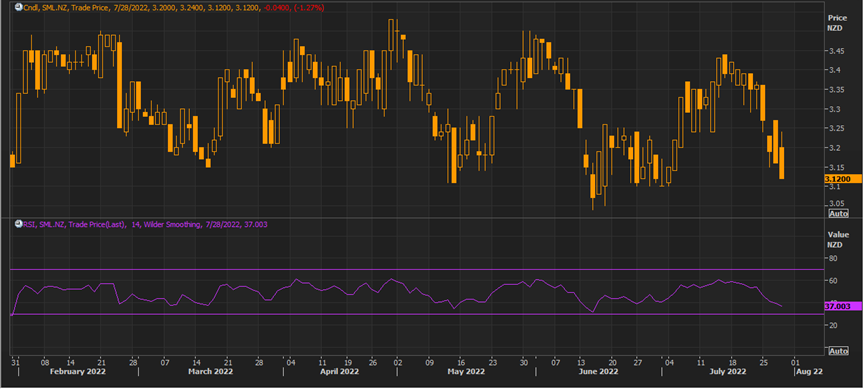
Source: REFINITIV, Note: Purple color line reflects Relative Strength Index (14-Period)
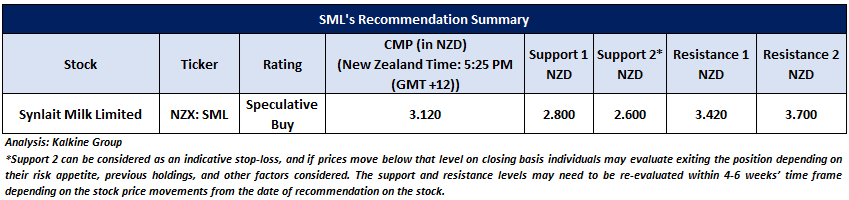
Stock Recommendation
The stock has been valued using P/E multiple-based illustrative relative valuation, and the target price reflects a rise of low double-digit (in % terms). A slight premium has been applied to P/E Multiple (NTM) (Peer Average), considering its strong result performance in H1FY22. Further, the company is on-track to attain at least $7 million in organisational reset savings in FY22 and is also aiming at a net debt to EBITDA ratio of 3.5x to 4.0x in FY22.
Considering the facts above, a ‘Speculative Buy’ recommendation on the stock has been provided at the current market price of $3.12 per share as of 28 July 2022 (New Zealand Time: 5:25 PM (GMT +12)).
3) Foley Wines Limited (Recommendation: Speculative Buy, Potential Upside: Low Double-Digit) (M-Cap: NZ$94.00 million, Annual Dividend Yield (TTM)1: 3.97%)
Business Description:
Foley Wines Limited (NZX: FWL) is engaged in the wineries business. It holds a collection of iconic wineries and brands from New Zealand’s most acclaimed wine regions that include Martinborough Vineyard, Te Kairanga, Grove Mill, Vavasour, Mt Difficulty, and Lighthouse Gin.

Outlook
The company is going as per plan to achieve an operating profit in line with last year’s result, primarily driven by the execution of its premiumisation strategy. Owing to the attempts made by the company towards creating solid routes to market this year’s harvest, FWL believes to be well placed to drive future growth.
Technical Overview:
Daily Price Chart
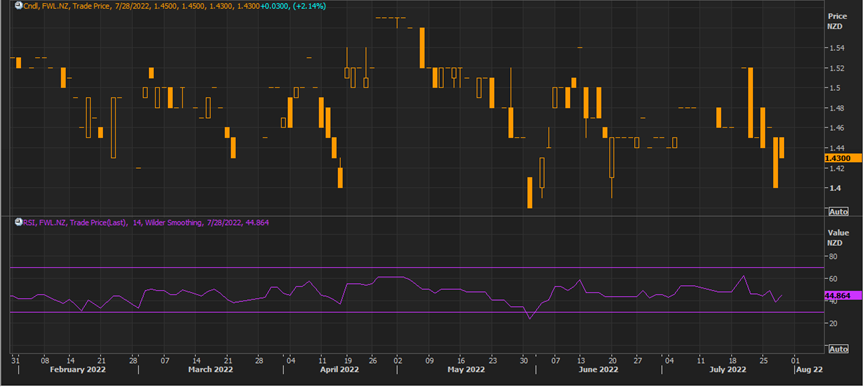
Source: REFINITIV, Note: Purple color line reflects Relative Strength Index (14-Period)
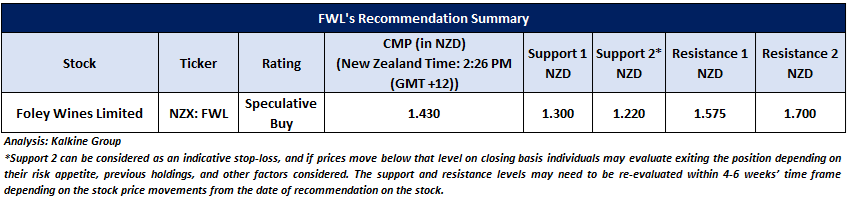
Stock Recommendation
Considering the facts above, a ‘Speculative Buy’ recommendation on the stock has been provided at the current market price of $1.43 per share as of 28 July 2022 (New Zealand Time: 2:26 PM (GMT +12)).
Markets are trading in a highly volatile zone currently due to certain macro-economic issues and geopolitical tensions prevailing. Therefore, it is prudent to follow a cautious approach while investing.
Note 1: Past performance is not a reliable indicator of future performance.
Note 2: The reference date for all price data, currency, technical indicators, support, and resistance levels is July 28, 2022. The reference data in this report has been partly sourced from REFINITIV.
Note 3: Investment decisions should be made depending on an individual's appetite for upside potential, risks, holding duration, and any previous holdings. An 'Exit' from the stock can be considered if the Target Price mentioned as per the Valuation and or the technical levels provided has been achieved and is subject to the factors discussed above.
Note 4: Annual Dividend Yield is on a Trailing Twelve Month (TTM1) basis and are subject to change based on factors such as company performance, stock price changes, etc.
Technical Indicators Defined: -
Support: A level at which the stock prices tend to find support if they are falling, and a downtrend may take a pause backed by demand or buying interest. Support 1 refers to the nearby support level for the stock and if the price breaches the level, then Support 2 may act as the crucial support level for the stock.
Resistance: A level at which the stock prices tend to find resistance when they are rising, and an uptrend may take a pause due to profit booking or selling interest. Resistance 1 refers to the nearby resistance level for the stock and if the price surpasses the level, then Resistance 2 may act as the crucial resistance level for the stock.
Stop-loss: It is a level to protect further losses in case of unfavourable movement in the stock prices.
Disclaimer
Kalkine New Zealand Limited is authorised to provide general advice only. The information on this website does not take into account any of your investment objectives, financial situation or needs. Before you make a decision about whether to acquire a financial product, you should obtain the Product Disclosure Statement from the product issuer. You should consider the appropriateness of advice taking into account your own objectives, financial situation and needs and seek independent financial advice before making any financial decisions.
Past performance is not a reliable indicator of future performance.
 Please wait processing your request...