
 AU
AU
 UK
UK
 CA
CA
 US
US
 IND
IND

 NZ
NZ

I. Sector Landscape and Outlook
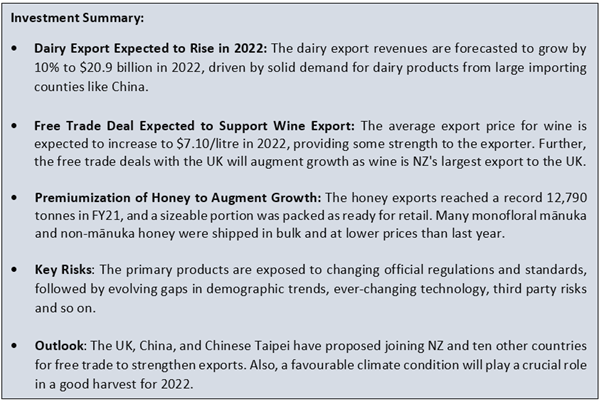
As per the Ministry for Primary Industries (MPI), food and fibre sector export revenue will cross $50 billion for the first time, reaching a record $50.8 billion in FY22, up 6% YoY. An increase in total export revenue is anticipated for most sectors like dairy, meat and wool, horticulture, seafood, forestry and arable. Meanwhile, the free trade deals with the UK reached an agreement in principle, removing ~97% of tariffs on goods after the agreement. Wine, honey, onions and hoki will be the immediate beneficiaries of complete tariff reductions.
Dairy Export Poised to Grow by 10% in 2022
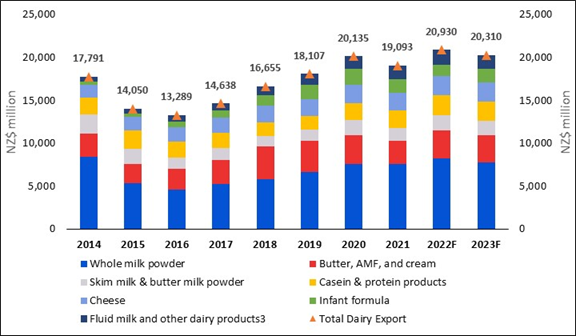
As per MPI, dairy export revenues are anticipated to grow by 10% to $20.9 billion in 2022 despite anticipation of a decline in milk production. The key driving factor for this growth would be a decrease in a few dairy exporting geographies and solid demand for dairy products from large importing counties like China. Therefore, higher export prices are anticipated to result in high farmgate milk prices. However, the industry continues to get disrupted due to COVID-19 related circumstances, high freight costs and rising farm input costs.
Exhibit 1: Trend in Dairy Export Revenue 2014–23 (Year to 30 June, NZ$ million)
Data Source: This work is based on/includes the Ministry for Primary Industries data which are licensed under Crown for reuse under the Creative Commons Attribution 4.0 International Licence; Chart Created by Kalkine Group
Electronic Card Transactions Continued to Grow in January 2022
As per Stats.NZ, the changes in the value of electronic card transactions for the January 2022 month versus December 2021 indicate that retail industries' spending increased 3.0% ($184 million) and spending in the core retail industries increased 3.0% ($164 million). In the consumables sub-industry space, durables grew $54 million (3.3%), and consumables increased by $44 million (1.8%).
Wine Export Supported by Growing Average Export Price
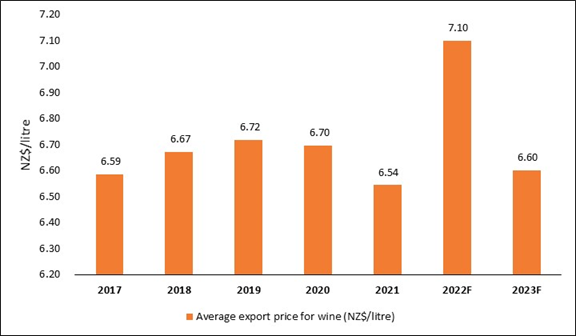
As per MPI, the average export price for wine is expected to increase to $7.10/litre in 2022, providing some strength to the exporter as poor harvest in autumn 2021 resulted in lower volumes. Following the massive 457,000 tonne harvest in 2020, production volumes decreased 19% to 370,000 tonnes in 2021. Further, NZ is progressing on free trade deals with the UK at a difficult time. Wine is NZ's largest export to the UK, as it accounted for $445 million in export revenue for the year to 30 June 2021. The removal of the current customs duty ($50 per 100 litres) is expected to save ~$14 million for the wine sector.
Exhibit 2: Trend in Average Export Price for Wine 2014-2023
Data Source: This work is based on/includes the Ministry for Primary Industries data which are licensed under Crown for reuse under the Creative Commons Attribution 4.0 International Licence; Chart Created by Kalkine Group
Export Demand to Drive Future Growth for Honey
As per MPI, honey exports reached a record 12,790 tonnes in FY21. However, the average price decreased by 9% to $37.66 per kg versus last year. While major exported honey was still packed ready for retail, many monofloral mānuka and non-mānuka honey were shipped in bulk and at lower prices than last year. Honey exports are anticipated to fall to $460 million for FY22. The demand for monofloral manuka is expected to remain firm.
Index Performance:
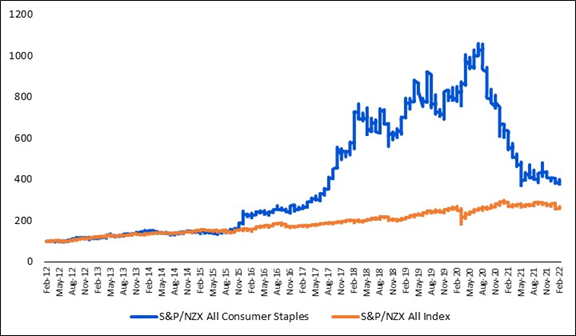
The S&P/NZX All Consumer Staples Index generated a 10-year return of ~292.5% versus ~164.4% by the S&P/NZX All Index. Therefore, S&P/NZX All Consumer Staples Index overperformed S&P/NZX All Index by ~128.1% in 10-year.
Exhibit 3: S&P/NZX All Consumer Staples Index vs S&P/NZX All Index
Source: REFINITIV, Chart Created by Kalkine
Key Risks and Challenges:
The changing international trends influence food security, poverty and complete sustainability of food and agricultural ecosystems. Further, climate change impacts disproportionately food-insecure regions, exposing crop and livestock production as well as fish stocks and fisheries. Also, the vital parts of food ecosystems are turning into more capital-intensive, vertically integrated and concentrated in fewer hands. Moreover, crises and natural disasters are growing in number and intensity.
The alcohol industry is competing to make its presence in online sales to reach a more extensive consumer base, like other booming online industries. While few alcohol brands have made their presence felt online, others have learned to create strategic partnerships.
Exhibit 4. Key Risks in Consumer Staples Sector:
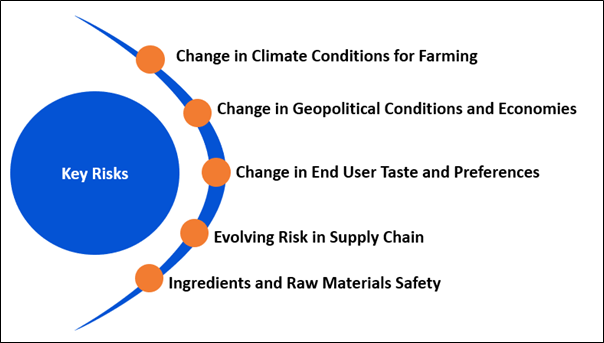
Sources: Analysis by Kalkine Group
Outlook:
As per MPI, total export revenue for food and fibre is expected to touch $50.8 billion in FY22, reflecting a net rise of 6% YoY. MPI reached a significant milestone in October 2021, agreeing in principle for the New Zealand-United Kingdom Free Trade Agreement (NZ-UK FTA) that will eliminate customs tariffs on food and fibre exports to the UK. This will facilitate exporters to compete on a level playing field in the UK market.
The country is seeing rising demand for NZ products, such as dairy products, logs sawn timber and horticultural produce, indicating a promising and growing future for New Zealanders.
Apart from the sector-specific factors, we have also analysed four NZX-listed companies operating in the same sector. This report covers their insights, outlook, performance and potential as expected to be delivered in the near to medium term.
1) The a2 Milk Company Limited (Recommendation: Buy, Potential Upside: Low Double-Digit (M-Cap: NZ$4.27 billion)
Business Description:
The a2 Milk Company Limited (NZX: ATM) provides branded products in targeted markets made with milk from cows that produce milk naturally containing only the A2 protein type.
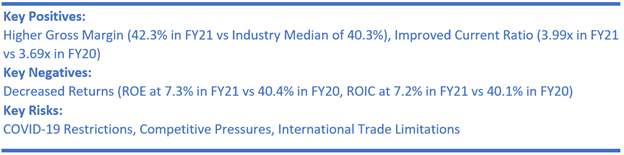
Outlook:
The company is confident in the fundamentals of its business, and it has a strong outlook on the future. It also acknowledges the inevitable challenges related to COVID-19 and other rapidly changing market dynamics. The overall marketing investment in FY 2022 is expected to return to approximately FY 2020 levels which is anticipated to continue to drive improved brand health metrics as well as future demand.
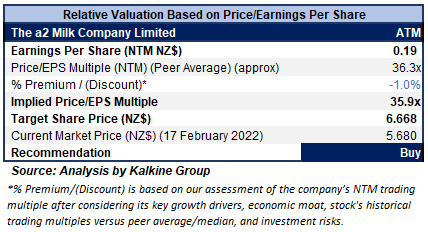
Valuation Methodology: Price/Earnings Per Share Based Relative Valuation (Illustrative)
Technical Overview:
Daily Price Chart
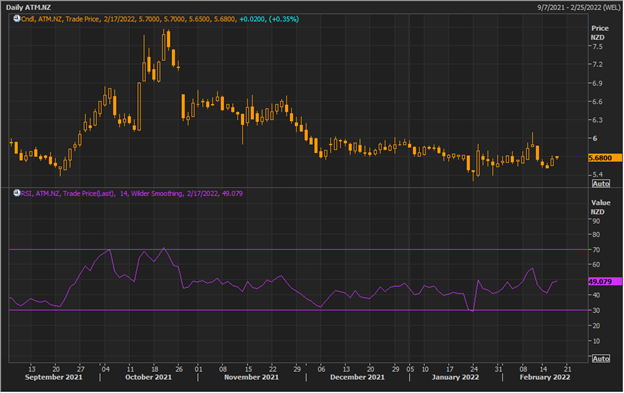
Source: REFINITIV, Note: Purple color line reflects Relative Strength Index (14-Period)
Stock Recommendation
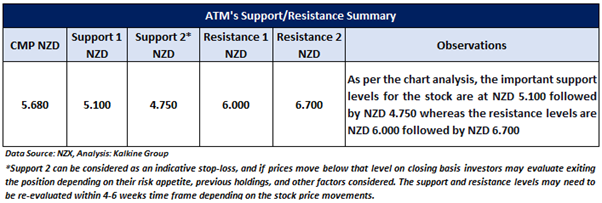
The stock has been valued using P/E multiple-based illustrative relative valuation, and the target price so arrived reflects a rise of low double-digit (in % terms). A slight discount has been assigned to P/E Multiple (NTM) (Peer Average), considering the risks related to the COVID-19 pandemic and supply chain disruption. However, the company is possessing decent outlook.
Considering the facts above, we give a “Buy” recommendation on the stock at the current market price of $5.68 per share as of 17th February 2022 (New Zealand Time: 12:17 PM (GMT +12)).
2) Delegat Group Limited (Recommendation: Buy, Potential Upside: Low Double-Digit) (M-Cap: NZ$1.36 billion, Gross Dividend Yield: 2.089%)
Business Description:
Based in New Zealand, Delegat Group Limited (NZX: DGL) is the country’s leading player in the export of wine.
Outlook
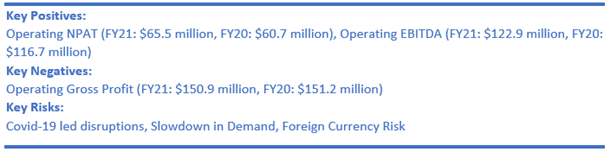
The company stated that the vintage outcome will result in delivering better quality wines. Also, it has maintained sufficient inventories to achieve the 2022 forecast case sales. The company plans to boost sales by 25% to 3,976,000 cases over the next three years mainly driven by Oyster Bay sales in North America. However, in FY22, it estimates to increase sales by 8% to 3,419,000 cases. DGL has guided achieving operating net profit after tax between $57 to $61 million in FY22.
Valuation Methodology: Price/Earnings Per Share Based Relative Valuation (Illustrative)
Technical Overview:
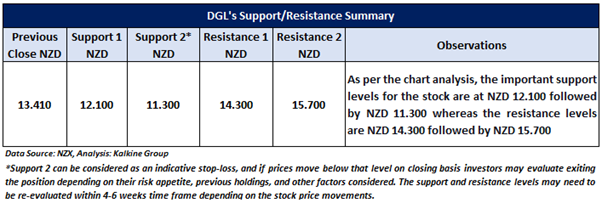
Daily Price Chart
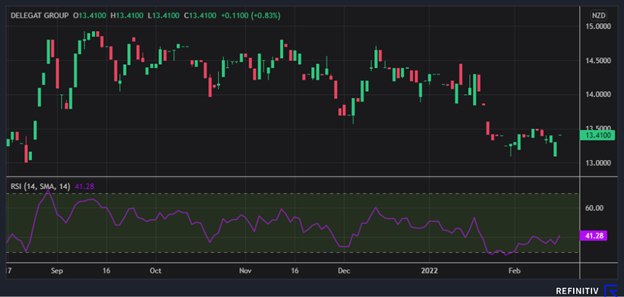
Source: REFINITIV, Note: Purple color line reflects Relative Strength Index (14-Period)
Stock Recommendation
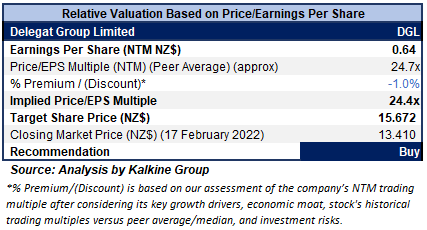
The stock has been valued using a P/E multiple-based illustrative relative valuation, and the target price so arrived reflects a rise of low double-digit (in % terms). Accordingly, a slight discount has been applied to P/E Multiple (NTM) (Peer Average), as it is expected that 2022 would see some churn in revenue for the industry versus 2021 performance.
Considering the facts above, we give a “Buy” recommendation on the stock at the closing market price of $13.41 per share, up 0.83% as of 17th February 2022.
3) Comvita Limited (Recommendation: Buy, Potential Upside: Low Double-Digit) (M-Cap: NZ$245.23 million, Gross Dividend Yield: 1.587%)
Business Description:
Comvita Ltd (NZX: CVT) is currently one of the leading players globally in producing Manuka honey. The company has a decent geographical presence across Australia, New Zealand, China, and North America.
Outlook:
The company’s mega plan of $25 million remains on track to deliver by 2025. The company has achieved over $12 million of improvements in the first 18 months, investing $1.2 million to deliver this in FY21. In addition to this, it will invest an additional $2.5 million in transformation projects in FY22. Meanwhile, it has announced a 60:15:20 plan to deliver a gross profit of over 60%, marketing to sales ratio of 15% and an EBITDA ratio of 20% by 2025.
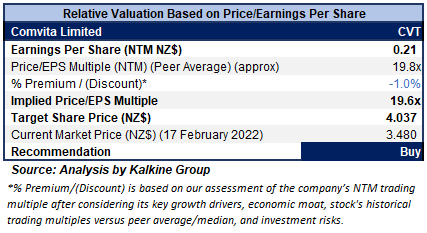
Valuation Methodology: Price/Earnings Per Share Based Relative Valuation (Illustrative)
Technical Overview:
Daily Price Chart
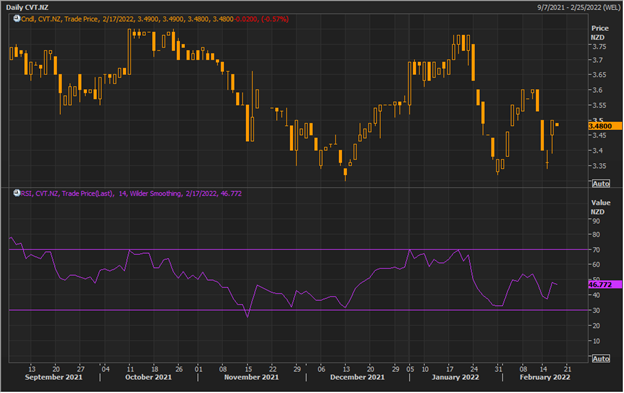
Source: REFINITIV, Note: Purple color line reflects Relative Strength Index (14-Period)
Stock Recommendation
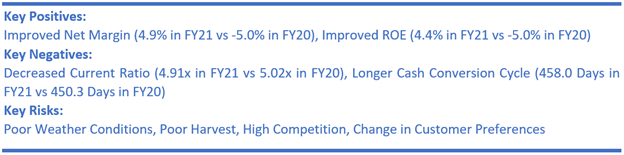
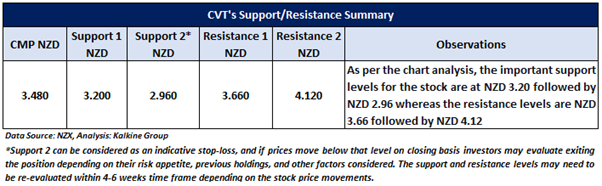
The stock has been valued using P/E multiple-based illustrative relative valuation, and the target price so arrived reflects a rise of low double-digit (in % terms). A slight discount has been assigned to P/E Multiple (NTM) (Peer Average), considering the decline in the current ratio to 4.91x in FY21 and a longer cash cycle Days to 458.0 days in FY21.
Considering the facts above, we give a “Buy” recommendation on the stock at the current market price of $3.48 per share as of 17th February 2022 (New Zealand Time: 1:20 PM (GMT +12)).
4) Synlait Milk Limited (Recommendation: Hold, Potential Upside: Low Double-Digit) (M-Cap: NZ$756.29 million)
Business Description:
Synlait Milk Limited (NZX: SML) is engaged in producing a range of nutritional milk products for its global customers by combining expert farming with state-of-the-art processing.
Outlook
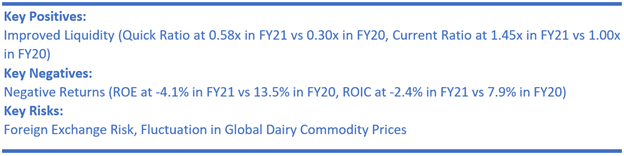
The company estimates its forecast milk price at $8.00 per kgMS for the current 2021-2022 season driven by sustained robust demand for dairy. Further, it expects to achieve strong profitability in FY22 driven by the benefits of return to normal trading conditions and tighter management of its Ingredient business. The company highlighted that its new Total Debt/EBITDA covenant limit stood at 4.5x for FY22, and it expects it to remain lower than 4.0x in FY22.
On 28 January 2022, the company increased its forecast base milk price for the 2021-2022 to $9.25/kgMS from $8.00/kgMS.
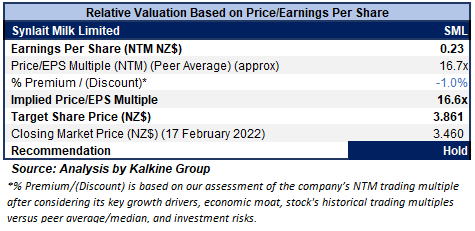
Valuation Methodology: Price/Earnings Per Share Based Relative Valuation (Illustrative)
Technical Overview:
Daily Price Chart
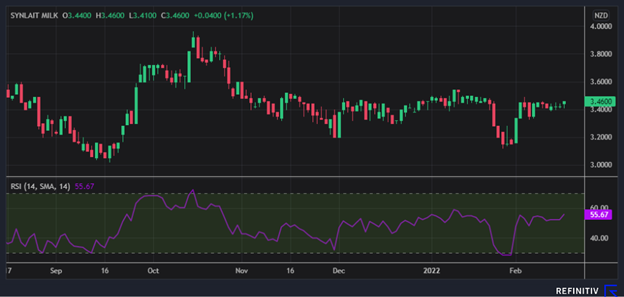
Source: REFINITIV, Note: Purple color line reflects Relative Strength Index (14-Period)
Stock Recommendation
The stock has been valued using a P/E multiple-based illustrative relative valuation, and the target price so arrived reflects a rise of low double-digit (in % terms). Accordingly, a slight discount has been applied to P/E Multiple (NTM) (Peer Average), considering lower EBITDA margin in FY21 on the YoY basis. However, the company has increased its current ratio in FY21 on the YoY basis.
Considering the facts above, we give a “Hold” recommendation on the stock at the closing market price of $3.46 per share, up 1.17% as of 17th February 2022.
Note 2: Investment decisions should be made depending on the investors’ appetite on upside potential, risks, holding duration, and any previous holdings. Investors can consider exiting from the stock if the Target Price mentioned as per the analysis has been achieved and subject to the factors discussed above alongside support levels provided.
Technical Indicators Defined: -
Support: A level where-in the stock prices tend to find support if they are falling, and downtrend may take a pause backed by demand or buying interest.
Resistance: A level where-in the stock prices tend to find resistance when they are rising, and uptrend may take a pause due to profit booking or selling interest.
Stop-loss: It is a level to protect further losses in case of unfavourable movement in the stock prices.
Disclaimer
Kalkine New Zealand Limited is authorised to provide general advice only. The information on this website does not take into account any of your investment objectives, financial situation or needs. Before you make a decision about whether to acquire a financial product, you should obtain the Product Disclosure Statement from the product issuer. You should consider the appropriateness of advice taking into account your own objectives, financial situation and needs and seek independent financial advice before making any financial decisions.
Past performance is not a reliable indicator of future performance.
 Please wait processing your request...