
 AU
AU
 UK
UK
 CA
CA
 US
US
 IND
IND

 NZ
NZ

Company Overview:
Delegat Group Limited (NZX: DGL) is a New Zealand-based wine company. Comvita Limited (NZX: CVT) is the global market leader in Mānuka honey and bee consumer goods.
Kalkine’s Sector Report covers the Key Financial Metrics, Risks, Outlook, Technical Analysis along with the Valuation, Target Price, and Recommendation on the stock.
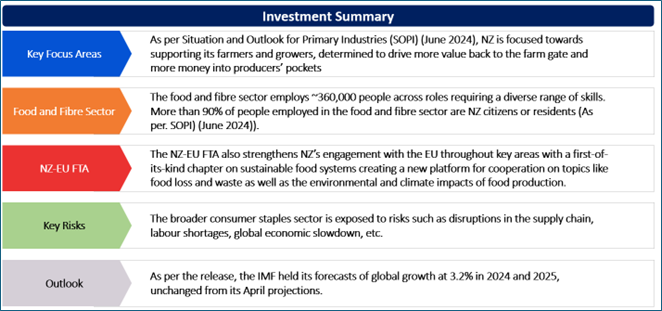
As per Situation and Outlook for Primary Industries (SOPI) (June 2024), NZ is focused towards supporting its farmers and growers, determined to drive more value back to the farm gate and more money into producers’ pockets so the sector can continue to adapt, evolve, and innovate for the long term. The food and fibre sector remains critical to the rural communities and underpins the entire New Zealand economy. NZ’s food and fibre sector is responsible for more than 80% of NZ’s goods exports, and the Government recognises the important role it plays in driving the economic success whether its through the jobs it provides, the rural communities it supports, or the millions of people around the world it feeds.
Food and fibre sector exports are making a significant contribution to the New Zealand economy. In 2023/24, the prices and revenue for many exports have corrected from highs in 2021/22 and 2022/23 because of the cyclical nature of commodity markets with slower global growth, specifically in the key export market China. Stats NZ recently stated that NZ’s consumers price index rose 2.2% in the September 2024 quarter as compared to September 2023 quarter.
Exhibit 1: Consumers Price Index, Quarterly Percentage Change, September 2023–September 2024 Quarters
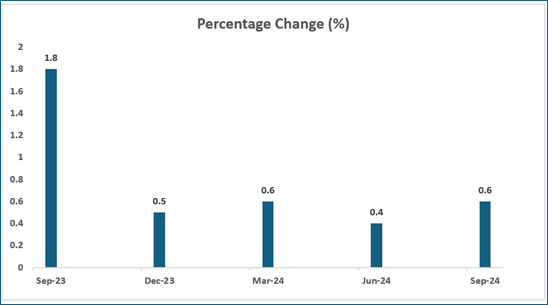
Data Source: This work is based on/includes Stats NZ’s data which are licensed by Stats NZ for reuse under the Creative Commons Attribution 4.0 International Licence; Chart Created by Kalkine Group
New Zealand’s Labour Market
The food and fibre sector employs ~360,000 people across roles requiring a diverse range of skills. More than 90% of people employed in the food and fibre sector are NZ citizens or residents (As per. SOPI) (June 2024)). The temporary migrants form an important part of the workforce, particularly for seasonal activities. There was an annual net migration gain of 111,100 for the year ended 31 March 2024. Notably, the annual net migration provisionally peaked in the year ended October 2023 with a gain of 139,100.
The NZ-EU FTA also strengthens NZ’s engagement with the EU throughout key areas with a first-of-its-kind chapter on sustainable food systems creating a new platform for cooperation on topics like food loss and waste as well as the environmental and climate impacts of food production.
Exhibit 2: Horticulture Export Revenue (NZ$ Mn) (Year to 30 June)
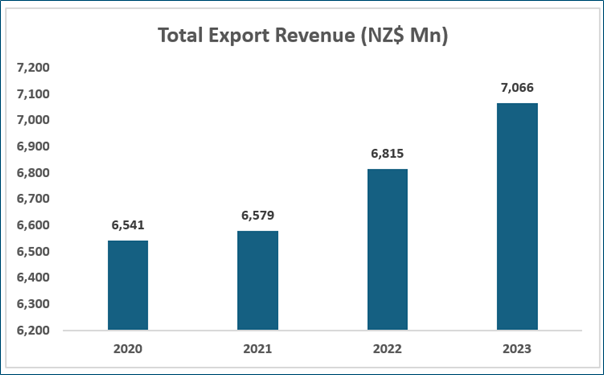
Data Source: This work is based on/includes MPI’s data which are licensed for reuse under the Creative Commons Attribution 4.0 International Licence; Chart Created by Kalkine Group
Kiwifruit Exports
As per the release by Stats NZ dated 23 September 2024, Kiwifruit exports were valued at $3.1 Bn in the year ended August 2024. This reflects an increase of $524 Mn (20%) when compared with the year ended August 2023. Notably, the gold kiwifruit exports stood at $2.4 Bn, up by $457 Mn (or 24%) from year ended August 2023. This increase was because of a rise in quantity (up 23%). The green kiwifruit exports amounted to $737 Mn, up $67 Mn (or 9.9%) over the same period. The increase in green kiwifruit export values were because of a rise in price (up 9.0%).
The growers in NZ are increasingly planting gold, and now red, kiwifruit, to tap greater export value in markets like China and Japan.
Key Risks and Challenges:
The broader consumer staples sector is exposed to risks such as labour shortages, global economic slowdown, higher inflation, etc. Also, geopolitical tensions might result in global energy and food crisis.
Also, increased borrowing costs from restrictive monetary policies might also act as a hurdle for the companies operating in the consumer staples sector. Despite some improvement in the prices, higher input costs might act as a critical challenge for fishers.
Exhibit 3. Key Risks in Consumer Staples Sector:
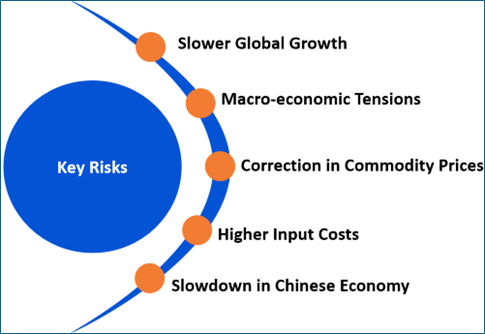
Source: Analysis by Kalkine Group
Outlook:
As per Fortnightly Economic Update dated 25 October 2024, the annual inflation has eased back within the Reserve Bank’s target range for the first time in 3 years. The annual CPI inflation eased from 3.3% to 2.2% during the September quarter, nearing the midpoint of the Reserve Bank’s 1%-3% inflation target band. Despite the easing, the underlying inflationary pressure might not be as soft as it seems. Numerous one-off factors underpinned the drop in headline inflation, such as removal of the Auckland regional fuel tax, lower global petrol prices as well as the government’s childcare rebate.
As per the release, the IMF held its forecasts of global growth at 3.2% in 2024 and 2025, unchanged from its April projections. However, there were changes at the country level, with rises in the US and China forecasts in 2024 and 2025, but cuts in the euro area and Japan, as well as a small downgrade for Australia in 2024.
The NZ forecast was cut to 0% from 1.1% in April, and the 2025 projection has been trimmed to 1.9% from 2.4%. Even though this is below the Treasury’s forecast, it is broadly in line with more recent Reserve Bank and market predictions.
Apart from the sector-specific factors, an analysis on three NZX-listed companies is provided. This report covers their insights, outlook, performance and potential as expected to be delivered in the near to medium term.
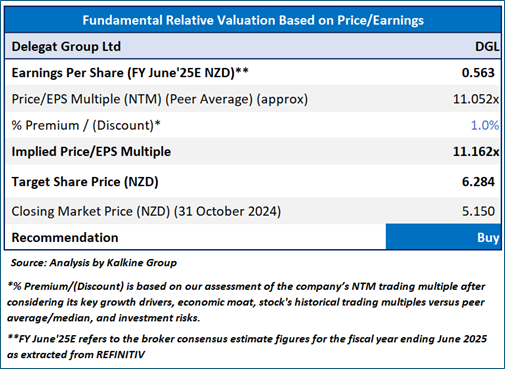
1) Delegat Group Limited (Recommendation: Buy, Potential Upside: Low Double-Digit) (M-Cap: NZD 520.8 Mn, Annual Dividend Yield: 5.39%)
Business Description:
Delegat Group Limited (NZX: DGL) is a New Zealand-based wine company.
Outlook:
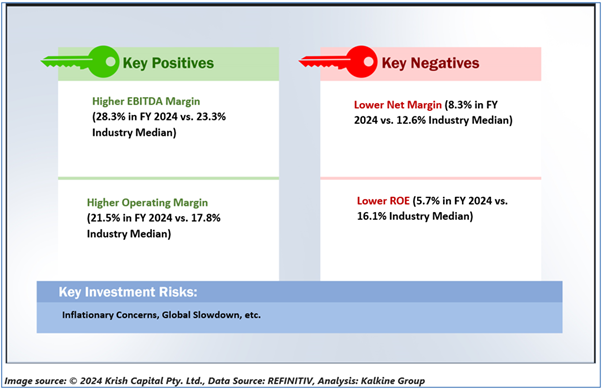
DGL’s Board is confident in the group’s ability to prosper as well as drive sustainable sales and earnings growth over the long term. The Group’s focus is on wine category premiumization and value growth, aligning to the long-term growth trend of super premium wine consumption. The Group’s sales are well diversified by market, with 48% in North America, 33% in the United Kingdom, Ireland and Europe, and 19% in Australia, New Zealand and the Asia Pacific region.
Fundamental Valuation
Technical Overview:
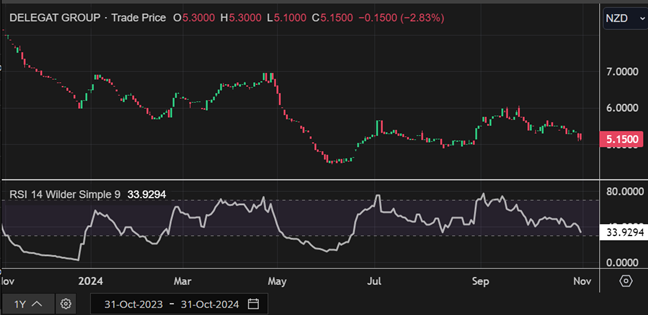
DGL Daily Technical Chart, Data Source: REFINITIV
Technical Commentary
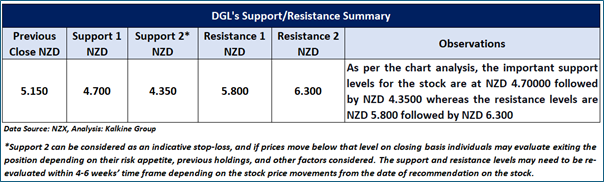
On the daily chart, while experiencing a downtrend, DGL’s stock prices are fluctuating between the two boundaries of a downward slope channel, suggesting that the current sideways period stock might continue to persist in the near future. Moreover, the momentum oscillator RSI (14-period) is hovering around its midpoint, adding further evidence to the mentioned recommendation. Prices are trading between its previous peak and trough, which might function as resistance and support levels for the stock, respectively. A significant support level for the stock is positioned at NZD 4.7, while critical resistance level is located at NZD 5.80.
Stock Recommendation
Considering the facts above, a ‘Buy’ recommendation on the stock has been provided at the closing market price of NZD 5.15 per share, down by 2.83% as on October 31, 2024.
2) Comvita Limited (Recommendation: Speculative Buy, Potential Upside: Low Double-Digit) (M-Cap: NZD 80.3 Mn, Annual Dividend Yield: 4.88%)
Business Description:
Comvita Limited (NZX: CVT) is the global market leader in Mānuka honey and bee consumer goods.
Outlook:
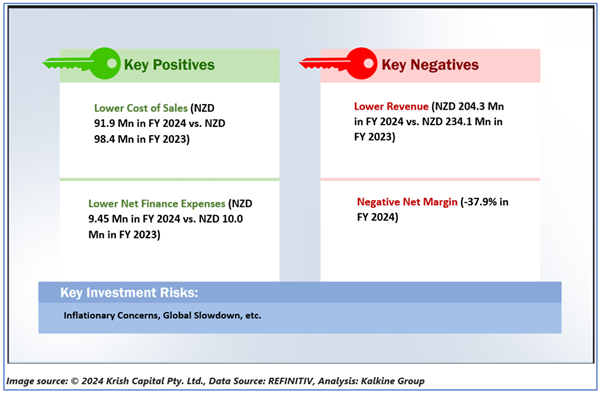
The global Total Addressable Market (TAM) for honey is forecast to grow by 6.5% CAGR to 2030. Google searches for Mānuka honey are increasing as consumers seek natural health and wellness products. Comvita science places the company well to capitalise on this opportunity. CVT’s emphasis in FY 2025 is towards cost reduction, positive operating cashflow as well as debt reduction.
Technical Overview:
Technical Commentary
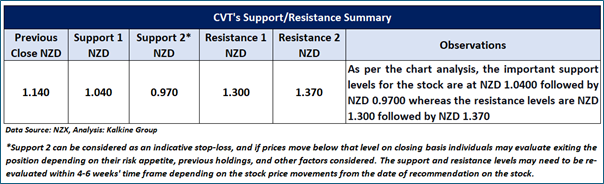
On the daily chart, CVT’s stock prices are developing a trading range, characterized by lower highs and higher lows, suggesting that the sideways period in the stock might continue to persist in the near future. Moreover, the momentum oscillator RSI (14-period) is hovering around its midpoint, adding further evidence to the mentioned recommendation. Prices are trading between its previous peak and trough, which might function as resistance and support levels for the stock, respectively. A significant support level for the stock is positioned at NZD 1.04, while critical resistance level is located at NZD 1.30.
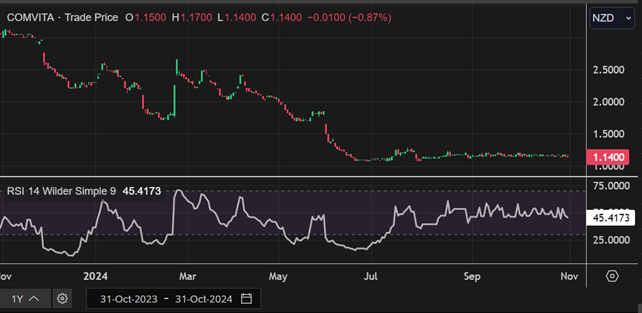
CVT Daily Technical Chart, Data Source: REFINITIV
Fundamental Valuation
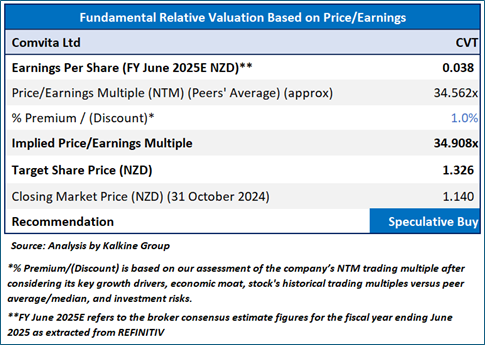
P/E Based Relative Valuation
Stock Recommendation
Considering the facts above, a ‘Speculative Buy’ recommendation on the stock has been provided at the closing market price of NZD 1.14 per share, down by 0.87% as on October 31, 2024
Markets are trading in a highly volatile zone currently due to certain macro-economic issues and geopolitical tensions prevailing. Therefore, it is prudent to follow a cautious approach while investing.
Note 1: Past performance is not a reliable indicator of future performance.
Note 2: The reference date for all price data, currency, technical indicators, support, and resistance levels is October 31, 2024. The reference data in this report has been partly sourced from REFINITIV.
Note 3: Investment decisions should be made depending on an individual's appetite for upside potential, risks, holding duration, and any previous holdings. An 'Exit' from the stock can be considered if the Target Price mentioned as per the Valuation and or the technical levels provided has been achieved and is subject to the factors discussed above.
Note 4: Annual Dividend Yield is on a Trailing Twelve Month (TTM1) basis and are subject to change based on factors such as company performance, stock price changes, etc.
Technical Indicators Defined: -
Support: A level at which the stock prices tend to find support if they are falling, and a downtrend may take a pause backed by demand or buying interest. Support 1 refers to the nearby support level for the stock and if the price breaches the level, then Support 2 may act as the crucial support level for the stock.
Resistance: A level at which the stock prices tend to find resistance when they are rising, and an uptrend may take a pause due to profit booking or selling interest. Resistance 1 refers to the nearby resistance level for the stock and if the price surpasses the level, then Resistance 2 may act as the crucial resistance level for the stock.
Stop-loss: It is a level to protect further losses in case of unfavourable movement in the stock prices.
Disclaimer This report has been issued by Kalkine New Zealand Limited (FSP691351) (NZBN:9429047678101) (“Kalkine”). Kalkine is a Financial Advice Provider (“FAP”) and is authorised by a Class 1 Financial Advice Provider Licence issued by Financial Markets Authority (“FMA”) to provide financial advice. Kalkine provides only general financial advice through its research reports following a person becoming a member. The reports contain buy/sell/hold and other recommendations in relation to equity securities, managed funds and other managed investment schemes and other financial advice products. The recommendations and opinions in this report and on Kalkine website do not take into account any of your investment objectives, financial situation or needs. Before you make a decision about whether to acquire a financial product, you should obtain the Product Disclosure Statement from the product issuer. You should consider the appropriateness of advice taking into account your own objectives, financial situation and needs and seek independent financial advice before making any financial decisions. If you act on the advice in the research reports, you may have to pay fees, expenses or other amounts (but not to Kalkine). Further information about the complaints and dispute resolution process, as well as information about Kalkine’s duties are available on Kalkine’s website. Please read our Financial Advice Provider (FAP) disclosure statement and Complaints Handling Guide, which are available on the website.
Past performance is not a reliable indicator of future performance.
 Please wait processing your request...