
 AU
AU
 UK
UK
 CA
CA
 US
US
 IND
IND

 NZ
NZ

Company Overview:
Move Logistics Group Limited (NZX: MOV) is one of NZ’s largest private domestic freight and logistics platforms, with a nationwide network of branches, depots and warehouses. Accordant Group Limited (NZX: AGL) is a New Zealand-based recruitment company engaged in the supply of temporary staff, contractor resources, and recruitment of permanent staff.
Kalkine’s Sector Report covers the Key Financial Metrics, Risks, Outlook, Technical Analysis along with the Valuation, Target Price, and Recommendation on the stock.
Sector Landscape and Outlook
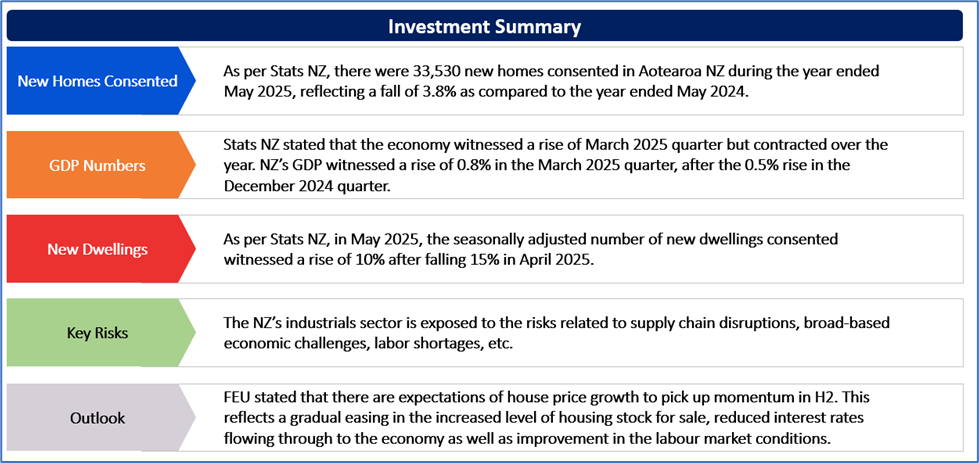
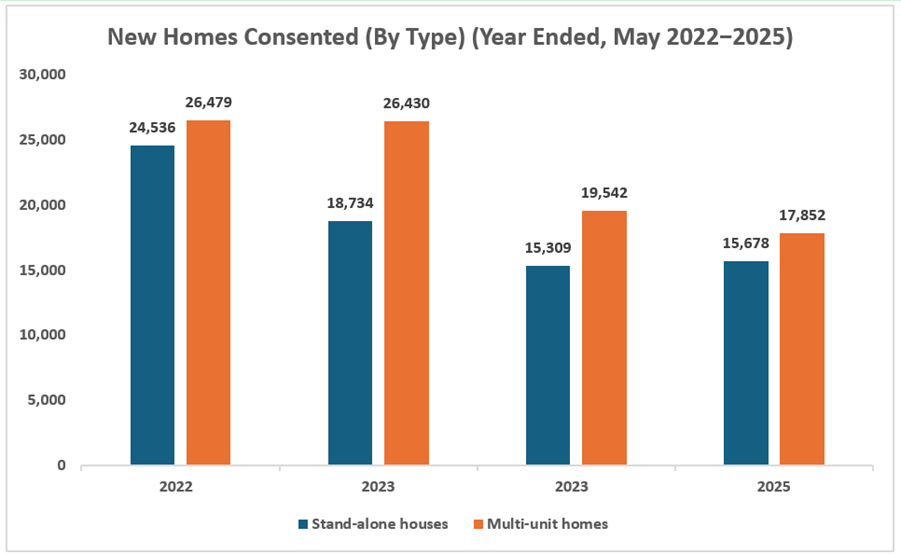
As per Stats NZ, there were 33,530 new homes consented in Aotearoa NZ during the year ended May 2025, reflecting a fall of 3.8% as compared to the year ended May 2024. During the year ended May 2025, there were 17,852 multi-unit homes consented, implying a fall of 8.6% as compared to the year ended May 2024. There were 15,678 stand-alone houses consented, an increase of 2.4% over the same period. Out of the multi-unit homes consented during the year to May 2025, there were 14,088 townhouses, flats, and units (a decline of 11% as compared to the year ended May 2024), 2,137 apartments (an increase of 6.2%), and 1,627 retirement village units (a fall of 4.5%).
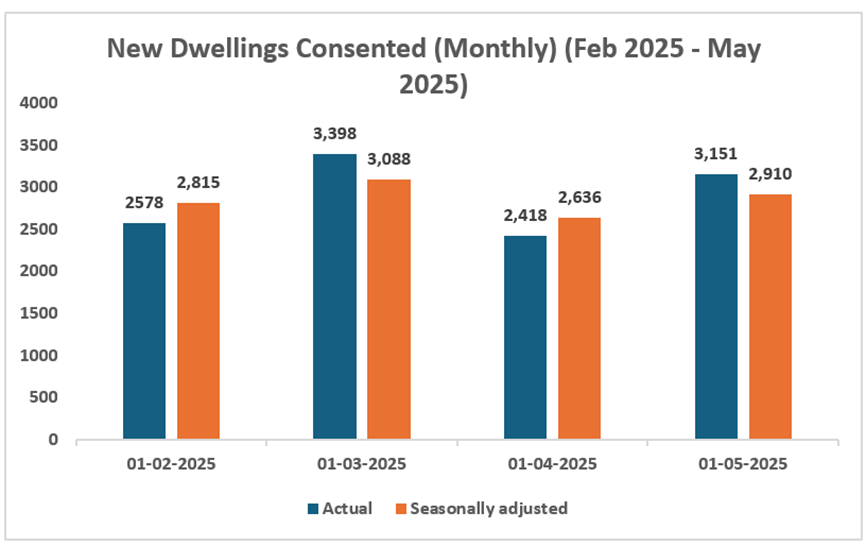
There were 3,151 new homes consented in May 2025, which reflects a fall of 0.8% as compared to May 2024. Out of these, there were 1,464 stand-alone houses consented (a fall of 5.9% as compared to May 2024) and 1,687 multi-unit homes consented (a rise of 4.1%).
Exhibit 1: New Homes Consented, By type, Year Ended May 2022−2025
Data Source: This work is based on/includes Stats NZ’s data which are licensed by Stats NZ for reuse under the Creative Commons Attribution 4.0 International Licence; Chart Created by Kalkine Group
Economic Snapshot for Quarter Ended March 2025
Stats NZ stated that the economy witnessed a rise of March 2025 quarter but contracted over the year. NZ’s GDP witnessed a rise of 0.8% in the March 2025 quarter, after the 0.5% rise in the December 2024 quarter. The GDP declined 1.1% over the year ended March 2025 as compared to the year to March 2024. The construction was up 0.5% in the March 2025 quarter, as measured in GDP. Notably, this was the first quarterly increase since the quarter ended December 2023.
As per the release, the residential building work put in place rose 2.6% in the March 2025 quarter. Notably, the cost of building a new home rose 1.9% in the 12 months ended March 2025, a decline from 3.3% in the same period in 2024. The number of homes in the construction pipeline witnessed a rise of 3.3% in the March 2025 quarter.
Building Consents Issued (May 2025)
As per Stats NZ, in May 2025, the seasonally adjusted number of new dwellings consented witnessed a rise of 10% after falling 15% in April 2025. Notably, the annual value of non-residential building work consented amounted to $9.0 Bn, a fall of 2.3% from the year ended May 2024. By region, 13,864 new dwellings were consented during the year to May 2025 in Auckland as compared to year ended May 2024, reflecting a decline of 4.3%.
Exhibit 2: New Dwellings Consented (Monthly)
Data Source: This work is based on/includes Stats NZ’s data which are licensed by Stats NZ for reuse under the Creative Commons Attribution 4.0 International Licence; Chart Created by Kalkine Group
Key Risks and Challenges:
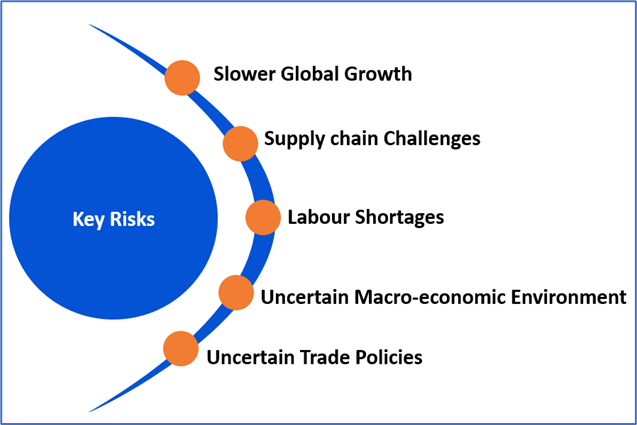
RBNZ recently stated that increased global tariffs as well as policy uncertainty can reduce the global growth. The Committee also noted downside risks to the outlook for broader export prices. This implies weakness in the global growth outlook as well as the potential for a rapid international supply response to high prices from global meat and dairy producers. Overall, the NZ’s industrials sector is exposed to the risks related to supply chain disruptions, broad-based economic challenges, labor shortages, etc.
Exhibit 3: Key Risks in Industrials Sector:
Source: Analysis by Kalkine Group
Outlook:
As per RBNZ, the NZ economy has started to recover, with the Committee noting that spare productive capacity remains available in the NZ economy. Notably, this is expected to dissipate over the medium term as and when the economy recovers. Furthermore, the elevated export commodity prices as well as reduced interest rates continue to help the overall economic activity in the NZ economy. As per the FEU dated 19th June, the growth in GDP witnessed in the March quarter surprised on the upside amidst strong gains in household spending, residential building as well as manufacturing.
Instead of evidence of economic momentum, the growth remained isolated mainly to the manufacturing sector as well as business services. Furthermore, the FEU also stated that there are expectations of house price growth to pick up momentum in H2 of the year. This reflects a gradual easing in the increased level of housing stock for sale, reduced interest rates flowing through to the economy as well as improvement in the labour market conditions.
Apart from the sector-specific factors, an analysis on 2 NZX-listed companies is provided. This report covers their insights, outlook, performance and potential as expected to be delivered in the near to medium term.
1) Accordant Group Limited (Recommendation: Speculative Buy, Potential Upside: Low Double-Digit) (M-Cap: NZD 10 Mn)
Business Description:
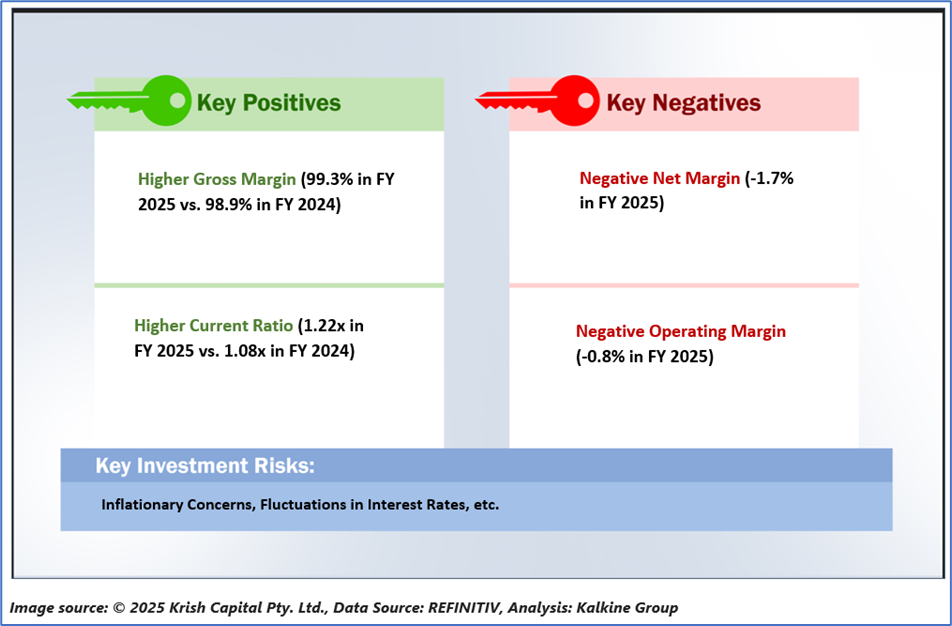
Accordant Group Limited (NZX: AGL) is a New Zealand-based recruitment company engaged in the supply of temporary staff, contractor resources, and recruitment of permanent staff.
Outlook:
AGL is confident in the breadth of services, focussing on growth from higher fee earning work and strategic contingent solutions which actively support clients through the present economic cycle. Furthermore, the company’s long-term commitment to the IT sector is still there, with Absolute IT maintaining active presence in the broader industry. The drive for productivity as well as innovation is anticipated to increase and help GDP growth.
Technical Overview:
Technical Commentary:
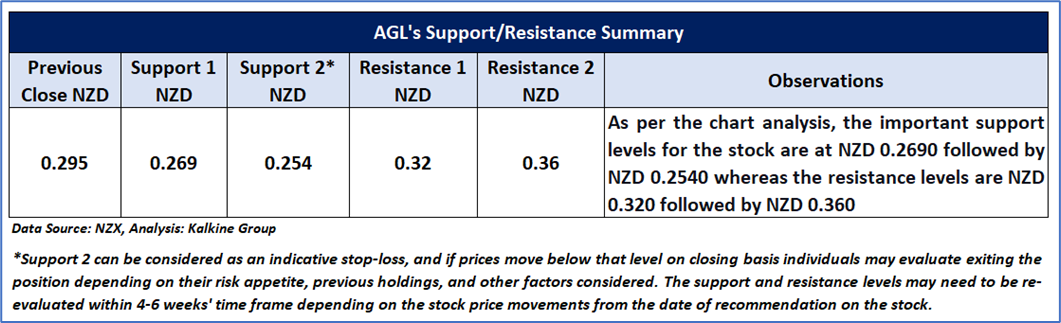
On the daily chart, AGL’s stock prices are undergoing a downtrend characterized by lower lows and lower highs, indicating a negative bias. Moreover, the momentum oscillator RSI (14-period) is trading below its midpoint, providing further support to the previous observation. Prices are trading below both 21-day and 50-day SMAs, which might function as dynamic resistance levels for the stock; in contrast, the stock’s nearest round level may act as a sentimental support level. A significant support level for the stock is positioned at NZD 0.269, while critical resistance level is located at NZD 0.32.
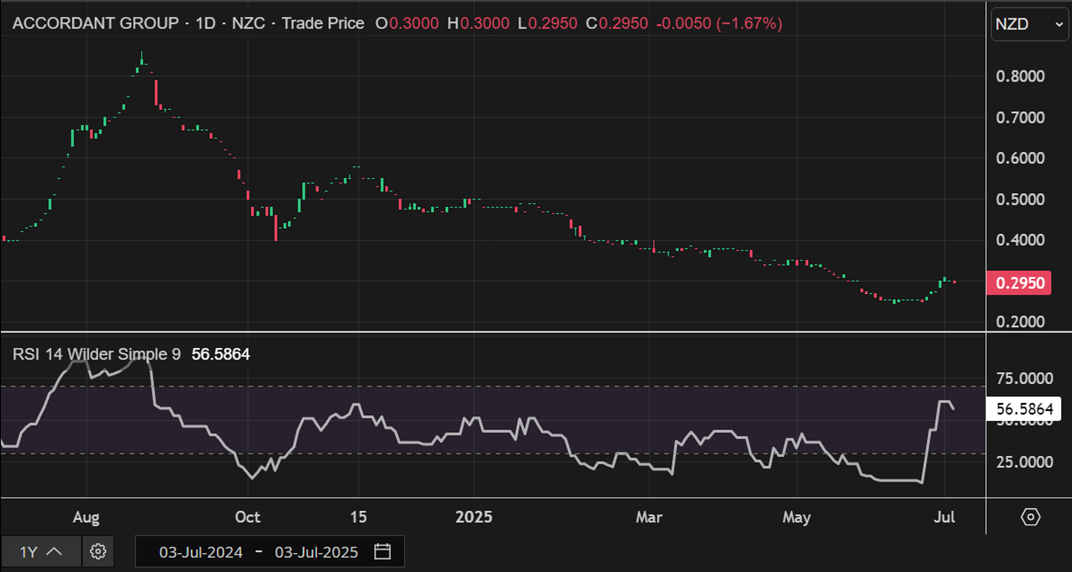
AGL Daily Technical Chart, Data Source: REFINITIV
Stock Recommendation
Considering the aforementioned factors, a ‘Speculative Buy’ rating is given on the stock at the closing market price of NZD 0.295 per share, down by 1.67% as on 3rd July 2025.
2) Move Logistics Group Limited (Recommendation: Hold, Potential Upside: Low Double-Digit) (M-Cap: NZD 23.9 million)
Business Description:
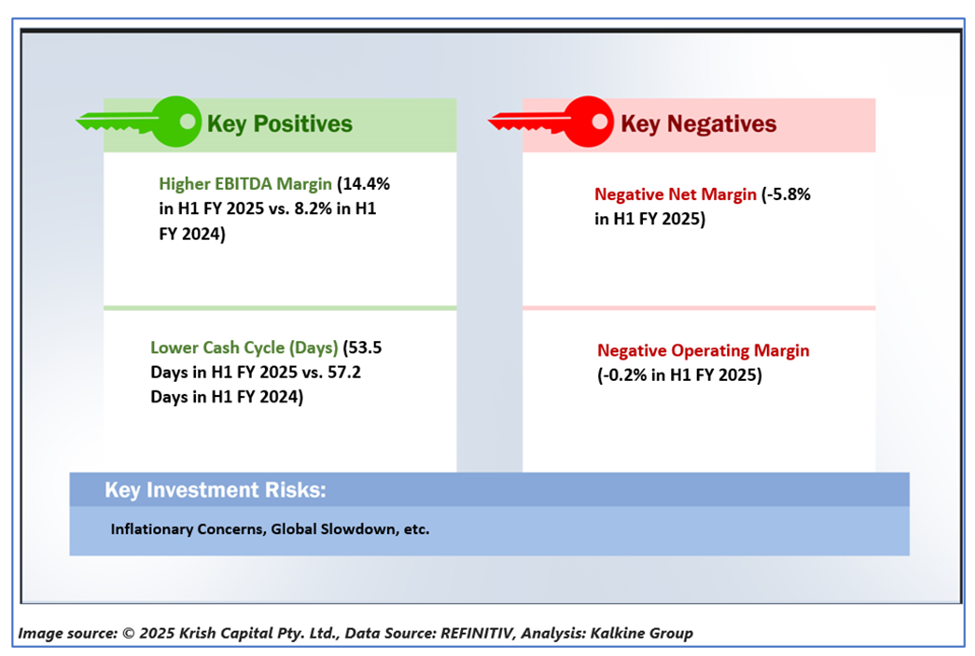
Move Logistics Group Limited (NZX: MOV) is one of NZ’s largest private domestic freight and logistics platforms, with a nationwide network of branches, depots and warehouses.
Outlook:
MOV’s priority focus is towards cost reduction, gross margin improvements as well as cashflow generation driven by sales-led recovery. The company is also aiming productivity improvements and positioning MOV for as and when market activity and demand returns. While the inflation has been eased as well as there are signs of improved business confidence, MOV stated that significant improvement in market conditions is not anticipated to be witnessed until at least mid-2025. Notably, a lift in market activity and customer demand, along with the improvements from the transformation plan, can allow earnings growth.
Technical Overview:
Technical Commentary
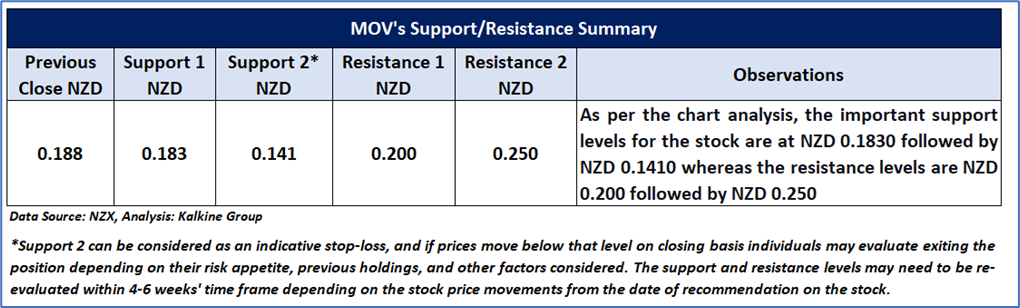
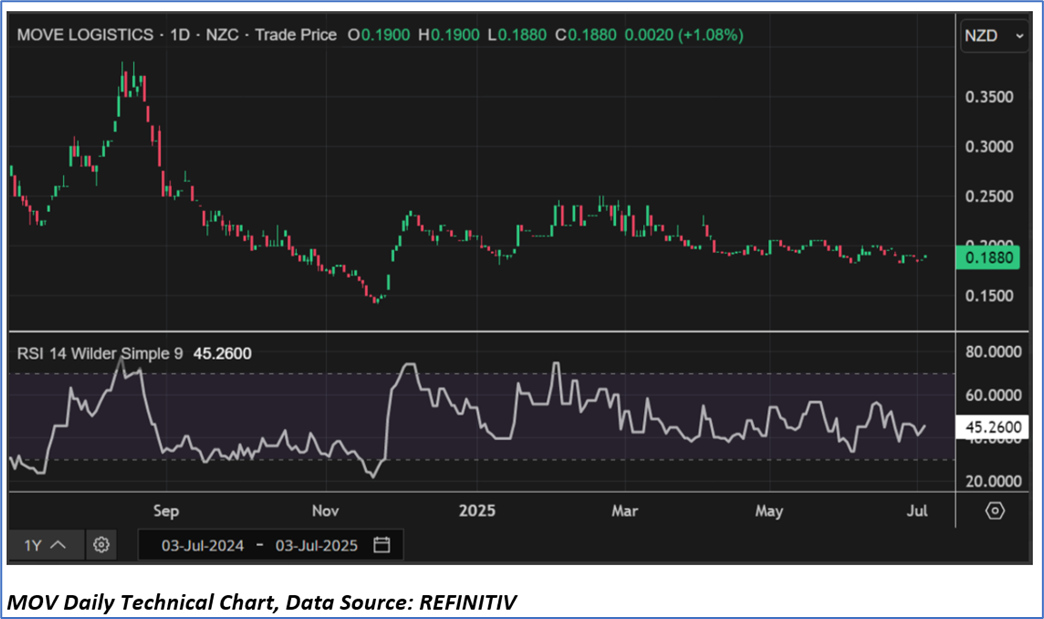
On the daily chart, MOV’s stock prices are forming a trading range characterized by lower highs and higher lows, suggesting that the current sideways period in the stock might continue to persist in the near future. Moreover, the momentum oscillator RSI (14-period) is trading near its midpoint, providing further support to the previous analysis. Prices are trading between its previous peak and trough, which might function as resistance and support levels for the stock, respectively. A significant support level for the stock is located at NZD 0.183, while critical resistance level is placed at NZD 0.200.
Stock Recommendation
Considering the aforementioned factors, a ‘Hold’ rating is given on the stock at the closing market price of NZD 0.188 per share, up by 1.08% as on 3rd July 2025.
Markets are trading in a highly volatile zone currently due to certain macro-economic issues and geopolitical tensions prevailing. Therefore, it is prudent to follow a cautious approach while investing.
Note 1: Past performance is neither an indicator nor a guarantee of future performance.
Note 2: The reference date for all price data, currency, technical indicators, support, and resistance levels is July 3, 2025. The reference data in this report has been partly sourced from REFINITIV.
Note 3: Investment decisions should be made depending on an individual's appetite for upside potential, risks, holding duration, and any previous holdings. An 'Exit' from the stock can be considered if the Target Price mentioned as per the Valuation and or the technical levels provided has been achieved and is subject to the factors discussed above.
Note 4: Annual Dividend Yield is on a Trailing Twelve Month (TTM1) basis and are subject to change based on factors such as company performance, stock price changes, etc.
Note 5: Kalkine reports are prepared based on the stock prices captured either from REFINITIV or Trading View. Typically, REFINITIV or Trading View may reflect stock prices with a delay which could be a lag of 25-30 minutes. There can be no assurance that future results or events will be consistent with the information provided in the report. The information is subject to change without any prior notice.
Technical Indicators Defined: -
Support: A level at which the stock prices tend to find support if they are falling, and a downtrend may take a pause backed by demand or buying interest. Support 1 refers to the nearby support level for the stock and if the price breaches the level, then Support 2 may act as the crucial support level for the stock.
Resistance: A level at which the stock prices tend to find resistance when they are rising, and an uptrend may take a pause due to profit booking or selling interest. Resistance 1 refers to the nearby resistance level for the stock and if the price surpasses the level, then Resistance 2 may act as the crucial resistance level for the stock.
Stop-loss: It is a level to protect further losses in case of unfavourable movement in the stock prices.
Disclaimer This report has been issued by Kalkine New Zealand Limited (FSP691351) (NZBN:9429047678101) (“Kalkine”). Kalkine is a Financial Advice Provider (“FAP”) and is authorised by a Class 1 Financial Advice Provider Licence issued by Financial Markets Authority (“FMA”) to provide financial advice. Kalkine provides only general financial advice through its research reports following a person becoming a member. The reports contain buy/sell/hold and other recommendations in relation to equity securities, managed funds and other managed investment schemes and other financial advice products. The recommendations and opinions in this report and on Kalkine website do not take into account any of your investment objectives, financial situation or needs. Before you make a decision about whether to acquire a financial product, you should obtain the Product Disclosure Statement from the product issuer. You should consider the appropriateness of advice taking into account your own objectives, financial situation and needs and seek independent financial advice before making any financial decisions. If you act on the advice in the research reports, you may have to pay fees, expenses or other amounts (but not to Kalkine). Further information about the complaints and dispute resolution process, as well as information about Kalkine’s duties are available on Kalkine’s website. Please read our Financial Advice Provider (FAP) disclosure statement and Complaints Handling Guide, which are available on the website.
Past performance is not a reliable indicator of future performance.
 Please wait processing your request...