
 AU
AU
 UK
UK
 CA
CA
 US
US
 IND
IND

 NZ
NZ

Overview:
ANZ Group Holdings Limited (NZX: ANZ) is a non-operating holding company. Its divisions include Australia Retail, Australia Commercial, Institutional, New Zealand, Suncorp Bank, Pacific, and Group Center. Heartland Group Holdings Limited (NZX: HGH) is a NZ-based financial services company.
Kalkine’s Sector Report covers the Key Financial Metrics, Risks, Outlook, Technical Analysis along with the Valuation, Target Price, and Recommendation on the stock.
Sector Landscape and Outlook
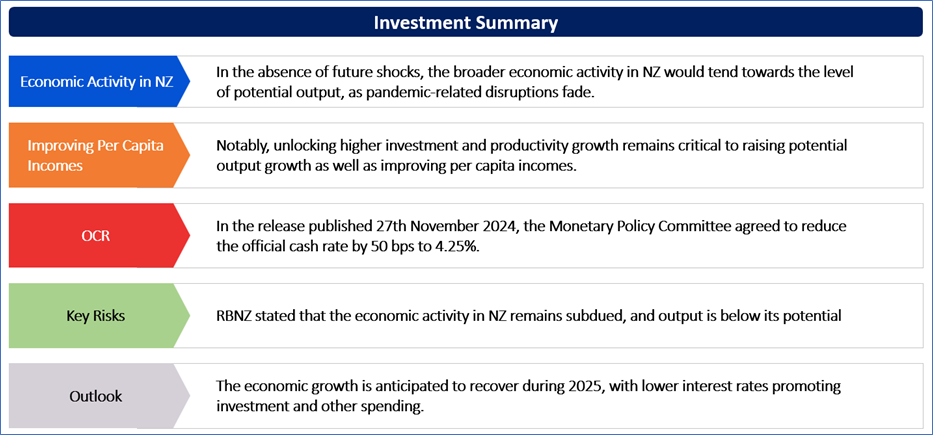
Reserve Bank Chief Economist Paul Conway recently discussed NZ’s longer-term ‘potential output’ and its significance for monetary policy. In the absence of future shocks, the broader economic activity in NZ would tend towards the level of potential output, as pandemic-related disruptions fade. Also, without future shocks, the OCR would tend towards the neutral interest rate. Over the upcoming few years, with declining inward migration as well as weak productivity growth, potential output growth is expected to be modest. This would be setting a modest ‘speed limit’ on how fast the economy could grow without generating excess inflation pressure.
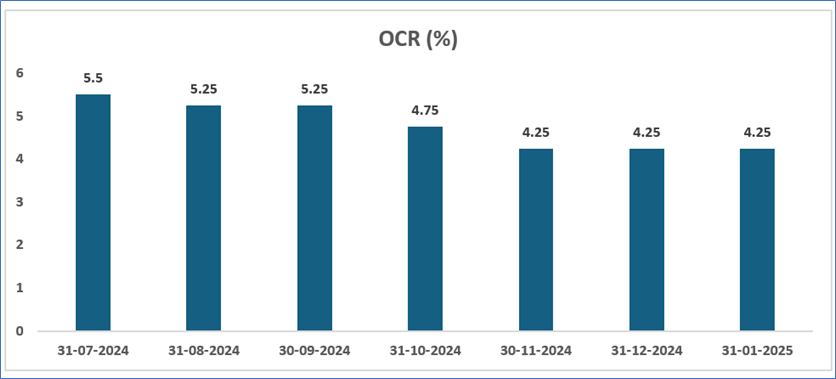
It was also mentioned that unlocking higher investment and productivity growth remains critical to raising potential output growth as well as improving per capita incomes. This would also reduce the likelihood of negative recessionary economic growth during future periods of restrictive monetary policy. In the release published 27th November 2024, the Monetary Policy Committee agreed to reduce the official cash rate by 50 bps to 4.25%. As per the release, annual consumer price inflation witnessed a decline and remains close to the midpoint of the Monetary Policy Committee’s 1% - 3% target band. Inflation expectations are also close to target and core inflation has been converging to the midpoint. If economic conditions evolve as per the expectations, the Committee anticipates to be able to lower the OCR further.
Exhibit 1: OCR (%)
Data Source: This work is based on/includes rbnz data which are licensed by rbnz.govt.nz for reuse under the Creative Commons Attribution 4.0 International Licence; Chart Created by Kalkine Group
Sector Lending Summary – Banks & NBLIs (December 2024)
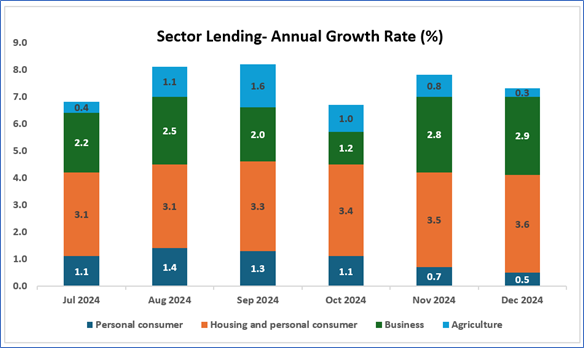
As per RBNZ, the housing lending stock rose by $1.7 Bn (0.4%) in December 2024, exceeding the $1.6 Bn increase shown last month. The annual growth rate increased from 3.6% to 3.8%, demonstrating its highest point since January 2023. The personal consumer lending stock rose by $46 Mn (0.3%) in December 2024, driven by a $42 Mn (0.6%) increase by NBLIs. The annual growth rate declined for the fourth consecutive month, declining from 0.7% to 0.5%. Notably business lending stock rose by $351 Mn (0.3%) in December 2024, down on the $1.7 Bn (1.2%) increase recorded last month. The annual growth rate increased from 2.8% to 2.9%.
The agriculture lending stock fell by $418 Mn (or 0.7%) in December 2024, following the $130 Mn decline last month.
Exhibit 2: Sector Lending - Annual Growth Rate) (%)
Data Source: This work is based on/includes rbnz data which are licensed by rbnz.govt.nz for reuse under the Creative Commons Attribution 4.0 International Licence; Chart Created by Kalkine Group
Credit Card Summary (June 2024)
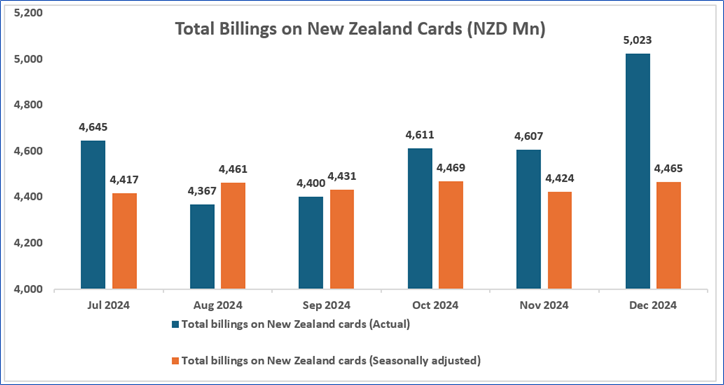
As per credit card summary release dated 24th January 2025, seasonally adjusted total billings in NZ remained broadly unchanged at $4.4 Bn (up 1.0% m-m) in December 2024. Annually, this was a decrease of 1.4% from December 2023. The seasonally adjusted domestic billings on NZ issued cards amounted to $3.8 Bn in December24, up 0.3% from November 2024, and down 2.7% from December 2023. The billings in New Zealand on overseas issued cards rose by 19.8% from last month to $0.8 Bn. Annually, billings on overseas issued cards increased 12.1%.
Total credit limits stood at $21.0 Bn (not seasonally adjusted) in December 2024, 0.1% lower than November 2024. This was the lowest value since November 2014.
Exhibit 3: Total Billings On New Zealand Cards (NZD Mn) (Actual vs Seasonally Adjusted)
Data Source: This work is based on/includes rbnz data which are licensed by rbnz.govt.nz for reuse under the Creative Commons Attribution 4.0 International Licence; Chart Analysis by Kalkine Group
Key Risks and Challenges:
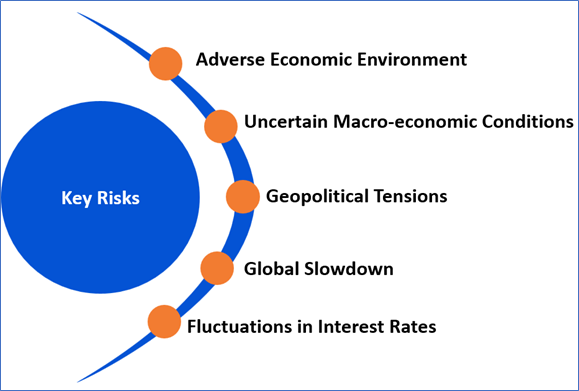
RBNZ stated that the economic activity in NZ remains subdued and output is below its potential. With excess productive capacity in the economy, inflation pressures have eased. The global economic growth is expected to remain subdued in the near term. Also, geopolitical conditions and policy uncertainty might result in increased economic and inflation volatility over the medium term. The release also stated that economic growth rates in the US and China are anticipated to slow over the year ahead, and the growth outlook for Europe remains sluggish.
Exhibit 4. Key Risks in Financial Sector:
Source: Analysis by Kalkine Group
Outlook:
RBNZ, in the release dated 27 November 2024, stated that wage growth is slowing, which remains consistent with inflation returning to the target midpoint. The employment levels as well as job vacancies have declined, demonstrating subdued economic activity. The unemployment is anticipated to continue rising in the near term as the labour market takes longer to recover than output. Net immigration to NZ has declined significantly from elevated rates. The rate of migrant arrivals has witnessed a slowdown, and departures of New Zealanders have increased, mainly in response to subdued labour market conditions relative to Australia. If the economic conditions continue to evolve, the Committee anticipates to lower the OCR further.
The economic growth is anticipated to recover during 2025, with lower interest rates promoting investment and other spending. The employment growth is anticipated to remain weak until mid-2025 and, for some, financial stress is expected to take time to ease. That being said, since there is excess productive capacity in the economy, the inflation pressures have eased.
Apart from the sector-specific factors, an analysis on 2 NZX-listed companies is provided. This report covers their insights, outlook, performance and potential as expected to be delivered in the near to medium term.
1) Heartland Group Holdings Limited (Recommendation: Hold, Potential Upside: Low Double-Digit) (M-Cap: NZD 1.01 billion, Annual Dividend Yield (TTM)1: 8.79%)
Business Description:
Heartland Group Holdings Limited (NZX:HGH) is the financial services group with operations in New Zealand and Australia.
Outlook:
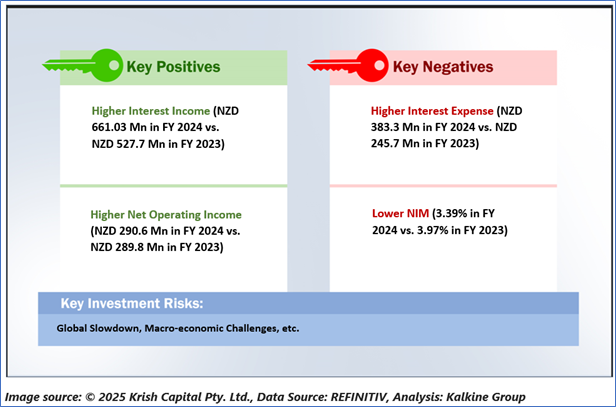
HGH provided a trading update for 4 months to 31 October 2024 (YTD 2025). Looking towards FY 2025 end, while Heartland remains cautious in the near term, it is anticipating growth in core lending to return as the NZ and Australian economies improve. Heartland Bank Limited’s NIM is improving and remains on track to achieve an exit NIM greater than 4.00% in the financial year ending 30 June 2025 (FY 2025).
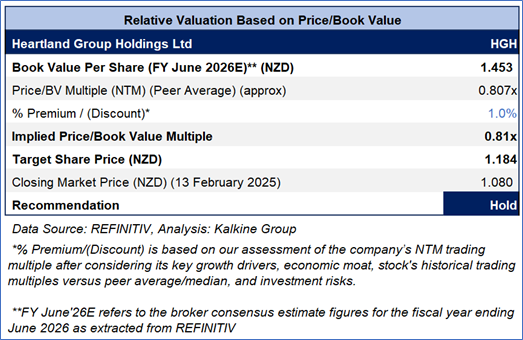
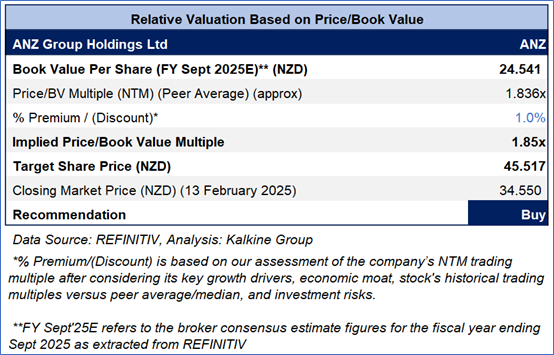
Valuation Methodology: Price/BV Per Share Based Relative Valuation (Illustrative)
Technical Overview:
Technical Commentary
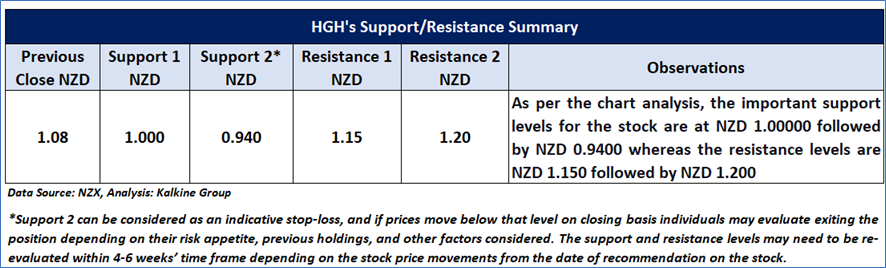
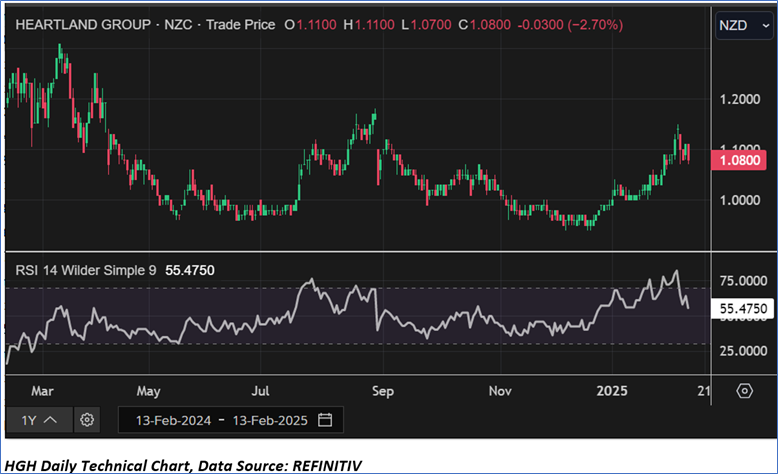
On the daily chart, HGH’s stock prices are forming a trading range characterized by higher lows and lower highs, suggesting that the current sideways period in the stock might continue to persist in the near future. Moreover, the momentum oscillator RSI (14-period) is trading near its midpoint, adding further evidence to the previous analysis. Prices are trading between its previous peak and trough, which might function as resistance and support levels for the stock, respectively. A significant support level for the stock is positioned at NZD 1.00, while critical resistance level is located at NZD 1.15.
Stock Recommendation
Considering the facts above, a ‘Hold’ recommendation on the stock has been provided at the closing market price of NZD 1.08 per share, down by 2.70% as on 13th February 2025.
2) ANZ Group Holdings Limited (Recommendation: Buy, Potential Upside: Low Double-Digit) (M-Cap: NZD 102.8 Bn, Annual Dividend Yield (TTM)1: 5.98%)
Business Description:
ANZ Group Holdings Limited (NZX: ANZ) is a non-operating holding company. Its divisions include Australia Retail, Australia Commercial, Institutional, New Zealand, Suncorp Bank, Pacific, and Group Center.
Outlook:
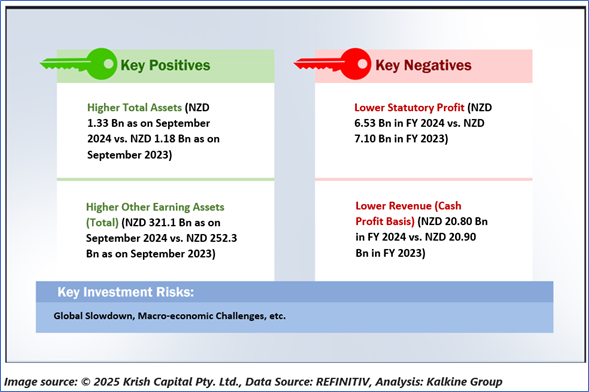
ANZ’s FY 2025 priorities revolve around delivering strong and sustainable financial outcomes, driving value from Suncorp Bank, remaining focused on productivity, improving platform excellence, etc. It has announced a series of organisational changes to further streamline and improve the efficiency, responsiveness, and effectiveness of the operations teams. Reporting to CEO Shayne Elliott and being a member of the Group Executive Committee, the new Group Executive Operations, would also be accountable for ANZ’s Group Capability Centre infrastructure together with the property and procurement teams. Despite the quieter housing market and robust competition, home lending witnessed a rise of 4%.
Technical Overview:
Fundamental Valuation
P/BV Based Relative Valuation
Technical Commentary
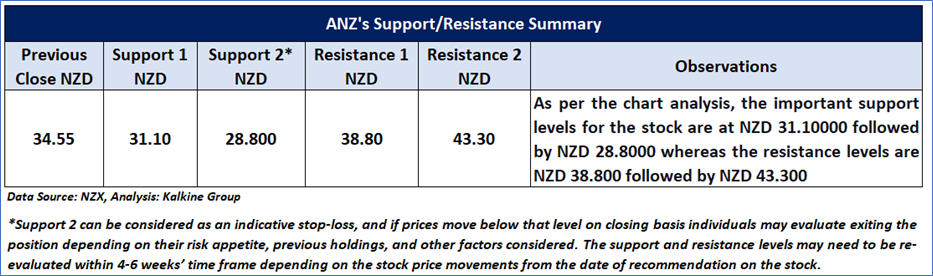
On the daily chart, ANZ’s stock prices are undergoing an uptrend characterized by higher highs and higher lows, indicating a positive bias. Moreover, the momentum oscillator RSI (14-period) is trading above its midpoint, adding further evidence to the previous analysis. Prices are trading above both the trend-following indicators 21-day and 50-day SMAs, which might function as support levels for the stock; in contrast, the stock’s most recent high may act as a resistance level. A significant support level for the stock is positioned at NZD 31.1, while critical resistance level is located at NZD 38.8.
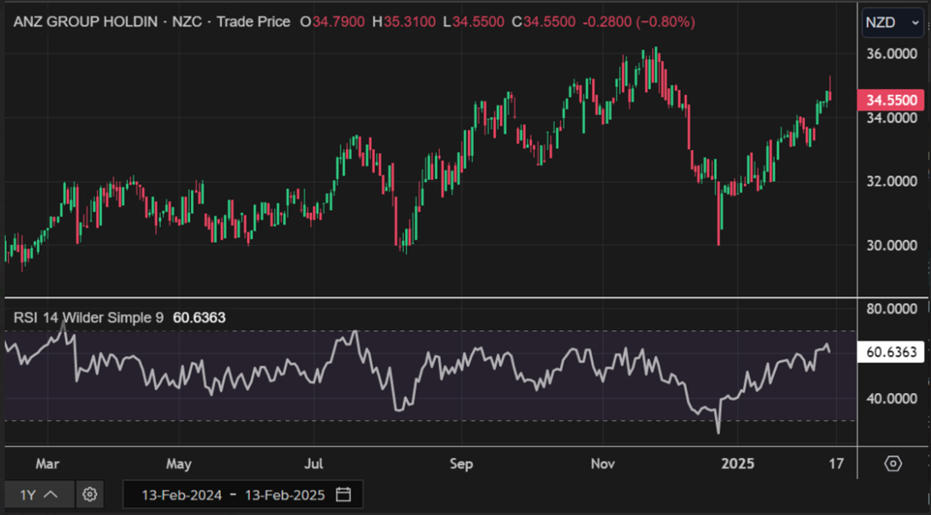
ANZ Daily Technical Chart, Data Source: REFINITIV
Stock Recommendation
Considering the facts above, a ‘Buy’ recommendation on the stock has been provided at the closing market price of NZD 34.55 per share, down by 0.80% as on 13 February 2025.
Note 1: Past performance is not a reliable indicator of future performance.
Note 2: The reference date for all price data, currency, technical indicators, support, and resistance levels is February 13, 2025. The reference data in this report has been partly sourced from REFINITIV.
Note 3: Investment decisions should be made depending on an individual's appetite for upside potential, risks, holding duration, and any previous holdings. An 'Exit' from the stock can be considered if the Target Price mentioned as per the Valuation and or the technical levels provided has been achieved and is subject to the factors discussed above.
Note 4: Annual Dividend Yield is on a Trailing Twelve Month (TTM1) basis and are subject to change based on factors such as company performance, stock price changes, etc.
Note 5: Kalkine reports are prepared based on the stock prices captured either from REFINITIV or Trading View. Typically, REFINITIV or Trading View may reflect stock prices with a delay which could be a lag of 25-30 minutes. There can be no assurance that future results or events will be consistent with the information provided in the report. The information is subject to change without any prior notice.
Technical Indicators Defined: -
Support: A level at which the stock prices tend to find support if they are falling, and a downtrend may take a pause backed by demand or buying interest. Support 1 refers to the nearby support level for the stock and if the price breaches the level, then Support 2 may act as the crucial support level for the stock.
Resistance: A level at which the stock prices tend to find resistance when they are rising, and an uptrend may take a pause due to profit booking or selling interest. Resistance 1 refers to the nearby resistance level for the stock and if the price surpasses the level, then Resistance 2 may act as the crucial resistance level for the stock.
Stop-loss: It is a level to protect further losses in case of unfavourable movement in the stock prices.
Disclaimer This report has been issued by Kalkine New Zealand Limited (FSP691351) (NZBN:9429047678101) (“Kalkine”). Kalkine is a Financial Advice Provider (“FAP”) and is authorised by a Class 1 Financial Advice Provider Licence issued by Financial Markets Authority (“FMA”) to provide financial advice. Kalkine provides only general financial advice through its research reports following a person becoming a member. The reports contain buy/sell/hold and other recommendations in relation to equity securities, managed funds and other managed investment schemes and other financial advice products. The recommendations and opinions in this report and on Kalkine website do not take into account any of your investment objectives, financial situation or needs. Before you make a decision about whether to acquire a financial product, you should obtain the Product Disclosure Statement from the product issuer. You should consider the appropriateness of advice taking into account your own objectives, financial situation and needs and seek independent financial advice before making any financial decisions. If you act on the advice in the research reports, you may have to pay fees, expenses or other amounts (but not to Kalkine). Further information about the complaints and dispute resolution process, as well as information about Kalkine’s duties are available on Kalkine’s website. Please read our Financial Advice Provider (FAP) disclosure statement and Complaints Handling Guide, which are available on the website.
Past performance is not a reliable indicator of future performance.
 Please wait processing your request...