
 AU
AU
 UK
UK
 CA
CA
 US
US
 IND
IND

 NZ
NZ

Allied Farmers Limited (NZX: ALF) is focused towards agricultural sector with two principal investments, such as 67.8% interest in New Zealand Farmers Livestock and 100% in New Zealand Rural Land Management GP Limited. Comvita Limited (NZX: CVT) is the global market leader in Mānuka honey and bee consumer goods.
Kalkine’s Sector Report covers the Investment Highlights, Key Financial Metrics, Risks, Outlook, Technical Analysis along with the Valuation, Target Price, and Recommendation on the stock.
1. Sector Landscape and Outlook
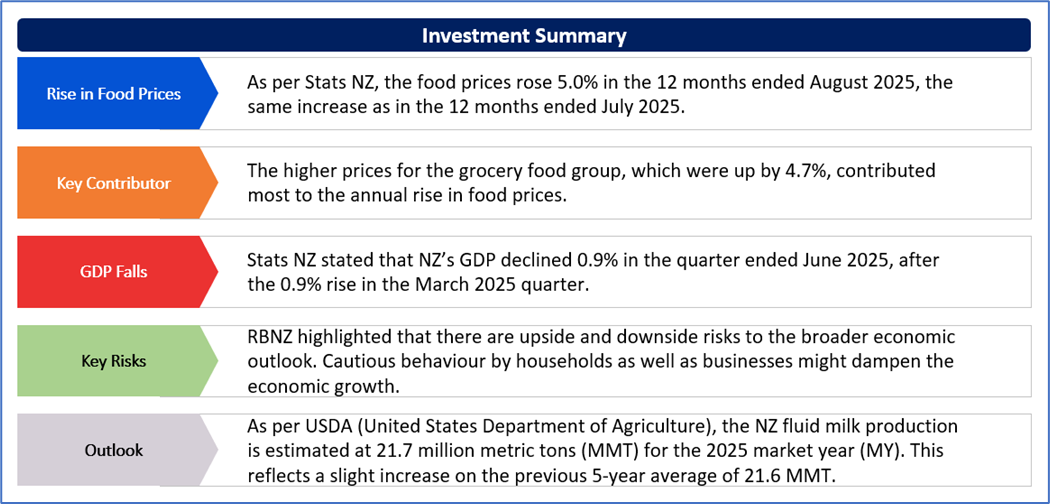
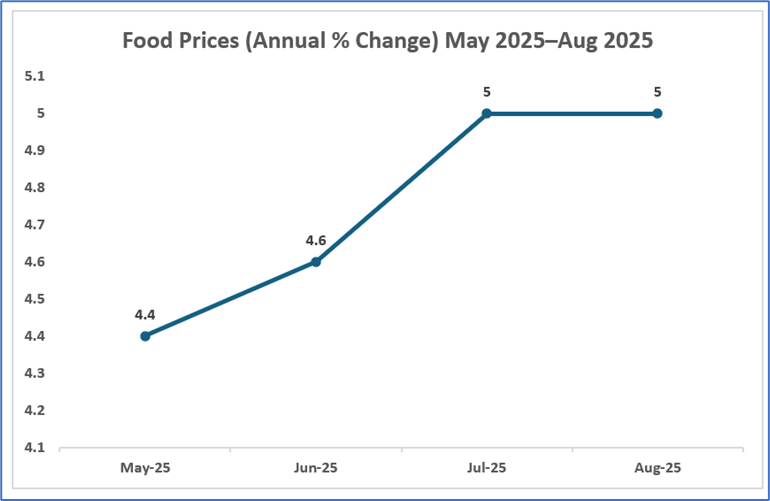
As per Stats NZ, the food prices rose 5.0% in the 12 months ended August 2025, the same increase as in the 12 months ended July 2025. The higher prices for the grocery food group, which were up by 4.7%, contributed most to the annual rise in food prices. The price rise for the grocery food group was because of the increased prices for milk, cheese, and butter. As per the release, the dairy products were the main driver for the increased annual food prices.
Furthermore, the prices for the meat, poultry, and fish group, which were up by 8.1%, were the next largest contributor to the annual rise food prices. This was because of increased prices for beef steak, beef mince, and lamb leg. Notably, the rent prices rose 2.1% in the 12 months ended August 2025, after the 2.4% rise in the 12 months ended July 2025.
Exhibit 1: Food Prices (Annual % Percentage) May 2025 – Aug 2025
Data Source: This work is based on/includes Stats NZ’s data which are licensed by Stats NZ for reuse under the Creative Commons Attribution 4.0 International Licence; Chart Created by Kalkine Group
GDP Falls in June 2025 quarter
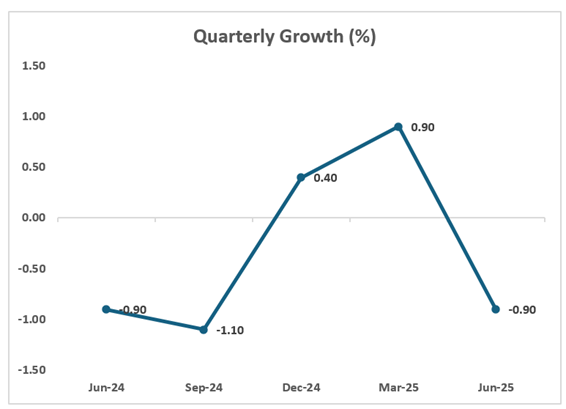
Stats NZ stated that NZ’s GDP declined 0.9% in the quarter ended June 2025, after the 0.9% rise in the March 2025 quarter. The activity decreased in the quarter ended June 2025 across 2 out of the 3 high-level industry groups--goods-producing industries declined 2.3%, and primary industries witnessed a fall of 0.7%. However, service industries remained flat.
The food, beverage and tobacco manufacturing, which was down 2.2%, also contributed to the decline in manufacturing. This was exhibited in the lower export volumes associated with this type of manufacturing, like meat products. The household consumption expenditure increased 0.4% in June quarter, with expenditure on durables and non-durables both increasing.
Exhibit 2: Gross Domestic Product, Quarterly Growth Rates, Chain-volume, June 2024 – June 2025
Data Source: This work is based on/includes Stats NZ’s data which are licensed by Stats NZ for reuse under the Creative Commons Attribution 4.0 International Licence; Chart Created by Kalkine Group
Dairy Export Volumes
As per Situation and Outlook for Primary Industries (SOPI) June 2025, the US is NZ wine’s largest market, making up $763 million in export revenue in the year ended 31 March 2025 – 37% of all the wine exports. As per USDA (United States Department of Agriculture), the final trade data for 2024 demonstrates that NZ dairy exports volumes rose ~1% YoY. This was because of recovery in Asian markets and strong early-season volumes. Notably, China has been accounting for ~30% of the total dairy exports, though diversification into Southeast Asia and the Middle East remains important for managing the trade risk.
Key Risks and Challenges:
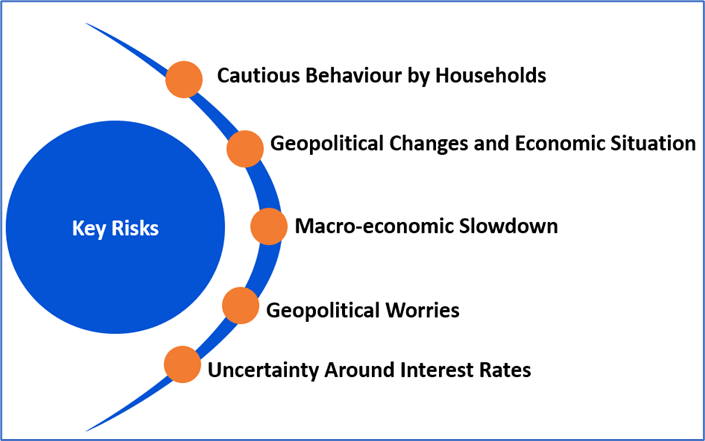
As per SOPI June 2025, on the global front, the industry has been witnessing short-term uncertainty because of the rapidly evolving global trade policies, but NZ wine has demonstrated healthy growth in the second-tier markets. RBNZ also highlighted that there are upside and downside risks to the broader economic outlook. Cautious behaviour by households as well as businesses might dampen the economic growth.
Exhibit 3. Key Risks in Consumer Staples Sector:
Source: Analysis by Kalkine Group
Outlook:
As per USDA (United States Department of Agriculture), the NZ fluid milk production is estimated at 21.7 million metric tons (MMT) for the 2025 market year (MY). This reflects a slight increase on the previous 5-year average of 21.6 MMT. The production outcome demonstrates long-term structural adjustments like herd consolidation and no major dairy expansion, along with other factors including improved productivity per cow as well as improved management practices. SOPI June 2025 highlighted that, while times might be tough, mainly for the financially squeezed growers, the medium to long-term outlook is positive. The consumer demand remains high in critical markets. In 2024, NZ wine sales in the US grew for the 16th consecutive year.
Notably, the dairy, red meat, and kiwifruit are expected to fuel the expansion of food and fibre sector export growth. The strong demand and limited supply can continue to support the increased prices and volumes. SOPI June 2025 also highlighted that prices are expected to be robust throughout most of the horticultural products.
Apart from the sector-specific factors, an analysis on 2 NZX-listed companies is provided. This report covers their insights, outlook, performance and potential as expected to be delivered in the near to medium term.
1) Allied Farmers Limited (Recommendation: Hold, Potential Upside: Low Double-Digit) (M-Cap: NZD 22.18 Mn)
Business Description:
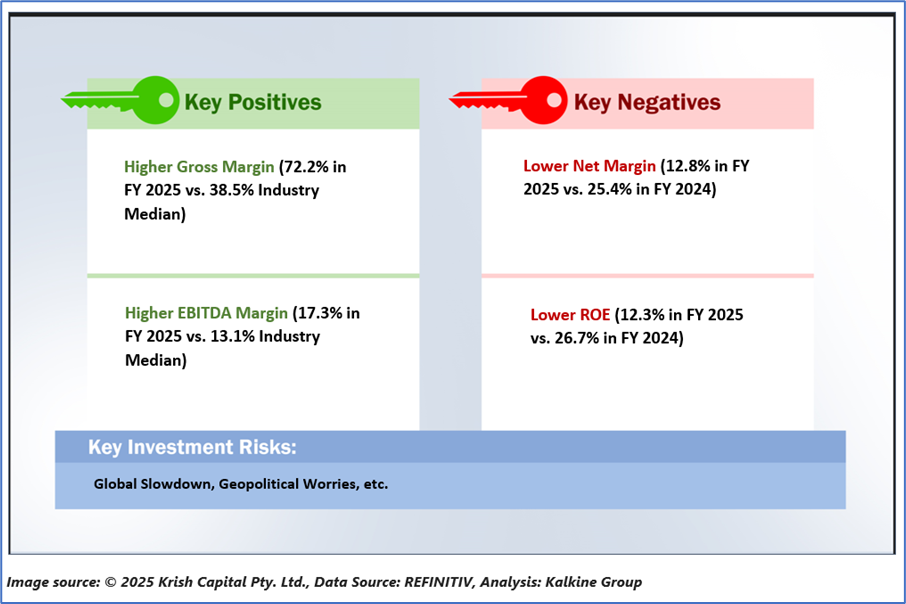
Allied Farmers Limited (NZX: ALF) is focused towards agricultural sector with two principal investments, such as 67.8% interest in New Zealand Farmers Livestock and 100% in New Zealand Rural Land Management GP Limited.
Outlook:
During FY 2025, the Board reviewed allocation of assets throughout the rural sector, with a focus towards ensuring the optimal deployment of ALF’s capital for long term value growth as well as tax loss utilisation Livestock Finance has continued the steady improvement in earnings contribution, and is a valued diversification of earnings.
Technical Overview:
Data Source: REFINITIV, Analysis: Kalkine Group
Technical Commentary
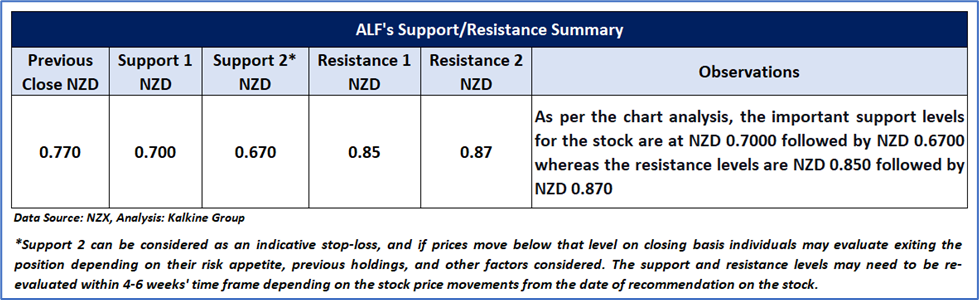
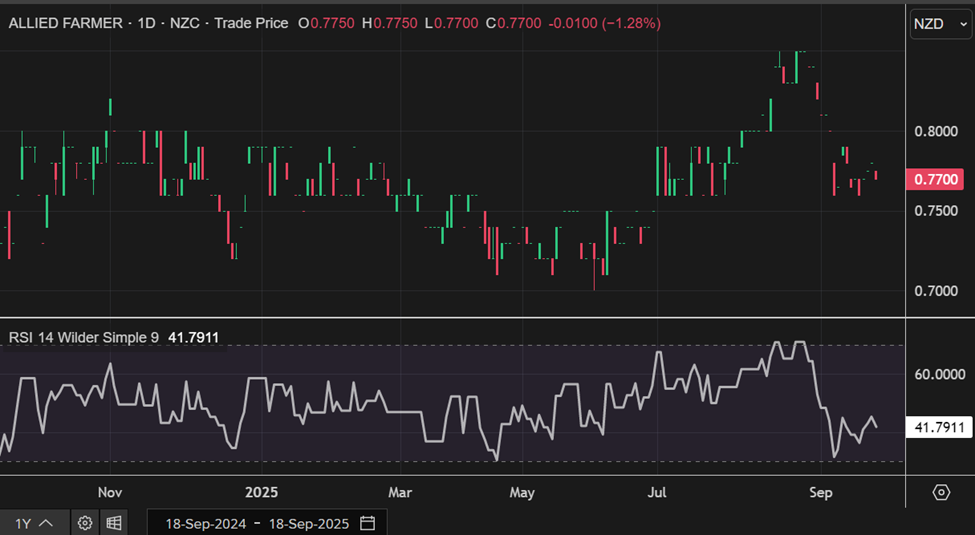
On the daily chart, ALF’s stock price is forming a trading range characterized by a Symmetrical triangle pattern, suggesting that the current sideways period in the stock might continue to persist in the near future. Moreover, the momentum oscillator RSI (14-period) is trading near its midpoint, adding more evidence to mentioned recommendation. Price is trading between its previous peak and trough, which might function as resistance and support levels for the stock, respectively. A significant support level for the stock is positioned at NZD 0.700, while critical resistance level is located at NZD 0.850.
Stock Recommendation
Considering the facts above, a ‘Hold’ recommendation on the stock has been provided at the closing market price of NZD 0.77 per share, down by 1.28% as on 18 September 2025.
2) Comvita Limited (Recommendation: Speculative Buy, Potential Upside: Low Double-Digit) (M-Cap: NZD 53.5 Mn)
Business Description:
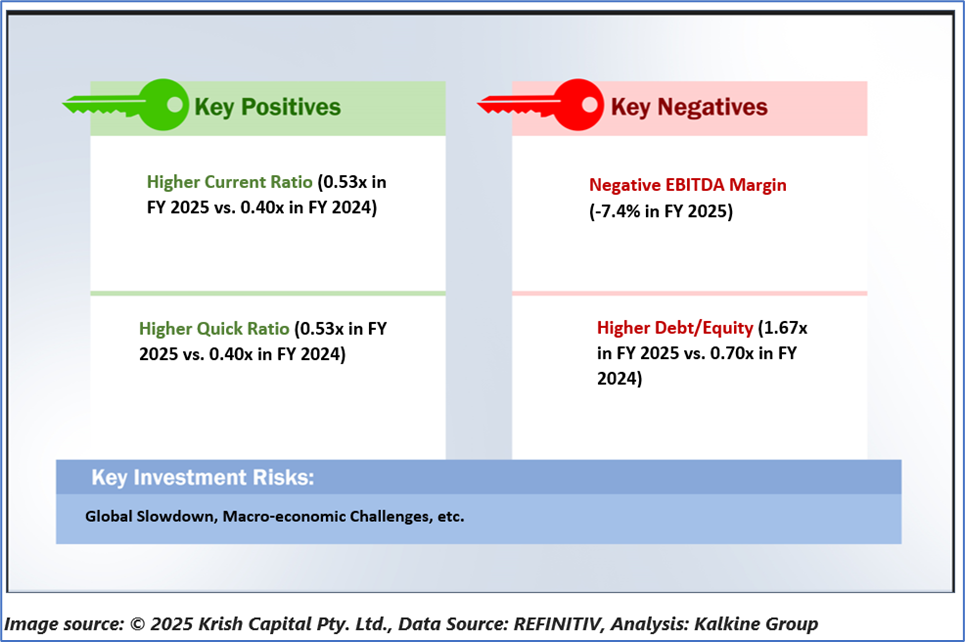
Comvita Limited (NZX: CVT) is the global market leader in Mānuka honey and bee consumer goods.
Outlook:
The core financial objective revolves around returning to profitability in FY 2026. CVT’s immediate focus remains towards strengthening the balance sheet as well as lifting delivery. The critical actions consist of reducing the net debt, delivering further cost savings as well as simplifying overheads and leadership structures.
Technical Overview:
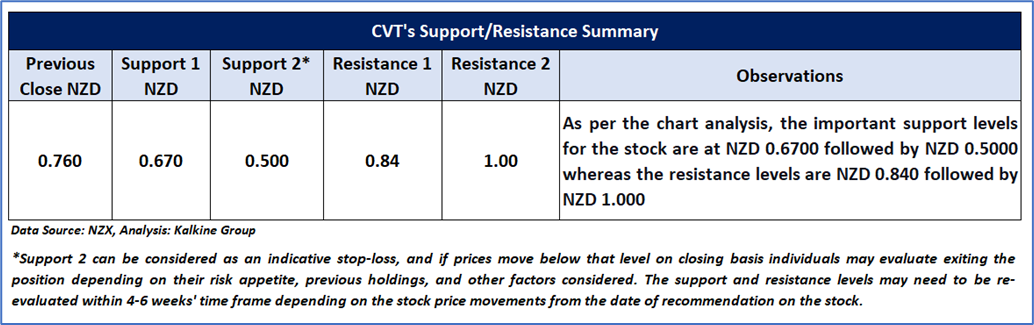
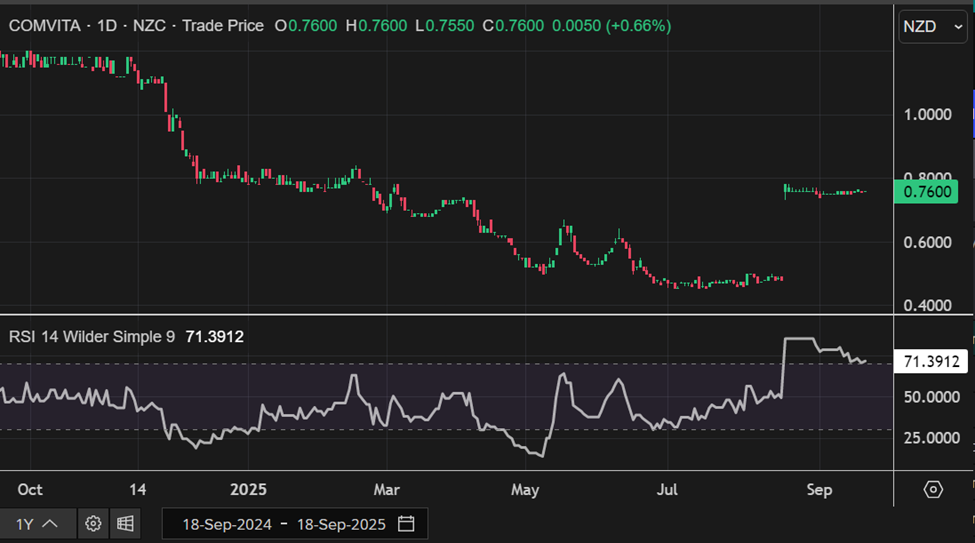
CVT Daily Technical Chart, Data Source: REFINITIV
Technical Commentary:
On the daily chart, CVT’s stock price broke above a descending wedge pattern with a Breakaway gap, indicating a positive bias in the near term. Moreover, the momentum oscillator RSI (14-period) is trading above its midpoint, providing further support to the previous observation. Price is trading above its previous peak, which might function as a support level for the stock; in contrast, the stock’s next round level may act as a sentimental support. A significant support level for the stock is positioned at NZD 0.670, while critical resistance level is located at NZD 0.840.
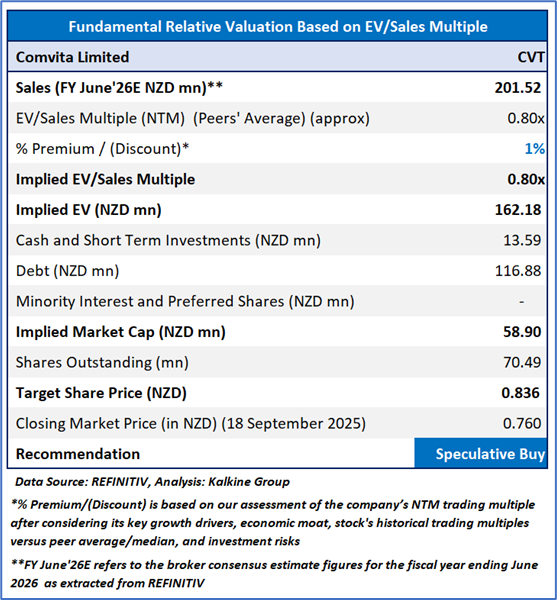
EV/Sales Based Valuation
Stock Recommendation
Considering the facts above, a ‘Speculative Buy’ recommendation on the stock has been provided at the closing market price of NZD 0.760 per share, up by 0.66% as on 18 September 2025.
Markets are trading in a highly volatile zone currently due to certain macro-economic issues and geopolitical tensions prevailing. Therefore, it is prudent to follow a cautious approach while investing.
Note 1: Past performance is not a reliable indicator of future performance.
Note 2: The reference date for all price data, currency, technical indicators, support, and resistance levels is September 18, 2025. The reference data in this report has been partly sourced from REFINITIV.
Note 3: Investment decisions should be made depending on an individual's appetite for upside potential, risks, holding duration, and any previous holdings. An 'Exit' from the stock can be considered if the Target Price mentioned as per the Valuation and or the technical levels provided has been achieved and is subject to the factors discussed above.
Note 4: Annual Dividend Yield is on a Trailing Twelve Month (TTM1) basis and are subject to change based on factors such as company performance, stock price changes, etc.
Note 5: Kalkine reports are prepared based on the stock prices captured either from REFINITIV or Trading View. Typically, REFINITIV or Trading View may reflect stock prices with a delay which could be a lag of 25-30 minutes. There can be no assurance that future results or events will be consistent with the information provided in the report. The information is subject to change without any prior notice.
Technical Indicators Defined: -
Support: A level at which the stock prices tend to find support if they are falling, and a downtrend may take a pause backed by demand or buying interest. Support 1 refers to the nearby support level for the stock and if the price breaches the level, then Support 2 may act as the crucial support level for the stock.
Resistance: A level at which the stock prices tend to find resistance when they are rising, and an uptrend may take a pause due to profit booking or selling interest. Resistance 1 refers to the nearby resistance level for the stock and if the price surpasses the level, then Resistance 2 may act as the crucial resistance level for the stock.
Stop-loss: It is a level to protect further losses in case of unfavourable movement in the stock prices.
Disclaimer This report has been issued by Kalkine New Zealand Limited (FSP691351) (NZBN:9429047678101) (“Kalkine”). Kalkine is a Financial Advice Provider (“FAP”) and is authorised by a Class 1 Financial Advice Provider Licence issued by Financial Markets Authority (“FMA”) to provide financial advice. Kalkine provides only general financial advice through its research reports following a person becoming a member. The reports contain buy/sell/hold and other recommendations in relation to equity securities, managed funds and other managed investment schemes and other financial advice products. The recommendations and opinions in this report and on Kalkine website do not take into account any of your investment objectives, financial situation or needs. Before you make a decision about whether to acquire a financial product, you should obtain the Product Disclosure Statement from the product issuer. You should consider the appropriateness of advice taking into account your own objectives, financial situation and needs and seek independent financial advice before making any financial decisions. If you act on the advice in the research reports, you may have to pay fees, expenses or other amounts (but not to Kalkine). Further information about the complaints and dispute resolution process, as well as information about Kalkine’s duties are available on Kalkine’s website. Please read our Financial Advice Provider (FAP) disclosure statement and Complaints Handling Guide, which are available on the website.
Past performance is not a reliable indicator of future performance.
 Please wait processing your request...