
 AU
AU
 UK
UK
 CA
CA
 US
US
 IND
IND

 NZ
NZ
Company Overview: New Zealand-based company, Vector Limited (NZX: VCT) owns and manages a portfolio of energy and fibre optic. Its Regulated Networks segment includes Auckland electricity and gas distribution services; Gas Trading segment includes natural gas and liquefied petroleum gas (LPG) sales, storage and processing, and cogeneration; and Technology segment includes metering services, telecommunications and new energy solutions. The Company's electricity lines and cables deliver power to around 544,510 homes and businesses on behalf of electricity retailers and maintain and operates around 1.5 million electricity and gas meters. The Company's gas brand, OnGas, promotes both piped and bottled gas supply to customers throughout New Zealand. Besides, it owns and operates gas processing facilities at Kapuni in South Taranaki.
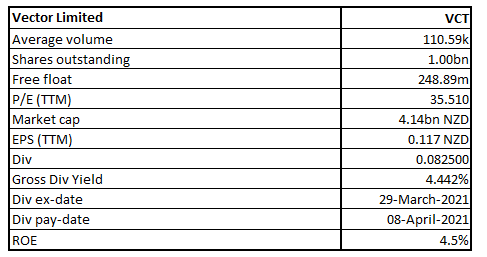
VCT Details
Vector Limited (NZX: VCT) is New Zealand’s leading network infrastructure company which runs a portfolio of businesses delivering energy and communication services to more than one million homes and commercial customers throughout the country. The market capitalisation of the company stood at ~$4.14 billion on 10th May 2021.
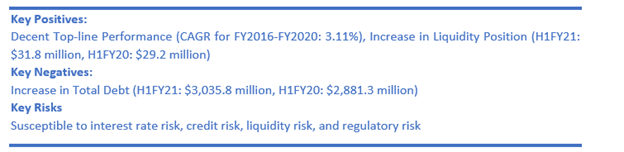
Looking at the past performance, VCT’s top-line over FY16-20 grew with a compounded annual growth rate (CAGR) of 3.11%. Its total revenue for FY20 stood at $1,294.0 million, as compared to $1,144.6 million in FY16.
Results Performance (Half-Year Ended 31 December 2020)
Despite the uncertainties that have risen due to COVID-19, the company delivered a solid result for the interim period with adjusted EBITDA recording 3.5% YoY growth to $273.8 million and net profit after tax recording growth of 26.8% YoY to $102.1 million. Electricity business for the period benefited from automation projects which enabled the company to better manage its maintenance programme with near real-time information thereby resulting in both cost and resource efficiencies. Adjusted EBITDA in the electricity segment increased by 3.5% YoY to $195.9 million. Adjusted EBITDA in the gas trading segment declined by 1.4% YoY due to lower natural gas volumes and margins despite improved performance from Ongas LPG business. Adjusted EBITDA in the metering segment increased by 9.2% YoY to $83.1 million which could be attributed to the continued rollout of advanced meter, particularly in Australia.
The Board declared an interim dividend of 8.25 cents per share at an imputation rate of 10.5%.
Exhibit 1: Key Metrics
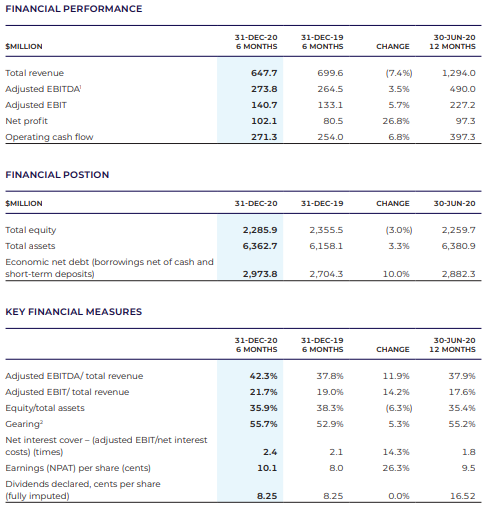
Key Data (Source: Company Reports)
Operational Performance (For Nine Months ended 31 March 2021)
Total electricity network connection in nine months to 31 March 2021 grew by 1.7% over the previous corresponding period (pcp). Driven by the reduced activity from the industrial and commercial sectors due to COVID-19, electricity volume for the nine-month period, declined by 1.6% over the pcp. Gas distribution network customers increased by 2.1% in total connections, mainly because of the continued growth of Auckland. However, gas distribution volume over the period was down 2.8% on pcp, due to reduced activity from the industrial and commercial sectors. Natural gas, LPG volumes and Liquigas LPG tolling were down on the March 2020 comparative period, with the 35.3% reduction in natural gas volumes driven primarily by the loss of a large customer in January 2020.
However, the metering business continues to perform both in New Zealand and Australia wherein advanced meter numbers increased by 8.7% YoY in March 2021.
Due to significant initiatives to improve network resilience despite ongoing challenges caused by weather events, traffic congestion and vegetation, SAIDI minutes for the twelve months ended 31 March 2021, was 21.5% lower than the previous year.
Exhibit 2: Key Operational Statistics
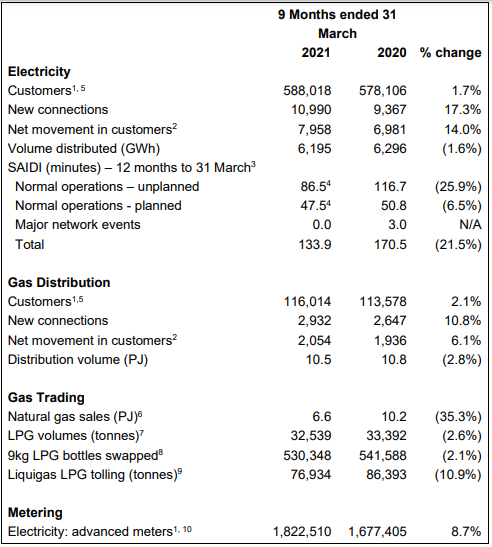
Key Data (Source: Company Reports)
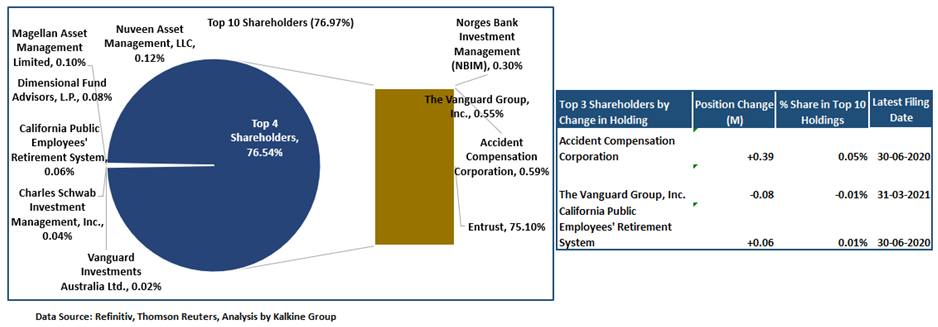
Top 10 Shareholders: The top 10 shareholders have been provided in the below given pie chart which together forms around 76.97% of the total shareholding. Entrust and Accident Compensation Corporation are holding maximum stake in the company at 75.10% and 0.59%, respectively.
Exhibit 3: Top 10 Shareholders
A Quick Look at Key Metrics: The company’s gross margin and EBITDA margin for H1FY21 stood at 69.0% and 50.2%, better than the H1FY20 result of 63.0% and 44.3%, respectively, implying an improvement in the company’s operational efficiency. Its cash cycle for H1FY21 stood at 66.7 days, better than the H1FY20 figure of 70.7 days, implying that the company efficiently managed its asset-liability balances.
Exhibit 4: Key Metrics
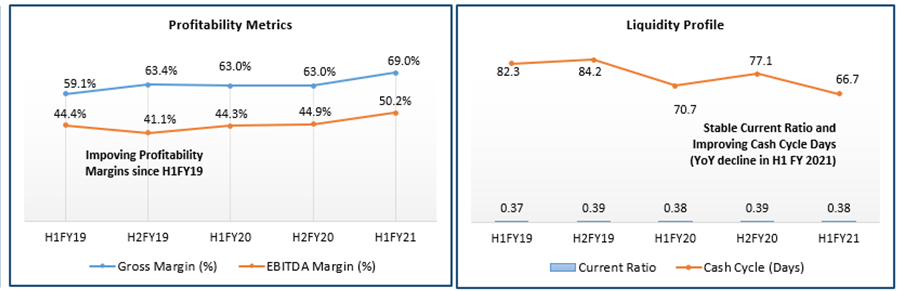
(Source: Refinitiv (Thomson Reuters)), Analysis by Kalkine Group
Outlook:
The operational performance for the nine months ended 31 March 2021 suggests that there has been strong growth in network connection numbers across electricity and gas networks. The company’s metering business continues to perform even in the increasingly competitive market. Besides, the company continues to invest in infrastructure to support network integrity, increasing deployment of advanced meters, the start of 4G modem upgrades, increasing stock levels to counter risk associated with global production shortage.
Going forward, the increased industrial and commercial activities post re-opening of economies will drive the demand for electricity, gas and advanced meter which will eventually help register higher growth in EBITDA. Encouraged by the favourable demand environment, VCT has upwardly revised its adjusted EBITDA guidance from the range of $480 - $500 million to $500 - 520 million for FY21.
Risks:
The global pandemic continues to affect the company’s supply chain through shipping and offshore manufacturing delays. Besides, the company’s business is exposed to cybersecurity risk with the potential of disrupting critical services.
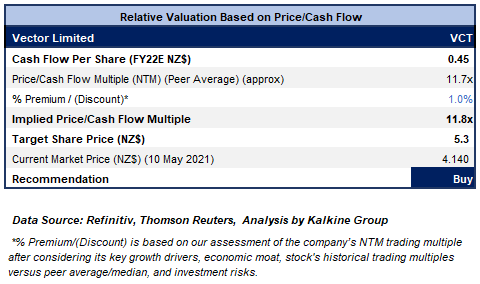
Valuation Methodology: Price/CF Based Relative Valuation (Illustrative)
Technical Overview:
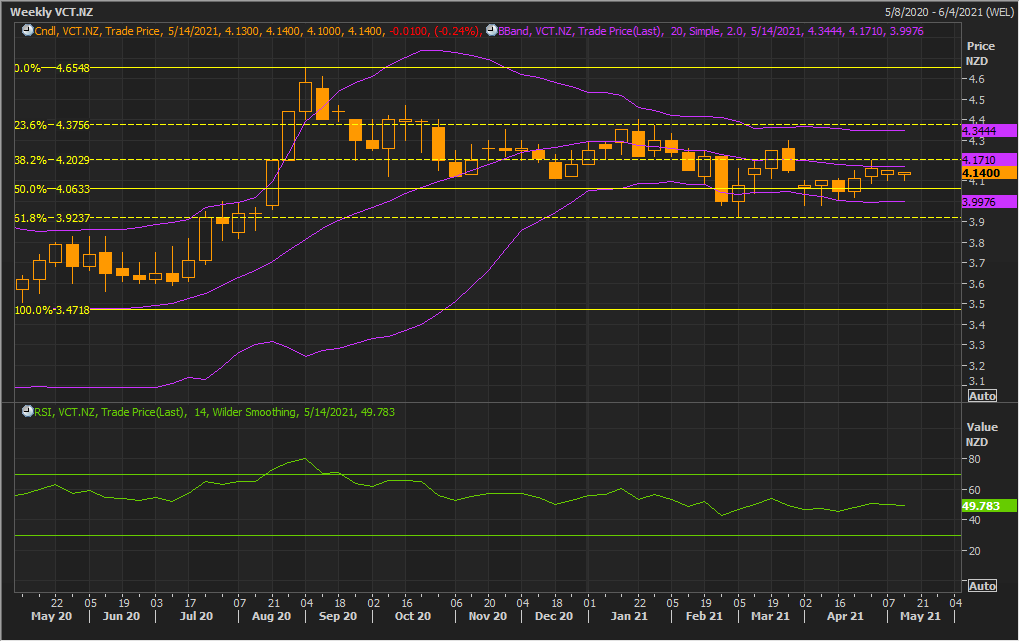
Weekly Chart –
Source: Refinitiv (Thomson Reuters)
Note: Purple colour lines are Bollinger Bands® with the upper band suggesting overbought status while the lower band oversold status, and yellow lines are Fibonacci retracement lines which measure price rebound and backtrack. https://www.bollingerbands.com/
The stock has given a stronger close at $4.14 above the 50% retracement level of $4.06 in the first trading session of the ongoing week thereby exhibiting strength in an uptrend. The technical indicator RSI with a reading around 50 suggests bullish momentum for the stock.
Going forward, the stock may have resistance around a 23.6% retracement level of $4.38 whereas support could be around a 50% retracement level of $4.06.
Stock Recommendation:
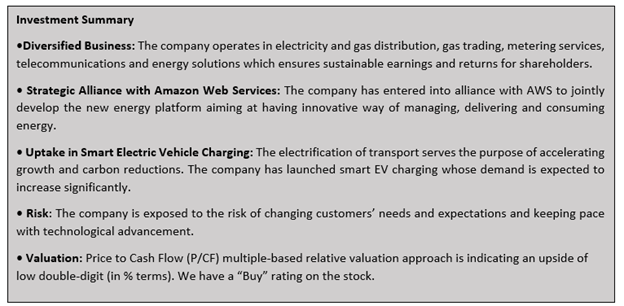
The company continues to invest in innovative technologies and infrastructure that support its customers. Moreover, the company is working closely with its partner Amazon Web Services (AWS) to deliver advanced energy solutions, such as the development of a next-generation advanced meter platform to reduce the processing time for meter data as well as analytical solutions for retailer customers. The stock rose by 13.8% in 1 year and by 4.3% in 9 months. It has made a 52-week low and high of $3.46 and $4.65, respectively.
We have valued the stock using a Price/CF multiple-based illustrative relative valuation and have arrived at a target price that reflects a rise of low double-digit (in % terms). We have assigned a slight premium to Price/CF Multiple (NTM) (Peer Average), considering diversified business and better liquidity position which could help the company in tackling tough conditions.
Hence, we give a “Buy” recommendation on the stock at the current market price of NZ$4.140 per share, down by 0.24% on May 10, 2021.
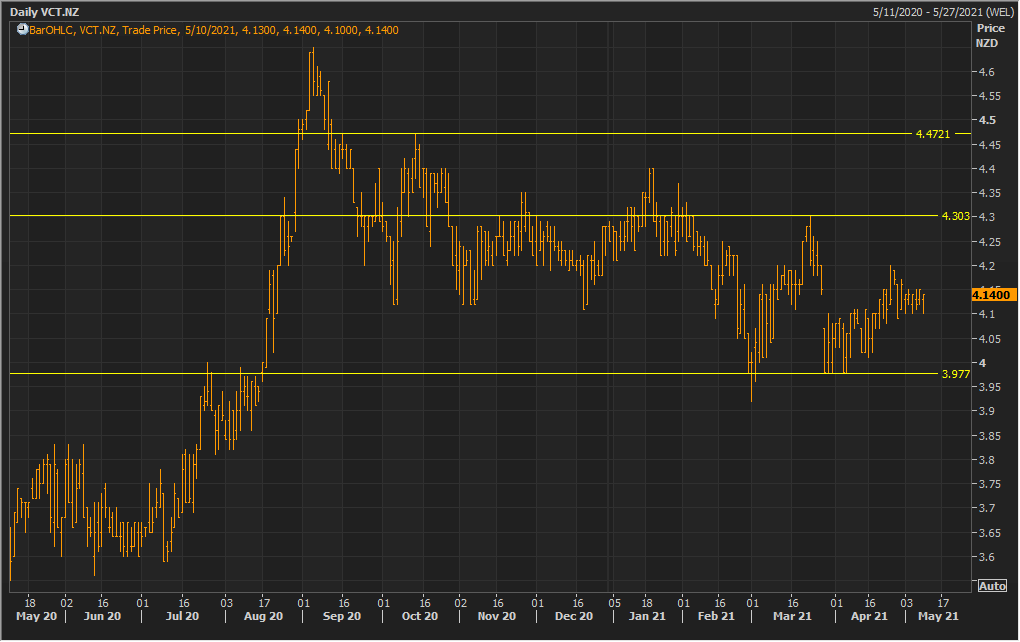
VCT Daily Technical Chart (Source: Refinitiv (Thomson Reuters))
Note: Investment decisions should be made depending on the investors’ appetite on upside potential, risks, holding duration, and any previous holdings. Investors can consider exiting from the stock if the Target Price mentioned as per the Valuation has been achieved and subject to the factors discussed above.
Disclaimer
Kalkine New Zealand Limited is authorised to provide class advice only. The information on this site does not take into account any of your investment objectives, financial situation or needs. Before you make a decision about whether to acquire a financial product, you should obtain the Product Disclosure Statement from the product issuer. You should consider the appropriateness of advice taking into account your own objectives, financial situation and needs and seek independent financial advice before making any financial decisions.
Past performance is not a reliable indicator of future performance.
 Please wait processing your request...