
 AU
AU
 UK
UK
 CA
CA
 US
US
 IND
IND

 NZ
NZ

I. Sector Landscape and Outlook
International energy price volatility plays a key role in New Zealand’s energy system. Volatilities in commodity prices and international geopolitical situations drive crude oil prices and domestic transport fuel prices. New Zealand’s electricity demand was at 89% of historical levels (an average of demand on each day across 2015-2019) in 2020, when the country entered alert level four of Covid-19. While New Zealand maintained oil stocks to ensure that the country has ~90 days of net oil imports available, the oil imports were at low levels as compared to pre-covid numbers. This was due to reduced demand for oil.
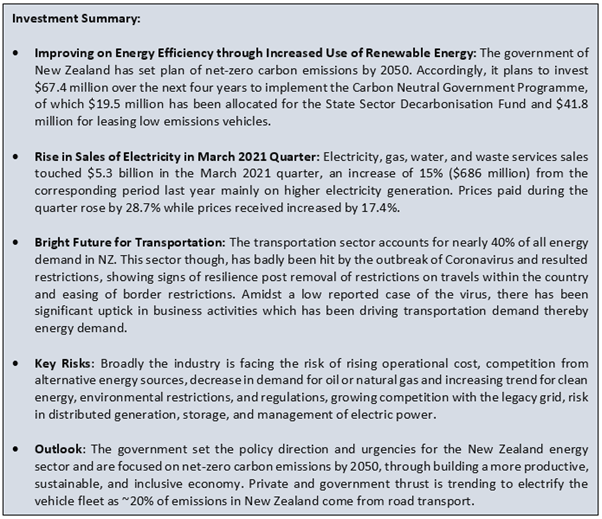
Budget 2021, besides other areas of concerns, is focused on the government’s commitment to a carbon-neutral public sector by 2025. Hence, it plans to invest a total of $67.4 million over the next four years to implement the Carbon Neutral Government Programme, of which $19.5 million for the State Sector Decarbonisation Fund (Estimated to save an additional 44,000 tonnes of carbon emissions over 10 years), and $41.8 for leasing low emissions vehicles (Estimated to save an additional 32,000 tonnes of carbon emissions over 10 years). In the previous three budgets, the government has made phenomenal investments in Aotearoa New Zealand’s low-carbon future, which includes climate-friendly transport options such as public transport and major cycling projects.
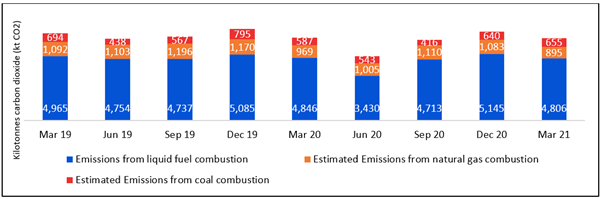
Exhibit 1: Trend in Primary Fuel Emissions – Since March 2019 to March 2021
Data Source: mbie.govt.nz, Chart Created by Kalkine Group
Increased Sales of Electricity in March 2021 Quarter
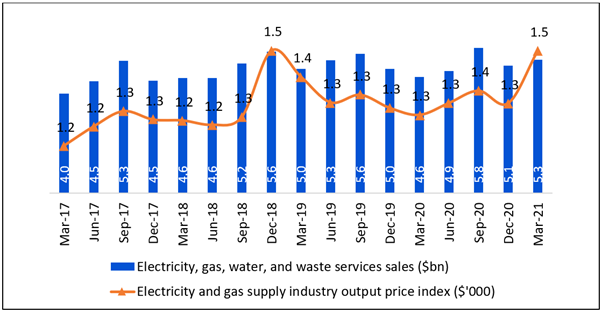
Electricity, gas, water, and waste services sales touched $5.3 billion in the March 2021 quarter, an increase of 15% ($686 million) from the corresponding period last year. Electricity generation contributes to a large proportion of this industry’s sales due to the non-market nature of gas, water, and waste services. The output price index for electricity and gas supply increased in March 2021 quarter that measures the price received by producers for electricity and gas supply generation. This index increased 17% from the December 2020 quarter and 21% from the March 2020 quarter.
Exhibit 2: Electricity, Gas, Water, and Waste Services Industry Sales March 2017-March 2021
Data Source: stats.govt.nz, Chart Created by Kalkine Group
Increase in Electricity Prices in March Quarter 2021
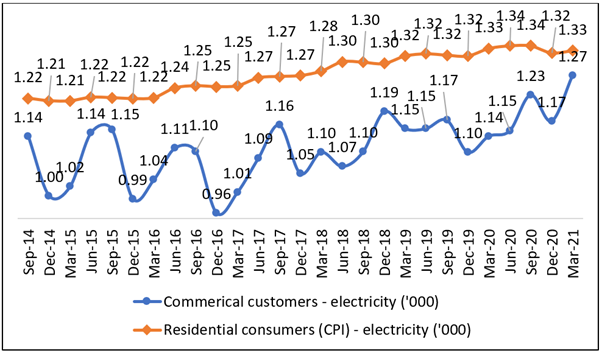
Prices paid by electricity and gas supply producers increased 28.7% in the March 2021 quarter, while prices they received for generation grew 17.4%. This March quarter 2021 price change is the largest increase since 2018 but is nowhere near the level seen in the 2008 power crisis. Electricity prices for residential customers rose 0.4%. The wholesale and household electricity price volatility are driven by transmission charges, industrial customers responding to peak-hour pricing, and hedging to manage price volatility. On a broader prospect, electricity retailers do not pass on wholesale pricing to households except they are on a spot price contract.
Exhibit 3: Trend in Commercial and Residential Electricity Commodities Price Indexes
Data Source: stats.govt.nz, Chart Created by Kalkine Group
Oil Supply Under Pressure in March 2021 Month, But Recovery is Underway
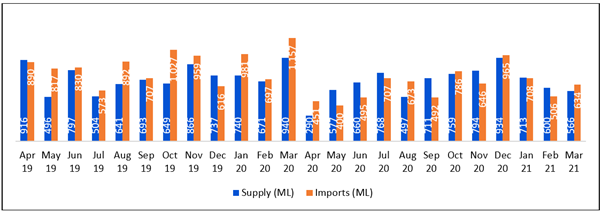
After posting growth in September-December 2020 months, the oil supply decreased since January 2021. It reported a de-growth of -23.7%, -15.8%, and -5.6% in January 2021, February 2021, and March 2021 respectively, though the fall in supply on MoM was in a decreasing trend. Moreover, oil is New Zealand’s largest source of energy and therefore has a strong impact on the economy. While there are multiple producing oil fields in New Zealand, the country is a net importer of oil. Further, the Marsden Point Oil Refinery, is New Zealand’s only oil refinery that is operated by Refining NZ. Refining NZ processes crude oil and condensate for the 3 biggest oil companies in New Zealand that include BP, Mobil, and Z Energy.
Exhibit 4: Monthly Trend in Oil Supply and Import (In Million Litres)
Data Source: mbie.govt.nz, Chart Created by Kalkine Group
Gas Supply and Production Slipped Marginally in March 2021 Month
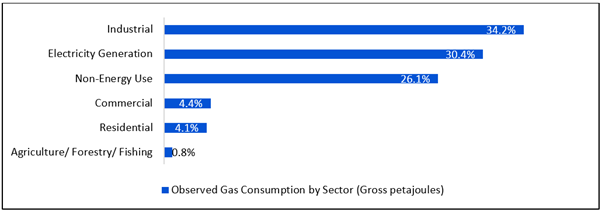
The gas supply and production grew by 6% and 4% respectively in February 2021 month, however, they fell by 1% and 3% respectively in March 2021 month, indicating lower demand and consumption for gas. Natural gas is obtained from the Taranaki region, from onshore and offshore wells that also produce oil. Several hundred explorations and production wells have been drilled since 1950. One of the oldest fields is Kapuni that is still producing natural gas today. Further, the gas transmission network is owned solely by First Gas Limited. It has been observed that the highest consumption of natural gas is in the Industrial sector (34.2%), followed by Electricity Generation (30.4%), and Non-Energy Use (26.1%). These three sectors consume over ~90% of Natural gas, while ~10% is consumed by commercial, residential, and Agriculture/Forestry/Fishing sectors.
Exhibit 5: Observed Gas Consumption by Sector in 2020
Data Source: mbie.govt.nz, Chart Created by Kalkine Group
Key Risks and Challenges:
The Government is taking measures to control climate change, and one of the measures was banning new low and medium-temperature coal-fired boilers and connecting with the private sector to help it transition away from fossil fuels. This decision will make a difference to New Zealand’s emissions profile and will provide a significant boost to the clean energy sector. The Government is also proposing to phase out existing coal boilers by 2037. In line with this, attention is on how to phase out other fossil fuels in existing sites through re-consenting processes and best practice requirements in a National Environment Standard.
Following climate change, the government said that the level of global emissions will result in an increase in temperature by a further 1 degree by 2040 and 3 degrees by 2090. Further, the associated sea-level rise would create an immense, widespread, and catastrophic impact on the climate. Its plan to ban new offshore oil and gas exploration, which was controversial, but in recent time the International Energy Agency has backed up this approach, pushing for more action to replace fossil fuels with clean energy.
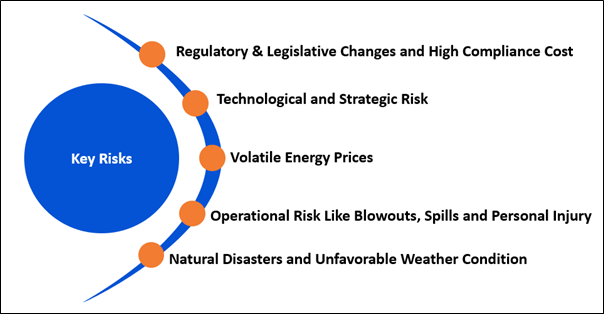
Exhibit 6. Key Risks in Utility and Energy Sector:
Sources: Analysis by Kalkine Group
Outlook:
The government has set the policy direction and urgencies for the New Zealand energy sector and is focused on net-zero carbon emissions by 2050, through building a more productive, sustainable, and inclusive economy. Future electricity demand will depend heavily on the movement of decarbonization and the length of changes in electricity using technologies and supply technologies over the next 30 years. Apart from the Environmental scenario, carbon prices are expected to rise from $25 per tonne of carbon dioxide in 2019 to $66 per tonne by 2050 in all the scenarios.
As per the Ministry of Business, Innovation & Employment (MBIE), the government thrust is trending to electrify the vehicle fleet as ~20% of emissions in New Zealand come from road transport. The development of new transport technologies that include EV and hydrogen fuel cell cars, and biofuels, is expected to improve CO2 emissions and the future electricity demand. The Reference scenario assumes by the government states that EVs will comprise 44% of the light vehicle fleet and 13% of the heavy vehicle fleet by 2050. In the Disruptive scenario, EVs will comprise 74% of the light vehicle fleet, and 45% of the heavy vehicle fleet by 2050, reflecting the falling costs of both batteries and EVs. These developments will impact the demand for oil and gas and subsequent pricing.
The share of electricity generation from renewable sources is forecasted to increase from 84% in 2018 to over 90% and 95% by 2035 and 2050, respectively. In the Reference scenario, 6,250 MW of electricity generation capacity will be needed by 2050, with 55% of the new build being wind generation. For other scenarios, the new build generation capacity is expected in the ambit of 3,800-10,600 MW across other scenarios in 2050 with capital expenditure in the ambit of $7-$24 billion.
Apart from the sector-specific factors, we have also analysed four NZX-listed companies operating in the same sector. This report covers their insights, outlook, performance and potential as expected to be delivered in the near to medium term.
1) Meridian Energy Limited (Recommendation: Buy, Potential Upside: Low Double-Digit) (M-Cap: NZ$13.35 billion, Gross Dividend Yield: 4.354%)
Business Description:
Meridian Energy Limited (NZX: MEL) generates electricity through 100% renewable sources such as wind, water, and the sun to supply the same to customers from the electricity grid that mixes electricity supplied from both renewable and non-renewable sources.
Outlook:
Meridian’s New Zealand retail sales volumes in May 2021 increased 23.4% over May 2020, contributed by increase in all segments: residential +5.7%, small-medium business +49.2%, agricultural +1.4%, large business +11.1%, and corporate +33.0%. As per the management, the performance of Meridian and Powershop brands is expected to shine further. Meanwhile, production volume and price fluctuation will be the key drivers in the future period to determine the financial performance of the company. Moreover, the company is experiencing a jump in customer numbers in New Zealand and Australia in the recent period.
Valuation Methodology: EV/EBITDA Based Relative Valuation (Illustrative)
Stock Recommendation
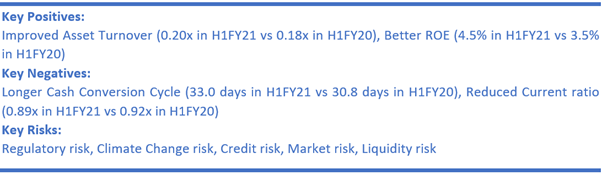
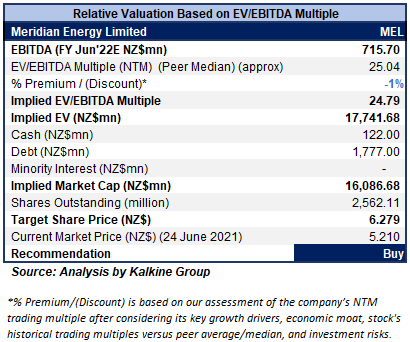
Considering the aforesaid facts, we have valued the stock using an EV/EBITDA multiple-based illustrative relative valuation and have arrived at a target price that reflects a rise of low double-digit (in % terms). We believe the company can trade at a slight discount to its peer EV/EBITDA (NTM Trading multiple) considering fall in current ratio.
For relative valuation, we have taken peers like Mercury NZ Ltd. (MCY.NZ), Tilt Renewables Ltd. (TLT.NZ), and Genex Power Ltd. (GNX.AX).
Considering the aforesaid facts, we give a “Buy” recommendation on the stock at the current market price of $5.21 per share, up 0.58% on 24th June 2021.
2) Z Energy Limited (Recommendation: Buy, Potential Upside: Low Double-Digit) (M-Cap: NZ$1.37 billion, Gross Dividend Yield: 7.365%)
Business Description:
Z Energy Limited (NZX: ZEL) supplies fuel to retail customers and large commercial customers such as airlines, trucking companies, mines, shipping companies, and vehicle fleet operators, as well as it also provides bitumen to roading contractors.
Outlook
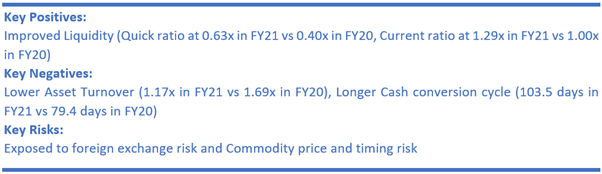
Assuming no further Covid-19 lockdowns, the company expects to grow earnings in FY22 as it is focused on reducing the structural costs, hold market share, optimize the use of terminals to improve returns, and deliver new customer offers. At the same time, the company is expected to manage its capital carefully. As per the release dated 25 May 2021, the company agreed in-principle to the terms offered by The New Zealand Refining Company to transition the refinery to an Import Terminal System (ITS).
Valuation Methodology: EV/EBITDA Based Relative Valuation (Illustrative)
Stock Recommendation
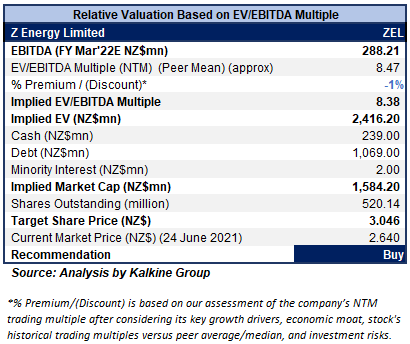
Considering the aforesaid facts, we have valued the stock using an EV/EBITDA multiple-based illustrative relative valuation and have arrived at a target price that reflects a rise of low double-digit (in % terms). We believe the company can trade at a slight discount to its peer EV/EBITDA (NTM Trading multiple) considering longer cash conversion cycle and elevated Debt to Equity versus industry median.
For relative valuation, we have taken peers like New Zealand Refining Company Ltd. (NZR.NZ), Ampol Ltd. (ALD.AX), and Senex Energy Ltd. (SXY.AX).
Considering the aforesaid facts, we give a “Buy” recommendation on the stock at the current market price of $2.64 per share on 24th June 2021.
3) New Zealand Oil & Gas Limited (Recommendation: Speculative Buy, Potential Upside: Low Double-Digit) (M-Cap: NZ$70.71 million)
Business Description:
New Zealand Oil & Gas Limited (NZX: NZO) is an exploration and production company, managing a portfolio of oil and gas assets.
Outlook
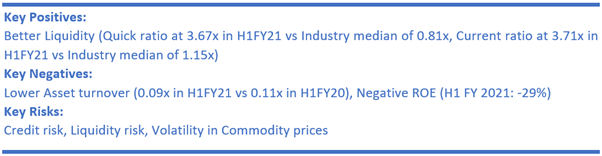
The company expects production revenues to increase in future periods driven by the performance of the Kupe field and production at the Mahato field in Indonesia following successful development there. Further, the company is focused on adding production revenue with development upside. Moreover, the company continues to explore opportunities for growth in markets. On 25 May 2021, the company agreed to purchase interests in 3 producing Northern Territory assets from Central Petroleum. On 24 June 2021, the management stated that this purchase will grow the 2P reserves by ~5-fold (14.5 million barrels of oil equivalent) and add 8.6 million barrels of oil equivalent to net 2C resources.
Technical Analysis
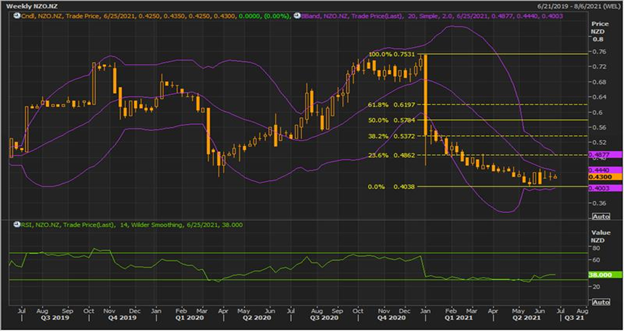
Weekly Chart
Source: REFINITIV
Note: Purple colour lines are Bollinger Bands® with the upper band suggesting overbought status while the lower band oversold status, and yellow lines are Fibonacci retracement lines which measure price rebound and backtrack. https://www.bollingerbands.com/
The stock is making its bid to bounce back from its low of $0.40. However, for the ongoing week, it has given a flattish close while experiencing low volatility. The technical indicator RSI with a reading around 38 and a curve at the end pointing up, suggests gaining of positive momentum for the stock.
Going forward, the stock may have resistance around the converging point of the 23.6% retracement level and 20 periods SMA of $0.48 whereas support could be around the previous low of $0.40.
Stock Recommendation
Considering current trading levels, plans to purchase interests in 3 producing Northern Territory assets from Central Petroleum, the commencement of Mereenie development well WM27, and a strong outlook, we give a “Speculative Buy” recommendation on the stock at the current market price of $0.43 per share on 24th June 2021.
4) Genesis Energy Limited (Recommendation: Hold, Potential Upside: Low Double-Digit) (M-Cap: NZ$3.49 billion, Gross Dividend Yield: 6.701%)
Business Description:
Genesis Energy Limited (NZX: GNE) is a diversified New Zealand energy company. It commercializes electricity, reticulated natural gas, and LPG through its retail brands of Genesis Energy and Energy Online.
Outlook
Genesis’ Future-gen strategy aims to displace baseload thermal electricity generation with 2,650GWh of renewable electricity to support the country’s transition to a low carbon future. GNE anticipates that the hydrological and gas market conditions which were witnessed in H1 FY 2021 would continue in H2FY21. Further, EBITDAF guidance for FY21 has been revised upward from previous guidance of $395-$415 million to $415-$425 million, subject to market conditions. Capital expenditure guidance for FY21 is unchanged at up to $95 million.
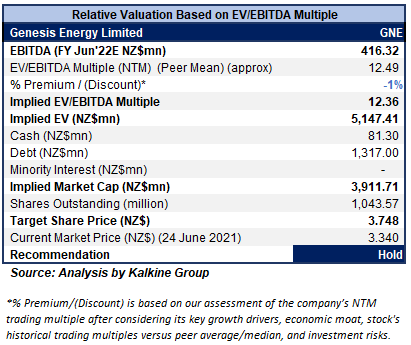
Valuation Methodology: EV/EBITDA Based Relative Valuation (Illustrative)
Stock Recommendation
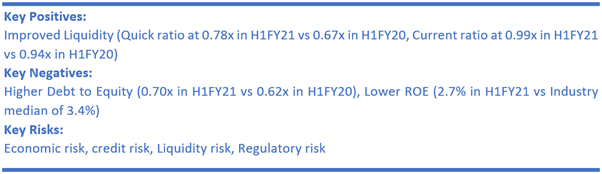
Considering the aforesaid facts, we have valued the stock using an EV/EBITDA multiple-based illustrative relative valuation and have arrived at a target price that reflects a rise of low double-digit (in % terms). We believe the company can trade at a slight discount to its peer EV/EBITDA (NTM Trading multiple) considering lower ROE and higher Debt to Equity versus peers.
For the purposes of relative valuation, we have taken peers like Contact Energy Ltd. (CEN.NZ), Infratil Ltd. (IFT.NZ), and Vector Ltd. (VCT.NZ).
Considering the aforesaid facts, we give a “Hold” recommendation on the stock at the current market price of $3.34 per share, down 1.18% on 24th June 2021.
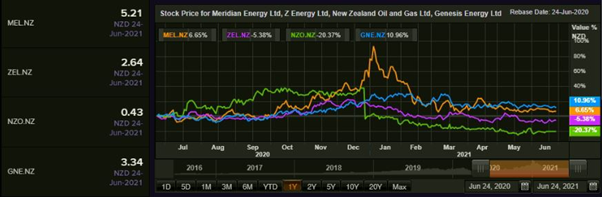
Comparative Price Chart (Source: REFINITIV)
Note 1: The reference data in this report has been partly sourced from REFINITIV.
Note 2: Investment decisions should be made depending on the investors’ appetite on upside potential, risks, holding duration, and any previous holdings. Investors can consider exiting from the stock if the Target Price mentioned as per the analysis has been achieved and subject to the factors discussed above alongside support levels provided.
Technical Indicators Defined: -
Support: A level where-in the stock prices tend to find support if they are falling, and downtrend may take a pause backed by demand or buying interest.
Resistance: A level where-in the stock prices tend to find resistance when they are rising, and uptrend may take a pause due to profit booking or selling interest.
Disclaimer
Kalkine New Zealand Limited is authorised to provide class advice only. The information on this site does not take into account any of your investment objectives, financial situation or needs. Before you make a decision about whether to acquire a financial product, you should obtain the Product Disclosure Statement from the product issuer. You should consider the appropriateness of advice taking into account your own objectives, financial situation and needs and seek independent financial advice before making any financial decisions.
Past performance is not a reliable indicator of future performance.
 Please wait processing your request...