
 AU
AU
 UK
UK
 CA
CA
 US
US
 IND
IND

 NZ
NZ

Company Overview:
Steel & Tube Holdings Limited (NZX: STU) is now one of NZ’s leading providers of steel solutions, allowing access to the widest range of steel products in the market, via a nationwide network of distribution centres. Accordant Group Limited (NZX: AGL) is a New Zealand-based recruitment company engaged in the supply of temporary staff, contractor resources, and recruitment of permanent staff.
Kalkine’s Sector Report covers the Key Financial Metrics, Risks, Outlook, Technical Analysis along with the Valuation, Target Price, and Recommendation on the stock.
Sector Landscape and Outlook
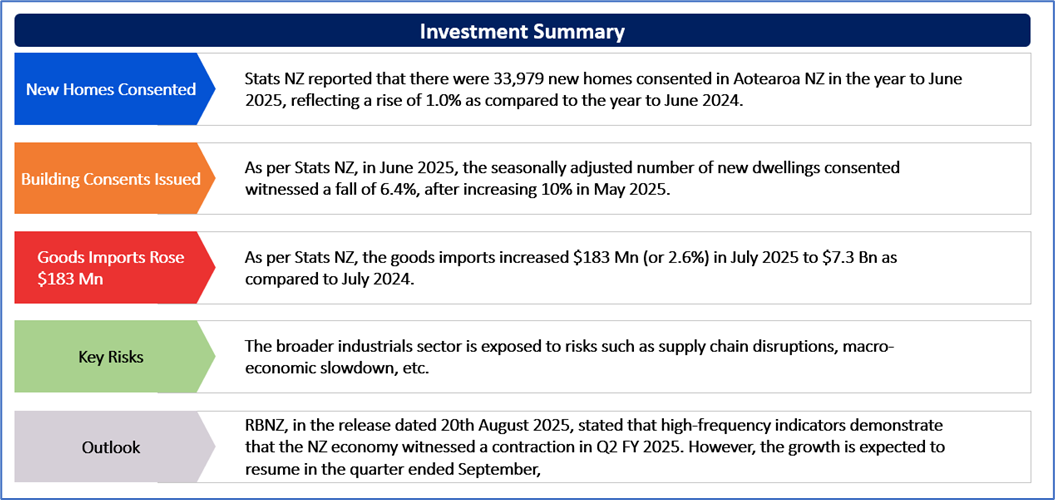
Stats NZ reported that there were 33,979 new homes consented in Aotearoa NZ in the year to June 2025, reflecting a rise of 1.0% as compared to the year to June 2024. Notably, this was the first time in 2 years that there was an annual growth in the number of new homes consented. The increase was mainly because of the 6.3% increase in stand-alone house consents, touching 15,858. In contrast, the consents for multi-unit homes declined 3.2% to 18,121 for the year to June 2025.
Out of the multi-unit homes consented in the year to June 2025, there were 14,361 townhouses, flats, and units, 2,178 apartments (a rise of 12%), and 1,582 retirement village units. Coming to the regional highlights, Auckland consented 14,295 new homes during the year to June 2025, up by 3.2%. The number of new homes consented during the June 2025 quarter stood at 8,196, a small decline from 8,279 in the quarter ended June 2024.
Exhibit 1: New Homes Consented
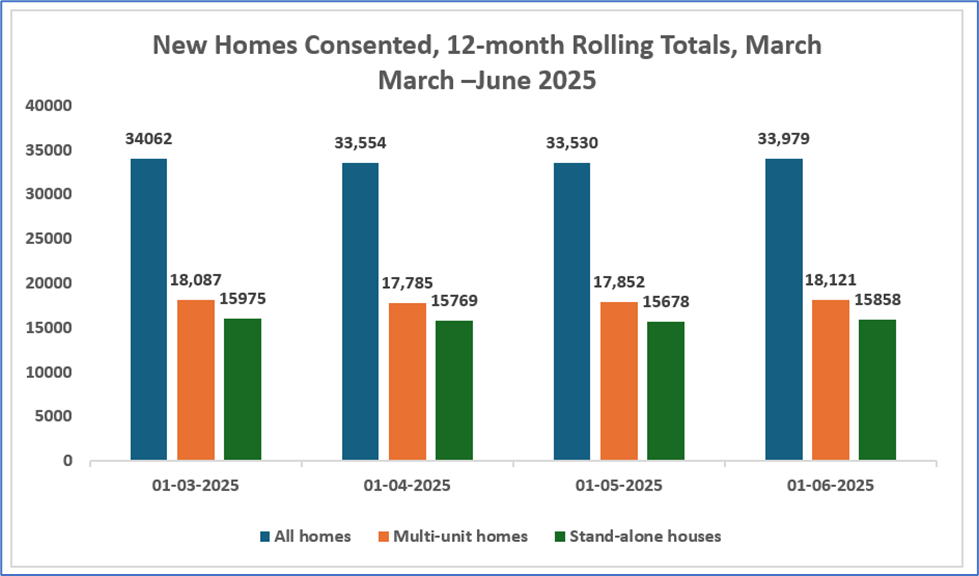
Data Source: This work is based on/includes Stats NZ’s data which are licensed by Stats NZ for reuse under the Creative Commons Attribution 4.0 International Licence; Chart Created by Kalkine Group
Building Consents Issued (June 2025)
As per Stats NZ, in June 2025, the seasonally adjusted number of new dwellings consented witnessed a fall of 6.4%, after increasing 10% in May 2025. In the year to June 2025, the actual number of new dwellings consented stood at 33,979, up by 1.0% from the year ended June 2024. The annual value of non-residential building work consented amounted to $9.0 Bn, down by 0.9% from the year ended June 2024. In June 2025, there were 2,627 new dwellings which were consented, consisting of 1,302 stand-alone houses, 1,169 townhouses, flats, and units, 116 apartments and 40 retirement village units.
The seasonally adjusted number of new stand-alone houses consented witnessed a rise of 2.9%, after increasing 3.6% in May 2025.
Exhibit 2: New Dwellings Consented
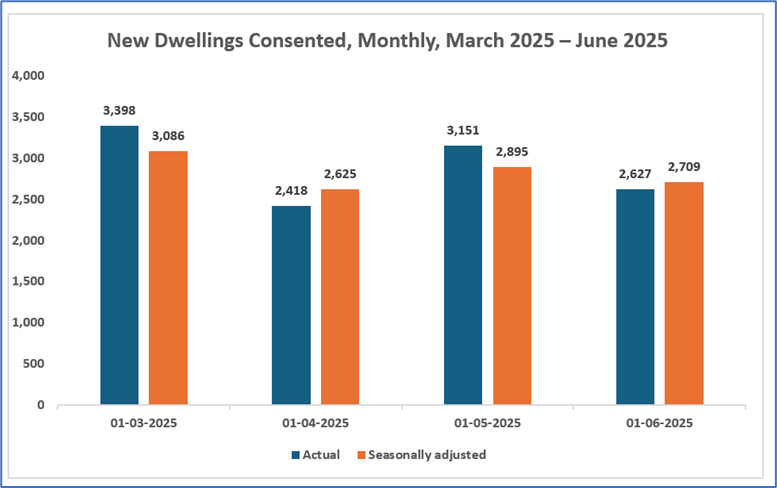
Data Source: This work is based on/includes Stats NZ’s data which are licensed by Stats NZ for reuse under the Creative Commons Attribution 4.0 International Licence; Chart Created by Kalkine Group
Goods Imports Rose $183 Mn (or 2.6%) in July 2025
As per Stats NZ, the goods imports increased $183 Mn (or 2.6%) in July 2025 to $7.3 Bn as compared to July 2024. With respect to China, the total imports rose $103 Mn (or 6.9%). The largest increases were electrical machinery and equipment (up by $41 Mn), vehicles, parts, and accessories (up $36 Mn), and mechanical machinery and equipment (up $32 Mn). The largest falls were witnessed in the petroleum and products, down by $54 Mn, and fertilisers (down by $26 Mn).
Key Risks and Challenges:
RBNZ recently stated that NZ’s economic recovery stalled in Q2 of this year. The spending by households and businesses was limited by global economic policy uncertainty, declining employment, increased prices for some essentials, and lower house prices. As per RBNZ, the cautious behaviour by households and businesses might further dampen the economic growth. Alternatively, the economic recovery might accelerate as the full effects of lower interest rates flow through the economy.
Exhibit 3: Key Risks in Industrials Sector:
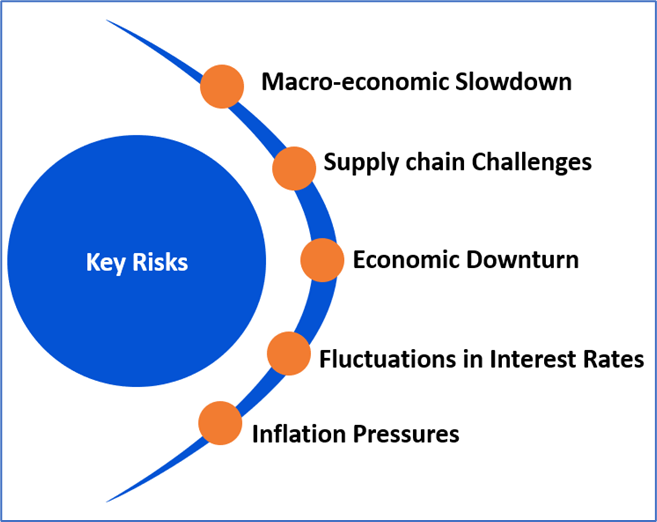
Source: Analysis by Kalkine Group
Outlook:
RBNZ, in the release dated 20th August 2025, stated that high-frequency indicators demonstrate that the NZ economy witnessed a contraction in Q2 FY 2025. However, the growth is expected to resume in the quarter ended September, consistent with a recovery in some economic indicators for July. The Committee also assessed the fiscal outlook. Notably, the decline in government spending as a share of the economy is projected to reduce the inflationary pressure over the medium term.
The Committee also assessed slow growth in productive capacity of NZ’s economy. As per the release, the potential output growth has slowed, demonstrating subdued investment, lower productivity growth, and historically low population growth via net immigration. The Committee highlighted that the appropriate monetary policy settings are expected to help the sustainable long-run investment and growth.
Apart from the sector-specific factors, an analysis on 2 NZX-listed companies is provided. This report covers their insights, outlook, performance and potential as expected to be delivered in the near to medium term.
1) Accordant Group Limited (Recommendation: Speculative Buy, Potential Upside: Low Double-Digit) (M-Cap: NZD 10.1 Mn)
Business Description:
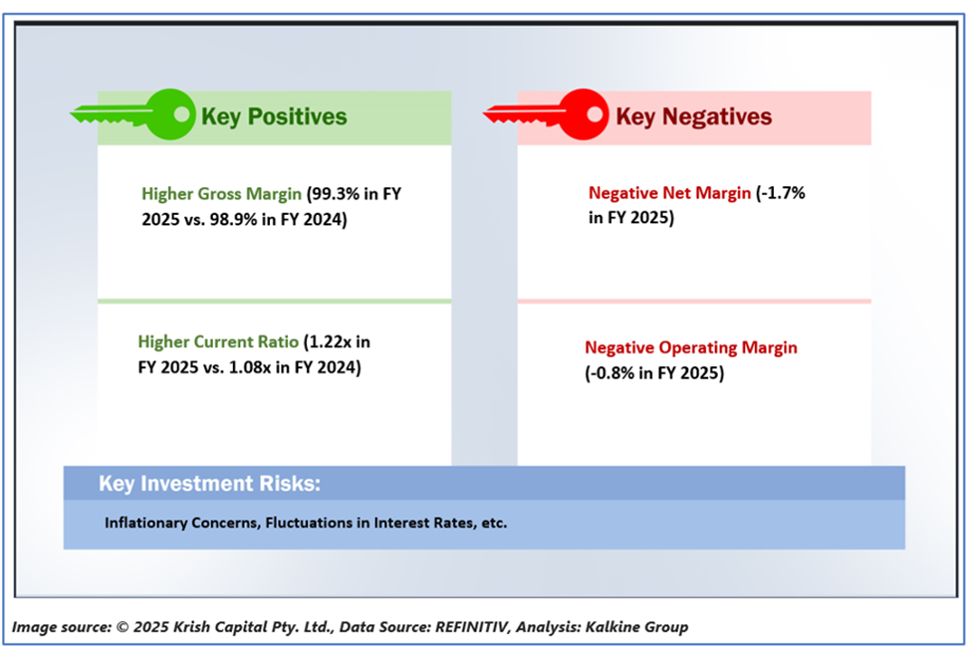
Accordant Group Limited (NZX: AGL) is a New Zealand-based recruitment company engaged in the supply of temporary staff, contractor resources, and recruitment of permanent staff.
Outlook:
For FY 2026, AGL’s strategic focus remains on aligning with resilient sectors and clients with the ongoing work pipelines as well as leveraging the diversified brand portfolio to provide end-to-end talent solutions. Notably, Madison’s entry into healthcare happens to be a strategic move, and robust foundations have been laid. With respect to JacksonStone & Partners, the company is witnessing a steady increase in contractor placements during Q1 FY 2026.
Technical Overview:
Technical Commentary:
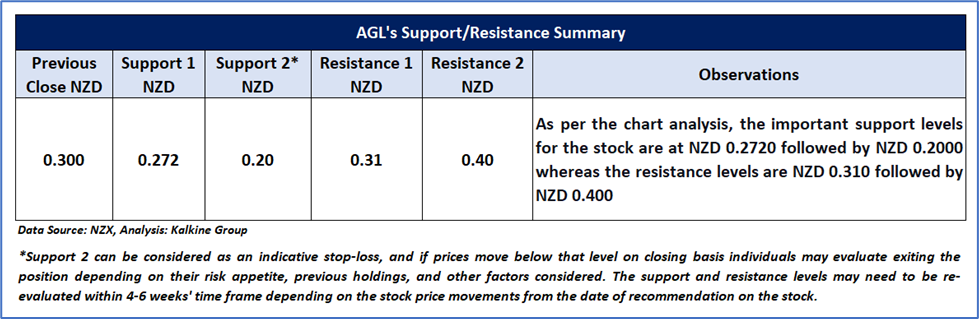
While undergoing a minor rally during a downtrend, AGL’s stock price is approaching its previous peak, suggesting that the stock might resume its previous downtrend soon. Moreover, the momentum oscillator RSI (14-period) is trading in its overbought region, providing further support to the previous observation. Prices are trading between its previous peak and trough, which might function as resistance and support levels for the stock, respectively. A significant support level for the stock is positioned at NZD 0.272, while critical resistance level is located at NZD 0.310.
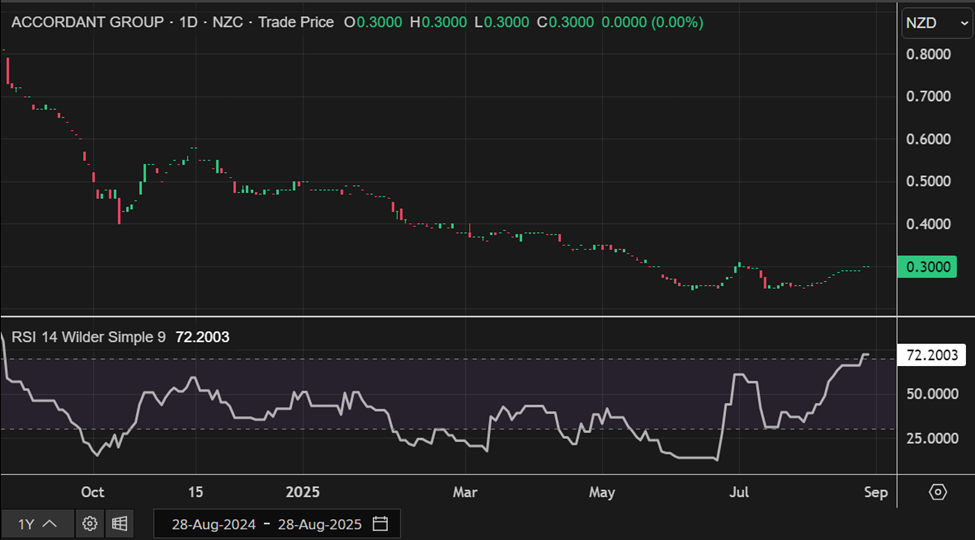
AGL Daily Technical Chart, Data Source: REFINITIV
Stock Recommendation
Considering the aforementioned factors, a ‘Speculative Buy’ rating is given on the stock at the closing market price of NZD 0.30 per share as on 28 August 2025.
2) Steel & Tube Holdings Limited (Recommendation: Buy, Potential Upside: Low Double-Digit) (M-Cap: NZD 126.7 Mn, Annual Dividend Yield: 4.03%)
Business Description:
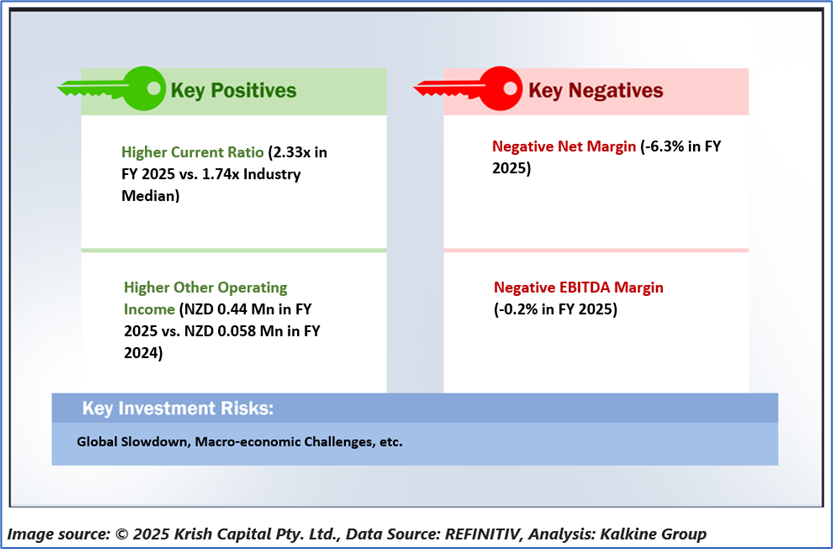
Steel & Tube Holdings Limited (NZX: STU) is now one of NZ’s leading providers of steel solutions, allowing access to the widest range of steel products in the market, via a nationwide network of distribution centres.
Outlook:
STU’s long term balance sheet strength allowed investment towards the growth initiatives, with bank facilities being utilised for M&A. Net debt stood at $36.3 Mn as at 30 June 2025, which included $30 Mn for the Perry’s acquisition. The company is starting to witness early signs of recovery.
Technical Overview:
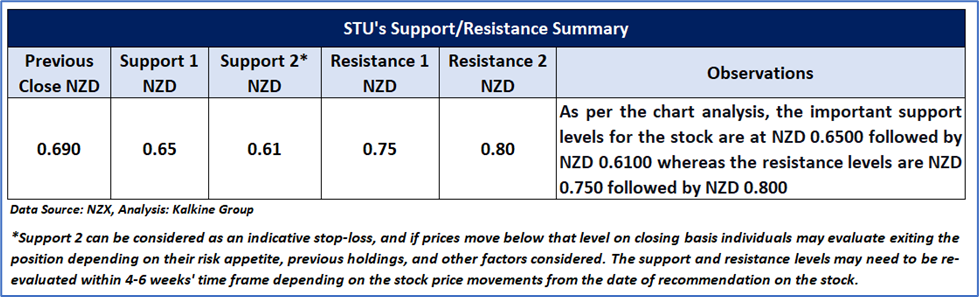
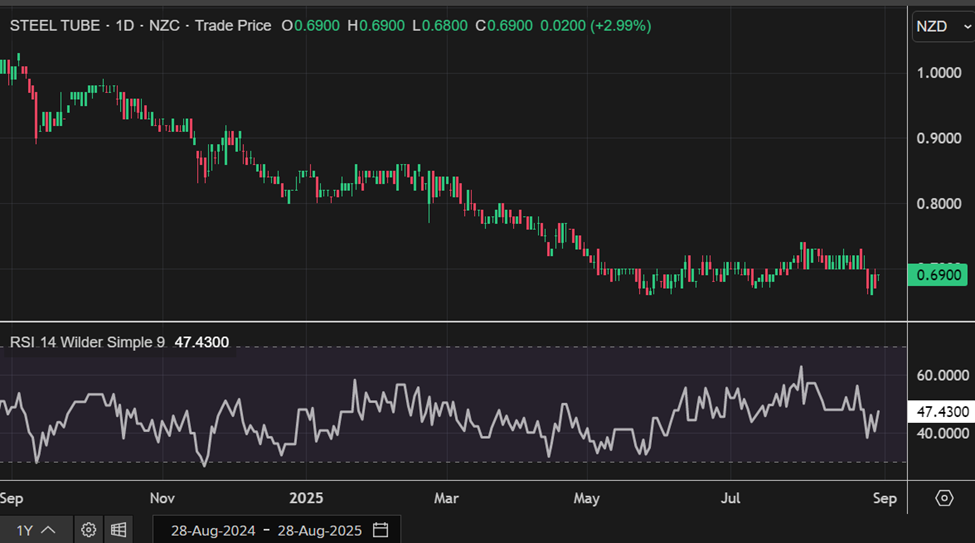
STU Daily Technical Chart, Data Source: REFINITIV
Technical Commentary
While experiencing a downtrend, STU’s stock price is rebounding from its previous trough, anticipating a potential minor rally. Moreover, the momentum oscillator RSI (14-period) is forming a bottom divergence in relation to prices, providing more support to the previous observation. Prices are trading between its previous peak and trough, which might function as a resistance and support levels for the stock, respectively. A significant support level for the stock is located at NZD 0.650, while critical resistance level is placed at NZD 0.750.
Fundamental Valuation:
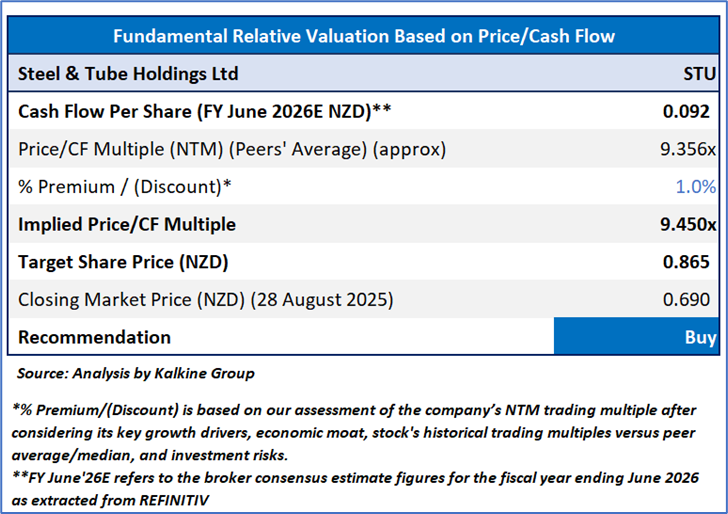
Price/Cash Flow Based Valuation
Stock Recommendation
Considering the aforementioned factors, a ‘Buy’ rating is given on the stock at the closing market price of NZD 0.69 per share, up by 2.99% as on 28 August 2025.
Markets are trading in a highly volatile zone currently due to certain macro-economic issues and geopolitical tensions prevailing. Therefore, it is prudent to follow a cautious approach while investing.
Note 1: Past performance is neither an indicator nor a guarantee of future performance.
Note 2: The reference date for all price data, currency, technical indicators, support, and resistance levels is August 28, 2025. The reference data in this report has been partly sourced from REFINITIV.
Note 3: Investment decisions should be made depending on an individual's appetite for upside potential, risks, holding duration, and any previous holdings. An 'Exit' from the stock can be considered if the Target Price mentioned as per the Valuation and or the technical levels provided has been achieved and is subject to the factors discussed above.
Note 4: Annual Dividend Yield is on a Trailing Twelve Month (TTM1) basis and are subject to change based on factors such as company performance, stock price changes, etc.
Note 5: Kalkine reports are prepared based on the stock prices captured either from REFINITIV or Trading View. Typically, REFINITIV or Trading View may reflect stock prices with a delay which could be a lag of 25-30 minutes. There can be no assurance that future results or events will be consistent with the information provided in the report. The information is subject to change without any prior notice.
Technical Indicators Defined: -
Support: A level at which the stock prices tend to find support if they are falling, and a downtrend may take a pause backed by demand or buying interest. Support 1 refers to the nearby support level for the stock and if the price breaches the level, then Support 2 may act as the crucial support level for the stock.
Resistance: A level at which the stock prices tend to find resistance when they are rising, and an uptrend may take a pause due to profit booking or selling interest. Resistance 1 refers to the nearby resistance level for the stock and if the price surpasses the level, then Resistance 2 may act as the crucial resistance level for the stock.
Stop-loss: It is a level to protect further losses in case of unfavourable movement in the stock prices.
Disclaimer This report has been issued by Kalkine New Zealand Limited (FSP691351) (NZBN:9429047678101) (“Kalkine”). Kalkine is a Financial Advice Provider (“FAP”) and is authorised by a Class 1 Financial Advice Provider Licence issued by Financial Markets Authority (“FMA”) to provide financial advice. Kalkine provides only general financial advice through its research reports following a person becoming a member. The reports contain buy/sell/hold and other recommendations in relation to equity securities, managed funds and other managed investment schemes and other financial advice products. The recommendations and opinions in this report and on Kalkine website do not take into account any of your investment objectives, financial situation or needs. Before you make a decision about whether to acquire a financial product, you should obtain the Product Disclosure Statement from the product issuer. You should consider the appropriateness of advice taking into account your own objectives, financial situation and needs and seek independent financial advice before making any financial decisions. If you act on the advice in the research reports, you may have to pay fees, expenses or other amounts (but not to Kalkine). Further information about the complaints and dispute resolution process, as well as information about Kalkine’s duties are available on Kalkine’s website. Please read our Financial Advice Provider (FAP) disclosure statement and Complaints Handling Guide, which are available on the website.
Past performance is not a reliable indicator of future performance.
 Please wait processing your request...