
 AU
AU
 UK
UK
 CA
CA
 US
US
 IND
IND

 NZ
NZ

I. Sector Landscape and Outlook
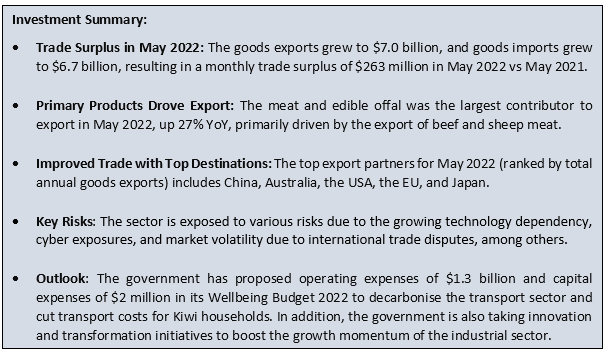
As per Stats.NZ, overseas visitors, arriving in NZ grew by 169,000 YoY, and NZ-resident traveller arrivals increased by 192,000 YoY in April 2022, as governments globally, including NZ, have started to relax a few of the travel restrictions, facilitating interested travellers to cross their borders. Monthly, overseas visitors arriving in NZ grew by 22,400 MoM, and NZ-resident traveller arrivals increased by 54,700 MoM in April 2022. The monthly trade balance for May 2022 indicates a trade surplus of $263 million, mainly driven by primary products.
Primary Products Drove Trade Value in May 2022
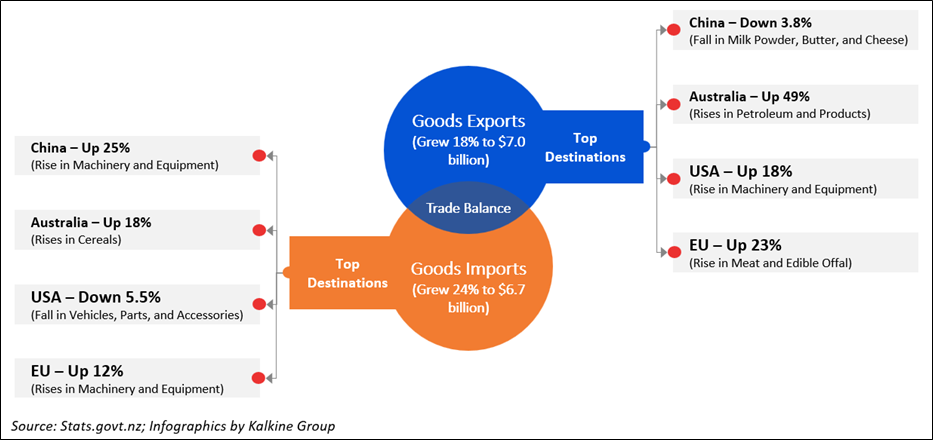
As per Stats.NZ, meat and edible offal was the most contributor to export in May 2022, up 27% YoY to $1.0 billion, primarily driven by the export of beef, which grew 34% in value and 0.5% in quantity, followed by sheep meat that grew 22% in value and the average unit value increased 25%. In line with this, milk powder, butter, and cheese were the second largest contributor to export, up 11 YoY to $1.6 billion, primarily driven by Milk fats (including butter) that grew 59% in value and 13% in quantity terms. Butter grew 16% in value while fell 19% in quantity terms. Milk powder grew 2.4% in value while it fell 23% in quantity.
Exhibit 1: Trend in Merchandise Trade Values ($ million) in May Month (2012-2022)
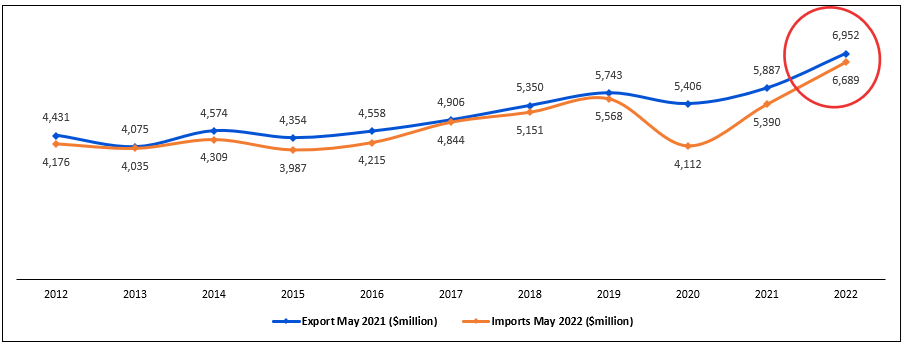
Data Source: This work is based on/includes Stats NZ’s data which are licensed by Stats NZ for reuse under the Creative Commons Attribution 4.0 International Licence; Chart Created by Kalkine Group
NZ Recorded Trade Surplus of $263 Million in May 2022
As per Stats.NZ, goods exports increased by 18% to $7.0 billion, and goods imports grew by 24% to $6.7 billion, resulting in a monthly trade surplus of $263 million in May 2022 versus May 2021. However, the annual trade deficit was $9.5 billion in May 2022 as annual goods exports stood at $67.2 billion, up $7.7 billion from the previous year, and yearly goods imports stood at $76.7 billion, up $17.1 billion from the prior year.
Exhibit 2 Trend in Goods Export and Import in May 2022
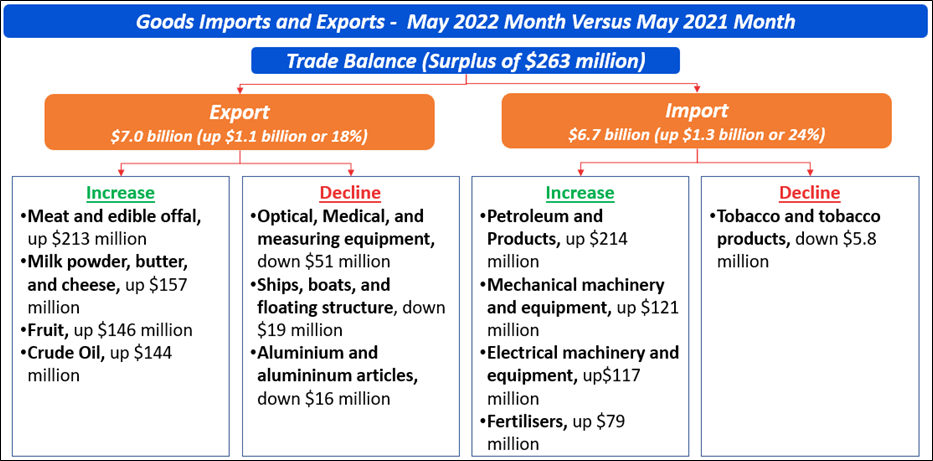
Data Source: This work is based on/includes Stats NZ’s data which are licensed by Stats NZ for reuse under the Creative Commons Attribution 4.0 International Licence; Chart Created by Kalkine Group
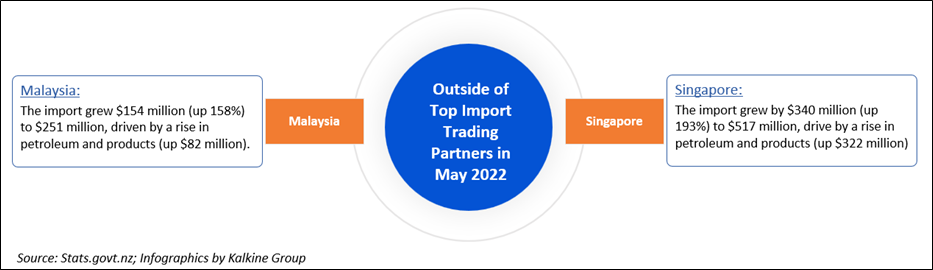
Import Contribution from Malaysia and Singapore
Index Performance:
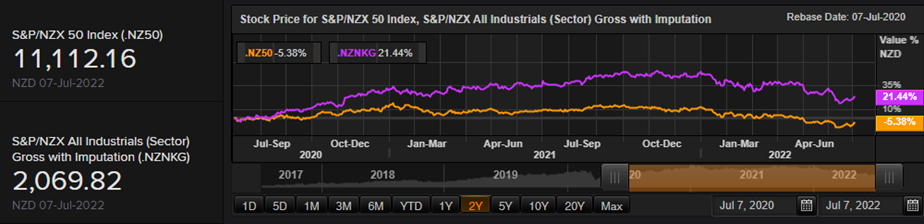
The S&P/NZX All Industrials (Sector) Index generated a 2-year return of ~21.44% versus ~-5.38% by the S&P/NZX 50 Index. Therefore, NZX All Industrials Index overperformed NZX50 Index by ~26.82% in 2-year.
Exhibit 3: S&P/NZX All Industrials (Sector) vs S&P/NZX50 Index
Source: REFINITIV
Key Risks and Challenges:
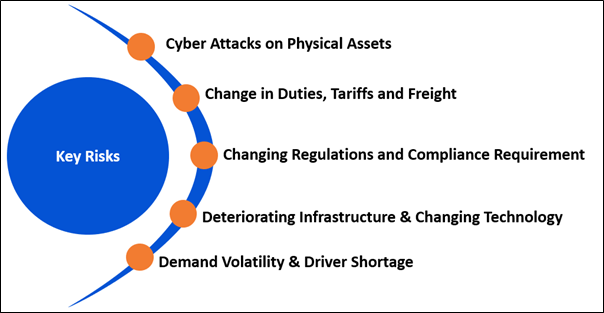
The trade restrictions imposed by the NZ government to control the infection spread are impacting the tourism and trade industry. A disrupted supply chain challenges the transit of essential goods from origin to destination and affects the quality and cost, which results in inflationary pressure. Also, the country is experiencing the impacts of climate change (like more frequent severe storm events, flooding, and coastal inundation), thereby restricting normal business flow.
Exhibit 4. Key Risks in Industrials Sector:
Source: Analysis by Kalkine Group
Outlook:
As per the Fortnightly economic update released on 23 June 2022, the current account deficit widened to 6.5% of GDP in the year ended March 2022, increasing from 5.8% of GDP in the year ended December 2021. However, the deficit is expected to narrow, driven by a revival in inbound tourism and a balance of supporting services. Meanwhile, card spending increased 1.4% in May 2022, following a 7.3% rise in April 2022. Further, the government in its Wellbeing Budget 2022, released on 19 May 2022, has announced an infrastructure investment of $61.9 billion over the next five years, to build improved foundations and reduce NZ's infrastructure deficit by investing in projects like Auckland Light Rail, water infrastructure, and rolling stock for rail.
Apart from the sector-specific factors, we have also analysed three NZX-listed companies operating in the same sector. This report covers their insights, outlook, performance and potential as expected to be delivered in the near to medium term.
1) Mainfreight Limited (Recommendation: Buy, Potential Upside: Low Double-Digit) (M-Cap: NZ$7.08 billion, Annual Dividend Yield (TTM)1: 2.80%)
Business Description:
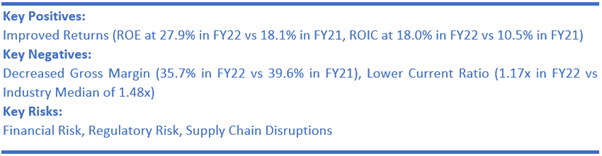
Mainfreight Limited (NZX: MFT) is an end-to-end supply chain logistic solution provider across Asia, Europe, Australia, New Zealand, and The Americas. It offers a wide range of services and specialised packaged solutions.
Outlook
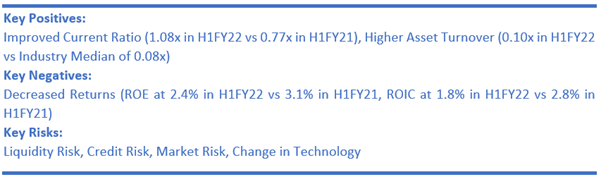
The supply chain congestion is expected to persist into the 2022 calendar year. Further, the Air and Ocean freight rates are expected to stay higher. Although trading has improved in the seven weeks since the financial year-end, the company believes the quantum of profit improvement of this past year to not reoccur in the short term. It is expected to revert to its regular revenue and profit growth levels.
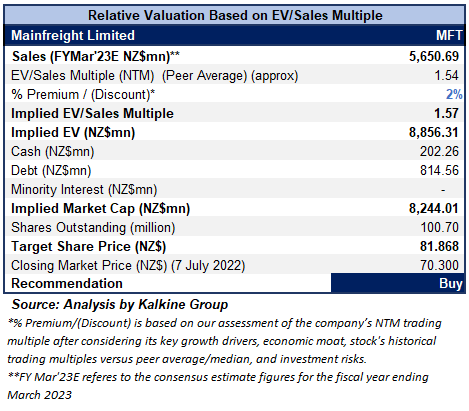
Valuation Methodology: EV/Sales Multiple Based Relative Valuation (Illustrative)
Technical Overview:
Daily Price Chart
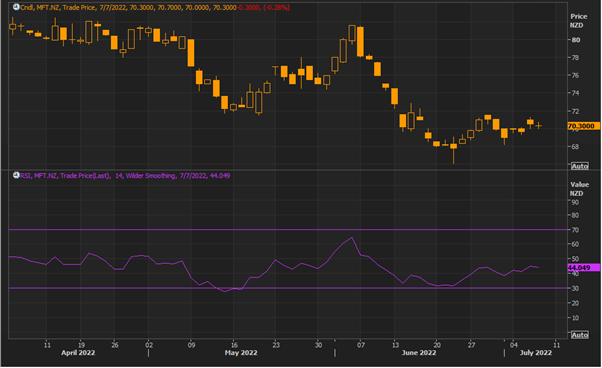
Source: REFINITIV, Note: Purple color line reflects Relative Strength Index (14-Period)
Stock Recommendation
The stock has been valued using an EV/Sales multiple-based illustrative relative valuation, and the target price so arrived reflects a rise of low-double-digit (in % terms). A slight premium has been applied to EV/Sales Multiple (NTM) (Peer Average), as the company is hopeful of achieving continued growth and performance improvement.
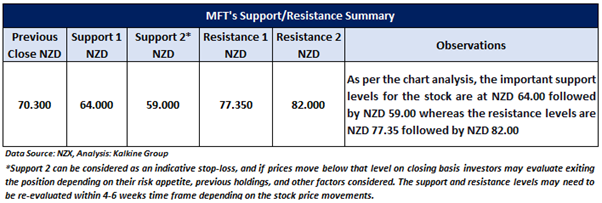
Considering the facts above and the recent update, we give a ‘Buy’ recommendation on the stock at the closing market price of $70.30 per share, down 0.28% as of 7 July 2022.
2) Napier Port Holdings Limited (Recommendation: Buy, Potential Upside: Low Double-Digit) (M-Cap: NZ$555.89 million, Annual Dividend Yield (TTM)1: 3.72%)
Business Description:
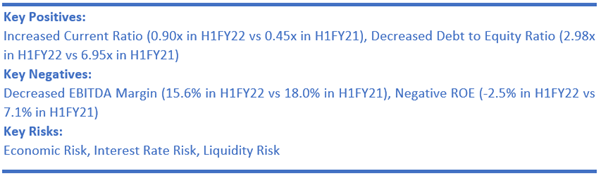
Napier Port Holdings Limited (NZX: NPH) is the shipping gateway that connects the centre of NZ with the people and markets of the world. It is the fourth-largest port by container volume.
Outlook
The company remains optimistic about the trade outlook for its region, driven by higher primary sector commodity prices. It expects an improved second half for meat, forestry, and horticulture exports. Meanwhile, it projects earnings to remain between $38-$42 million for FY22, after considering the continuation of current market conditions.
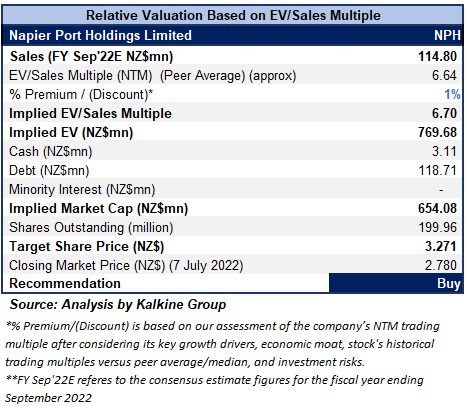
Valuation Methodology: EV/Sales Multiple Based Relative Valuation (Illustrative)
Technical Overview:
Daily Price Chart

Source: REFINITIV, Note: Purple color line reflects Relative Strength Index (14-Period)
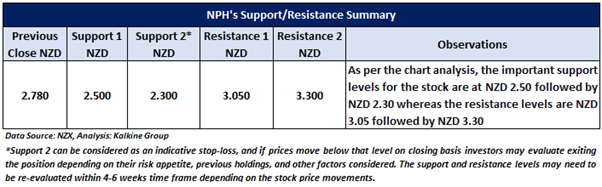
Stock Recommendation
The stock has been valued using an EV/Sales multiple-based illustrative relative valuation, and the target price so arrived reflects a rise of low double-digit (in % terms). A slight premium has been applied to EV/Sales Multiple (NTM) (Peer Average), considering its reaffirmation of earnings guidance for FY22 and decent outlook.
Considering the facts above and the recent update, we give a ‘Buy’ recommendation on the stock at the closing market price of $2.78 per share, down 0.71% as of 7 July 2022.
3) Move Logistics Group Limited (Recommendation: Speculative Buy, Potential Upside: Low Double-Digit) (M-Cap: NZ$129.19 million)
Business Description:
Move Logistics Group Limited (NZX: MOV) is among the leading domestic freight and logistics players in New Zealand. It is engaged in providing freight transporting and warehousing services. It also coordinates offshore freight movements through international alliances.
Outlook
Considering the completion of Q3FY22 along with the trading and economic conditions, the company expects to achieve underlying EBITDA in the range of $53-$56 million in FY22. Further, the company remain assured of attaining substantial benefits of the re-alignment for the business in the coming 12 months and beyond. The sale of the Specialist division is part of its strategy to emphasise core business: Freight and Contract Logistics.
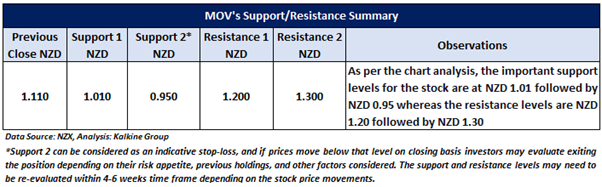
Technical Overview:
Daily Price Chart
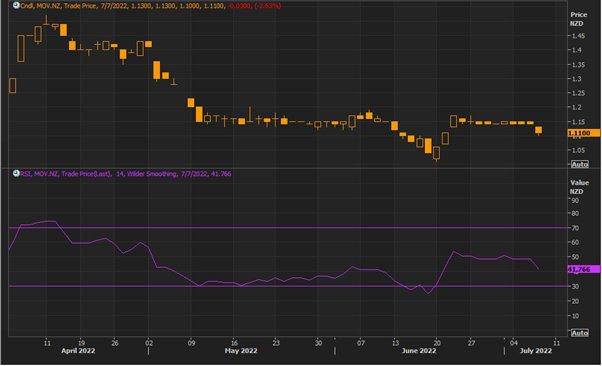
Source: REFINITIV, Note: Purple color line reflects Relative Strength Index (14-Period)
Stock Recommendation:
Considering the facts above and a decent outlook, we give a ‘Speculative Buy’ recommendation on the stock at the closing market price of $1.11 per share, down 2.63% as of 7 July 2022.
Markets are trading in a highly volatile zone currently due to certain macro-economic issues and geopolitical tensions prevailing. Therefore, it is prudent to follow a cautious approach while investing.
Note 1: The reference data in this report has been partly sourced from REFINITIV.
Note 2: Investment decisions should be made depending on an individual's appetite for upside potential, risks, holding duration, and any previous holdings. An 'Exit' from the stock can be considered if the Target Price mentioned as per the Valuation and or the technical levels provided has been achieved and is subject to the factors discussed above.
Note 3: Annual Dividend Yield is on a Trailing Twelve Month (TTM1) basis and are subject to change based on factors such as company performance, stock price changes, etc.
Technical Indicators Defined: -
Support: A level at which the stock prices tend to find support if they are falling, and downtrend may take a pause backed by demand or buying interest.
Resistance: A level at which the stock prices tend to find resistance when they are rising, and uptrend may take a pause due to profit booking or selling interest.
Stop-loss: In general, it is a level to protect further losses in case of any unfavourable movement in the stock prices.
Stop-loss: It is a level to protect further losses in case of unfavourable movement in the stock prices.
Disclaimer
Kalkine New Zealand Limited is authorised to provide general advice only. The information on this website does not take into account any of your investment objectives, financial situation or needs. Before you make a decision about whether to acquire a financial product, you should obtain the Product Disclosure Statement from the product issuer. You should consider the appropriateness of advice taking into account your own objectives, financial situation and needs and seek independent financial advice before making any financial decisions.
Past performance is not a reliable indicator of future performance.
 Please wait processing your request...