
 AU
AU
 UK
UK
 CA
CA
 US
US
 IND
IND

 NZ
NZ

I. Sector Landscape and Outlook
The Ministry of Business, Innovation & Employment (MBIE) is responsible for maintaining a sound regulatory environment for the information and communications technology (ICT) sector. MBIE manages the legislation through (i) Telecommunications Act 2001 and its associated regulations which together comprise the New Zealand telecommunications regulatory regime, (ii) Telecommunications Act 2013 which focuses on 2 main areas: interception capability and network security, (iii) Radiocommunications Act 1989 and its associated regulations, (iv) Postal Services Act 1998and its associated regulations, (v) Part 4 of the Contract and Commercial Law Act 2017, and (vi) Unsolicited Electronic Messages Act 2007.
Economic activity, as measured by Gross Domestic Product (GDP) increased 1.6% in the March 2021 quarter, whereas average annual GDP fell 2.3% through the year to March 2021. Broadly, all industry groups increased in the quarter March 2021, where service industries, that contributes approximately two-thirds of the economy, increased 1.1%. Goods producing industries, that contributes approximately one-fifth of the economy, increased 2.4%. Primary industries, that contributes approximately 7% of the economy, increased 0.3%. Unallocated taxes increased by 7.2%, (includes GST and import duties).
Exhibit 1: GDP by Industry, December 2020 Quarter Change Versus March 2021 Quarter Change
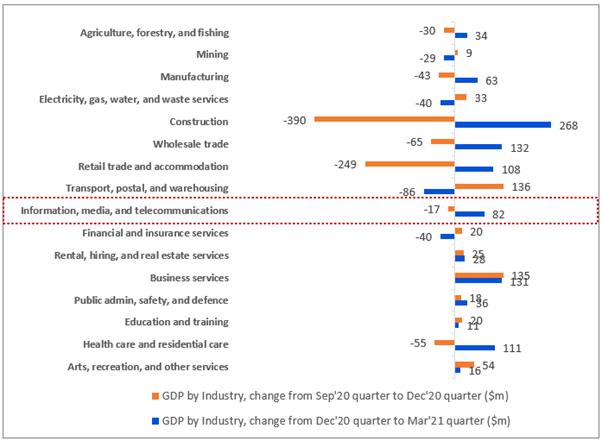
Data Source: This work is based on and includes Stats NZ’s data which are licensed by Stats NZ for reuse under the Creative Commons Attribution 4.0 International Licence; Chart Analysis by Kalkine Group
Rise in Fibre Users and Fall in ‘No Plans to Use Fibre’
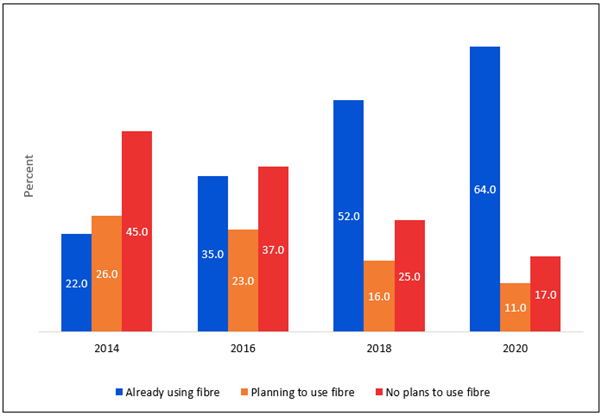
As per the ‘Business operations survey: 2020’, published by stats.nz, approximately all businesses subscribed to broadband to connect to the internet. Almost two-thirds of businesses connect to high-speed fibre-optic broadband connections. Meanwhile, the education and training sector realized one of the largest uptakes in fibre usage, jumped from 50% of businesses in 2018 to 72% in 2020. Importantly, 11% of businesses plan to switch to fibre connection in the next two years or more compared with 17% who do not want to connect to fibre.
Of the businesses who have no plans to connect to fibre, the main reasons cited were unavailability in the local area (58%) and needs met through other technologies (19%). The industry has ample opportunity to penetrate in areas where users are inclined towards fibre connection but due to limited availability, they are unable to use the facility of fibre. Also, there is an equal opportunity in the areas where people are using other sources of technology other than fibre connect for internet requirements.
Exhibit 2: Business Use of Fibre-To-Premise Connection, 2014-20
Data Source: This work is based on and includes Stats NZ’s data which are licensed by Stats NZ for reuse under the Creative Commons Attribution 4.0 International Licence; Chart Created by Kalkine Group
The Digital Technologies Industry Transformation Plan
As per the Minister for the Digital Economy and Communications, the government plans to make New Zealand a leading digital nation. The Ministry stated that Google has estimated digital transformation to unlock $46.6 billion worth of economic value in non-technology sectors by 2020-30. The Digital Technologies Industry Transformation Plan, under the Digital Economy portfolio, is a key driver to drive the growth of the digital technologies sector in New Zealand. The Digital Technologies ITP is creating an AI Strategy for Aotearoa. AI has the ability and size to accelerate change further, magnifying other disruptive technologies such as 5G, the Internet of Things (IoT), data analytics, and robotics. Further, as per the Minister (HON DR DAVID CLARK), the companies like Facebook, Google, Uber, Airbnb, WebMD, and Amazon have displayed that significant value can be unlocked from Big Data.
Index Performance:
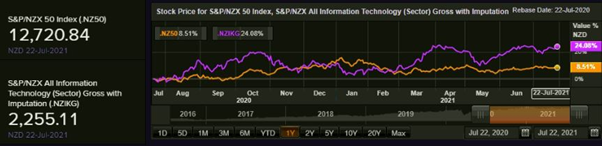
The S&P/NZX All Information Technology Index generated a 1-year return of ~24.08% versus ~8.51% by the S&P/NZX 50 Index. Therefore, S&P/NZX All Information Technology Index overperformed S&P/NZX 50 Index by ~15.57% in 1-year.
Exhibit 3: S&P/NZX All Information Technology Index vs S&P/NZX 50 Index
Source: REFINITIV
Key Risks and Challenges:
Due to few heavyweight players and their dominance in certain services and products in the telecommunication sector, the Commerce Commission plays an important regulatory role. The regulatory governance has progressed in recent years to reflect technological changes and has a regulatory structure dedicated to specific subject areas such as fibre wholesale services or copper line wholesale services.
The regulation clearly regulates the auctioning of spectrum bands through the Radiocommunications Act 1989, completely managed by Radio Spectrum Management at MBIE. Under the Act, property ownership was set-up for spectrum bands. Post a review in 2005, there is a defined spectrum auction design that ensures a systematic allocation.
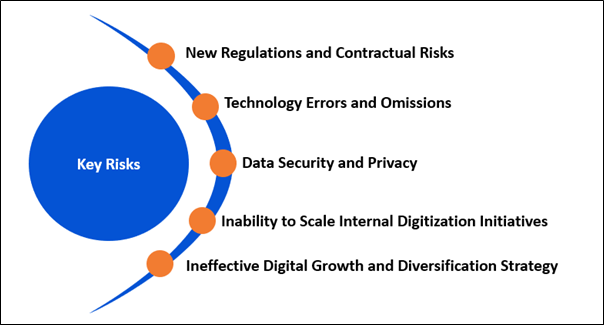
The technological shift towards transparency and usefulness of information technology applications are few reasons for the high magnitude of risks undertaken in executing the company’s IT goal. In addition to this, the industry is also impacted by the rapid speed of disruptive innovations and new technologies, low entry barrier of new players in the competitive sphere, privacy/identity management, and information security, succession challenges and difficulty in attract and retain top talent, cyber threats, close substitute services, and products impacts the operations of the company and planned business initiatives.
Exhibit 4. Key Risks in Telecommunication and Information Technology Sector:
Sources: Analysis by Kalkine Group
Outlook:
The Government has extended its support to small businesses and entrepreneurs by providing an extra $55 million to obtain free expert consultancy to help them in adapting and innovating to deal with COVID-19 circumstances. In 2021, the Government is expected to focus on below initiatives:
In the Telecom space, the 5G network offers an exponential opportunity as the trials indicated it to be 20 times faster versus 4G which has an ideal speed in the range of 30-80 Mbps. Also, it offers lower latency as well as higher network capacity which is expected to boost internet speeds in rural areas, especially, among other benefits. Further, it is expected that there will be a high rise in data consumption. These factors will attract users and accordingly will lift the operating revenue of the companies.
Apart from the sector-specific factors, we have also analysed four NZX-listed companies operating in the same sector. This report covers their insights, outlook, performance and potential as expected to be delivered in the near to medium term.
1) Chorus Limited (Recommendation: Buy, Potential Upside: Low Double-Digit) (M-Cap: NZ$2.77 billion, Gross Dividend Yield: 5.497%)
Business Description:
Chorus Limited (NZX: CNU) is a telecommunication infrastructure company engaged in building and managing an open-access internet network and offering broadband services.
Outlook:
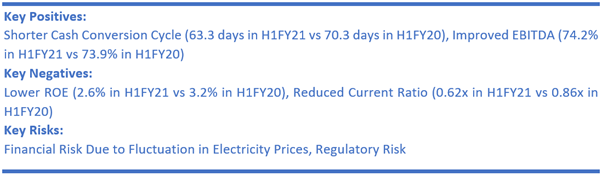
As per the Q4FY21 overview released on 12 July 2021, total fixed-line connections declined by 16k to 1,340,000, where copper broadband and voice connections fell by 44k (Q3FY21: -42k), total broadband connections fell by 1k to 1,180,000 (Q3FY21: -2k), however, fibre broadband connections increased by 29k (Q3FY21: +29k).
As per the half-yearly result release on 22 February 2021, the company expected EBITDA for FY21 to be in the range of $640-$660 million, depending upon material changes in the expected regulatory and competitive outlook. Further, Capex was expected in the range of $125-$145 million for UFB2 communal, however, gross Capex has been planned between $670-$700 million. Importantly, the dividend was expected at 25 cps.
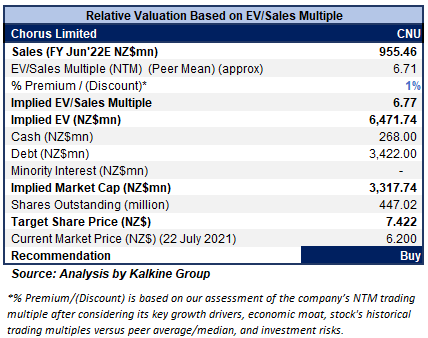
Valuation Methodology: EV/Sales Based Relative Valuation (Illustrative)
Stock Recommendation
We have applied EV/Sales based relative valuation (on an illustrative basis) and the target price reflects a rise of low double-digit (in % terms). We have applied a premium to EV/Sales Multiple (NTM) (Peer Average) considering the focus of the company on fibre uptake, investment, and innovation, that are aligned with the goals of public-private partnership.
For relative valuation, we have taken peers like Spark New Zealand Ltd. (SPK.NZ), Macquarie Telecom Group Ltd. (MAQ.AX), and 5G Networks Ltd. (5GN.AX).
Considering the aforesaid facts, we give a “Buy” recommendation on the stock at the current market price of $6.2 per share, up 0.16% on 22nd July 2021.
2) Gentrack Group Limited (Recommendation: Buy, Potential Upside: Low Double-Digit) (M-Cap: NZ$200.81 million)
Business Description:
Gentrack Group Limited (NZX: GTK) provides essential software and services to the utility and airport industry.
Outlook
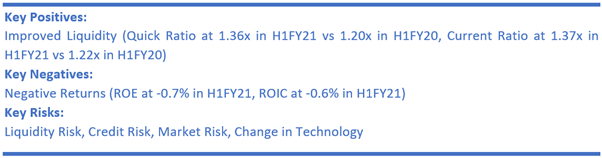
As per the market announcement released on 27 May 2021, FY21 revenues are expected to be slightly ahead of FY20 revenues of $100.5 million. Further, FY21 EBITDA is expected to be around $10 million. Further, it expects net cashflow to be positive in FY21, building on the $16.8 million of net cash reported as of 30 September 2020.
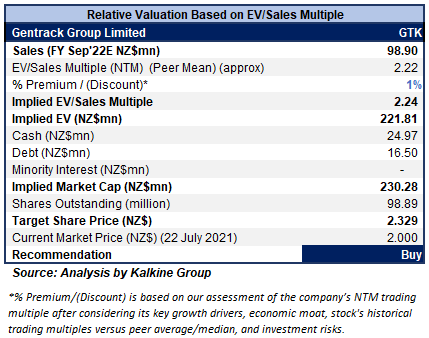
Valuation Methodology: EV/Sales Based Relative Valuation (Illustrative)
Stock Recommendation
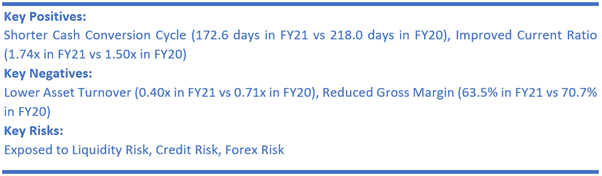
We have applied EV/Sales based relative valuation (on an illustrative basis) and the target price reflects a rise of low double-digit (in % terms). We have applied a premium to EV/Sales Multiple (NTM) (Peer Average) considering revised upside revenue guidance for FY21 and improved asset turnover at 0.24x in H1FY21 versus 0.21x in H1FY20.
For relative valuation, we have taken peers like Plexure Group Ltd. (PX1.NZ), Vista Group International Ltd. (VGL.NZ), and Reckon Ltd. (RKN.AX).
Considering the aforesaid facts, we give a “Buy” recommendation on the stock at the current market price of $2.00 per share (New Zealand Time: 11:33 AM (GMT +12) on 22nd July 2021.
3) ikeGPS Group Limited (Recommendation: Hold, Potential Upside: Low Double-Digit) (M-Cap: NZ$149.50 million)
Business Description:
ikeGPS Group Limited (NZX: IKE) is a technology company that designs, sells, and delivers solutions for the collection, analysis, and management of distribution assets for electric utilities and communications companies.
Outlook
In Q4FY21, the company closed ~$5.4 million of contracts with most of the revenue expected in the FY22 period to March 2022. The same momentum of new contract wins is expected to grow further. Broadly, the plan and focus remain consistent that was seen in the past 24 months. The company is focused on being the Pole OS platform for the North American market. Further, the balance sheet strength supports the business plan to grow to build decades-long relationships with target customers.
Technical Overview:
Weekly Chart –
Source: REFINITIV
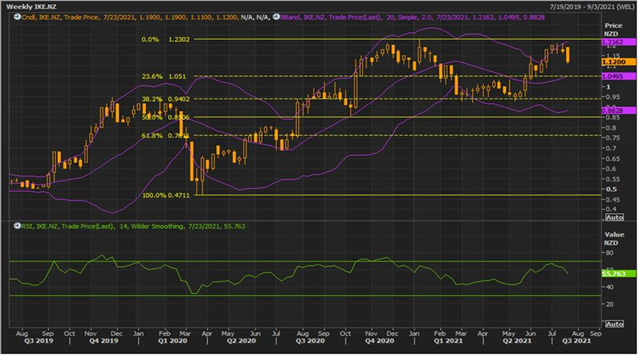
Note: Purple colour lines are Bollinger Bands® with the upper band suggesting overbought status while the lower band oversold status, and yellow lines are Fibonacci retracement lines which measure price rebound and backtrack. https://www.bollingerbands.com/
While remaining in an underlying uptrend, the stock has witnessed a selloff in the ongoing week leading to a lower closing at $1.12. The technical indicator RSI with a reading around 56 and a curve at the end pointing down, suggests softening of bullish momentum.
Going forward, the stock may have resistance around $1.20 whereas support could be around the converging point of 23.6% retracement level and 20 periods SMA of $1.05.
Stock Recommendation
Considering the aforesaid facts, we give a “Hold” recommendation on the stock at the current market price of $1.12 per share on 22nd July 2021.
4) Vital Limited (Recommendation: Hold, Potential Upside: Low Double-Digit) (M-Cap: NZ$32.28 million, Gross Dividend Yield: 4.452%)
Business Description:
Vital Limited (NZX: VTL) is a critical communication provider. The company designs, builds, and operates integrated communication solutions.
Outlook
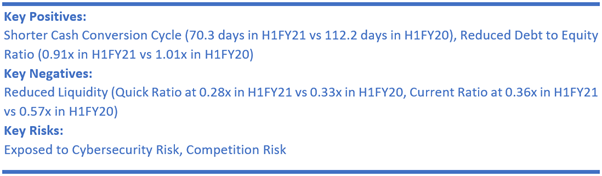
As per the interim result update, released on 25 February 2021, the company is confident in its plan to achieve increased profitability in FY22. The company is expected to complete its major capital investments.
Further, it has introduced its new products to address the issues relating to the decline in its old fibre services as well as achieving growth. The new wholesale fibre products launched in November 2020 have been well accepted by its partners and it expects to see stable churn and recapture lost market share in the next 6-9 months. Importantly, the company expects its Net Profit after Tax to be broadly in line with FY20.
Technical Overview:
Weekly Chart –
Source: REFINITIV
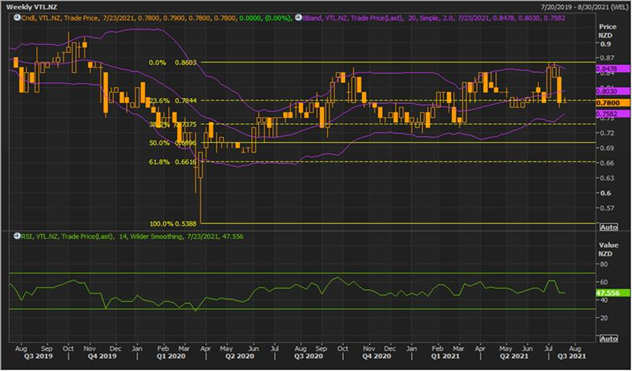
Note: Purple colour lines are Bollinger Bands® with the upper band suggesting overbought status while the lower band oversold status, and yellow lines are Fibonacci retracement lines which measure price rebound and backtrack. https://www.bollingerbands.com/
The stock made a low of $0.54 and from there it rebounded to the high of $0.86 where it formed a ‘Double Top’ and came under selling pressure thereby pushing the stock down temporarily beyond the 23.6% retracement level of $0.78 and final close at $0.78 in the previous week. However, for the ongoing week, it has given a flattish close at 0.78 while experiencing low volatility. The technical indicator RSI with a reading around 48 and a flattish curve at the end suggests bullish momentum getting weak to flat.
Going forward, the stock may have resistance around the previous high of $0.86 whereas support could be around the 38.2% retracement level of $0.74.
Stock Recommendation
Considering the aforesaid facts, we give a “Hold” recommendation on the stock at the current market price of $0.78 per share on 22nd July 2021.
Note 1: The reference data in this report has been partly sourced from REFINITIV.
Note 2: Investment decisions should be made depending on the investors’ appetite on upside potential, risks, holding duration, and any previous holdings. Investors can consider exiting from the stock if the Target Price mentioned as per the analysis has been achieved and subject to the factors discussed above alongside support levels provided.
Technical Indicators Defined: -
Support: A level where-in the stock prices tend to find support if they are falling, and downtrend may take a pause backed by demand or buying interest.
Resistance: A level where-in the stock prices tend to find resistance when they are rising, and uptrend may take a pause due to profit booking or selling interest.
Disclaimer
Kalkine New Zealand Limited is authorised to provide class advice only. The information on this site does not take into account any of your investment objectives, financial situation or needs. Before you make a decision about whether to acquire a financial product, you should obtain the Product Disclosure Statement from the product issuer. You should consider the appropriateness of advice taking into account your own objectives, financial situation and needs and seek independent financial advice before making any financial decisions.
Past performance is not a reliable indicator of future performance.
 Please wait processing your request...