
 AU
AU
 UK
UK
 CA
CA
 US
US
 IND
IND

 NZ
NZ

Energy is central to the well-being of New Zealand. The country possesses a well-developed energy sector for meeting the basic needs. Utility sector is characterized by a rapidly changing regulatory and technological environment. The utility of the future will not control the value chain but will have to be enabler to consumer energy solutions.
The New Zealand Government established the NZ Energy Strategy 2011–2021 and the NZ Energy Efficiency and Conservation Strategy 2017-2022 in order to convey vision for sector and identify the priorities and trends. Notably, other government strategies also focus towards energy issues – mainly in transport, environment, agriculture and food production, business growth, as well as natural resource use. Non-governmental organisations and industry have also expressed aspirations for this sector.
As we know, New Zealand happens to be a mountainous country sitting astride a plate boundary, which spans subtropical to cool temperate island climates. As a result, this provides a good range of natural energy resources. To name a few:
The demand for electricity in New Zealand is largely driven by factors like GDP, pricing, wealth and population size. Generally, a growing economy leads to growing demand for electricity, and vice versa. According to Electricity Authority, in 2017, residential customers consumed 32 percent of electricity produced. Household consumption depends on many factors, including the number of occupants, size, age and construction materials of the house, heating choices and environmental factors.
Coming to the usage aspect, most residential electricity use is for refrigeration, water heating and space heating. Although there has been an increase in the types of technology that need electricity, appliances are generally becoming more efficient.
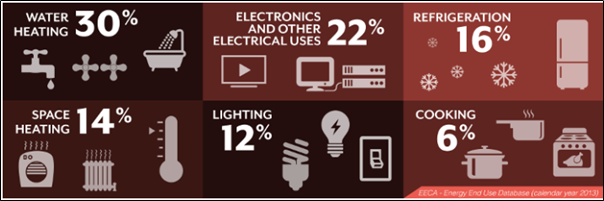
Typical Household Electricity Usage (Source: Electricity Authority)
Four Major Components in Electricity Sector You Need to Understand
Retailers are power companies that sell electricity to consumers. Most consumers buy their electricity from one of about 48 different retail brands, which are spread across the country. In most places there are more than 25 brands to choose from. While the five largest retailers have the biggest share of the market, the proportion of the market taken up by small and medium-sized retailers is steadily increasing.
Distribution companies transport electricity on local lines from the national grid. They provide and maintain the power lines that carry electricity from the national transmission grid to homes and businesses across New Zealand. On average, distribution accounts for 27 percent of residential consumers’ total electricity costs.
The national grid spreads across most of the country and is used to transport electricity from generators, which are often located in remote areas. It takes the electricity to the distribution networks and to large industries that are connected directly to the transmission network. New Zealand’s national transmission grid is owned and operated by Transpower, a state-owned enterprise. Transpower is responsible for new grid investments and is responsible for all transmission development processes.
Generation companies use resources such as water, wind, gas, geothermal, steam or coal to generate electricity. There are more than 219 electricity generation stations in New Zealand. Five large generation companies produce majority of the electricity.
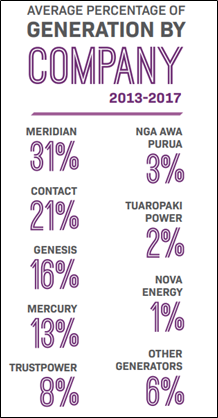
Generation by Company (Source: Electricity Authority)
Demand Drivers of Energy in New Zealand
Technological transformation, changes in the consumer preferences and demands, rising focus on critical role that energy plays with respect to business competitiveness, volatility in commodity prices, and the need to transition towards lower carbon economy – are the factors which are playing a crucial role in broader energy industry in New Zealand and internationally. Improving the value the country obtains from energy use helps the broader business performance, minimises the household costs as well as benefits the economy. These are expected to act as a solid base for the growth in the energy sector.
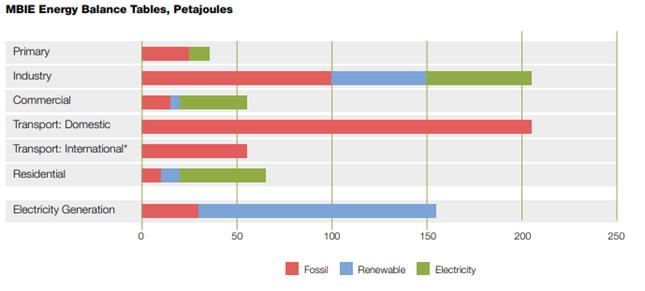
Approximate End Use of NZ Energy By Sector (Source: National Energy Research Institute)
Energy Usage in New Zealand By Services Sector
In 2018, Energy Use Survey measured energy utilised by services sector of the economy and the sector includes wide range of service industries, like accommodation and food, the arts, finance, and rental and real estate services. In year ended March 2018, services sector utilised a total of 135,101 terajoules of energy and electricity was most commonly used fuel type in services sector, accounting for 53.4% of the energy it used.
Out of the electricity utilised by the services sector, healthcare and social assistance industry utilised 22.1% of this, followed by accommodation and food services industry at 21.6%. However, diesel made up for 14.1% and petrol 9.5% of the total energy utilised by services sector.
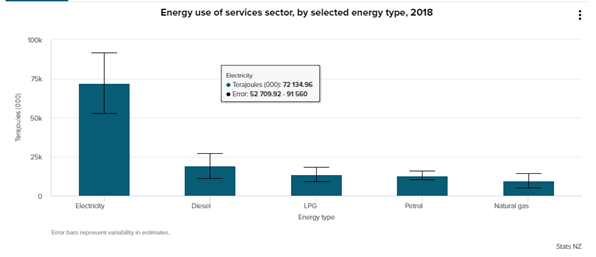
Energy Use (Source: Stats NZ)
Opportunities For New Zealand’s Utilities Industry
As per the report by Electricity Authority, the renewable generation of electricity touched 85% in New Zealand in 2016 and the target of touching 100% renewable electricity generation by 2035 is assisted by New Zealand’s flexible and resilient electricity system. The electricity system has been able to accommodate increased renewable generation mainly because of the flexibility.
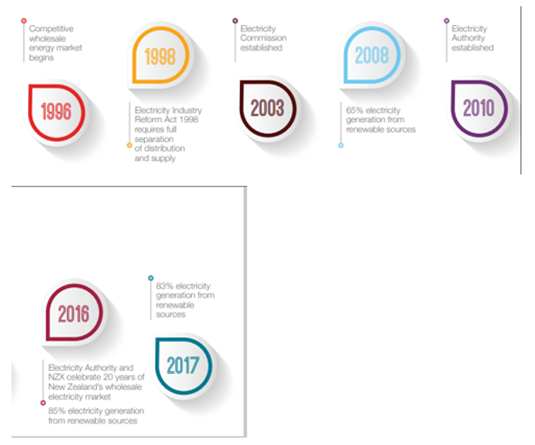
Successful Use of Opportunities (Source: Electricity Authority)
Growth Path of Utility Sector in New Zealand: How Leading Companies Can Reap Benefits?
Over the past 25 years, the New Zealand utility sector has essentially followed the value chain of generation, transmission, distribution and retail.
About 95% of electricity generation companies are listed on the NZX, and the sector is very attractive to global investors because of its strong carbon reduction profile, good growth prospects, a subsidy-free renewable investments model and the characteristics of high cash-flows produced by renewable energy.
S&P/NZX50 vs S&P/NZX All Utilities Sector
The global financial markets have been significantly impacted by the outbreak of coronavirus and the impact has also been felt in New Zealand markets. However, it can be said that New Zealand has been able to contain the spread of this deadly virus as the country has moved to Alert Level 3 from Alert Level 4. In the past one month, S&P/NZX50 Index has witnessed a rise of 8.56% while S&P/NZX All Utilities Sector rose by 8.63%.
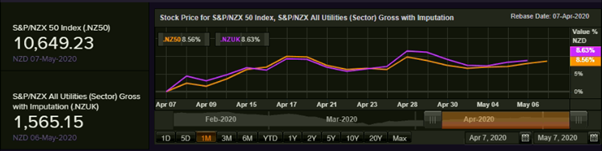
S&P/NZX50 vs S&P/NZX All Utilities Sector (Source: Refinitiv (Thomson Reuters))
Now that we have a broader idea of the utilities sector of New Zealand, its time to look at four stocks which are in the same business i.e. (TPW, ZEL, TLT and MEL).
1. Trustpower Limited (NZX: TPW) (Recommendation: Buy, Potential Upside: Higher Single-Digit)
(M-Cap: ~$2.12 billion, Gross Dividend Yield: 9.413%)
Business Description: Trustpower Limited is primarily engaged in the ownership and operation of electricity generation facilities from renewable energy sources and the retail sale of energy and telecommunications services to its customers.
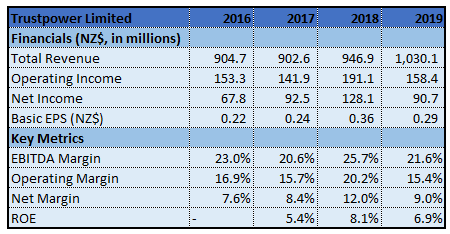
Key Metrics (Source: Refinitiv (Thomson Reuters))
Outlook: The company is expecting its FY-20 EBITDAF to be between $185 million to $195 million. It remains optimistic on longer-term outlook from the industry point of view and due to investments, it has made internally, and its market positioning. The company continues to monitor as well as assess all the metrics throughout the business, including cash collection and credit. Its robust balance sheet ensures that the company is well placed if adverse conditions impact its cash flow or profitability.
Valuation: Trustpower Limited has been operating well under the current lockdown conditions. The company is an essential service business and it has significant majority staff working remotely from home, supported by the recent deployments towards technology and capability, as well as business continuity plans. We have applied P/E based relative valuation (on an illustrative basis) and the target price reflects an increase of higher single-digit (in % terms).
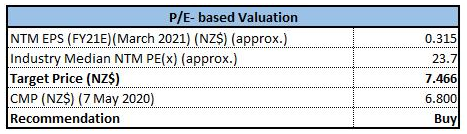
P/E Based Relative Valuation (Source: Refinitiv (Thomson Reuters)) (Illustrative)
2. Z Energy Limited (NZX: ZEL) (Recommendation: Buy, Potential Upside: Higher Single-Digit)
(M-Cap: ~$1.26 billion, Gross Dividend Yield: 20.789%)
Business Description: Z Energy Limited (NZX: ZEL) supplies fuel to retail and many large commercial customers like trucking companies, airlines, mines, vehicle fleet operators and shipping companies.
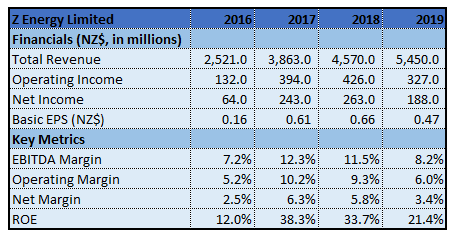
Key Metrics (Source: Refinitiv (Thomson Reuters))
Outlook: The company is expecting EBITDAF earnings guidance for FY20 in the range of $355 million to $365 million. This guidance includes expected provisions of $27 million related to Covid-19 costs that have already been incurred as well as additional Covid-19 related provisions.
Valuation: The company stated that its volume levels for week ended 3rd May 2020 increased significantly as nation moved into level 3 (L3) of national lockdown. Also, volumes increased by 41% as compared to the last week (49% excluding Jet). We have applied P/BVPS based relative valuation (on an illustrative basis) and the target price reflects the growth of higher-single digit (in % terms).
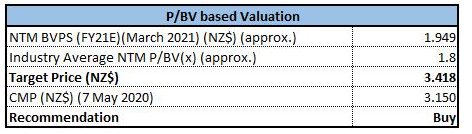
P/BV Based Relative Valuation (Source: Refinitiv (Thomson Reuters)) (Illustrative)
3. Tilt Renewables Limited (NZX: TLT) (Recommendation: Buy, Potential Upside: Lower Double-Digit)
(M-Cap: ~$1.48 billion)
Business Description: Tilt Renewables Limited is engaged in the business of development, ownership and operating of electricity generation facilities as well as trading of electricity and associated products from renewable energy sources.
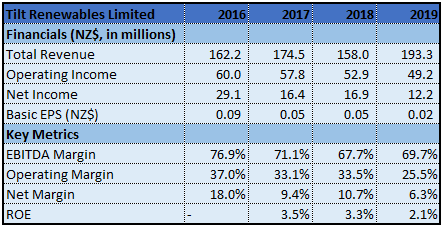
Key Metrics (Source: Refinitiv (Thomson Reuters))
Outlook: The company’s FY20 earnings result is expected to be up to $1 million lower than the bottom end of the updated guidance range of $118 million to $122 million provided earlier. This is the result of both the 500kV transmission outages in Victoria during February, which impacted revenue from the Snowtown 1 Wind Farm, and a slower than anticipated ramp up of generation at DDWF in March.
Valuation: The company owns 7 operational wind farms throughout Australia and New Zealand and 2 significant assets under construction, one in Australia and one in NZ. The company’s operational assets in both Australia and New Zealand provide a ‘lifeline utility’ or ‘essential service’ and are, therefore, not subject to lockdown restrictions. We have applied P/BVPS based relative valuation (on an illustrative basis) and the target price reflects an increase of lower double-digit (in % terms).
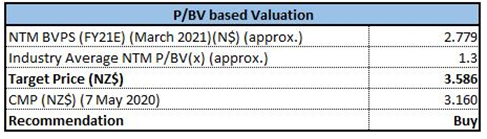
P/BV Based Relative Valuation (Source: Refinitiv (Thomson Reuters)) (Illustrative)
4. Meridian Energy Limited (NZX: MEL) (Recommendation: Buy, Potential Upside: Lower-Double Digit)
(M-Cap: ~$11.78 billion, Gross Dividend Yield: 5.980%)
Business Description: Meridian Energy Limited is 51% government-owned New Zealand’s listed company. It is the only New Zealand electricity company with a customer and asset base diversified throughout different countries.
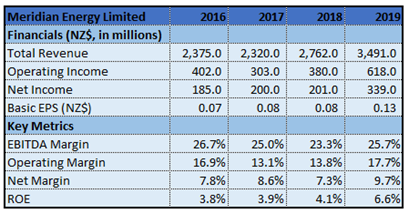
Key Metrics (Source: Refinitiv (Thomson Reuters))
Outlook: About 40% of New Zealand generation is covered by a price guarantee contract with Rio Tinto/Sumitomo’s New Zealand aluminum smelter. In October 2019, the company’s largest customer, Rio Tinto, announced that they would be conducting a strategic review of the Tiwai smelter.
Valuation: As a 100% renewable energy generator, the company continue to lead environmental change as New Zealand works towards a low carbon future. The company is now net zero carbon across operations and it has committed to halve its gross emissions by 2030. We have applied P/E based relative valuation (on an illustrative basis) and the target price reflects an increase of lower double-digit growth (in % terms).
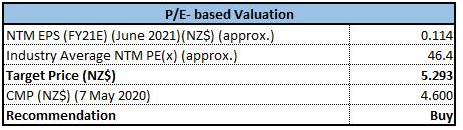
P/E Based Relative Valuation (Source: Refinitiv (Thomson Reuters)) (Illustrative)
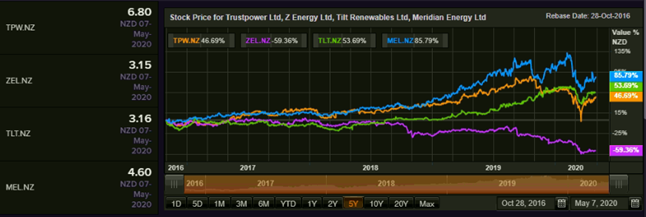
Comparative Price Chart (Source: Refinitiv (Thomson Reuters))
Disclaimer
Kalkine New Zealand Limited is authorised to provide class advice only. The information on this site does not take into account any of your investment objectives, financial situation or needs. Before you make a decision about whether to acquire a financial product, you should obtain the Product Disclosure Statement from the product issuer. You should consider the appropriateness of advice taking into account your own objectives, financial situation and needs and seek independent financial advice before making any financial decisions.
Past performance is not a reliable indicator of future performance.
 Please wait processing your request...