
 AU
AU
 UK
UK
 CA
CA
 US
US
 IND
IND

 NZ
NZ

Company Overview: Ryman Healthcare Limited (NZX: RYM) focuses towards improving resident experience and developing its people. As at September 2019, the company owns and operates 36 retirement villages in NZ and Australia, and it has 18 new villages in its pipeline. The company’s focus towards excellence in care has continued in 1H FY 2020 (six months ended September 30, 2019), and 84% of the company’s NZ care centres now have 4-year Ministry of Health accreditation, as compared to an average of 47% among the large operators in the sector.
Ryman Healthcare Limited
.png)
RYM Details
Decent Results Posted in 1H FY 2020: Ryman Healthcare Limited (NZX: RYM) was founded in 1984 and the company has become one of NZ’s leading listed companies. RYM owns and operates 36 villages which are home to over 11,600 residents in Australia and New Zealand, and the company employs 5,700 staff. The market capitalisation of the company stood at ~$7.23 billion as on 09th March 2020. Recently, the company has reported the results for the six months ended September 2019, wherein, it posted decent set of numbers. RYM’s underlying profit stood at $103 million, up 6.2% for the first half, due to record resales volumes. Reported profit, which contains unrealised fair value gains on investment property, increased 11.1% to $188.3 million. The company declared an increased interim dividend of 11.5 cps in line with the increase in underlying profit. Cash generation was solid in the first half, with operating cashflows increasing by 17.6% to $256.1 million. Total assets went up by 17.4% to $7.26 billion on last year, representing the value generated by strong demand and ongoing development. During the first half, the company acquired two new sites: Northwood in Christchurch and Highett in Victoria taking the land bank to 7,074 units and beds.
The company’s full year profits are anticipated to lift in line with the growth in build programme, while the construction is targeted to be under way at twelve sites by March 2020, which reflects an increase from eight a year ago. The company’s New Zealand resales volume rose 11.3%, while the volumes in wider real estate market fell by 15%, reflecting continued appeal of Ryman villages. The company’s key personnel has stated that 1H was achieved against the background of tougher market conditions in Melbourne and Auckland.
Over the time period of FY15 to FY19, the company has registered CAGR growth of 13.91% and 7.74% in total revenue and net income respectively. The CAGR in the top line reflects that the company is possessing decent capabilities to garner revenues, which would help the company broadly in further strengthening its financial footing.
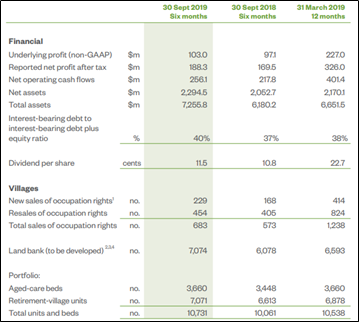
Key Statistics (Source: Company Reports)
Top 10 Shareholders: The top 10 shareholders have been highlighted in the table, which together forms around 35.77% of the total shareholding. Cumming (Geoffrey Alexander) and Hickman (Kevin James) are holding maximum interests in the company at 10.19% and 7.00%, respectively (as shown in the table below).
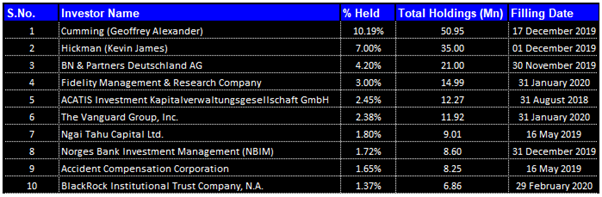
Top 10 Shareholders (Source: Thomson Reuters)
Brief Overview of Key Metrics: The company’s EBITDA margin and net margin for H1FY20 stood at 18.8% and 90.6%, better than the industry median of 9.0% and 3.4%, respectively which reflects upon the management being more efficient in utilizing resources and generating profit.
RoE for H1FY20 stood at 8.4%, better than the industry median of 6.8%, which implies that the company generated a better return for its shareholders than its peer group and this might attract the attention of the market participants moving forward.
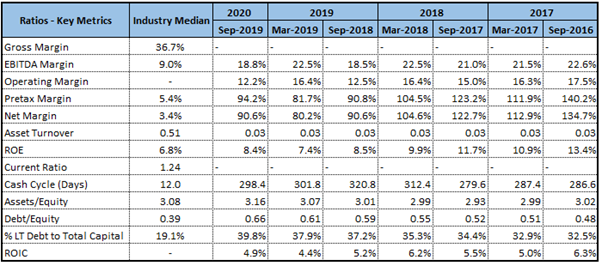
Key Metrics (Source: Thomson Reuters)
RYM Lifted its Land Bank:
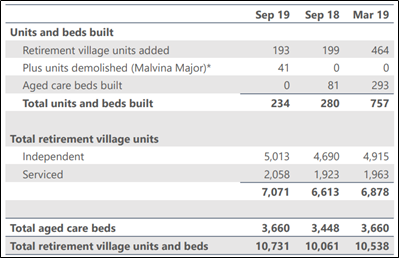
Development During First Half (Source: Company Reports)
FY19 Underlying Profit Rose By 11.5%: The company’s full-year underlying profit increased 11.5% to a record $227 million driven by increased development margins and solid demand. The company deployed $552 million towards new and existing villages during FY 2019, which reflects a rise from $478 million in the last year. The company declared final dividend amounting to 11.9 cents per share, which took the total dividend for FY 2019 to 22.7 cps, that was in line with an increase in underlying profit.
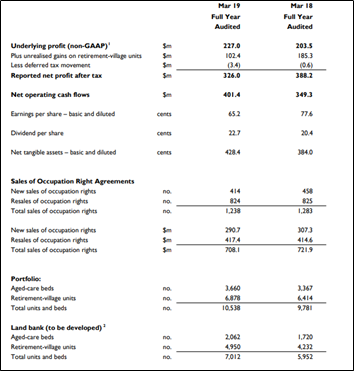
Key Statistics of FY19 (Source: Company Reports)
Financial Position in FY19: The company’s net assets reached $2.17 billion, up from $1.94 billion. Operating cashflows rose 15 per cent to $401.4 million, with cash receipts from residents surpassing $1 billion for the first time. As per the annual report FY 2019, the company’s medium-term target revolves around doubling the underlying profit every five years.
A Look At Recent Announcements: The company’s Chief Sales and Marketing Officer Debbie McClure is retiring after 30 years at the company. She started as a part-time receptionist at Ryman’s Woodcote village in Christchurch in 1990 and had made an enormous contribution over her long career. As per the release dated January 17, 2020, Jeremy Moore has been appointed to the designation of Chief Development Officer. Mr Moore joined RYM’s development team in 2012 and he has been Acting Chief Development Officer since the month of May 2019.
Positive Industry Outlook: The company has been providing dementia care for more than 20 years now, and the demand for its services is growing fast. According to the release dated November 21, 2019, there are 70,000 New Zealanders living with dementia, which is expected to grow to 170,000 by 2050.
In Victoria, the numbers are even greater. There are 104,000 people living with dementia, and that is anticipated to grow to 280,000 over the next 30 years. By 2058, there is expected to be more than 1 million Australians with dementia. The company has signed up as Alzheimer's New Zealand's lead partner for the next three years, and more than 1,200 of staff have signed up to become Dementia Friends.
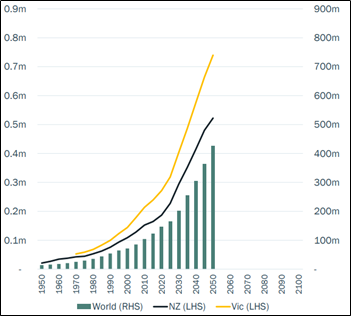
World Population Growth (80+) (Source: Company Reports)
What to Expect in FY20 and Beyond: The company’s full-year profits are projected to lift in line with growth in the build programme, and construction is aimed to be underway at twelve sites by March 2020, up from 8 a year ago. The company anticipates to be providing homes and care for more than 20,000 people. They are aiming a build rate of 900 units and beds in FY20, a rise from 757 in the FY19. The full-year underlying profits have been anticipated to be in the range of $250 million to $265 million.
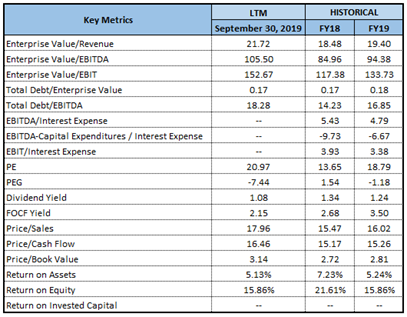
Key Valuation Metrics (Source: Thomson Reuters)
Valuation Methodology: Price to Book Value Based Valuation
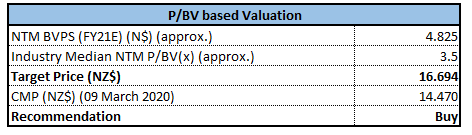
Price to Book Value Based Valuation (Source: Thomson Reuters), NTM: Next Twelve Months
Note: All forecasted figures and peers have been taken from Thomson Reuters
Technical Overview:
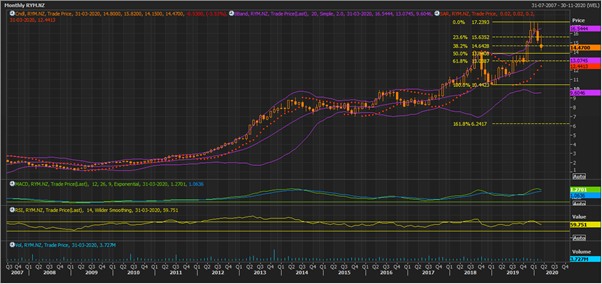
Monthly Chart –
Source: Thomson Reuters
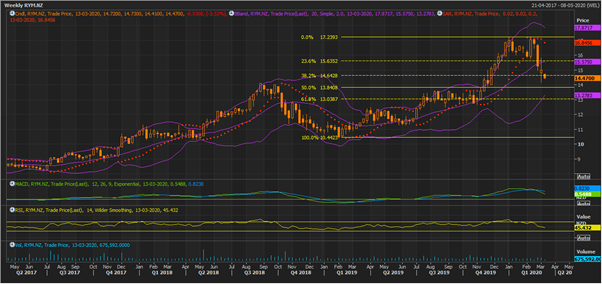
Weekly Chart –
Source: Thomson Reuters
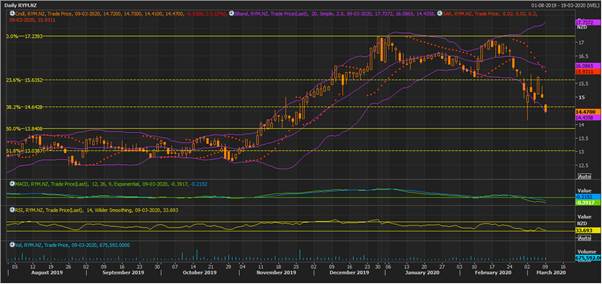
Daily Chart –
Source: Thomson Reuters
Note: Purple colour lines are Bollinger bands, yellow lines are retracement lines and orange colour dotted line is Parabolic SAR.
The stock gave bullish break-out in the month Feb. 2019 and since then it largely kept maintaining uptrend till it made the high of $17.239 in the month of Dec. 2019. The stock made several attempts to breach the high but all the time it met with failure. The selling pressure around its pick resulted into price correction for the stock. In the past, the stock merely experienced minor correction by 23.6% retracement level of $15.63. But, this time around, the stock has corrected beyond 38.2% retracement level of $14.64 and is currently trading around $14.47.
Looking at the performance of technical tools, it appears that while stock may have limited downside in near-term on the back of bearish cross-over for MACD and RSI reading around 34 on the daily chart, medium-term to long-term momentum remains bullish as suggested by bullish cross-over for MACD on the monthly and weekly charts and RSI with reading above neutral zone.
We believe that the stock on continuing with downtrend, will have limited price fall by the 50% retracement level of $13.84 and on technical rebound, it may have initial resistance around $16.00 and on breach above previous high of $17.23 should provide major resistance to the stock.
Stock Recommendation: The stock of RYM gave a return of 10.95% in the span of previous 6 months. However, in the past one year, the stock rose by 34.05%. Since 1999, the company has deployed $4 billion in building communities and it has returned $860 million in the form of dividends. From the past few years, the company has witnessed decent growth momentum in its total assets which could attract the attention of the market players moving forward.
Considering the aforesaid facts and the growth in dementia patients in the coming years, we have valued the stock using Price to Book Value based relative valuation approach and have arrived at a target price which reflects the growth of lower double-digit (in percentage terms).
Hence, we recommend a “Buy” rating on the stock at the current market price of NZ$14.470, down by 3.53% on March 09, 2020.
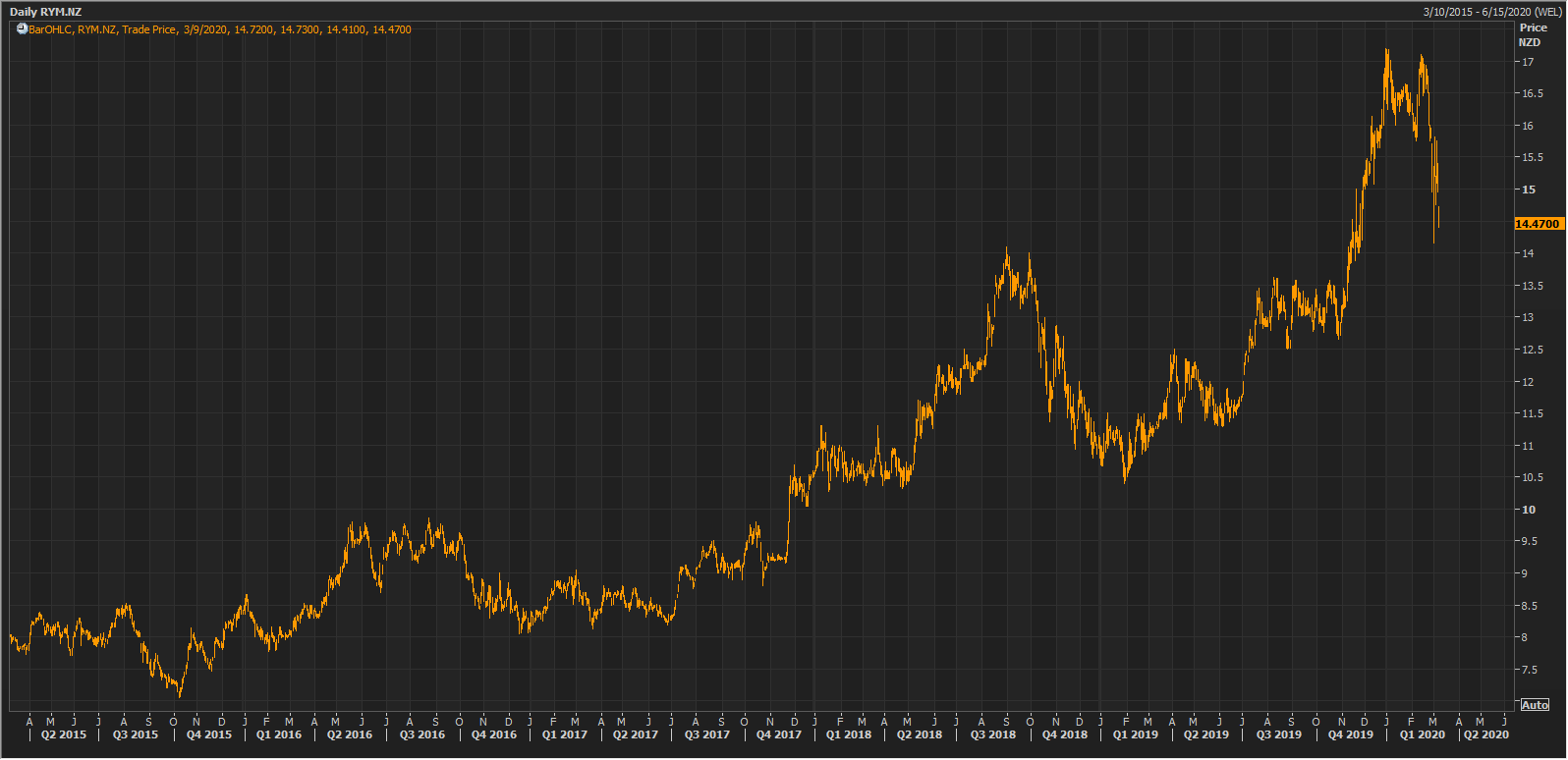
RYM Daily Technical Chart (Source: Thomson Reuters)
Disclaimer
Kalkine New Zealand Limited is authorised to provide class advice only. The information on this site does not take into account any of your investment objectives, financial situation or needs. Before you make a decision about whether to acquire a financial product, you should obtain the Product Disclosure Statement from the product issuer. You should consider the appropriateness of advice taking into account your own objectives, financial situation and needs and seek independent financial advice before making any financial decisions.
Past performance is not a reliable indicator of future performance.
 Please wait processing your request...