
 AU
AU
 UK
UK
 CA
CA
 US
US
 IND
IND

 NZ
NZ

I. Sector Landscape and Outlook
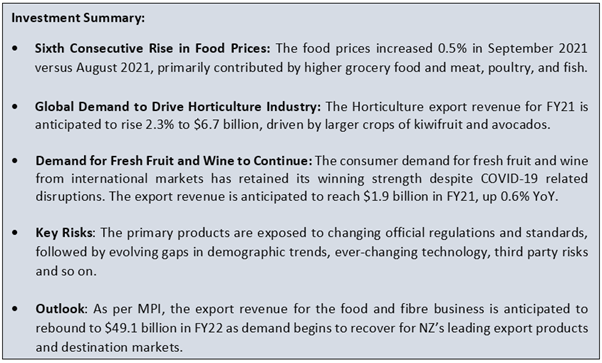
As per the Ministry for Primary Industries (MPI), food and fibre sector export revenue is anticipated to decrease 1.1% in FY21 to $47.5 billion, primarily due to a slowdown in demand from the global market because of COVID-19 related circumstances and a stronger NZD. On the other hand, the forestry sector made a swift recovery over the past year, mainly led by China who was fast to resume infrastructure investment over the past year, resulting in robust Chinese demand for logs, which is forecasted to continue into the medium term. In addition, consumer demand for fruit and wine has accelerated since the pandemic began. However, production-related headwinds are restricting the available export volumes for some products.
Food Prices Continue to Rise for the Sixth Consecutive Month in September 2021
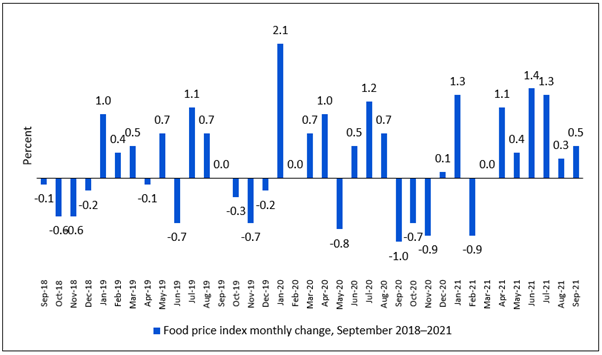
As per Stats.NZ, food prices increased 0.5% in September 2021 versus August 2021, primarily contributed by higher prices for grocery food and meat, poultry, and fish. The September 2021 movement was the sixth consecutive monthly increase. After adjusting for seasonality, prices increased 0.9% in September 2021.
Grocery food prices increased 0.8%, primarily contributed by higher prices for fresh eggs (up 12%), chocolate biscuits (up 6.1%), and sweets (up 3.2%). Meat, poultry, and fish prices increased 1.8%, which were higher for chicken pieces (up 10%) and roasting pork (up 8.7%).
Exhibit 1: Food Price Index Monthly Change, September 2018–2021
Data Source: This work is based on/includes Stats NZ’s data which are licensed by Stats NZ for reuse under the Creative Commons Attribution 4.0 International Licence; Chart Analysis by Kalkine Group
Swift Recovery in Global Market is Expected to Accelerate Horticulture Products
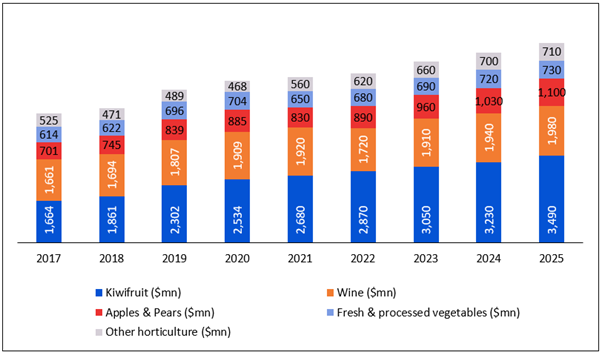
As per MPI, Horticulture export revenue for FY21 is anticipated to rise 2.3% to $6.7 billion, driven by larger crops of kiwifruit and avocados. The seasonal labour supply and freight cost are forecasted to decrease static planted areas for some crops in the short-term. However, consumer demand for fresh fruit and wine from overseas markets has remained strong, which is expected to grow further. Wine contributes 29% to total horticulture export revenue, followed by Kiwifruit (40%), Apples and Pears (13%), Vegetables (10%), and other horticulture items (8%).
Exhibit 2: Trend in Horticulture Export Revenue 2017-2025 ($ million)
Data Source: This work is based on/includes the Ministry for Primary Industries data which are licensed under Crown for reuse under the Creative Commons Attribution 4.0 International Licence; Chart Created by Kalkine Group
Growing Aquaculture Sector Will Drive Revenue Growth for Seafood
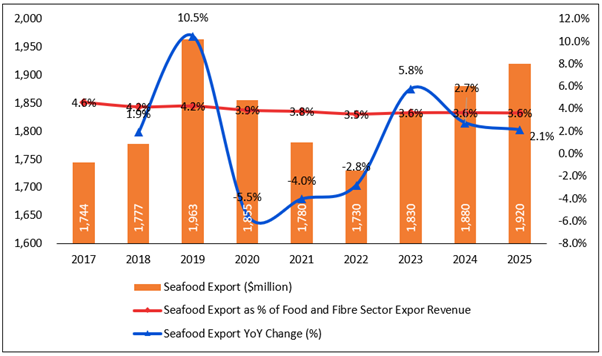
As per MPI, seafood exports are anticipated to decrease to $1.8 billion for FY21 as they are dependent on the foodservice sector and COVID-19 related circumstances have disrupted the ability to sell the product. However, future seafood sector export growth will be driven by the positive change in wild capture production and a rising aquaculture sector. The export revenue is anticipated to begin recovering in FY22, as the foodservice industry will pick pace, though it will take years to return to previous levels. The rock lobster reached record prices in January 2021, led by Australia’s absence in the Chinese market.
Exhibit 3: Trend in Seafood Export Revenue 2017-2025 ($ million)
Data Source: This work is based on/includes the Ministry for Primary Industries data which are licensed under Crown for reuse under the Creative Commons Attribution 4.0 International Licence; Chart Created by Kalkine Group
Export Demand to Drive Future Growth for Wines
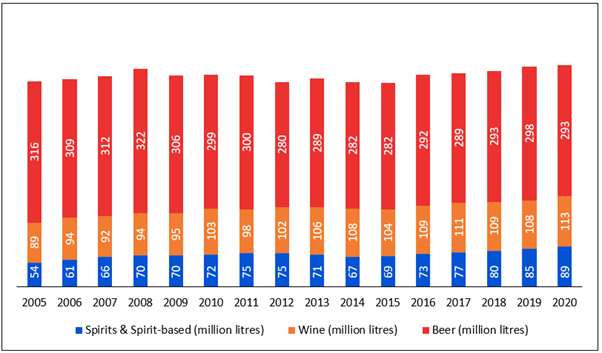
As per Stats.NZ, the total volume of alcoholic beverages available for consumption was marginally changed, rose 0.8% to 495 million litres in FY20. The volume of beer decreased 1.7% to 293 million litres. In comparison, the volume of spirits (including spirit-based drinks) increased 5.2% to 89 million litres, followed by the volume of wine up 4.3% to 113 million litres. As per MPI, the consumer demand for fresh fruit and wine from international markets has retained its winning strength despite COVID-19 related disruptions, which is anticipated to continue further. As a result, the export revenue will reach $1.9 billion in FY21, up 0.6% YoY. However, poor weather for the 2021 vintage would lead to a significant decline in FY22, with export revenue anticipated to fall 10.4% YoY to $1.7 billion in FY22.
Exhibit 4: Trend in Volume of Alcoholic Beverages Available for Consumption (litres), by type, year ended December 2005–2020
Data Source: This work is based on/includes Stats NZ’s data which are licensed by Stats NZ for reuse under the Creative Commons Attribution 4.0 International Licence; Chart Analysis by Kalkine Group
Index Performance:
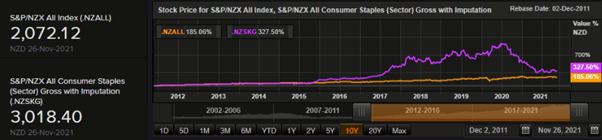
The S&P/NZX All Consumer Staples Index generated a 10-year return of ~327.50% versus ~185.06% by the S&P/NZX All Index. Therefore, S&P/NZX All Consumer Staples Index overperformed S&P/NZX All Index by ~142.44% in 10-year.
Exhibit 5: S&P/NZX All Consumer Staples Index vs S&P/NZX All Index
Source: REFINITIV
Key Risks and Challenges:
The changing international trends are influencing food security, poverty and complete sustainability of food and agricultural ecosystems. Further, climate change impacts disproportionately food-insecure regions, exposing crop and livestock production as well as fish stocks and fisheries. Also, the vital parts of food ecosystems are turning into more capital-intensive, vertically integrated and concentrated in fewer hands. Moreover, crises and natural disasters are growing in number and intensity.
The alcohol industry is competing to make its presence in online sales to reach a more extensive consumer base, like other booming online industries. While few alcohol brands have made their presence felt online, others have learned to create strategic partnerships.
Exhibit 6. Key Risks in Consumer Staples Sector:

Sources: Analysis by Kalkine Group
Outlook:
As per MPI, the International Monetary Fund (IMF) has revised its forecast for the global economic recovery in 2021 and 2022 (as of April 2021). As a result, world GDP is forecasted to grow by 6.0% in 2021 and 4.4% in 2022, if vaccination campaigns will accelerate during 2021 and be supported by stimulus packages. Moreover, amid a 5.3% drop in 2020, the volume of world merchandise trade is forecasted to rise by 8% in 2021. Meanwhile, a rapid rise in demand as economies reopen has pushed up prices for essential commodities.
In NZ, commodity and food prices have continued to accelerate over the last few months, with global prices higher than their five-year averages for all major product groups (Meat, skins and wool, Dairy, Horticultural products, Seafood, Forestry). This confidence has sparked a global stock market rally, which has also impacted commodity markets. This rising trend in commodity prices has been supporting NZ’s export revenues. But broadly, NZ’s export growth momentum will continue to depend on the economic recovery of its main trading partners.
Apart from the sector-specific factors, we have also analysed four NZX-listed companies operating in the same sector. This report covers their insights, outlook, performance and potential as expected to be delivered in the near to medium term.
1) Comvita Limited (Recommendation: Buy, Potential Upside: Low Double-Digit (M-Cap: NZ$243.84 million, Gross Dividend Yield: 1.574%)
Business Description:
Comvita Ltd (NZX: CVT) is currently one of the leading players globally in producing Manuka honey. The company has a decent geographical presence across Australia, New Zealand, China, and North America.
Outlook:
The company’s mega plan of $25 million investment for strategic business development remains on track to deliver by 2025. The company has achieved over $12 million of improvements in the first 18 months, investing $1.2 million to deliver this in FY21. Additionally, the company will invest $2.5 million in transformation projects in FY22. Meanwhile, it has announced a 60:15:20 plan to deliver a gross profit of over 60%, marketing to sales ratio of 15% and an EBITDA ratio of 20% by 2025. Further, the company is encouraged to publish the first Green House gas emissions report in this year’s annual report as it plans to be carbon neutral by 2025 and carbon positive by 2030.
On 16 November 2021, the company reported record China market sales during the 11:11 event that boosted confidence in the focused strategy and lifted the unique business model. The domestic market reported a high double-digit growth driven by the quality of market execution.
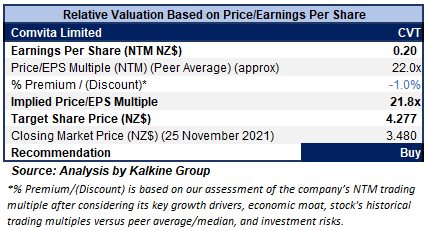
Valuation Methodology: Price/Earnings Per Share Based Relative Valuation (Illustrative)
Technical Overview:
Daily Price Chart
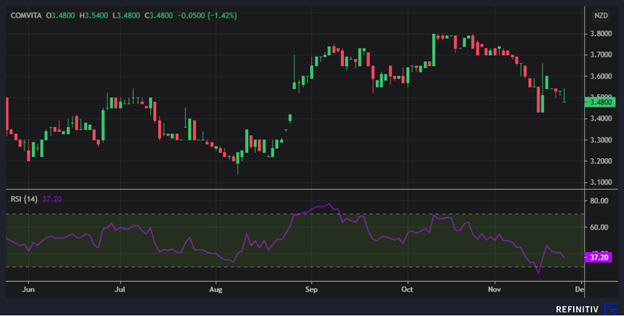
Source: REFINITIV, Note: Purple color line reflects Relative Strength Index (14-Period)
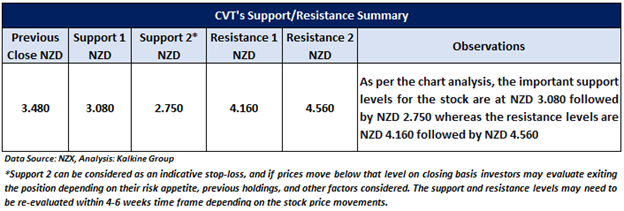
Stock Recommendation
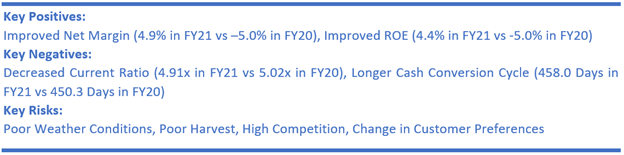
The stock has been valued using Price/Earnings Per Share multiple-based illustrative relative valuation, and the target price so arrived reflects a rise of low double-digit (in % terms). A slight discount has been assigned to Price/Earnings Per Share Multiple (NTM) (Peer Average), considering the decline in the current ratio to 4.91x in FY21 and a longer cash cycle days to 458.0 days in FY21.
For relative valuation, peers like PGG Wrightson Ltd (PGW.NZ), Sanford Ltd (SAN.NZ), Seeka Ltd (SEK.NZ), among others, have been considered.
Considering the facts above, we give a “Buy” recommendation on the stock at the closing market price of $3.48 per share, down 1.42% as of 25th November 2021.
2) New Zealand King Salmon Investments Limited (Recommendation: Speculative Buy, Potential Upside: Low Double-Digit) (M-Cap: NZ$194.58 million)
Business Description:
New Zealand King Salmon Investments Limited (NZX: NZK) is one of the largest aquaculture producers of the premium King Salmon species. It operates under four key brands: Ōra King, Regal, Southern Ocean, and Omega Plus, as well as the New Zealand King Salmon label.
Outlook
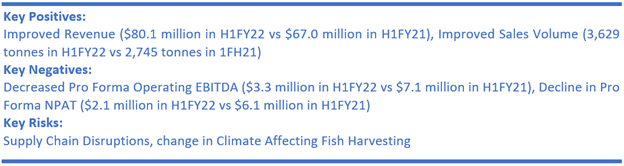
The company anticipates harvest volumes of over 4,000 tonnes in H2FY22, delivering at usual premium prices maintained despite COVID-19 circumstances. In addition, excess unbranded stock, primarily whole frozen fish, continues to be sold to global customers outside of traditional branded channels. Further, the company is extending its innovation program for Ōra King and launched a limited edition new Ōra King Keiji product, premium sashimi or plate-size salmon recognized for unique flavour and delicate texture.
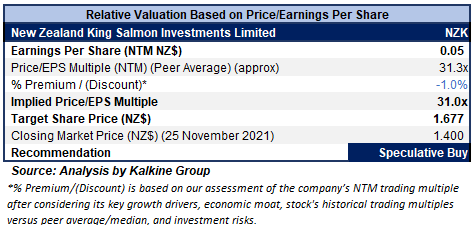
Valuation Methodology: Price/Earnings Per Share Based Relative Valuation (Illustrative)
Technical Overview:
Daily Price Chart
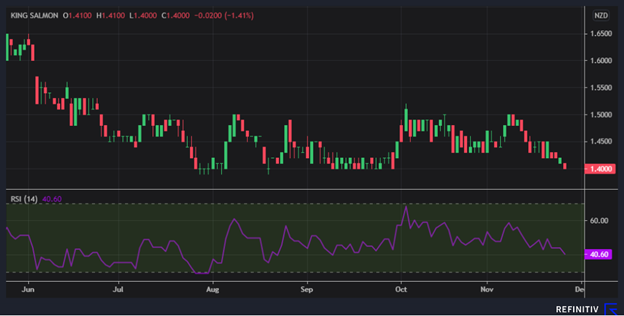
Source: REFINITIV, Note: Purple color line reflects Relative Strength Index (14-Period)
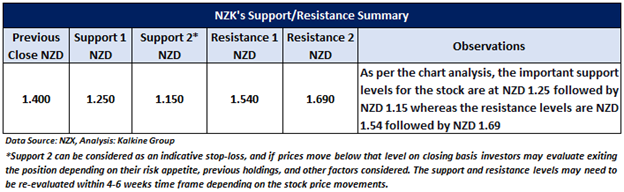
Stock Recommendation
The stock has been valued using a P/E multiple-based illustrative relative valuation, and the target price so arrived reflects a rise of low double-digit (in % terms). Accordingly, a slight discount has been applied to P/E Multiple (NTM) (Peer Average), as the small fish size and compensating restrictions on harvest have negatively disrupted the company's financial performance.
For relative valuation, we have taken peers like A2 Milk Company Ltd. (ATM.NZ), Scales Corporation Ltd. (SCL.NZ), and Blackmores Ltd. (BKL.NZ).
Considering the facts above, we give a “Speculative Buy” recommendation on the stock at the closing market price of $1.4 per share, down 1.41% as of 25th November 2021.
3) Savor Limited (Recommendation: Speculative Buy, Potential Upside: Low Double-Digit) (M-Cap: NZ$30.13 million)
Business Description:
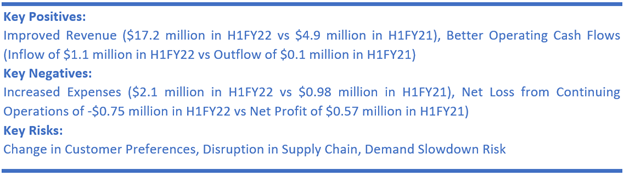
Savor Limited (NZX: SVR) is in the hospitality business with ten venues in Auckland, including Azabu Ponsonby, Azabu Mission Bay, Ebisu and Non Solo Pizza. In April 2021, the company acquired the Auckland venues Amano, Ortolana, and The Store.
Outlook
The company acquired Oji Sushi in July 2021 to accompany existing Japanese credentials that will strengthen the casual offering and further expansion. Moreover, the organic growth continued with the establishment of Bar Non Solo in the Seafarers Building. This cocktail lounge expansion of NSP brand from Parnell contributed high energy to the Italian Aperitivo restaurant dining district. Further, it remains in discussions with multiple parties to acquire profitable assets. On the financial front, the company is well placed to maximise trading opportunities once restrictions are lifted.
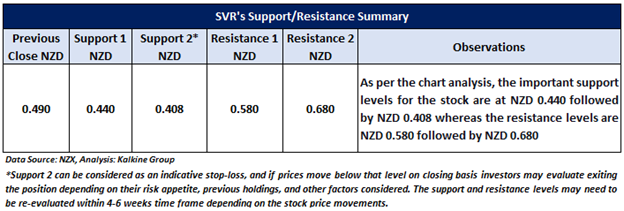
Technical Overview:
Daily Price Chart
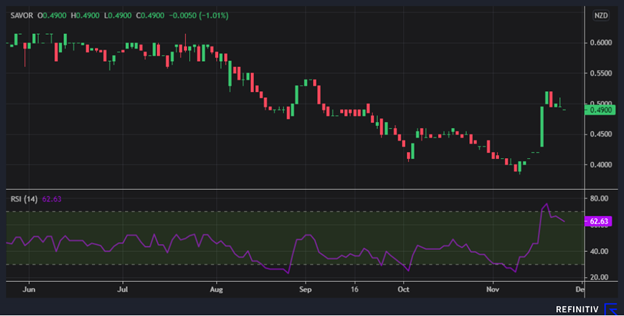
Source: REFINITIV, Note: Purple color line reflects Relative Strength Index (14-Period)
Stock Recommendation
Considering the facts above, we give a “Speculative Buy” recommendation on the stock at the closing market price of $0.49 per share, down 1.01% as of 25th November 2021.
4) Scales Corporation Limited (Recommendation: Hold, Potential Upside: Low Double-Digit) (M-Cap: NZ$761.81 million, Gross Dividend Yield: 4.869%)
Business Description:
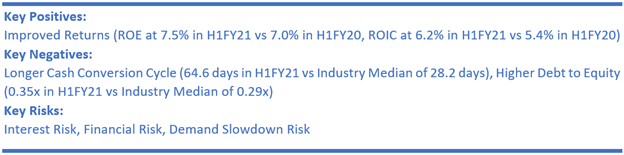
Scales Corporation Limited (NZX: SCL) is engaged in the agri-business. It operates in three divisions, including horticulture, logistics, and food ingredients, in adjacent primary sectors.
Outlook
FY21 Guidance: Amid robust first half-year performance, the underlying net profit is forecasted to be between $32.0 and $37.0 million, and the underlying EBITDA will be between $65.0 and $72.0 million.
The company expects disruptions in the domestic and international operations, including labour availability and supply chains, due to the ripple effects of COVID-19. Despite incurring massive one-time transaction costs for unsuccessful acquisitions, the company continues to anticipate being firmly positioned to take advantage of future opportunities.
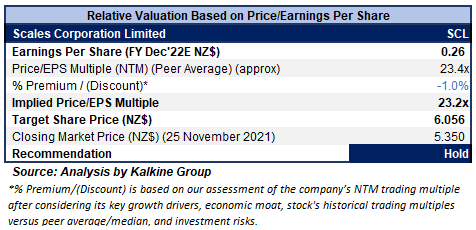
Valuation Methodology: Price/Earnings Per Share Based Relative Valuation (Illustrative)
Technical Overview:
Daily Price Chart
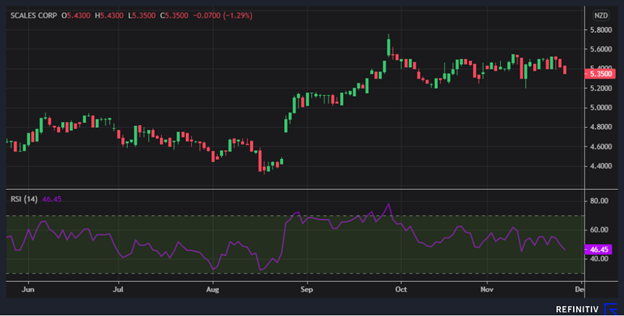
Source: REFINITIV, Note: Purple color line reflects Relative Strength Index (14-Period)
Stock Recommendation
The stock has been valued using a P/E multiple-based illustrative relative valuation, and the target price so arrived reflects a rise of low double-digit (in % terms). Accordingly, a slight discount has been applied to P/E Multiple (NTM) (Peer Average), considering a lower gross margin at 29.3% in H1FY21 versus the industry median of 39.6% and a reduced fixed asset turnover at 0.97x in H1FY21 vs 1.04x in H1FY20.
For the purposes of relative valuation, we have taken peers like Sanford Ltd. (SAN.NZ), The a2 Milk Company Ltd. (ATM.NZ), and New Zealand King Salmon Investments Ltd. (NZK.NZ).
Considering the aforesaid facts, we give a “Hold” recommendation on the stock at the closing market price of $5.35 per share, down 1.29% as of 25th November 2021.
Note 1: The reference data in this report has been partly sourced from REFINITIV.
Note 2: Investment decisions should be made depending on the investors’ appetite on upside potential, risks, holding duration, and any previous holdings. Investors can consider exiting from the stock if the Target Price mentioned as per the analysis has been achieved and subject to the factors discussed above alongside support levels provided.
Technical Indicators Defined: -
Support: A level where-in the stock prices tend to find support if they are falling, and downtrend may take a pause backed by demand or buying interest.
Resistance: A level where-in the stock prices tend to find resistance when they are rising, and uptrend may take a pause due to profit booking or selling interest.
Stop-loss: It is a level to protect further losses in case of unfavourable movement in the stock prices.
Disclaimer
Kalkine New Zealand Limited is authorised to provide general advice only. The information on this website does not take into account any of your investment objectives, financial situation or needs. Before you make a decision about whether to acquire a financial product, you should obtain the Product Disclosure Statement from the product issuer. You should consider the appropriateness of advice taking into account your own objectives, financial situation and needs and seek independent financial advice before making any financial decisions.
Past performance is not a reliable indicator of future performance.
 Please wait processing your request...