
 AU
AU
 UK
UK
 CA
CA
 US
US
 IND
IND

 NZ
NZ

Health research in New Zealand is being supported by internationally recognised strengths, and the broader healthcare sector is being characterized as one of the largest sectors in the nation when it comes to revenue and employment. Beginning with the passage of Social Security Act in 1938, consensus has developed in NZ that the Government possesses a fundamental role in providing for the health care needs of the population. Higher government intervention, robust and resilient nature of the industry, government policies, access to offshore markets and higher dependency on technological tools are likely to drive growth of healthcare sector.
New Zealand has demonstrated to have a dynamic health technology sector and an active research community. There is an ecosystem of accelerators as well as investors with growing expertise in partnering health technology companies which makes this a space for significant economic opportunities. As per the International Trade Administration, approximately 85% of NZ’s healthcare is financed by the Government and delivered through a network of 20 District Health Boards. The broader healthcare sector has been receptive to the US technologies. It is constantly seeking out for new solutions which have the potential to add value to a healthcare system to reduce costs.
In the financial year 2015:
There is continued public support for the private sector role as well. Through New Zealand Health Strategy, Government plays a central role when it comes to setting the policy agenda and service requirements as well as in determining publicly funded annual health budget. Health spending in NZ (excluding investment expenditure in the health sector) was 9.5% of the GDP in 2013, that is slightly above OECD average of 8.9%. This has increased 2 percentage points since 2000, as spending on health outpaced economic growth in 2000s. According to the OECD report in July 2015, the share of government spending in NZ as a share of total spending on health has been relatively constant over the last decade (i.e. at around 80%). Notably, this is above the OECD average of 73%.
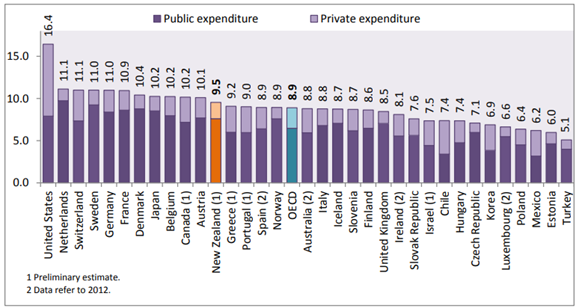
Health Spending as a Share of GDP, 2013 (Source: OECD)
Role of the New Zealand Government in Improving Healthcare Sector
According to The New Zealand Technology Industry Association, in 2015/2016 year, NZ government spent $15.6 billion on health accounting for around 80% of all health spending. Therefore, it can be said that, as a country, New Zealand is spending close to $20 billion a year on health.
Medical Technology Acting as Base for Growth of Healthcare Sector
Innovation, diversity, and growth are being demonstrated in New Zealand's healthcare sector, with the industry being primarily supported by favourable compliance environment, thereby helping greater product speed to market. According to Medical Technology Industry Sector Blueprint (2011), raising export revenues, increasing high-value jobs, cultivation of new businesses in regional centres as well as encouraging expansion in inventive and high-tech industries can be considered as fundamental activities assisting economic growth. The medical technology sector in NZ possesses robust potential to grow from the already strong foundations, and the strategy is in place to achieve the growth.
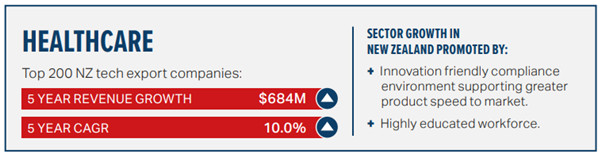
Growth Momentum (Source: Ministry of Business, Innovation & Employment)
Ageing Population: Challenges and Opportunities
Population around the world is rapidly ageing, whereby the average age increases as a result of an increase in life expectancy or falling fertility. As per one projection, growth in the population aged 65 and older, and aged 80 or older are common across most developed countries including the EU, the USA, Canada, Japan, Australia, New Zealand, etc. Ageing presents both challenges and opportunities.
COVID-19 Pandemic- What Opportunities Have Been Created for Healthcare Sector?
Since the outbreak of COVID-19, the demand for ventilators and other equipment and aged care and retirement villages have surged across the world, providing for great opportunities to healthcare sectors to capitalize on. However, New Zealand has managed to contain the spread of the deadly virus thanks to strong government policies, advanced and developed healthcare ecosystem, and a stable economy.
Going forward, healthcare companies, with innovative approaches, having technologies to address health concerns in a cost-effective manner, are expected to get benefited. Presence of leading and developed healthcare companies in New Zealand further strengthens the broader healthcare system in the nation. There are companies listed on NZX such as Fisher & Paykel Healthcare Corporation Limited with the leadership in medical devices and systems for use in respiratory care, and in treatment of obstructive sleep arena, Bliss Technologies Limited - a leading manufacturer of probiotic strains that provides probiotic solutions for specific health targets, TruScreen, which offers the latest technology in cervical screening and Pacific Edge Limited - a cancer diagnostic company, which are expected to benefit from their innovative and cost-effective medical devices.
Robust And Resilient Healthcare Space- The Road Ahead
Healthcare sector is much diversified and is full of opportunities in every segment, which include providers, payers, and medical technologies.
After having a broader overview of the healthcare, let us quickly have a look at the companies that could benefit from the overall growth of the sector (MEE, AFT, OCA, EBO).
1. Me Today Limited (NZX: MEE) (Recommendation: Speculative Buy) (M-Cap: ~NZ$29.92 Million)
Business Description: Me Today Limited (NZX: MEE) owns and operates the Me Today brand and The Good Brand Company. Me Today is a New Zealand founded and based health and wellness brand that produces premium quality products clearly linking supplements and natural skincare.
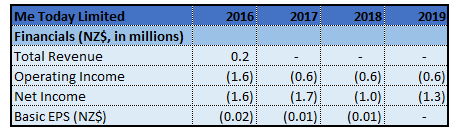
Key Metrics (Source: Refinitiv (Thomson Reuters))
Outlook: The company has a great opportunity for growth in the New Zealand market, and it wants to cement a position of strength in the local market before fully embarking on international expansion plans. Accessing the Chinese market remains top of the mind as this can be accessed through the local NZ community of daigou traders.
Technical Overview: As is obvious from the weekly chart as shown below that the stock has been trading in range provided by upper Bollinger Band on the upside and 20 period SMA on the downside thereby demonstrating strength in uptrend. Within the range, the trading bias has been down. However, it also appears that the chart is forming Rounding Bottom having taken support around $0.080. If Rounding Bottom gets confirmed with price movements in upcoming weeks, then the stock will have long sustained upside. Technical indicators such as MACD with bullish cross-over and RSI with around 54 reading confirm to inherent strength in bullish momentum.
Going forward, the stock is likely to have resistance around $0.100 while support could be around $0.080. Thus, we give a “Speculative Buy” rating on the stock at the current price of NZ$0.082 per share.
Weekly Chart -
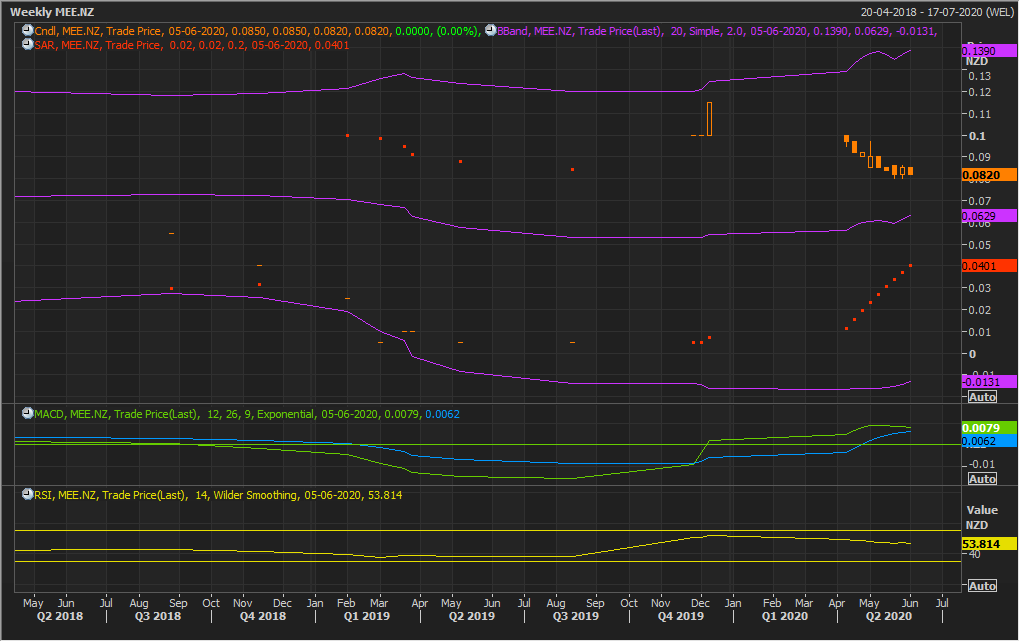
Source: Refinitiv (Thomson Reuters)
Note: Purple color lines are Bollinger Bands with upper band suggesting overbought status while lower band oversold status and orange colour dotted line is Parabolic SAR suggesting reversal of position (i.e., from buy to sell or sell to buy).
2. AFT Pharmaceuticals Limited (NZX: AFT) (Recommendation: Buy, Potential Upside: Lower Double-Digit) (M-Cap: ~NZ$467.33 Million)
Business Description: AFT Pharmaceuticals Limited (NZX: AFT) is a growing multinational pharmaceutical company that develops, markets and distributes a broad portfolio of pharmaceutical products across a wide range of therapeutic categories which are distributed across all major pharmaceutical distribution channels: over the counter (OTC), prescription and hospital.
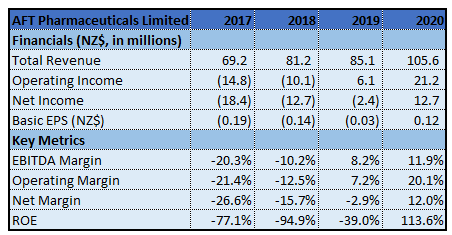
Key Metrics (Source: Refinitiv (Thomson Reuters))
Outlook: The company witnessed significant potential for its products in both global and local markets. It continues to develop and commercialise line extensions of the Maxigesic range and other products such as NasoSurf and Pascomer. All the products have the potential to generate significant shareholder value and improve healthcare outcomes for patients around the globe.
Valuation: Despite all the present challenges, including the COVID19 pandemic, the company is looking at the rest of the 2021 financial year with confidence. It is expecting continuing positive cash flow and an operating profit of between $14.0 million to $18.0 million. We have applied EV/Sales Based relative valuation (on an illustrative basis) and the target price reflects a rise of lower double-digit (in % terms).
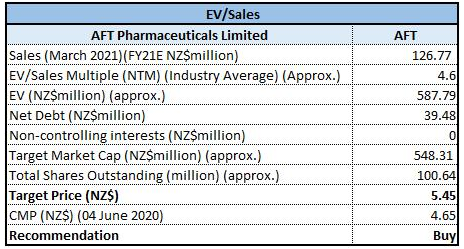
EV/Sales Based Relative Valuation (Illustrative) (Source: Refinitiv (Thomson Reuters))
3. Oceania Healthcare Limited (NZX: OCA) (Recommendation: Buy, Potential Upside: Lower Double-Digit) (M-Cap: ~NZ$584.14 Million, Gross Dividend Yield: 5.213%)
Business Description: Oceania Healthcare Limited (NZX: OCA) provides Rest Home, Hospital, Dementia, Respite and Palliative/End of Life Care, as well as Independent Retirement Village living, at over 40 New Zealand locations.
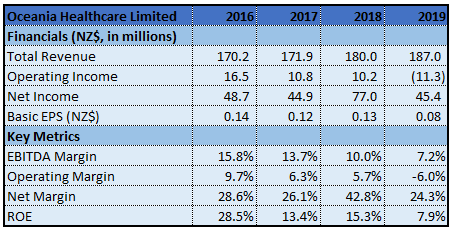
Key Metrics (Source: Refinitiv (Thomson Reuters))
Outlook: As per the release dated April 28, 2020, none of the company’s aged care centres or retirement villages reported any cases of COVID-19. The company’s aged care business has also proven resilient, despite the restrictions of the Alert Level 4 lockdown, with new admissions taken and stable occupancy levels recorded during the period. It has continued to sign applications and completed sales of Care Suites throughout the lockdown period. The company will also benefit from the recently announced increase in Government funding for aged residential care.
Valuation: The company is in a strong financial position with current drawn debt of $321.2 million, $12.1 million of cash and therefore $110.9 million of undrawn net debt headroom. We have applied P/E Based relative valuation (on an illustrative basis) and the target price reflects a growth of lower double-digit (in % terms).
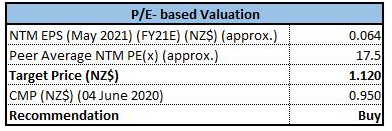
P/E Based Relative Valuation (Illustrative) (Source: Refinitiv (Thomson Reuters))
4. EBOS Group Limited (NZX: EBO) (Recommendation: Buy, Potential Upside: Lower double-digit) (M-Cap: ~NZ$3.58 Billion, Gross Dividend Yield: 3.640%)
Business Description: EBOS Group (NZX: EBO) is a leading marketer and distributor of recognised consumer products and animal care brands.
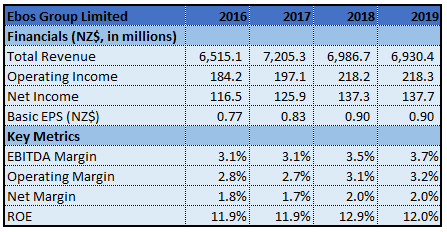
Key Metrics (Source: Refinitiv (Thomson Reuters))
Outlook: The company’s wholesale, distribution and retail healthcare businesses were essential services and were critical in ensuring a continued and stable supply of healthcare, medical and pharmaceutical products to the community. Its healthcare segment remained open and operational. During the third quarter ended 31 March 2020, the healthcare segment experienced unprecedented levels of demand in response to COVID-19 developments.
Valuation: Whilst the outlook for consumer demand in the current environment is evolving and uncertain, the company is confident that there will be no impact on its FY20 results. We have applied P/BV based relative valuation (on an illustrative basis) and the target price reflects a growth of lower double-digit (in % terms).
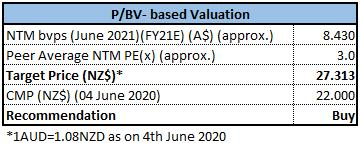
P/BV Based Relative Valuation (Illustrative) (Source: Refinitiv (Thomson Reuters))
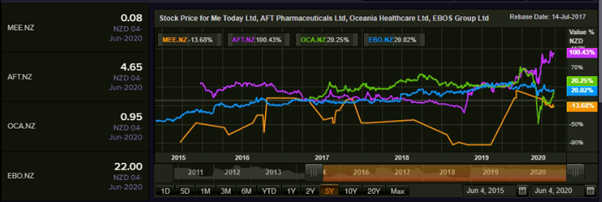
Comparative Price Chart (Source: Refinitiv (Thomson Reuters))
Disclaimer
Kalkine New Zealand Limited is authorised to provide class advice only. The information on this site does not take into account any of your investment objectives, financial situation or needs. Before you make a decision about whether to acquire a financial product, you should obtain the Product Disclosure Statement from the product issuer. You should consider the appropriateness of advice taking into account your own objectives, financial situation and needs and seek independent financial advice before making any financial decisions.
Past performance is not a reliable indicator of future performance.
 Please wait processing your request...