
 AU
AU
 UK
UK
 CA
CA
 US
US
 IND
IND

 NZ
NZ

.png)
Sector Landscape and Outlook
Renewable energy has assumed great significance in the economic development of New Zealand. It is already on its way to achieving its goal of 100 percent renewable generations by 2035. The country’s commitment towards the clean, green, and sustainable environment has brought it to this level which separates it from many countries. The country’s investment in hydro and geothermal plants have positioned it to shift its energy reliance towards sustainable sources.
Energy is an essential part of everyday life. Fuels and electricity power transport systems, heat buildings, and produce the goods and services that underpin New Zealand’s economic and social well-being. Using energy supplies efficiently saves money and helps New Zealand companies produce their goods and services more competitively.
New Zealand has access to a wide range of energy sources, both renewable (hydro, geothermal, wood, wind, biogas, and solar) and non-renewable (oil, gas, and coal). New Zealand has increased its focus on renewable energy, its efficiency and conservation to meet its increasing energy demands and to respond to national and international demands on climate change.
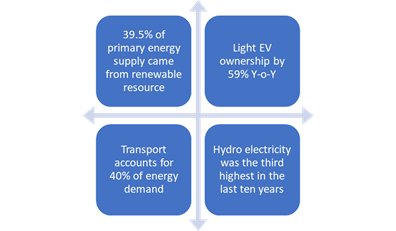
Exhibit 1: Snapshot of New Zealand Energy Sector
Source: Ministry of Business Innovation and Employment (MBIE), Kalkine
Globally, the S&P Global Clean Energy Index has outperformed the S&P Global 1200 performance by a wide margin (66.78%) as charted below since the beginning of the year 2020.
Exhibit 2: S&P Global Clean Energy Index versus S&P Global 1200*

Data Source: SP Global.com; Chart Created by Kalkine Group; * Relative performance rebased to 100 for the period of 3rd January 2020 – 4th November 2020
Renewable Energy plays a very important role in New Zealand’s energy supply system, with approximately 39.5% energy supply coming from renewable sources. Renewable energy can be divided into two categories: Energy used in large scale electricity generation and all other uses for renewable energy. Both uses total primary energy as a measure of supply. The latest data from IEA (International Energy Agency) shows that on an average 27% of the electricity generation was done from renewables in 2019. And in 2018, New Zealand was ranked third highest for share of renewables used in electricity generation.
Types of Renewable Energy Sources
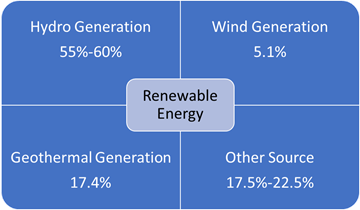
Exhibit 3: Major Sources of Renewable Energy with Market Share
Source: Ministry of Business Innovation and Employment (MBIE), Kalkine
Hydro Generation
Each year hydro generation provides 55% to 60% of New Zealand’s electricity supply, or about 24,000 GWh each year to help meet an annual average demand of around 40,000 GWh. In 2019, the total hydro generation stood at 25,321 GWh down from 26,030 GWh in 2018. This was mainly due to less favourable hydrological conditions as compared to 2018. Despite this, electricity generation from hydro was at its third highest level for the past ten years.
Wind Generation
Wind generation supplied 2,232 GWh of electricity, or 5.1%, of total electricity supply in 2019. This was up 9.1% on the 2018 level. The capacity factor for wind generation increased from 34% in 2018 to 37% in 2019. This states that wind turbines were generating more frequently in 2019 compared to 2018. The better generation conditions were largely due to high wind speed in November and December, and repairs for 11 MW of turbines at the Te Āpiti windfarm.
Geothermal Generation
In 2019, the total geothermal generation output stood at 7,586 GWh, up 0.8 per cent on 2018. This accounted for 17.4 per cent of New Zealand’s total electricity supply in 2019, just 0.3 percentage points less than it was at its peak in 2016. Most of the country’s installed geothermal generation is in the Taupō Volcanic Zone.
Solar
Solar energy accounts for major part in other source of renewable energy. In 2019, solar energy increased by 27% Y-o-Y to 126 GWh in 2019. Solar PV accounted for just over 0.3 per cent of total electricity generation in 2019 at 126 GWh. Most solar generation is produced by solar panels (photovoltaic) on private homes.
Thermal
Generating electricity using coal, diesel and gas are known as thermal generators. Thermal fuel can be stored and is not dependent on weather conditions. Thermal plants often generate when other supply sources are scarce.
Cogeneration
It is the process under which some industrial sites produce heat and electricity for industrial purposes. Excess cogenerated electricity is often exported into distribution networks or to the national grid.
Wave power
Tidal and wave power are examples of emerging technologies that may become viable forms of electricity generation for New Zealand in the future.
Batteries
It may increasingly become a viable option to store electricity when price or demand is low and release that electricity later when price or demand is high. Importantly, batteries do not generate any new electricity but can be used to reduce the need for a new generation by reducing the peak demand.
An Overview of Electricity Demand
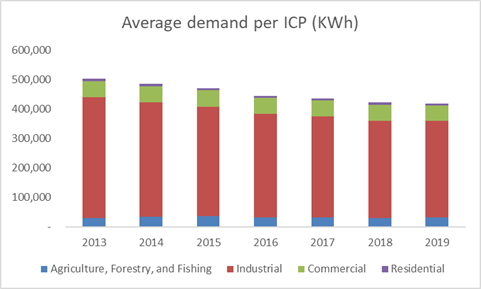
As at the end of 2017, electricity was supplied to around 1.7 million residential consumers. They account for about 85 percent of all customers but consume only about 32 percent of the country’s electricity. Commercial consumers (such as shops, factories, and other businesses) represent about nine percent of customers. They use about 24 percent of the electricity consumed. Although there are only 123,000 industrial consumers in New Zealand (six percent of customers), they use 44 percent of total electricity consumption. This includes about seven percent used in the agriculture, forestry, and fishing sectors. The single largest consumer is New Zealand Aluminium Smelters Limited, at Tiwai Point in Southland, which is included in the industrial sector. It consumed about 5,000 GWh, which was about 13 percent of New Zealand’s total electricity demand in 2017.
Demand and Supply of Electricity in 2019
During 2019, the electricity generation from the wind increased; however, the total share of renewables in electricity generation decreased from 84% in 2018 to 82.4% in 2019. This was mainly due to low rainfall in the North Island and as a result less hydro electricity generation than usual.
Exhibit 4: Consumption by Sector
Source: MBIE, Chart Created by Kalkine Group
The consumption of electricity remained stable in 2019, with a marginal increase of 0.6% over 2018, driven by higher demand in the agricultural, industrial and transport sectors. The demand from residential and commercial sectors was stable in 2019.
Demand from the agricultural sector increased by 11% over 2018. Dry conditions during 2019 led to increased demand for electricity in irrigation. However, the demand in 2019 was around two per cent less than what it was in 2017 when the weather was drier.
New Zealand All Set for Greener Future
The Government has approved the Climate Change Response (Zero Carbon) Amendment Act and is aiming for net-zero carbon emissions by 2050 (except biogenic methane). New Zealand is pushing faster towards 100% renewable electricity by 2030, having already achieved 82% through sustained effort and good policy. The country is planning to invest in a network of hydrogen refueling stations for the heavy transport fleet.
As per the Ministry of Business, Innovation and Employment, the share of electricity generation from renewable sources is expected to rise from 84% in 2018 to more than 90% and 95% by 2035 and 2050, respectively.
Outlook
Even though geothermal energy and other renewable sources can support continuously growing electricity demand in New Zealand, it may require the development of new infrastructure for electricity generations and transmission. Geothermal energy is a strong contributor to renewable energy generation, and it is expected to grow over time. The country’s ease of access to geothermal and its investment in technology will see it play a vital role in future energy generation. The country is likely to experience changes in the type of fuel used in vehicles, with the uptake of biofuels and an increasing number of hybrid vehicles on roads.
Key Challenges Faced
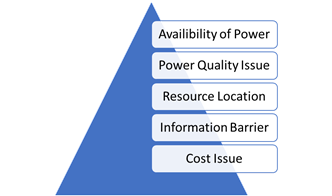
Exhibit 4: Key Challenges
Source: Kalkine Group
Availability of Power: One of the biggest concerns in the field of renewable energy is power generation depending on natural resources that are uncontrollable by humans. For example, wind energy depends on the availability of wind. If the wind is slow, the turbine will not turn, which will result in zero power flow to the grid.
Power Quality Issue: Regularly high-power quality is necessary to ensure stability and high efficiency of the network. The condition of the power supply lets the system to work well with high reliability and lower costs.
Resource Location: Most renewable energy plants that share their energy with the grid require large areas of space. In most cases, renewable energy sources are dictated by location which can be off-putting to users. Some renewable energy sources are simply not available in different regions.
Information Barrier: While this area is upgrading, there is still a lack of awareness and information about the advantages and need of renewable energy. Investment and capital payments have been made accessible for the application of renewable energies.
Cost Issue: The high initial cost of installation is one of the major hurdles in the development of renewable energy.
Apart from the sector-specific factors, we have also analyzed four NZX-listed companies operating in the renewables sector. This report covers their insights, outlook, performance and potential as expected to be delivered in the near to medium term (TLT, CEN, MCY, VCT).
1. Tilt Renewables Limited (NZX: TLT) (Recommendation: Buy, Potential Upside: Low Double-Digit), (M-Cap: ~NZ$1.470 Billion)
About the Company
Tilt Renewables Limited is engaged in the business of development, ownership and operating of electricity generation facilities as well as trading of electricity and associated products from renewable energy sources.
.png)
Outlook
FY21 is expected to be a transitional year for the company with a new generation of 469MW is planned to come on-line during the year. The company stated that ramp-up of production from these new assets is affected by many factors and therefore, is harder to forecast than production from commissioned assets. Also, the commissioning production volume is subjected to spot market pricing. Therefore, EBITDAF is anticipated to be between $80 million to $95 million. The company is expected to release half-year results on 9th November 2020.
Recent Update:
For the three months from 1 July 2020 to 30 September 2020, the total group production was up by 43% Y-o-Y mainly driven by 152 GWh produced during the commissioning of the 336MW Dundonnell Wind Farm. Australian fully operational asset production was down by 4.7% Y-o-Y and NZ’s production was down by 2.5% Y-o-Y.
Valuation Methodology: P/BV Based Relative Valuation (Illustrative)
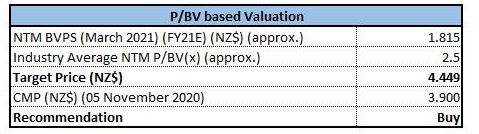
P/BV Based Relative Valuation (Source: Refinitiv (Thomson Reuters))
We have applied P/BV Based Relative Valuation (on an illustrative basis) and the target price reflects a rise of low double-digit (in % terms).
Considering the expected upside, positive outlook for FY 2021 and decent ROE position, we give a “Buy” rating on the stock at the current price of NZ$3.900 per share on November 5, 2020.
2. Contact Energy Limited (NZX: CEN) (Recommendation: Hold, Potential Upside: Low Double-Digit), (M-Cap: ~NZ$5.48 Billion, Dividend Yield: 6.31%)
About the Company
Contact Energy Limited is a diversified as well as integrated energy company, focusing towards generation of electricity and sale of electricity and gas in NZ.
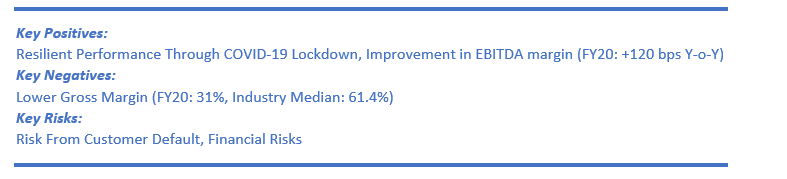
Outlook
The company will remain focussed on improving operational efficiency and leveraging its lean operating model. The company has a robust balance sheet and an excellent portfolio of assets. It is working with commercial and industrial customers to deliver reductions to their carbon footprints by connecting them with low-carbon, reliable electricity. Recently, it signed a long-term 13MW renewable agreement with Open Country Dairy.
Recent Update:
The company has provided operating performance, and the key highlights are given below:
Valuation Methodology: P/BV Based Relative Valuation (Illustrative)
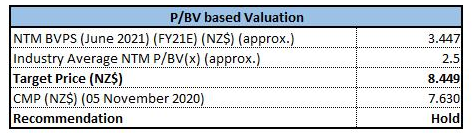
P/BV Based Relative Valuation (Source: Refinitiv (Thomson Reuters))
We have applied P/BV Based Relative Valuation (on an illustrative basis) and the target price reflects a rise of low double-digit (in % terms).
Considering the company's focus towards operational efficiency, robust balance sheet position, and current trading levels we give a “Hold” rating on the stock at the current price of NZ$7.630 per share, up by 0.39% on November 5, 2020.
3. Mercury NZ Limited (NZX: MCY) (Recommendation: Hold, Potential Upside: Low Double-Digit), (M-Cap: ~NZ$7.32 Billion, Dividend Yield: 4.12%)
About the Company
Mercury NZ Limited generates electricity from 100% renewable resources. It also sells electricity to customers via retail brands – Mercury and GLOBUG.
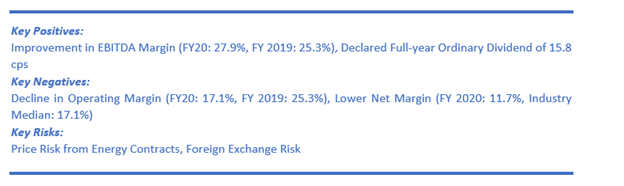
Outlook:
As per the release dated September 24, 2020, the company has revised FY21 EBITDAF guidance from $515 million to $505 million. This shows an anticipated 200 GWh decrease in full year hydro generation to 3,700 GWh due to dry weather conditions in the Taupo catchment in FY21 to date.
This guidance can change in the future and remains subject to any material events, significant one-off expenses or other unforeseen circumstances including changes to hydrological conditions.
Recent Update:
In the first quarter of FY21, the company’s hydro generation was 142GWh below average, declining by 170GWh to 1,044GWh. The company’s continued focus towards customer value saw the average Commercial & Industrial sales yield increase by 8.6% Y-o-Y, from $88/MWh to $96/MWh, with sales volumes rising by 130GWh.
Valuation Methodology: P/BV Based Relative Valuation (Illustrative)

P/BV Based Relative Valuation (Source: Refinitiv (Thomson Reuters))
We have applied P/BV Based Relative Valuation (on an illustrative basis) and the target price reflects a rise of high single- digit (in % terms).
4. Vector Limited (NZX: VCT) (Recommendation: Hold, Potential Upside: Low Double-Digit), (M-Cap: ~NZ$4.12 Billion, Dividend Yield: 4.38%)
About the Company
Vector Limited is NZ’s leading network infrastructure company which runs a portfolio of businesses delivering energy as well as communication services to over one million homes and commercial customers.
Outlook
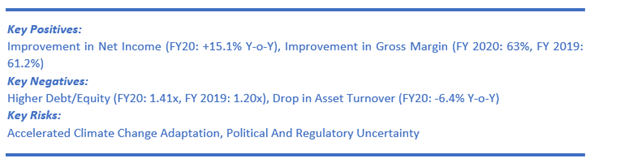
For FY21, the company is expecting adjusted EBITDA in the range of $480 million to $500 million. In July 2020, the company announced a strategic alliance with Amazon Web Services (AWS) to jointly develop new energy platform, aimed at changing how the energy is being managed, delivered as well as consumed.
Recent Update:
For the three months ended 30 September 2020, Vector Limited reported total new electricity connections of 3,839, up 19.4% Y-o-Y. The company’s metering business performed amidst increased competition. Notably, connection numbers rose by 9.2 percent on September 2019, with a total fleet of 1,746,990. The company has now installed more than 300,000 advanced meters in Australia.
Valuation Methodology: P/BV Based Relative Valuation (Illustrative)
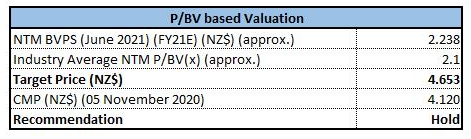
P/BV Based Relative Valuation (Source: Refinitiv (Thomson Reuters))
We have applied P/BV Based Relative Valuation (on an illustrative basis) and the target price reflects a rise of low double-digit (in % terms).
Considering the decent upside potential, increase in net income and decent performance for the 3 months to September 30, 2020, we give a “Hold” rating on the stock at the current price of NZ$4.120 per share, down by 2.14% on November 5, 2020.
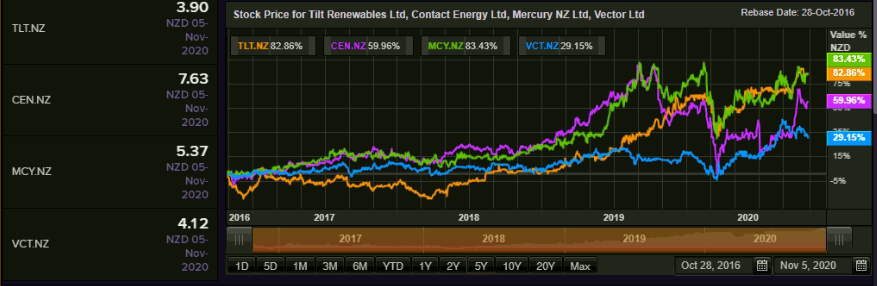
Comparative Price Chart (Source: Refinitiv (Thomson Reuters))
Disclaimer
Kalkine New Zealand Limited is authorised to provide class advice only. The information on this site does not take into account any of your investment objectives, financial situation or needs. Before you make a decision about whether to acquire a financial product, you should obtain the Product Disclosure Statement from the product issuer. You should consider the appropriateness of advice taking into account your own objectives, financial situation and needs and seek independent financial advice before making any financial decisions.
Past performance is not a reliable indicator of future performance.
 Please wait processing your request...