
 AU
AU
 UK
UK
 CA
CA
 US
US
 IND
IND

 NZ
NZ

New Zealand Communication Services Sector Outperformed S&P/NZX 50 Index (YTD*)
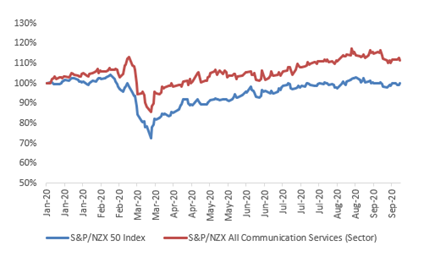
S&P/NZX50 vs S&P/NZX All Communication Services (Sector) (Source: S&P Dow Jones Indices) *3rd January 2020 – 1st October 2020
New Zealand Telecommunication Industry Snapshot
The Telecommunication Industry of New Zealand is an important part of modern life. The country has the most competitive and mature telecommunications market.
Figure 1. Snapshot of New Zealand’s Telecommunications Sector
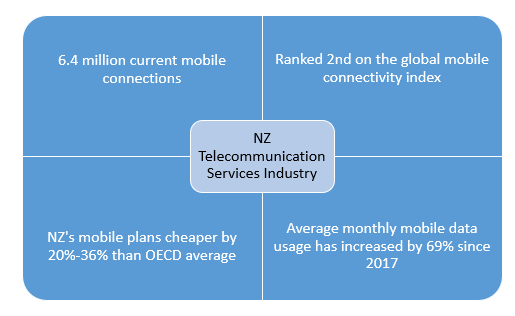
Data Source: TCF Annual Report, Chart: Kalkine Group
New Zealand Provides Cheaper Phone Services
The prices of the country’s mobile phone services are considerably cheaper than other countries by about 20 to 40 percent the OECD average. The cost of broadband in New Zealand is also lower than the OECD average, with the cost for consumers for unlimited fixed-line broadband and voice services (with speeds of 100 Mbps) 9% less than the OECD average.
UFB Roll-out Crossed more than 1 million Milestone
In less than 10 years, fibre has exceeded copper to become the leading fixed broadband technology in the country. The first stage of the ultra-fast broadband (UFB) rollout was finished in December 2019. By March 2020, about 1.7 million (82%) New Zealand premises had access to fibre and of these, 58% (966,773) were using fibre services, which is more than double the initial take-up expectation when the UFB rollout began in 2012.
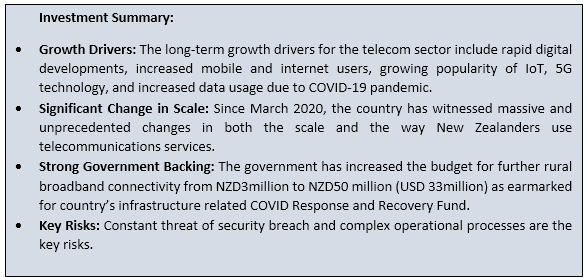
Additionally, the government has increased the budget for further rural broadband connectivity from NZD3million to NZD50 million (USD 33million) as earmarked for country’s infrastructure related COVID Response and Recovery Fund.
Figure 2: Homes and Businesses connected to UFB
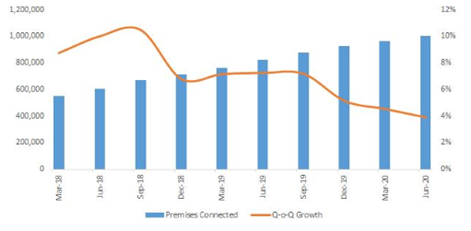
Data Source: MBIE, Chart: Kalkine Group
Exponential Growth During the Lockdown Period
Ever since the country went into lockdown since March 2020, the demand for data and voice services grew exponentially. The overall data usage went up drastically , primarily during the peak working hours. As per the data released by Chorus, during Alert Level 4, its networks witnessed an increase in daytime traffic of up to 85% and an increase in evening traffic of up to 40%.
Figure 3: Network Traffic – Upstream
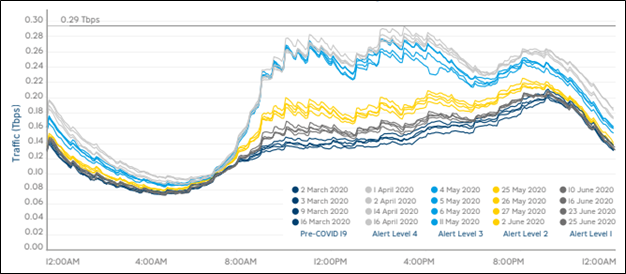
Network Traffic – Upstream (Source: TCF)
The jagged lines in this graph represent half hour breaks, in line with the way video conference calls are often scheduled. Traditional voice calling came back into picture and scaled up 70% higher compared to the pre-COVID-19 baseline, however, later it moved down to near to normal levels.
During the lockdown, telecommunications companies enabled New Zealanders to achieve near normal productivity level by providing high network connectivity, guaranteeing essential services, and increasing mobile cell tower capacity where it was needed.
Robust Demand for Data Services to Continue
New Zealanders’ desire for data has grown gradually partially driven by decline in cost over the past ten years. The decline in the cost has been led by the innovation in technology for both fixed and mobile networks further supported by increasing smartphone penetration and use of new applications. Data usage by fixed as well as mobile connections continued to increase over the year. Average data consumption per fixed broadband connection rose from 172GB to 208GB per month.
Figure 4: Average Data Usage Per Fixed Broadband Connection
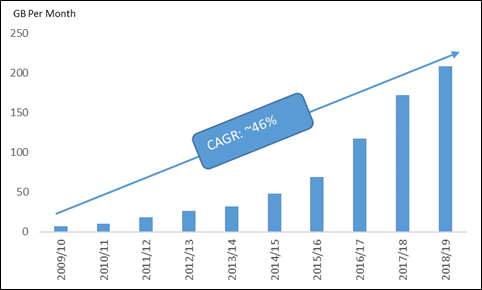
Data Source: Commerce Commission, Chart: Kalkine Group
Key Risks and Challenges
With the rise of COVID-19 cases across the globe, the consumer demand is evolving for each industry, and the telecommunication industry is not far behind. During the uncertain times, clients require omnichannel, self-service and instant communication. They also need fast and seamless data connections as well as quick solutions to any network issues. These issues presented various challenges in terms of architecture, operations, networks, and customer service.
Figure 5: Key Challenges Faced by Telecommunication Industry
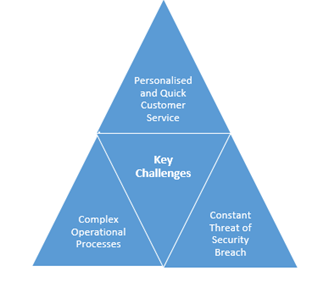
Key Challenges (Source: Kalkine Group)
Personalised and Quick Customer Service: The telecom service providers get millions of customer requests each day. With the increasing number of requests, the inability to go to stores, and many employees working from home, providing quick assistance becomes a challenge.
Operational Processes Are Complex: With millions of customers and a range of products and tailored solutions, operational responsibilities have become even more complex, as face-to-face assistance is not an option. Conducting complex operations involve more tools and resources, that increases the financial costs of telecom companies.
Constant Threat of Security Breach: Ensuring network security is one of the challenges the telecommunication industry faces. New technologies create new risks in relation with the security of applications and networks. This is mainly true with teams functioning remotely and customers requesting for assistance from home.
Since we now have a broad idea of telecommunications sector, it is important to look at the performance of some companies operating in the same sector.
1. Chorus Limited (NZX: CNU) (Recommendation: Buy, Potential Upside: Lower Double-Digit), (M-Cap: ~NZ$3.809 Billion, Dividend Yield: 3.85%)
Business Description: Chorus Limited is New Zealand’s leading telecommunications infrastructure company. It also maintains as well as builds network primarily made up of local telephone exchanges, cabinets, as well as copper and fibre cables.
Outlook:
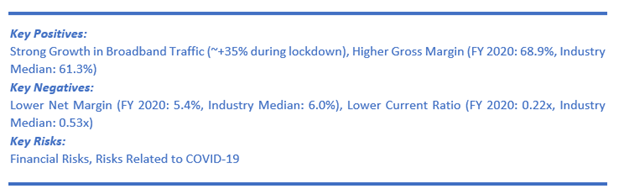
The company announced financial results for 12 months to June 30, 2020, and there was a decline in the annual revenue to NZ$959 million from previous year’s NZ$970 million. It witnessed NZ$1 million drop in the net profit to NZ$52 million. The company’s EBITDA increased NZ$12 million YoY to NZ$648 million even though there were operational restrictions as well as financial impact of COVID-19. This was due to NZ$23 million reduction in the operating expenses to NZ$311 million as well as focus towards reshaping business for the fibre-centric future.
Although COVID-19 had a negative financial impact on the company’s EBITDA in FY20, it has speeded up some positive underlying trends that support the business. For FY21, the company is expecting to report EBITDA of $640 million to $660 million. Capital expenditure is expected between $630 million to $670 million and FY21 dividend is expected to be 25 cents per share, subject to no material adverse changes in circumstances or outlook.
Valuation Methodology: EV/EBITDA Multiple Based Relative Valuation (Illustrative)
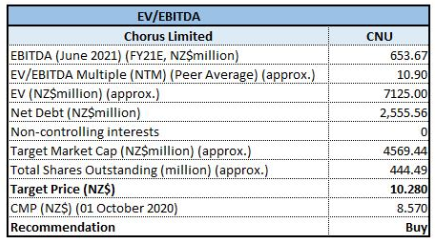
EV/EBITDA Multiple Based Relative Valuation (Source: Refinitiv (Thomson Reuters))
Note: All forecasted figures and peers have been taken from Thomson Reuters, NTM-Next Twelve Months.
We give a “Buy” recommendation at NZ$8.570 per share, down by 1.04% on October 1, 2020.
2. Vital Limited (NZX: VTL) (Recommendation: Hold, Potential Upside: High Single-Digit), (M-Cap: ~NZ$34.35 Million, Dividend Yield: 4.18%)
Business Description: Vital Limited is the provider of fundamental nationwide infrastructure which is Vital to New Zealand. The company owns and operates fibre infrastructure in Auckland as well as Wellington and it is well placed to take advantage of growing data consumption.
.png)
Outlook:
The company has successfully implemented its business continuity plan. Being a provider of essential services, the company was fully operational during the lock-down period. As a provider of critical nationwide communications, the company’s services were essential and were on the list of lifeline utilities.
Technical Overview:
Weekly Chart –
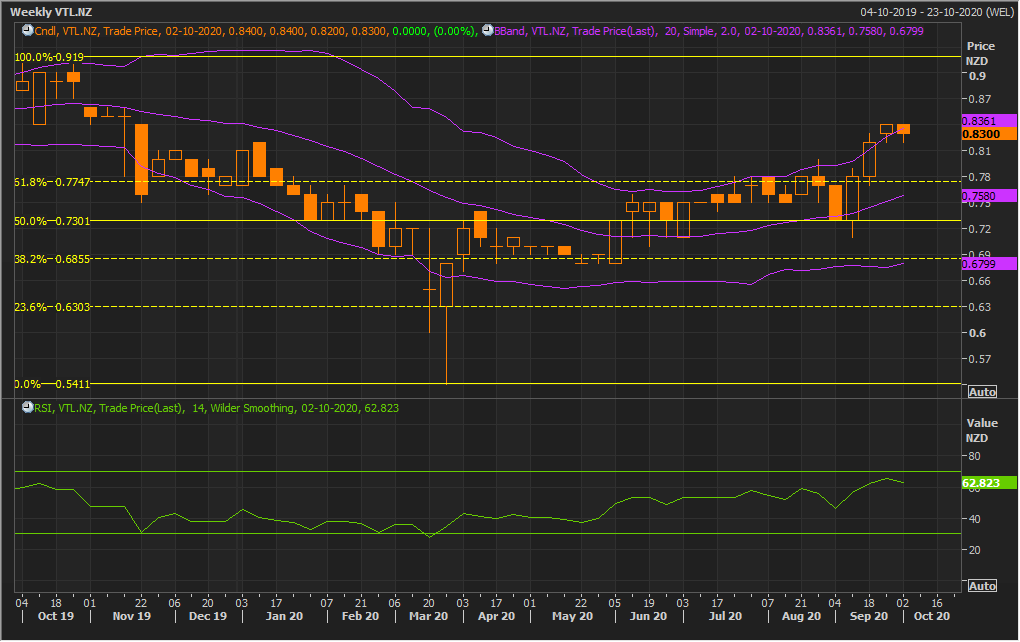
Source: Refinitiv (Thomson Reuters)
Note: Purple colour lines are Bollinger Bands with the upper band suggesting overbought status while the lower band oversold status, and yellow lines are Fibonacci retracement lines which measure price rebound and backtrack.
While remaining on an underlying uptrend, the stock opened at the previous week closing price which remained high for it, and finally gave lower close at $0.83, for the ongoing week. The technical indicator RSI with a reading around 63 suggests strong bullish momentum for the stock.
Going forward, the stock may have resistance around the previous high of $0.92 whereas support could be around the 61.8% retracement level of $0.77.
We give a “Hold” recommendation at NZ$0.83 per share on October 1, 2020.
3. Spark New Zealand Limited (NZX: SPK) (Recommendation: Hold, Potential Upside: High Single-Digit), (M-Cap: ~NZ$8.55 Billion, Dividend Yield: 7.13%)
Business Description: Spark New Zealand Limited is New Zealand’s leading telecommunications as well as digital services company.
Outlook:
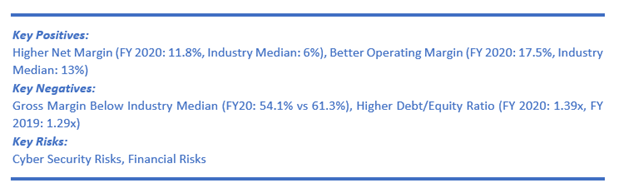
The company reported total revenue of $3,623 million, up by 2.5% y-o-y driven by rise in cloud, security and service management revenue of $43 million or 10.8%, excellent performance in mobile with growth in high margin service revenue of $32 million or 3.9% and growth in emerging revenue streams via Spark Sport and Qrious data analytics business. For FY21, the company has given EBITDAI guidance of $1,090 million to $1,130 million.
Spark Releases its Three-Year Strategy
The company has released its three-year strategy for the period covering FY21 to FY23. The new strategy is focused on the company’s established markets of broadband, wireless, and cloud, along with the three future growth markets identified as IoT, digital health and sports. By FY23, the company aspires to become primarily wireless, digitally native, and a leading cloud custodian.
The strategy also focusses on three important areas:
Valuation Methodology: EV/EBITDA Based Relative Valuation (Illustrative)
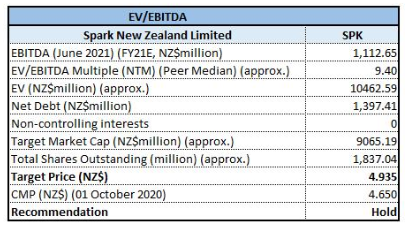
EV/EBITDA Based Relative Valuation (Source: Refinitiv (Thomson Reuters))
Note: All forecasted figures and peers have been taken from Thomson Reuters, NTM-Next Twelve Months
We give a “Hold” recommendation at NZ$4.65 per share, down by 1.06% on October 1, 2020.
4. Rakon Limited (NZX: RAK) (Recommendation: Hold, Potential Upside: High Single-Digit), (M-Cap: ~NZ$93.91 Million)
Business Description: Rakon Limited designs and manufactures advanced frequency control and timing solutions. Its three core markets are Global Positioning, Telecommunications and Space and Defence.
.png)
Outlook:
COVID-19 has impacted revenue of FY21 but considering the longer-term demand for 5G, business is still expected to witness growth. The future of telecommunications sector remains positive with all three mobile operators in China installing 5G networks, and the ongoing demand for stable, reliable, and greater capacity communications networks highlighted by COVID-19. The company’s market share is growing in the high precision sub-segment for low g-sensitivity products, and this movement is likely to be continued. In the high-volume sub-segment, competitive pressures from global positioning module makers in Asia are likely to increase price pressure; however, with the company’s alliance with low-cost manufacturer Taiwan-based Siward Crystal Technology Co. Limited, Rakon is expected to remain competitive.
Technical Overview:
Weekly Chart –
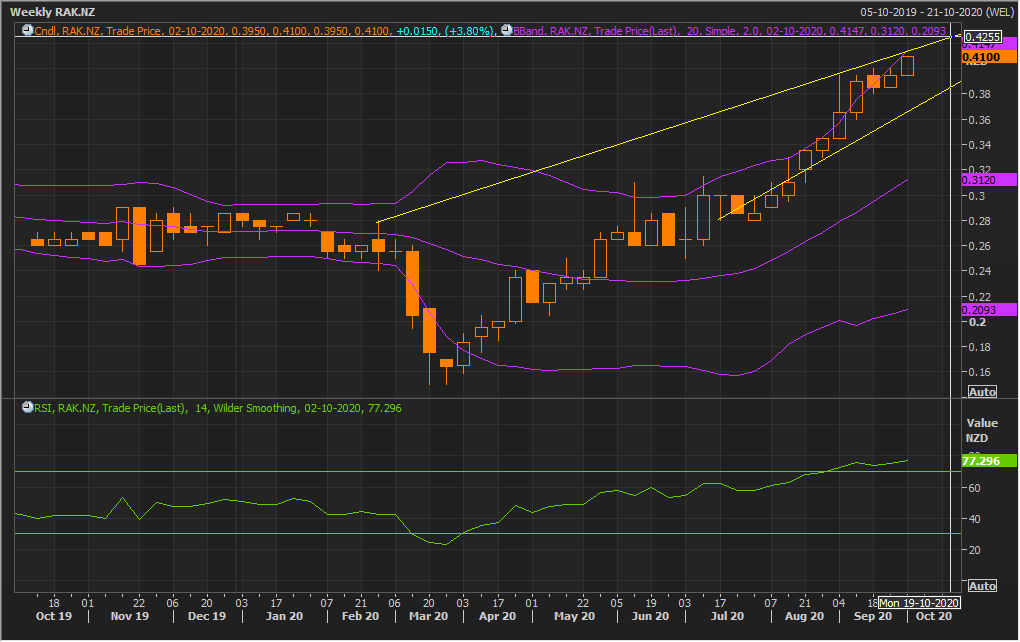
Source: Refinitiv (Thomson Reuters)
Note: Purple colour lines are Bollinger Bands with the upper band suggesting overbought status while the lower band oversold status.
The stock has been on a winning streak for multi-weeks in the process, making the high of $0.41. The technical indicator RSI with 77 reading while suggests strong bullish momentum, it also suggests that the stock has reached in the overbought zone.
Going forward, the stock may have resistance around the upper Bollinger band of $0.425 whereas support could be around $0.38.
We give a “Hold” recommendation at NZ$0.41 per share, up by 3.80% on October 1, 2020.
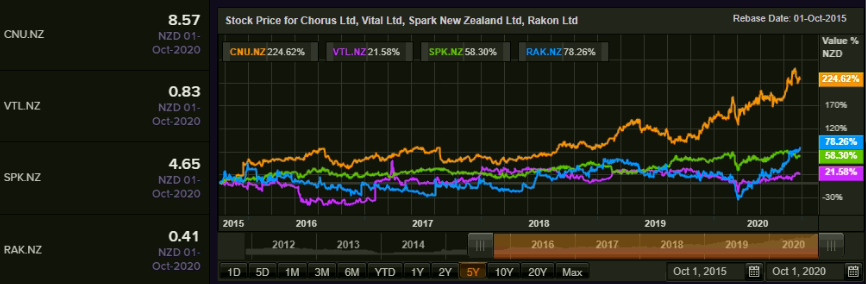
Comparative Daily Technical Chart (Source: Refinitiv (Thomson Reuters))
Disclaimer
Kalkine New Zealand Limited is authorised to provide class advice only. The information on this site does not take into account any of your investment objectives, financial situation or needs. Before you make a decision about whether to acquire a financial product, you should obtain the Product Disclosure Statement from the product issuer. You should consider the appropriateness of advice taking into account your own objectives, financial situation and needs and seek independent financial advice before making any financial decisions.
Past performance is not a reliable indicator of future performance.
 Please wait processing your request...