
 AU
AU
 UK
UK
 CA
CA
 US
US
 IND
IND

 NZ
NZ

This report is an updated version of the report published on 30 April 2025 at 11:10 AM AEDT.
Section 1: Company Overview and Fundamental Insights
1.1 Company Overview: Ramelius Resources Ltd is a Western Australia-based gold producer engaged in the exploration, development, and operation of gold mining assets. The company owns and operates several key projects including Mt Magnet, Penny, Cue, and Edna May, with ore processed primarily at the Mt Magnet and Edna May facilities. Ramelius also holds growth-stage assets such as the Rebecca-Roe Project, and is in the process of acquiring Spartan Resources to expand its production profile. Its business model follows a hub-and-spoke strategy focused on operational efficiency, resource expansion, and shareholder returns. Kalkine’s Resources Report covers the Investment Highlights, Management Insights, Key Financial Metrics, Risks, Technical Analysis along with the Valuation, Target Price, and Recommendation on the stock.
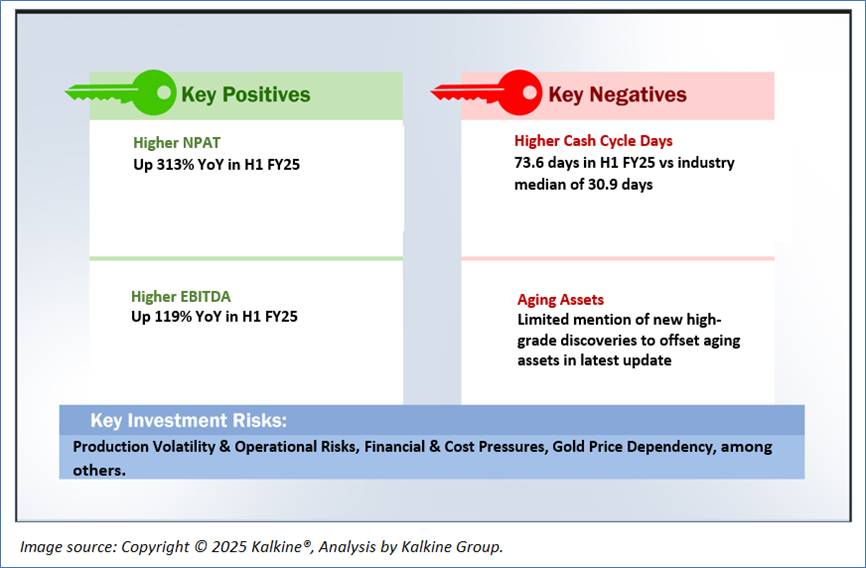
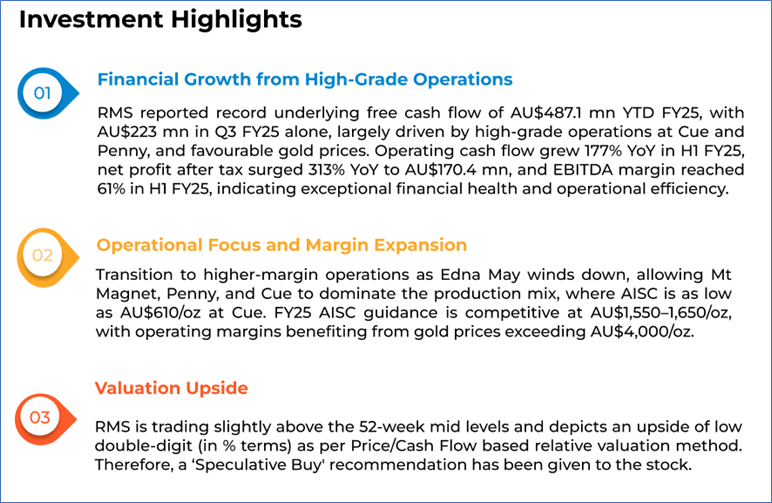
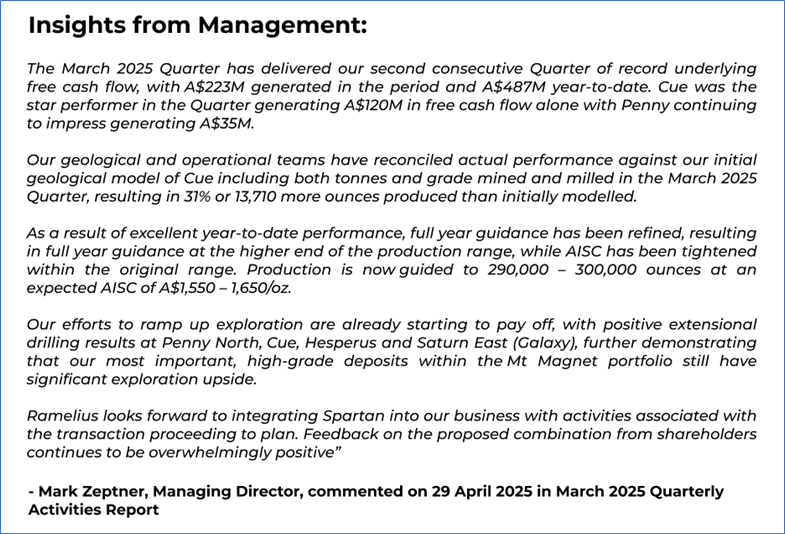
1.2 The Key Positives, Negatives, Investment Highlights, and Management Insights
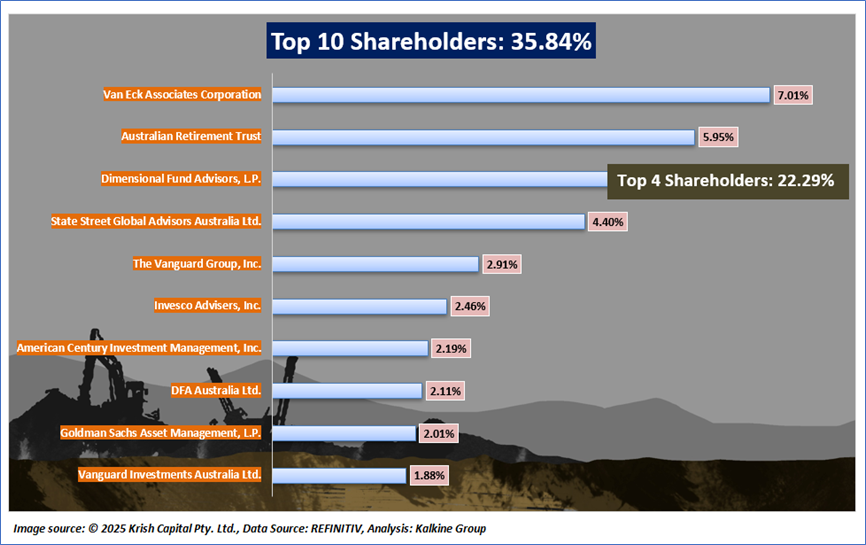
1.3 Top 10 Shareholders:
The top 10 shareholders together form 35.84% of the total shareholding. Van Eck Associates Corporation and Australian Retirement Trust hold maximum stakes in the company at 7.01% and 5.95%, respectively.
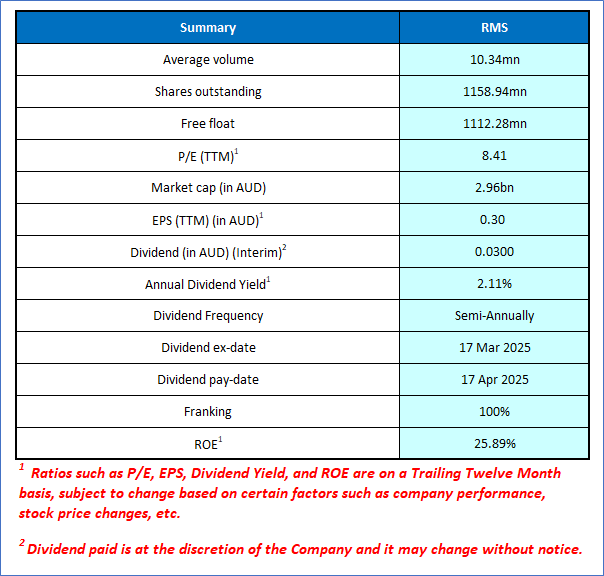
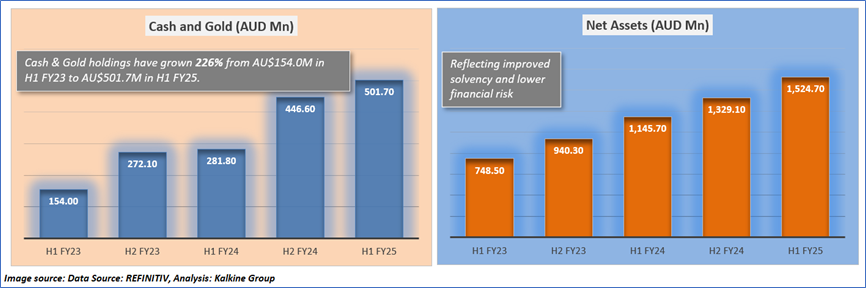
1.4 Key Metrics: During H1 FY25, RMS demonstrated balance sheet strength with net assets reached AU$1.52 billion in H1 FY25—more than double since H1 FY23. Cash & gold reserves have grown steadily to AU$501.7 million, supported by AU$1.0 billion in liquidity, including undrawn facilities and listed investments. Despite a reduction in the hedge book, working capital remained healthy at AU$410.4 million, even after accounting for a significant income tax payable. This reflects earnings retention, and prudent capital management. Below are captured some key metrics:
Section 2: Business Updates, Financial and Operational Highlights
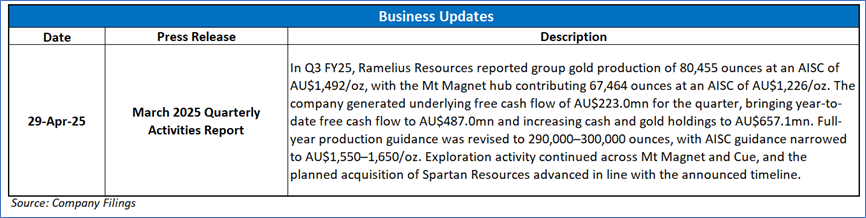
2.1 Recent Business Updates:
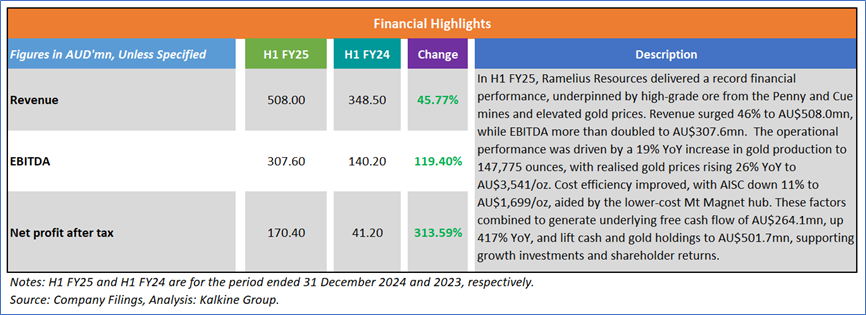
2.2 Financial Highlights: Below mentioned are some key financial highlights:
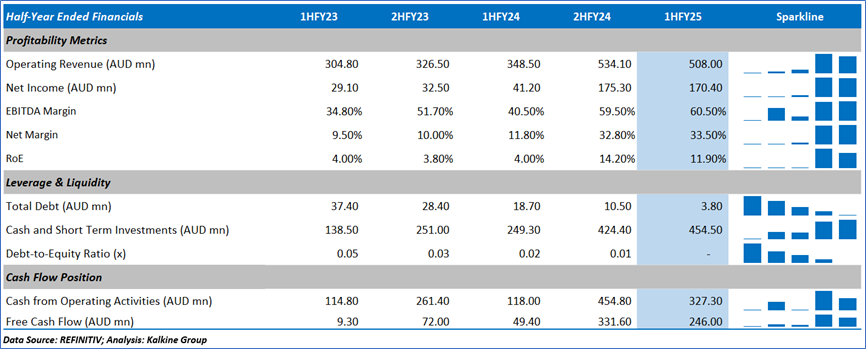
2.3 Historical Financial Trend
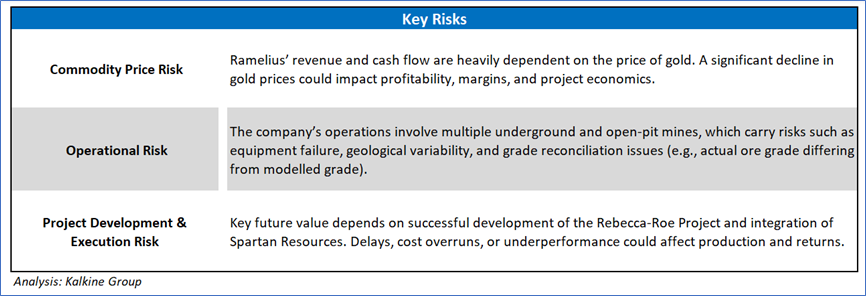
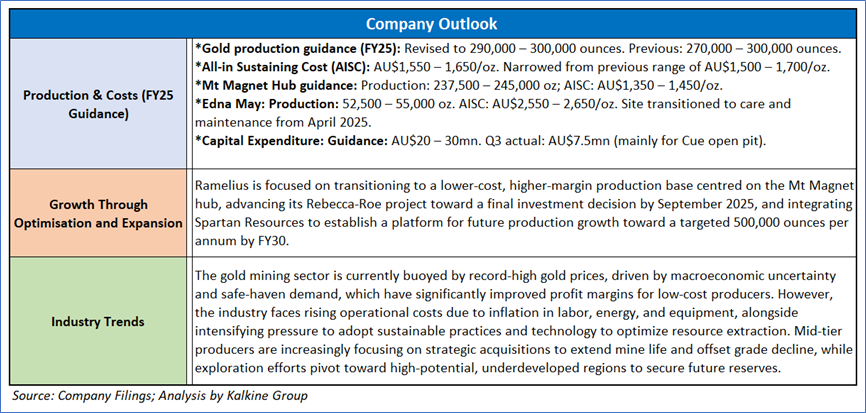
Section 3: Key Risks and Outlook:
Section 4: Stock Recommendation Summary
4.1 Price Performance and Technical Summary
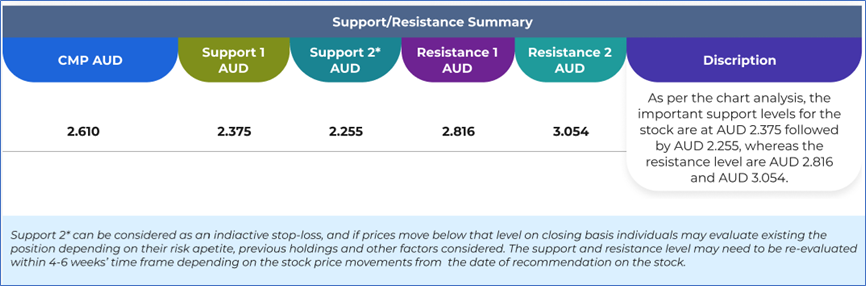
The stock price has gained around 10.13% in the last 1 month, whereas over the last 6 months, the stock price has increased around 9.21%. The stock has a 52-week low and 52-week high of AUD 1.785 and AUD 2.960, respectively, and is currently trading slightly above the 52-week mid-level.
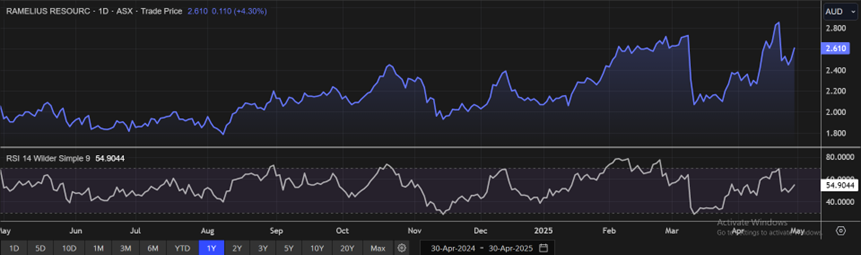
(Source: REFINITIV; Analysis by Kalkine Group)
4.2 Fundamental Valuation
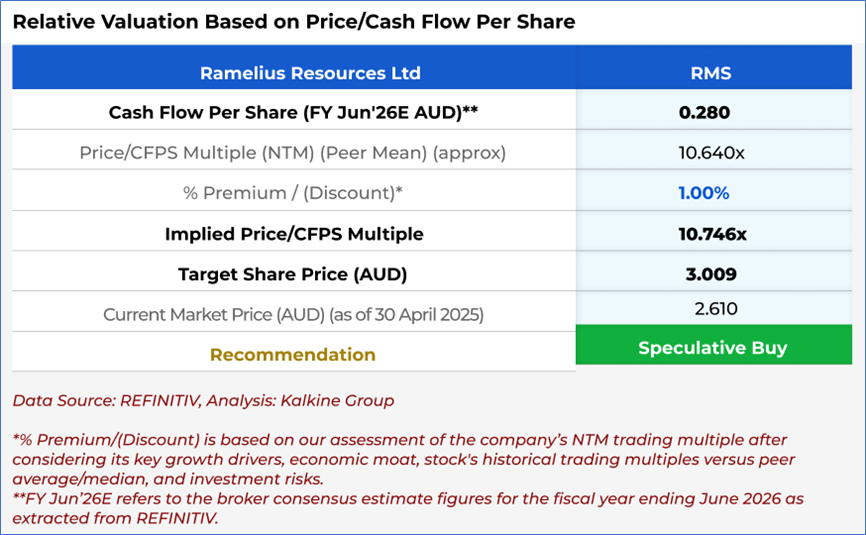
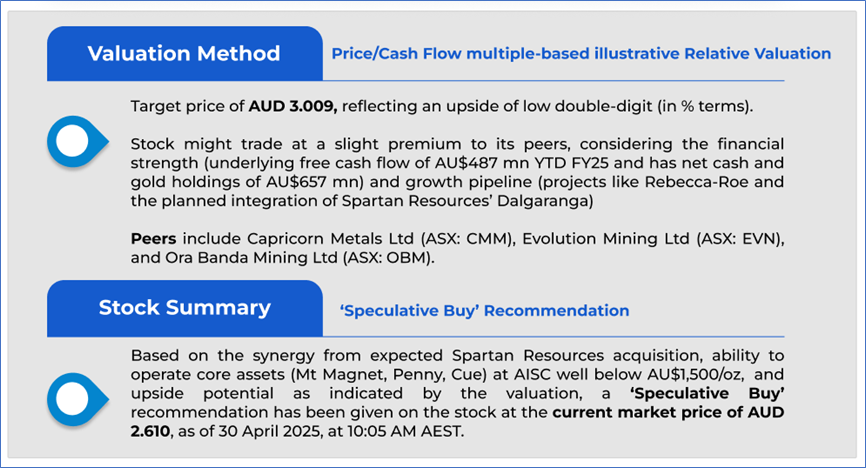
Valuation Methodology: Price/Cash Flow Multiple Based Relative Valuation (Illustrative)
Markets are trading in a highly volatile zone currently due to certain macro-economic issues and geopolitical tensions prevailing. Therefore, it is prudent to follow a cautious approach while investing.
Note 1: Past performance is neither an indicator nor a guarantee of future performance.
Note 2: The reference date for all price data, currency, technical indicators, support, and resistance levels is 30 April 2025. The reference data in this report has been partly sourced from REFINITIV.
Note 3: Investment decisions should be made depending on an individual's appetite for upside potential, risks, holding duration, and any previous holdings. An 'Exit' from the stock can be considered if the Target Price mentioned as per the Valuation and or the technical levels provided has been achieved and is subject to the factors discussed above.
Note 4: Dividend Yield may vary as per the stock price movement.
Note 5: Kalkine reports are prepared based on the stock prices captured either from REFINITIV or Trading View. Typically, REFINITIV or Trading View may reflect stock prices with a delay which could be a lag of 25-30 minutes. There can be no assurance that future results or events will be consistent with the information provided in the report. The information is subject to change without any prior notice.
Technical Indicators Defined: -
Support: A level at which the stock prices tend to find support if they are falling, and a downtrend may take a pause backed by demand or buying interest. Support 1 refers to the nearby support level for the stock and if the price breaches the level, then Support 2 may act as the crucial support level for the stock.
Resistance: A level at which the stock prices tend to find resistance when they are rising, and an uptrend may take a pause due to profit booking or selling interest. Resistance 1 refers to the nearby resistance level for the stock and if the price surpasses the level, then Resistance 2 may act as the crucial resistance level for the stock.
Stop-loss: It is a level to protect further losses in case of unfavourable movement in the stock prices.
Disclaimer This report has been issued by Kalkine New Zealand Limited (FSP691351) (NZBN:9429047678101) (“Kalkine”). Kalkine is a Financial Advice Provider (“FAP”) and is authorised by a Class 1 Financial Advice Provider Licence issued by Financial Markets Authority (“FMA”) to provide financial advice. Kalkine provides only general financial advice through its research reports following a person becoming a member. The reports contain buy/sell/hold and other recommendations in relation to equity securities, managed funds and other managed investment schemes and other financial advice products. The recommendations and opinions in this report and on Kalkine website do not take into account any of your investment objectives, financial situation or needs. Before you make a decision about whether to acquire a financial product, you should obtain the Product Disclosure Statement from the product issuer. You should consider the appropriateness of advice taking into account your own objectives, financial situation and needs and seek independent financial advice before making any financial decisions. If you act on the advice in the research reports, you may have to pay fees, expenses or other amounts (but not to Kalkine). Further information about the complaints and dispute resolution process, as well as information about Kalkine’s duties are available on Kalkine’s website. Please read our Financial Advice Provider (FAP) disclosure statement and Complaints Handling Guide, which are available on the website.
Past performance is not a reliable indicator of future performance.
 Please wait processing your request...