
 AU
AU
 UK
UK
 CA
CA
 US
US
 IND
IND

 NZ
NZ

Primary Industries in New Zealand are mainly classified as Dairy, Meat and Wool, Forestry, Horticulture, Seafood, Arable and other such sectors. In general, primary sector operates throughout the entire value chain from the paddock, orchard, forest or ocean, through to processing, packaging, and transportation system, all the way to market, and ultimately to the consumers throughout the globe. The economic impact of the sector is huge. Product diversification and innovation have helped the dairy industry to grow over time. Horticulture production with major crops including wine, grapes, kiwi, potatoes, and apples caters to local needs as well as growing global population. Exports of logs and wood products create another major source of export revenue.
As per New Zealand Environment Guide, agriculture has been the major industry in New Zealand as seen over the many years, and looking back in time, total agricultural exports reached more than $28 billion as at June 30, 2016. This included more than $759 million of raw wool, $6.77 billion from meat, $12.1 billion from dairy, $812 million of other animal products and livestock exports amounting to $242 million. Total primary industry exports including forestry, horticulture and others stood at more than $34.78 billion. Each of the industries mentioned are crucial to the economic and social fabric of rural communities, districts, and regions as well as to the broader NZ. Export revenue of primary sector is expected to reach $46.5 billion for the year ending June 2020, up 0.5% from the previous year. For 2021, the ministry expects an increase of 2.4% in export revenue to $47.6 billion as global demand is expected to recover from the effects of COVID-19 by FY 2021.
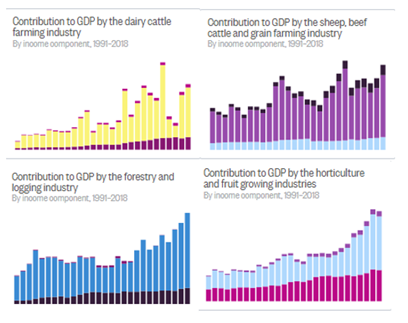
Select Sectors’ Contribution to GDP (Source: Stats NZ)
A Look at Top Export Destinations
As per the report by Ministry for Primary Industries in October 2017, in 2016, food and primary sector made up 10.6% of NZ’s Gross Domestic Product (or GDP). More than 80% of the food produced by New Zealand was exported, and 78% of the merchandise exports (54% of total exports) were generated by the sector.
The food and primary sector is integral to the country’s trading and diplomatic relationships, exporting to over 205 countries and territories. It happens to be an important contributor to NZ’s international reputation, attracting tourists as well as investment.
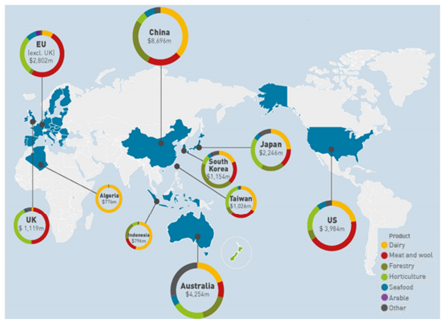
Top Export Destinations (Source: Ministry for Primary Industries)
Since the broader NZ economy primarily relies on the exports from the agriculture sector, we will now focus on some of the government measures.
The government has recently stepped up investment in the drought-hit communities throughout the North Island with the major new drought relief package. This relief package consists:
The package would be focusing on solving immediate needs, that cannot otherwise be resolved with the help of existing sources and suppliers and ensuring adequate water supply to the North Island communities.
Recently, the government and primary sector have joined forces and they are taking action in order to fix skills gap facing farmers as well as growers. There are expectations that primary sector would be requiring another 50,000 workers by 2025 and over 92,000 more workers with the qualifications. It can be said that this step has been adopted because primary sector happens to be the engine for the economy to run. This sort of collaboration between the industry and government is very important to dodge the long-term challenge of skill shortages.
In response to confirmed and probable cases of COVID-19, the authorities in New Zealand declared a state of emergency on March 25, 2020 and implemented strong containment measures including closures of all non-essential businesses, cancellation of all events and gatherings, closures of schools & colleges and cancellation of discretionary domestic air travel. Amidst all this, MPI, Ministry of Foreign Affairs and Trade (or MFAT) and New Zealand Trade & Enterprise (or NZTE) have been carefully monitoring how COVID-19 is affecting the primary industries. The government has rolled-out wage subsidy and leave payment scheme. To help the farmers, COVID-19 Wage Subsidy would be paid at the flat rate of:
Ministry for Primary Industries is focused towards the success of primary industries so that people of New Zealand can be benefitted. It can be said that primary industries are integral to the growth of New Zealand as the country relies on exports. Through the work, Ministry for Primary Industries focuses on:
Importance of Technology in Strengthening Agriculture in New Zealand
Technology has been playing a critical role in almost every industry and most of the sectors are adopting technology in order to sustain market competitiveness and maintain a decent market share. While Healthcare sector has been rigorously resorting to technology needs every now and then, the consumer staples sector has also joined the race.
As New Zealanders know, it has been around 2 years since Agritech New Zealand launched in the month of May 2018. Agritech focuses on its mission which is to scale NZ agritech ecosystem via advocacy, collaboration, innovation, and support farmers and growers to adopt agritech in order to increase productivity, profitability and sustainability. Moving forward, Agritech is expected to focus towards:
Understanding the Importance of Dairy Sector in New Zealand
The dairy companies in New Zealand are trusted suppliers of the full range of dairy products, including fresh milk, milk powder, high-value dairy nutritional products, specialised dairy ingredients for food service as well as infant formulas. Over 2015/16 year, dairy companies processed 20.9 billion litres of milk containing 1.86 billion kilograms of milk solids.
NZ’s organic dairy sector is growing, and dairy is one of the country’s major organic exports. For the year to June 2020, the Ministry expects dairy exports to rise 6.3% to $19.2 billion on the back of strong production and rising prices. Despite short term impacts of COVID-19 on the commodity prices, over the medium term, constraints with respect to global supply might maintain export price strength. This could lead to a 0.5% forecast growth in export revenues to $19.3 billion in 2021.
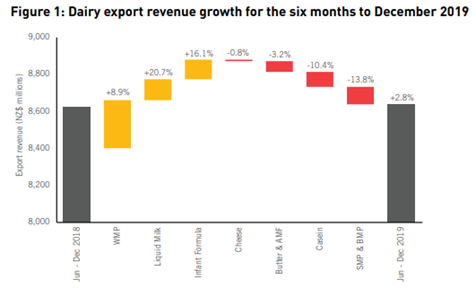
Dairy Export Revenue Growth (Source: Ministry for Primary Industries)
Since we have talked about the broader agricultural sector and the sub-sector (Dairy), we will now focus on consumer staples sector.
All Eyes on Consumer Staples Industry Amidst Uncertainty
As on April 23, 2020, S&P/NZX All Consumer Staples (Sector) has a market capitalisation of ~$19.94 billion and it looks like the composition is being dominated by the dairy companies as The a2 Milk Company (NZX: ATM) and Synlait Milk Limited (NZX: SML) have a market capitalisation of ~$14.43 billion and ~$1.27 billion, respectively. While gradual improvement in macro-economic scenario would act as a growth driver, companies in consumer staples sector also need to work towards strengthening their business structure in order to remain competitive. The below mentioned four factors should help the sector sustain its recent momentum:
Since agriculture is very crucial for the NZ economy, now is the time to understand some government measures which have been adopted to support this sector.
Projections of Primary Sector: A Quick Look
The COVID-19 outbreak has been severely impacting several industries and sectors, as a result of which, the outlook seems to be uncertain. However, once the situation subsides, some sort of recovery in the global economy is expected which could help broader sectors and industries. The following projections include the data published as per the report which was last reviewed by Ministry of New Zealand on March 12, 2020:
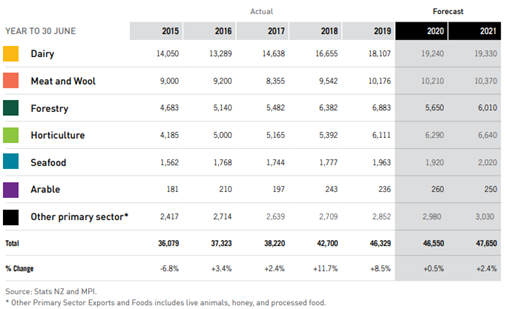
Forecasts* (Source: Ministry for Primary Industries)
Note: The above forecasts are subject to change as the extent of the impact of COVID-19 and other macro-economic pressures is still uncertain.
S&P/NZX50 vs S&P/NZX All Consumer Staples Sector: A Comparison
Consumer staples’ space, with perceived defensiveness, offers best investment destination. Many companies dealing in consumer staples supply essential goods to customers and are, therefore, less vulnerable to or sensitive to the changes in the economic cycles. The sector is also likely to get some boost from recovery in the economy and the positive impact of lower fuel costs on household disposable income. The below image provides a broader overview of how S&P/NZX All Consumer Staples has outperformed S&P/NZX50 in the span of three months:

S&P/NZX50 vs S&P/NZX All Consumer Staples Sector (Source: Thomson Reuters)
It can be seen that in the past three months, S&P/NZX50 has witnessed a fall of 12.23% while, in the same time span, S&P/NZX All Consumer Staples has increased by 15.91%, outperforming the broader market by a wide margin. S&P/NZX50 has a market capitalisation of $107.32 billion out of which S&P/NZX All Consumer Staples makes up $17.36 billion i.e. ~16.17%.
Let’s look at 4 stocks of primary industries (CVT, SML, PGW, SEK)
1. NZX: CVT (Comvita Limited) (Recommendation: Buy, Potential Upside: lower double-digit)
Business Description: Comvita Limited (NZX: CVT) is a global natural health company dedicated to the development of innovative products, supported by ongoing investment in scientific research.
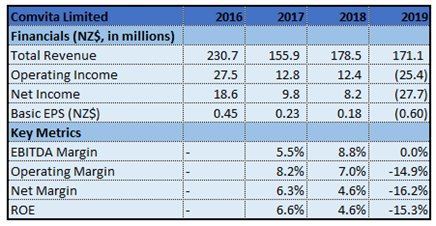
Key Metrics (Source: Thomson Reuters)
Outlook: The company experienced strong demand in mid-March which has continued throughout March and resulted in a strong quarter delivering double-digit growth year on year, with all major markets reporting good sales output. The company is profitable in each month and has generated good cashflows and working capital improvements that have enabled the company to continue to reduce debt.
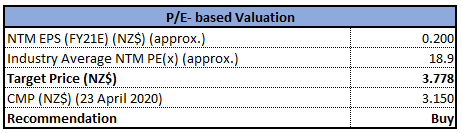
P/E Based Relative Valuation (Source: Thomson Reuters)
Valuation: The company reflected favorable views on good trading throughout all the markets as consumers are actively seeking out the company’s products. Additionally, it has delivered good working capital control, enabling it to continue paying down debt, supporting the decision to postpone planned capital raise. Coming to the valuations, we have applied P/E based illustrative relative valuation approach and the target price reflects that the stock price might witness a rise of lower double-digit (in % terms).
2. NZX: SML (Synlait Milk Limited) (Recommendation: Buy, Potential Upside: higher single-digit)
Business Description: Synlait Milk Limited (NZX: SML) is a dairy manufacturer focused on supplying higher value dairy products to leading milk-based health and nutrition companies.
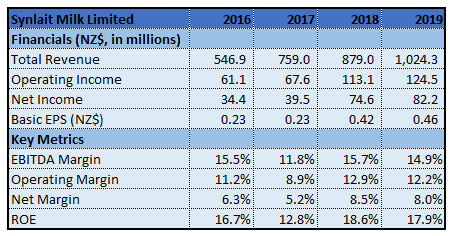
Key Metrics (Source: Thomson Reuters)
Outlook: The FY20 EBITDA is expected to be stronger than FY19 due to higher sales of consumer-packaged infant formula and lactoferrin offset by increased operational costs. Synlait has a strong and growing core business which has put in the position of being able to invest for the future. The Overseas Investment Office has given permission to the company to acquire Dairyworks Limited. Dairyworks specializes in the packaging, marketing, and processing of dairy goods.
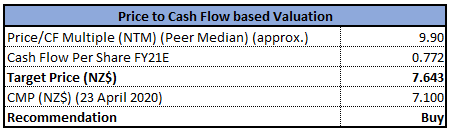
P/CF Based Relative Valuation (Source: Thomson Reuters)
Valuation: The acquisition of Dairyworks is likely to support SML as it accelerates SML’s diversification strategy achieving instant scale in Everyday Dairy category. Dairyworks possesses a strong market presence in cheese, retail butter and grocery channels, which reduces Synlait’s site, customer, product and market risks. Moreover, the acquisition happens to be financially attractive and immediately EPS accretive. We have applied P/CF based illustrative relative valuation model and arrived and the target price of high single-digit upside (in % terms).
3. NZX: PGW (PGG Wrightson Limited) (Recommendation: Hold (Subject to certain factors)), Potential Upside: lower double-digit)
Business Description: PGG Wrightson Limited (NZX: PGW) offers a wide range of products and services that allows it to be one of the key suppliers to the agricultural sector in New Zealand.
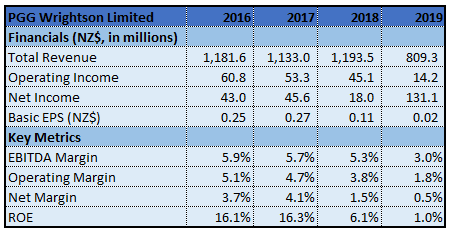
Key Metrics (Source: Thomson Reuters)
Outlook: Earlier, the company gave operating EBITDA guidance of about $30 million for the financial year to 30 June 2020, while noting the potential for volatility to earnings due to impacts of the COVID-19 virus on agricultural trade flows. However, as the potential impact of the pandemic is still not clear, the company has withdrawn its guidance. The services that PGW delivers to the New Zealand rural sector are considered an “essential service” as part of the food production supply chain provided that these services can be delivered in a manner that appropriately minimises risks associated with the spread of the COVID-19 virus.
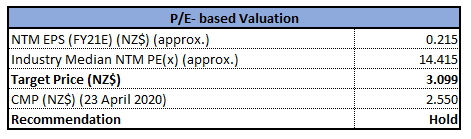
P/E Based Relative Valuation (Source: Thomson Reuters)
Valuation: During the lockdown, the company will continue to operate its network of Rural Supplies and Fruitfed Supplies stores and essential warehouse supplies facility, Agritrade and other supporting functions. Coming to the valuations, we have applied P/E based illustrative relative valuation model and there are expectations that the stock might witness a rise of lower double-digit (in % terms). The Board has withdrawn the current guidance and is assessing the impact of COVID-19 on the earnings. Therefore, we advise the investors to "Hold" this stock, in view of the above and the current trading levels.
4. NZX: SEK (Seeka Limited) (Recommendation: Hold (Subject to certain factors)), Potential Upside: lower double-digit)
Business Description: Seeka Limited (NZX: SEK) happens to be integrated horticulture and produce company which is in the business of growing, processing, distributing, and marketing high quality produce to the world markets.
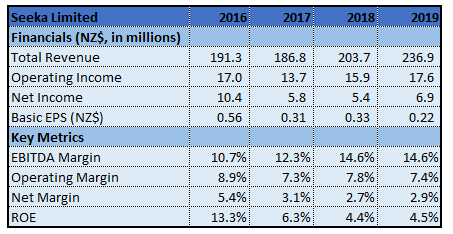
Key Metrics (Source: Thomson Reuters)
Outlook: The company has been classified as an essential business for its fruit production, processing and wholesale market operations and is registering under the Ministry of Primary Industries scheme. It is adhering to the proper and stringent distancing and hygiene protocols put in place by the Government to contain Covid-19 and required to keep its people safe. It is also continuing the harvest of fruit in New Zealand and Australia. The company is expecting improved earnings in FY20 depending on New Zealand and Australian crop volumes. The company has an increasing volume of Zespri SunGold with both new growers and new developments, along with a significantly improved SeekaFresh business and increasing avocado volumes.
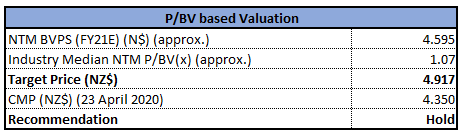
P/BV Based Valuation (Source: Thomson Reuters)
Valuation: The company continues to consolidate the acquired businesses and complete Northland orchard sales and is investigating the potential sale and leaseback of the Group’s Australian kiwifruit orchards. Seeka is anticipating earnings growth, noting market uncertainty from the current coronavirus outbreak. With respect to valuations, we have applied P/BV based illustrative relative valuation model and the target price suggests a growth of lower double-digit (in % terms). The company has reviewed the current environment and, because of the uncertainty of Covid-19, it decided to defer the payment of declared dividend of $0.12 per share. This would be reconsidered at the meeting in June. Therefore, we advise the investors to "Hold" this stock, in view of the above and the current trading levels.
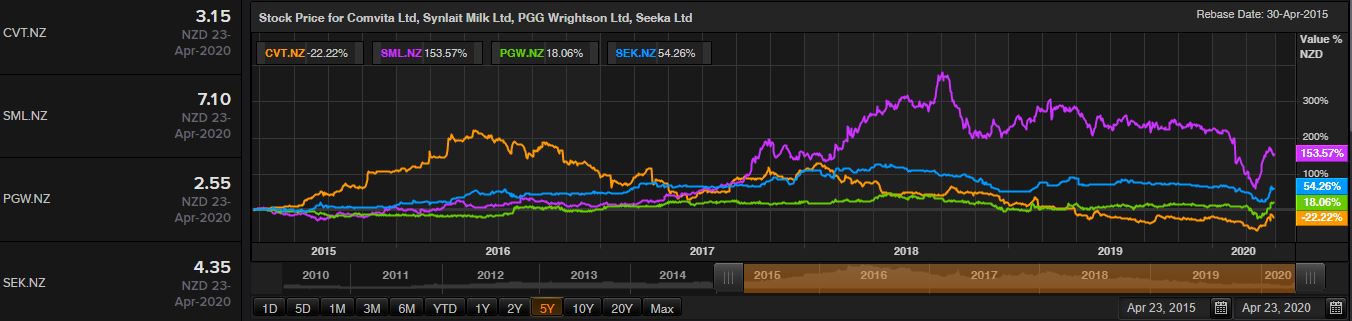
Comparative Price Chart (Source: Thomson Reuters)
Disclaimer
Kalkine New Zealand Limited is authorised to provide class advice only. The information on this site does not take into account any of your investment objectives, financial situation or needs. Before you make a decision about whether to acquire a financial product, you should obtain the Product Disclosure Statement from the product issuer. You should consider the appropriateness of advice taking into account your own objectives, financial situation and needs and seek independent financial advice before making any financial decisions.
Past performance is not a reliable indicator of future performance.
 Please wait processing your request...