
 AU
AU
 UK
UK
 CA
CA
 US
US
 IND
IND

 NZ
NZ

.png)
Exhibit 1: S&P/NZX All Information Technology (Sector) vs S&P/NZX All Index (YTD)*
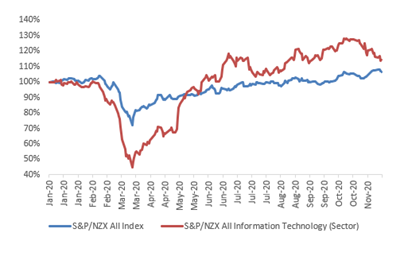
Source: S&P Dow Jones Indices, *till November 19, 2020.
As evidenced by the above chart, S&P/NZX All Information Technology sector has outperformed S&P/NZX All Index by ~7.6%. It can be said that the outperformance was on the back of increased adoption of digital tools amidst COVID-19 pandemic.
NZ Technology Sector Landscape
The rapidly evolving technology sector plays a critical part in shaping the economy. New Zealand has a history of innovation and embracing of new technologies.
The technology sector makes a significant contribution to the country’s economy, creating employment, contributing towards growth in GDP, and exports. The sector is the third-largest revenue generator and contributes about $16.2 billion to GDP and about $6.3 billion in exports. Key contributions from the sector include:
Digital Technologies: Transforming the Industry
Digital technologies play a very important role in transforming lives. It has created several opportunities in various areas like precision e-education, healthcare, and autonomous vehicles. The government has also set strategic priorities for changing New Zealand into a digitalized nation. The rapid rise in Artificial Intelligence (AI) technologies offers major opportunities in agriculture, government, manufacturing, and services industries. Further, The Internet of Things (IoT) creates a progressive future for New Zealand by connecting data, devices, and people to seize opportunities for economic growth.
Exhibit 2: Broad Overview of NZ Tech Sector (FY 2019)
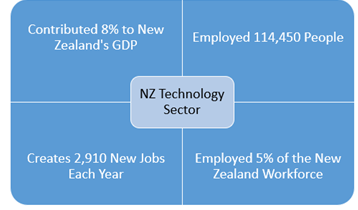
(Source: NZTech, Kalkine Group)
Digital Tools: Great Enabler to SMEs in COVID World
During New Zealand’s COVID-19 Alert Level 3 and 4 lockdown, digital technologies were a critical enabler for society and businesses. With attention now shifting towards economic recovery and future growth, the digital technologies sector is prepared to perform an increasingly important role. Tourism Minister Kelvin Davis and Small Business Minister Stuart Nash have announced a $20 million digital capability funding to support small businesses especially the tourism sector, to adapt and innovate in a COVID world.
The $20 million package includes: -
Under the package, Qualmark will provide a series of workshops and one-on-one advice. Key areas are strategic digital marketing, Search Engine Optimisation (SEO), organic growth, website performance and online booking system audits, online advertising and paid media, social media content and creation, conversion optimisation, lead generation and measuring success.
Big businesses like supermarkets, banks, professional and corporate service providers, and manufacturers have transformed, but small and medium enterprises are at risk of lagging behind. The wider use of digital commerce by SMEs will help them adapt and innovate in order to thrive in the COVID economy.
On Track to Emerge as the Largest Export Sector
According to the Ministry of Business, Innovation and Employment (MBIE), the technology industry in the country is on track to become the biggest export industry, worth about $16 billion by 2030. Some of the top technology exports:
Fintech: Fintech companies enable people to have greater control over their finances. As per MBIE 2019 tech industry data, the top 200 export companies of the country experienced an increase of $705 million in revenue over five years.
Healthtech: As per a report from Technology Investment Network (TIN), healthtech companies generated $1.9 billion in revenue in the previous year.
IT: MBIE data reveals that between April 2019 and May 2020, IT services exports exceeded $4 billion with key markets in the USA, Australia, and Europe. Working from Home (WFH) necessitated with the outbreak of the COVID-19 pandemic has propelled businesses to embrace cloud computing. Most of the companies have responded quickly to move everything on the cloud so as their workforce can work remotely.
Agritech: Agriculture assumes a significant role in New Zealand’s economy. But it is not automated to the extent it should have been. According to TIN Agritech Insight 2020 report, top 20 agritech companies of the country spent $97.3 million on R & D in the previous year.
Gaming: The gaming industry has become another popular sector for technology export. With new games popping up so often, it is becoming difficult to keep track. According to NZ Game Developers Industry Survey, the industry earned $203.4 million during the FY19.
Key Challenges
The technology sector has proven its resilience and is continuing to create growth in employment and exports for New Zealand. During the lockdown period, the main problem technology companies faced was access to customers and corresponding concerns regarding cash flow. For start-up businesses, the main concern was access to funding. As consumers moved to remote working, IT service providers witnessed continued workflow, however, there was a worrying freeze on major projects and forward planning.
Exhibit 3: Challenges Faced by Technology Sector During COVID-19
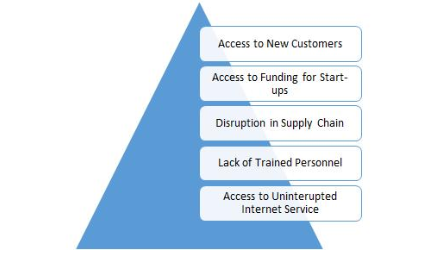
(Source: Kalkine Group)
In other parts of the technology sector, like the fast growing digital and software as a service (SaaS) firms only experienced minimal impact. There was some slowdown in sales reported, but a little reduction was witnessed in the overall business. Across the sector, further hiring of employees was stopped, with 15 percent of firms reduced their staff during April and May due to COVID-19.
Many technology firms that were in a growth phase also experienced slow down due to reduced access to capital. Exporting firms, both hi-tech manufacturers and digital have also faced challenges due to travel constraints and manufacturers are suffering from supply chain challenges. Almost all the digital technologies supporting deeper digital transformation need untethered real-time transmission of data and the deployment of 5G is a key tool.
The country’s resilient technology, creative and digital sectors are not only surviving the global economic downturn well, but they are also presenting a promising outlook on the economy. It is a future that blends primary production and knowledge creation to deliver a more prosperous future for all New Zealanders.
Outlook
New Zealand ranks first in the world when it comes to ease of doing business and the country is also having strong technology ecosystem. As a result, the high growth technology companies thrive on the potential sector opportunities. Several global industry leaders prefer New Zealand to base their operations.
These global industry leaders should be provided with enabling business environment in terms of business-friendly policies which will in turn, encourage them to invest more in technology sectors.
Apart from the sector-specific factors, we have also analyzed four NZX-listed companies operating in the technology sector. This report covers their insights, outlook, performance and potential as expected to be delivered in the near to medium term.
(1) Plexure Group Limited (NZX: PLX) (Recommendation: Buy, Potential Upside: Low Double-Digit), (M-Cap: ~NZ$198.144 Million)
About the Company
Business Description: Plexure Group Limited happens to be a mobile engagement software company. The company’s software integrates with operational systems in order to remove friction as well as create seamless purchase experience for the consumers.
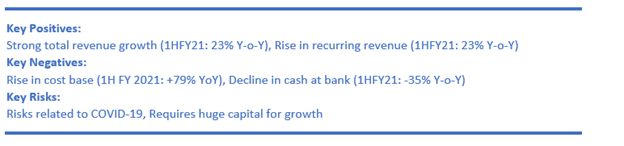
Outlook: The company’s goal still remains to be a world leader in the delivery of highly personalised mobile engagement experiences that drive sales for global brands by increasing customer numbers and visitor frequency, increasing average transaction values, increasing share of wallet and improving customer satisfaction scores. For FY21, the company is expecting revenue of $29.1 million, an increase of 14% on FY20 revenues.
Technical Overview:
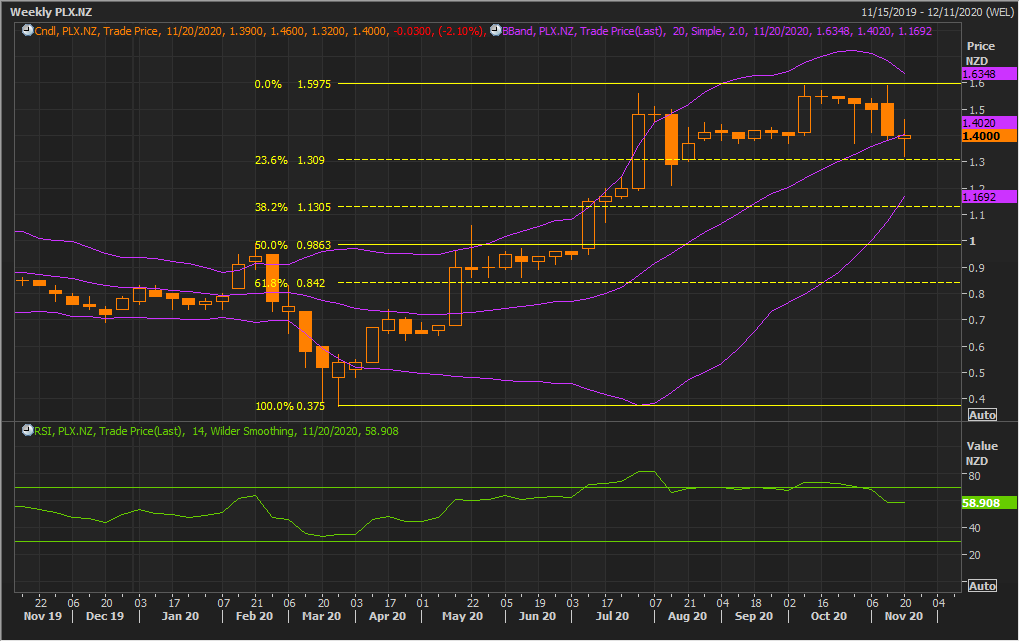
Weekly Chart –
Source: Refinitiv (Thomson Reuters)
Note: Purple colour lines are Bollinger Bands® with the upper band suggesting overbought status while the lower band oversold status, and yellow lines are Fibonacci retracement lines which measure price rebound and backtrack. https://www.bollingerbands.com/
The stock while remaining on an underlying uptrend, took minor correction to the 23.6% retracement level of $1.30 and has rebounded from there closing at $$1.40. The chart pattern suggests a near-term bullish reversal for the stock. The technical indicator RSI with a reading around 51 suggests bullish momentum for the stock.
Going forward, the stock may have resistance around the previous high of $1.60 whereas support could be around the 23.6% retracement level of $1.30.
Hence, considering the strong revenue growth, rise in recurring revenue and decent outlook, we give a “Buy” recommendation on the stock at the current price of NZ$1.400 per share, down by 2.10% on November 19, 2020.
(2) PaySauce Limited (NZX: PYS) (Recommendation: Speculative Buy, Potential Upside: Low Double-Digit), (M-Cap: ~NZ$47.747 Million)
About the Company
Business Description: PaySauce Limited is a SaaS employment solutions provider which allows business owners to pay and manage employees accurately and efficiently with the help of iOS, web, and Android applications.
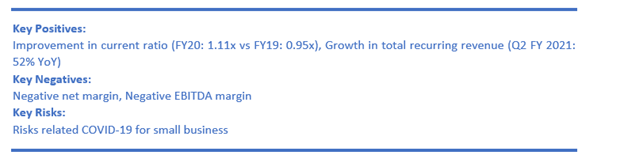
The company delivered strong growth in 2QFY21, with total recurring revenue rising by 52% Y-o-Y to $519K. The company has also reported high performance in customer satisfaction and loyalty, with a Net Promoter Score of 76.
The company added more than 261 new clients in 2QFY21, up by 9% in the total customer base since June 30th, and the majority was organic growth.
Outlook
The company remains focused on its core partnerships and maintaining robust financial position with the help of savvy decision making as well as careful strategic planning. It will continue to keep a close eye on the long-term ramifications of the pandemic for small business.
Technical Overview:
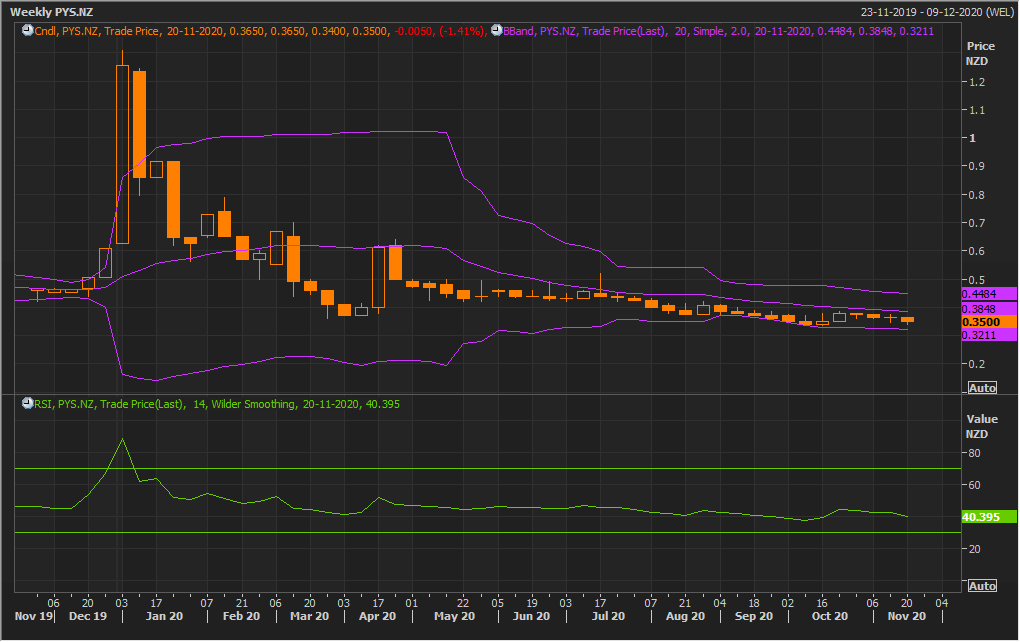
Weekly Chart –
Source: Refinitiv (Thomson Reuters)
Note: Purple colour lines are Bollinger Bands with the upper band suggesting overbought status.
The stock has been in a sideways trend with 20 periods SMA of $0.38 providing the upper limit and the lower Bollinger band of $0.32 providing the lower limit. The technical indicator RSI with around 40 reading and a curve at the end pointing down, suggest neutral to weak momentum for the stock.
Going forward, the stock may have resistance around $0.45 provided the level of $0.38 is decisively broken. However, on price retreating, the lower Bollinger band of $0.32 will continue to provide good support to the stock.
Hence, considering the improvement in current ratio and technical analysis, we give a “Speculative Buy” recommendation on the stock at the current price of NZ$0.350 per share, down by 1.41% on November 19, 2020.
(3) Gentrack Group Limited (NZX: GTK) (Recommendation: Hold, Potential Upside: Low Double-Digit), (M-Cap: ~NZ$141.062 Million, Gross Dividend Yield: 2.914%)
About the Company
Business Description: Gentrack Group Limited provides essential software for essential services, pairing powerful platforms with deep market knowledge to help utilities and airports lower service costs, foster innovation and confidently navigate market reform.
Outlook
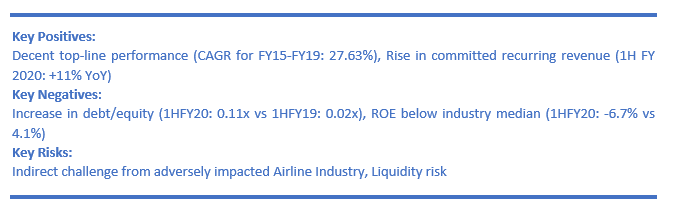
The company stated that cash generation in 2H is expected to be positive. Profitability in 2HFY20 has been driven by reduced costs partly as a result of the reduction in workforce programme in February/March 2020, and other cost reductions from further employee attrition and COVID-19 related cost savings.
Valuation Methodology: EV/Sales Multiple Based Relative Valuation (Illustrative)
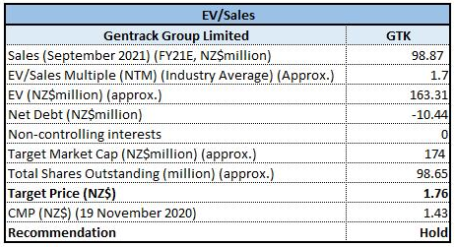
We have applied EV/Sales based relative valuation (on an illustrative basis) and the target price reflects a rise of low double-digit (in % terms).
(4) Rakon Limited (NZX: RAK) (Recommendation: Hold, Potential Upside: Low Double-Digit), (M-Cap: ~NZ$88.186 Million)
About the Company
Business Description: Rakon Limited designs and manufactures advanced frequency control and timing solutions. Its three core markets are Global Positioning, Telecommunications and Space and Defence.
Outlook
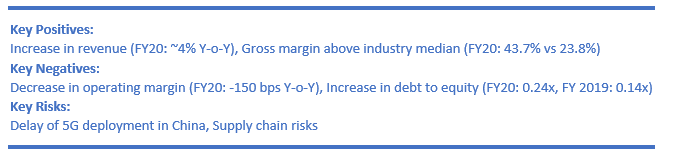
For the six months ended 30 September 2020, the company reported net profit after tax of $4.6 million, up by 246% Y-o-Y and underlying EBITDA stood at $11.4 million, up by 64% Y-o-Y. The company also stated that full-year guidance of $16 million – $18 million in underlying EBITDA is valid. Also, net debt improved by $5.1 million to $2.8 million over the span of 6-month period. This was because of robust operating cash flows as well as lower capital expenditure. Notably, the Directors of the company have confirmed that HY 2021 results are based on unaudited results.
Technical Overview:
Weekly Chart –
Source: Refinitiv (Thomson Reuters)
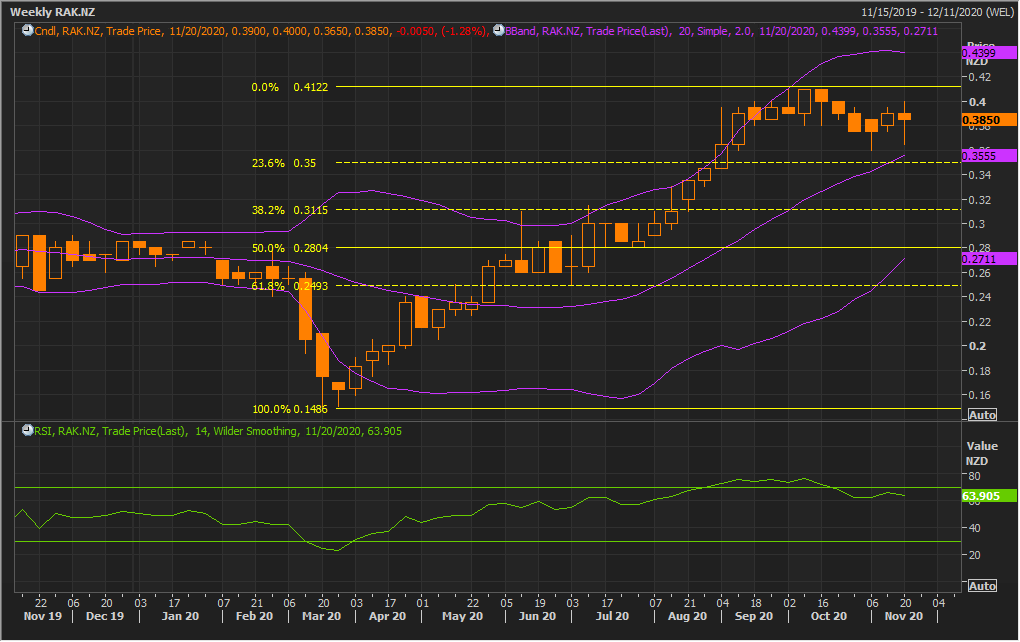
Note: Purple colour lines are Bollinger Bands with the upper band suggesting overbought status while the lower band oversold status, and yellow lines are Fibonacci retracement lines which measure price rebound and backtrack.
The stock has been very volatile during the ongoing week wherein it has given comparatively lower closing than the previous week. The long lower shadow though suggests near-term bearish reversal but the manner in which the stock has been holding itself on an underlying uptrend, suggests that there is good room for further upside for the stock. Technical indicator RSI with around 64 reading suggests strong bullish momentum for the stock.
Going forward, the stock may have resistance around the upper Bollinger band of $0.43 whereas support could be around 20 periods SMA of $0.35.
Hence, considering the decent gross margin and technical analysis, we give a “Hold” recommendation on the stock at the current price of NZ$0.385 per share, down by 1.28% on November 19, 2020.
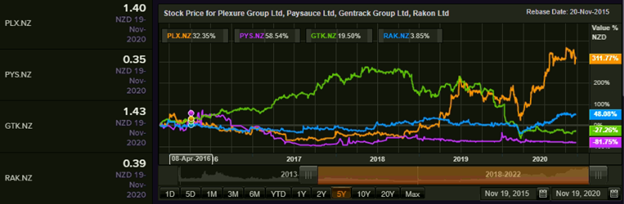
Comparative Price Chart (Source: Refinitiv (Thomson Reuters))
Disclaimer
Kalkine New Zealand Limited is authorised to provide class advice only. The information on this site does not take into account any of your investment objectives, financial situation or needs. Before you make a decision about whether to acquire a financial product, you should obtain the Product Disclosure Statement from the product issuer. You should consider the appropriateness of advice taking into account your own objectives, financial situation and needs and seek independent financial advice before making any financial decisions.
Past performance is not a reliable indicator of future performance.
 Please wait processing your request...