
 AU
AU
 UK
UK
 CA
CA
 US
US
 IND
IND

 NZ
NZ

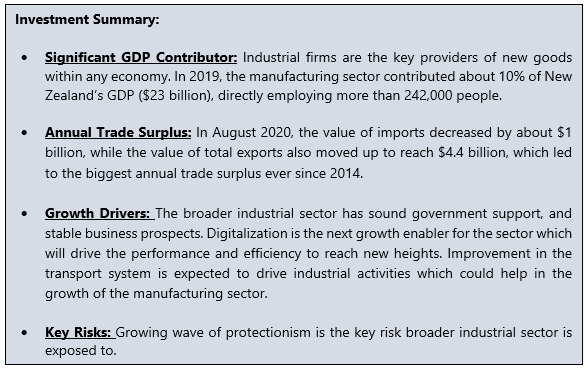
Industrial Sector as Important Contributor to GDP in New Zealand
Industrialization is a must to achieve sustainable economic growth. It unleashes competitive economic forces that enable efficient use of resources, facilitates international trade, and generate employment and income. However, the success of the economy depends on the simultaneous growth of primary sector (agriculture & allied), secondary sector (manufacturing) and tertiary sector (services) as they are inter-dependent. The output of the primary sector does not have direct household demand. Most of them are processed before final consumption or other uses. However, the output of the service sector is sold directly to consumers with exceptions of legal, accounting, banking, electricity, transport, and communications that are sold to primary and secondary sectors.
Manufacturing Plays Key Role in NZ’s Economy
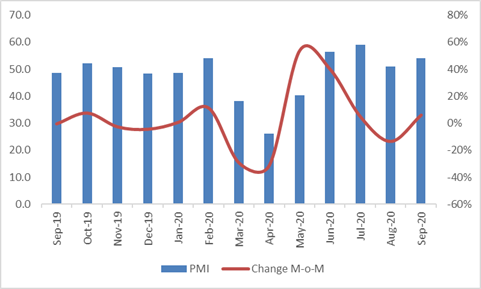
Manufacturing is a key growth sector for the New Zealand economy with various companies comprising those involved in the manufacturing of machinery and equipment, cement, building and construction material, electrical and metal products, automation technology products, and rubber and plastic products.
Figure 1: Seasonally Adjusted PMI
Source: BNZ
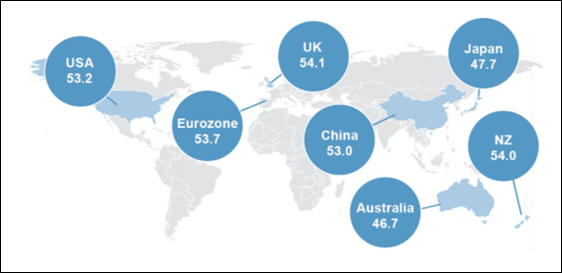
The most recent J.P Morgan Global Manufacturing PMI shows the cautious recovery now visible in several countries after the damage evident in the initial stages of the global lockdown. Notwithstanding, it is important to understand that given the hammering global manufacturing production took over the first and more importantly, the second quarter of 2020, some upswing would be almost inevitable – coming off such a low base.
Figure 2: International Results
Source: J.P. Morgan Global Manufacturing PMITM
Improved Transport System Will Drive Industrial Activities
The logistics sector plays a key role in providing or improving access to different locations for individuals and businesses. Logistics support the movement and flow of many economic transactions and it is an important activity in facilitating the sale of virtually all goods and services.
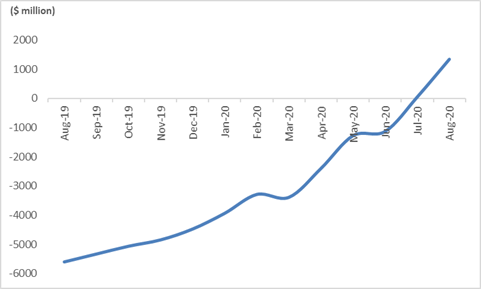
Value of Exports Rises in August
The rise in the value of kiwifruit exports was mainly led from higher prices, strong international demand, and better harvested volumes, mainly of gold kiwifruit.
Wine exports were up by 18 percent or $30 million and dairy products were up by 10 percent or $55 million from the previous year. The biggest rise in total goods exports in August 2020 was witnessed for aircraft and parts, up $205 million.
Figure 3: Trade Balance
Source: Stats NZ
Digitalization Efforts Will Improve Performance and Efficiency
Digitalization in the industrial sector will not only lower the cost of delivering the services, however, it will also enable the firms to develop close long term relationships with the customers that offer a variety of new services. Few digital transformation initiatives disrupting the industry include customization of products at a mass level, use of automation, lean, and smart manufacturing. Other examples of digitalization in the industrial sector include the use of mobile and AI-enabled devices making service field personnel more efficient, advancements made in 3D printing technologies, cheaper and faster computing power, low-cost sensors, and prevalent wireless communication, etc.
Challenges faced by the Industrial Sector
The industrial sector is an exciting industry to be a part of; however, like every other sector, manufacturing faces its fair share of challenges. Organizations must overcome these hurdles to continue being successful in 2020 and beyond:
Apart from the sector-specific factors, we have also analysed four NZX-listed companies operating in industrial sector. This report covers their insights, outlook, performance and potential as expected to be delivered in the near to medium term (WDT, SKL, QEX, MMH).
1. Wellington Drive Technologies Limited (NZX: WDT) (Recommendation: Speculative Buy, Potential Upside: Low Double-Digit), (M-Cap: ~NZ$26.78 Million)
Wellington Drive Technologies Limited is a leading provider of IoT solutions, cloud-based fleet management platforms, proximity marketing solutions, energy-efficient electronic motors, and connected refrigeration control solutions.
.png)
Outlook
The company’s customers are still impacted by government and regional responses to COVID-19 as well as to most food and beverage companies postponing equipment capital expenditure decisions.
The company continues to focus on various priorities to effectively manage through COVID-19 and ensure it emerges in a strong position. It is deferring and minimising operating costs and capital expenditure to preserve cash. It continues to develop and introduce critical new IoT hardware and software products to guarantee increased revenue opportunities once demand normalises.
Technical Overview:
Weekly Chart –
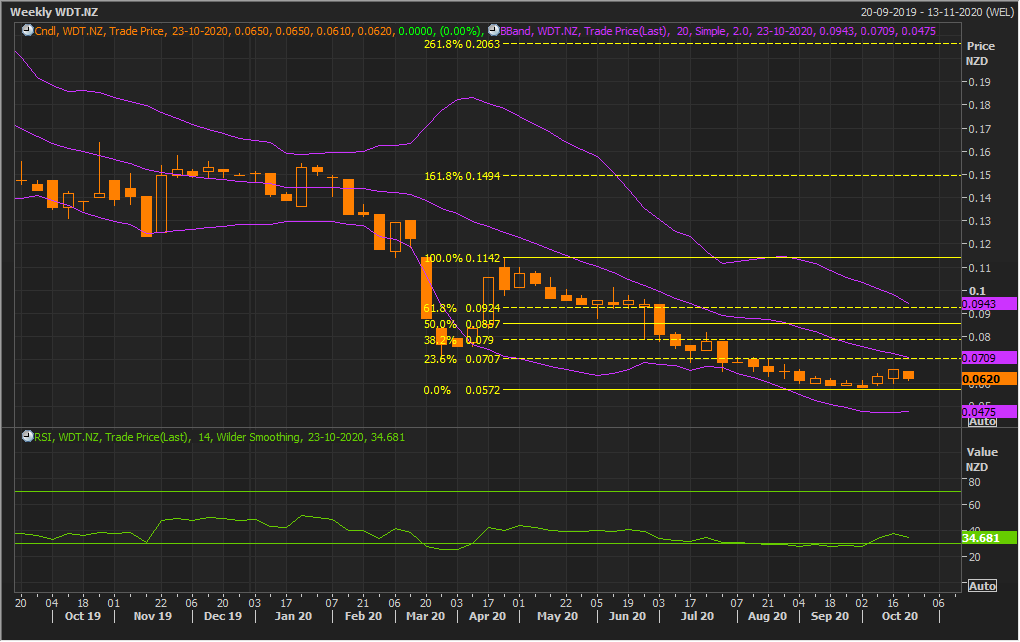
Source: Refinitiv (Thomson Reuters)
Note: Purple colour lines are Bollinger Bands* with the upper band suggesting overbought status while the lower band oversold status, and yellow lines are Fibonacci retracement lines which measure price rebound and backtrack.
After two weeks of a strong showing, the stock has given a softer close at $0.062 for the ongoing week. The technical indicator RSI with a reading around 35 suggests weak momentum for the stock.
Going forward, the stock may have resistance around the converging point of 23.6% retracement level and 20 periods SMA of $0.709 whereas support could be around the previous low of $0.057.
Thus, we give a “Speculative Buy” recommendation on the stock at the current price of NZ$0.062 per share on October 22, 2020.
2. Skellerup Holdings Limited (NZX: SKL) (Recommendation: Buy, Potential Upside: Low Double-Digit), (M-Cap: ~NZ$576.470 Million, Dividend Yield: 5.246%)
About the Company
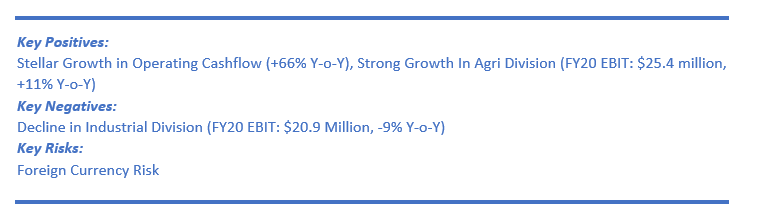
Skellerup Holdings Limited is a New Zealand based distributor, manufacturer and designer of vacuum systems and polymer products. The company has two divisions: Agri and Industrial.
Outlook
The company is committed to operate as effectively as possible, ensuring future growth. The company is planning to deliver sustainable returns now and in the years ahead.
Valuation Methodology: P/E Based Relative Valuation (Illustrative)
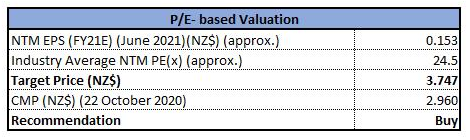
P/E Based Relative Valuation (Source: Refinitiv (Thomson Reuters))
Note: All forecasted figures and peers have been taken from Thomson Reuters, NTM-Next Twelve Months
We have applied P/E multiple based relative valuation (on an illustrative basis) and the target price reflects a rise of low double-digit (in % terms).
Thus, we give a “Buy” recommendation on the stock at the current price of NZ$2.960 per share on October 22, 2020.
3. QEX Logistics Limited (NZX: QEX) (Recommendation: Speculative Buy, Potential Upside: Low Double-Digit), (M-Cap: ~NZ$24.95 Million)
Business Description: QEX Logistics Limited happens to be a leading cross-border logistics service provider in NZ. The company has established the ability to provide customers with integrated logistics solutions as well as offer customers with a range of services including Shanghai based bonded warehouse, overseas warehousing, supply chain finance, B2B supply chain services, landing distribution as well as packaging.
.png)
Outlook
The company expects the first half of FY21 to be challenging, considering the current uncertainty about the extent and duration of the COVID-19 impacts. While the impacts of COVID-19 do present risks for the company, there are also many opportunities. The company is confident that demand for milk powder and other New Zealand products in China is still strong, despite the uncertain global economic environment.
Technical Overview:
Weekly Chart –
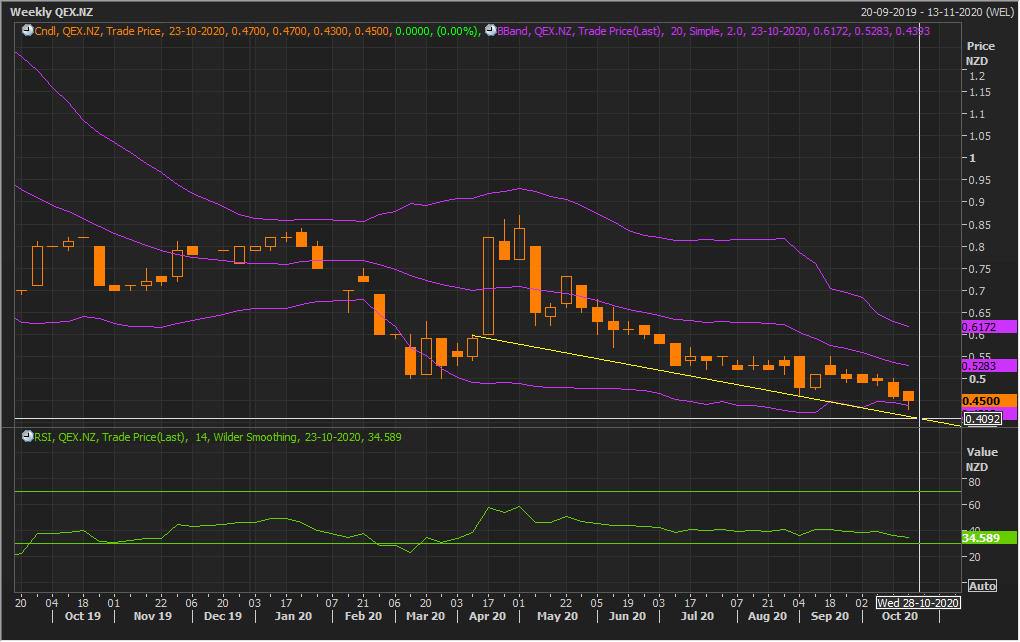
Source: Refinitiv (Thomson Reuters)
Note: Purple colour lines are Bollinger Bands* with the upper band suggesting overbought status while the lower band oversold status.
The stock has been in a downtrend for few weeks now and extending the same trend, it has given lower close for the ongoing week around $0.45. However, ‘Hammer’ candle formed for the ongoing week suggests a likely bullish reversal for the stock. The technical indicator RSI with around 35 reading suggests weak momentum for the stock.
Going forward, the stock may have resistance around 20 periods SMA of $0.528 whereas major support could be around $0.409.
Thus, we give a “Speculative Buy” recommendation on the stock at the current price of NZ$0.45 per share on October 22, 2020.
4. Marsden Maritime Holdings Limited (NZX: MMH) (Recommendation: Buy, Potential Upside: Low Double-Digit), (M-Cap: ~NZ$242.43 Million, Dividend Yield: 3.79%)
Business Description: Marsden Maritime Holdings Limited is a designated Port Company with stake holdings in several business activities in the Greater Marsden Point Area, including the port operator, Northport Ltd.
.png)
Outlook
While the national and international economic outlook remains challenging, the company has remained strong and will continue to seek opportunities that serve its long-term goals. Cuts in interest rates have decreased the cost of investment and the company’s appetite for development is undiminished.
Technical Overview:
Weekly Chart –
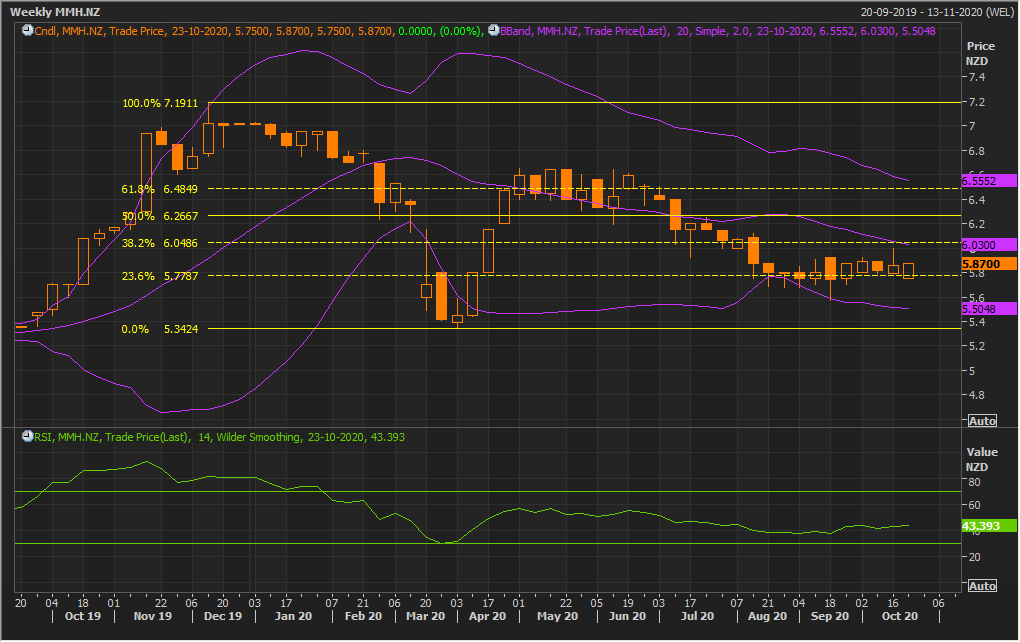
Source: Refinitiv (Thomson Reuters)
Note: Purple colour lines are Bollinger Bands* with the upper band suggesting overbought status while the lower band oversold status, and yellow lines are Fibonacci retracement lines which measure price rebound and backtrack.
For the past few weeks, the stock has been giving higher close taking support around 23.6% retracement level of $5.77. Extending the existing trend, the stock opened and made the low of $5.75 and gave closing at the peak price of $5.87 for the week thereby exhibiting positive sentiment on the stock. Technical indicator RSI with a reading around 43 and curve at the end pointing up, suggests neutral to bullish momentum for the stock.
Going forward, the stock may have resistance around the upper Bollinger band of $6.55 whereas support could be around $5.75.
Thus, we give a “Buy” recommendation on the stock at the current price of NZ$5.87 per share on October 22, 2020.
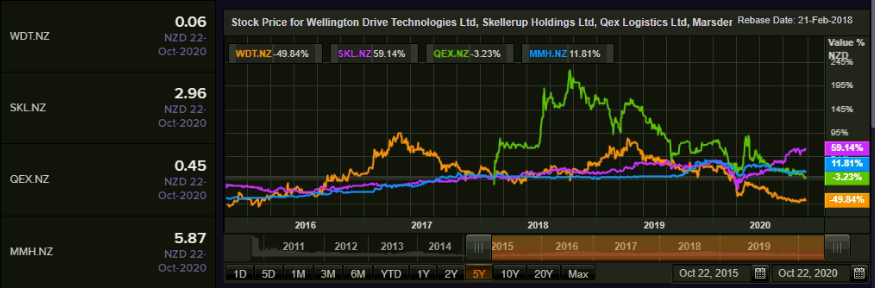
Comparative Daily Technical Chart (Source: Refinitiv (Thomson Reuters))
Disclaimer
Kalkine New Zealand Limited is authorised to provide class advice only. The information on this site does not take into account any of your investment objectives, financial situation or needs. Before you make a decision about whether to acquire a financial product, you should obtain the Product Disclosure Statement from the product issuer. You should consider the appropriateness of advice taking into account your own objectives, financial situation and needs and seek independent financial advice before making any financial decisions.
Past performance is not a reliable indicator of future performance.
 Please wait processing your request...