
 AU
AU
 UK
UK
 CA
CA
 US
US
 IND
IND

 NZ
NZ

Sector Landscape
The healthcare sector is one of the largest and highly complex sectors, comprising a broad range of companies that offer medical products and services. The healthcare sector comprises of companies that sell drugs, medical devices, and insurance, as well as hospitals and healthcare providers. Health spending is the largest area of public spending. Budget 2020 provides for $5.6 billion for the health sector to respond to the pandemic while maintaining sustainable delivery of existing services. The focus is on response, recovery and rebuild from the pandemic.
Exhibit 1: S&P/NZX All Health Care (Sector) v/s S&P/NZX All Index (on YTD Basis)*
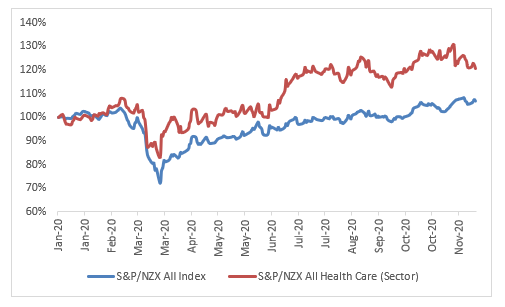
S&P/NZX All Health Care (Sector) v/s S&P/NZX All Index (Source: S&P Dow Jones Indices)
*January 3, 2020 - November 26 2020
As evidenced from the above chart, S&P/NZX All Health Care Index has outperformed S&P/NZX All Index by ~13.72% on a YTD basis.
New Zealand has a mainly publicly funded, universal coverage health system with services provided by public, private and non-governmental sectors. The government focused approach and realization of its fundamental role in providing for healthcare needs have helped it achieve the goal of universal health coverage. The Minister of Health has overall responsibility for the health and disability system, and the Ministry of Health (MOH) is the main advisory body to the government on policy issues.
Twenty District Health Boards (DHBs) are responsible for planning and funding health services for their geographical areas. They are governed by boards of elected and appointed members that are accountable to the Minister of Health. They are required to undertake formal strategic planning processes and, in doing so, to cooperate with neighbouring DHBs.
The country has a mix of private and public hospitals, but it is dominated by public hospitals providing all emergency and intensive care. With the realization that no citizens should be denied treatment in public hospitals and all citizens have insurance and accessible health services, health insurance has been made available at low costs. Both public and private hospitals accept health insurance. Most of the employers in the country offer medical cover as part of their employment contracts.
Rising Contribution to GDP
According to the latest release by Stats NZ, the healthcare industry contributed about 5.96% to the total New Zealand GDP in 2019 up from 5.78% in 2018. The sector is the fifth biggest contributor to the country's GDP.
Exhibit 2: Contribution Healthcare Sector to GDP
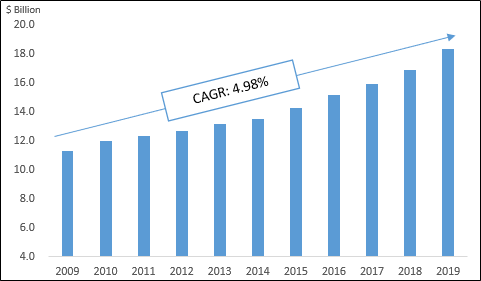
Source: Stats NZ, Kalkine Group
Major Reforms Introduced in the Healthcare Systems
The health strategy launched in 2016, consists of two parts:
The Future Direction: It outlines directions for the health system over the 10 years from 2016 to 2026 and talks about the challenges and opportunities the system faces: describes the future needs and identifies five strategic themes which includes improving patients literacy and empowerment, emphasizing prevention, early intervention and community care, improving system performance, delivering integrated and collaborative health care delivery, and pursuing technological innovation for the changes.
The New Zealand Health Strategy: The Roadmap of actions 2016 identifies 27 areas for actions over 5 years to make strategies happen. The actions are organized under the five themes of the strategy. The roadmap will be updated over a 10-year lifetime of the strategy.
Surge in Online Consultations
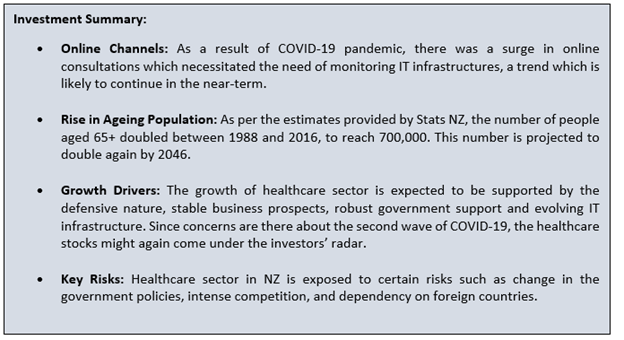
The COVID-19-led nationwide lockdown and social distancing norms led to a sharp growth for e-health, as customers moved to online consultation, treatment, medical tests, and e-pharmacies. During the nationwide lockdown, the country’s DHBs delivered about 34,500 telehealth consultations to patients a week in April. National lockdown due to Covid-19 led to a significant rise in the usage of telehealth.
As this pandemic has caused healthcare delivery through digital channels, it has become essential for any healthcare providers to remain on top of monitoring their complex IT infrastructures ensuring they are operating at their optimal level. This smart approach allows the medical teams to focus on delivering the highest quality frontline care with zero technical impediments.
Green Cross Health Launches Online GP Consultation
Green Cross Health, one of New Zealand’s most experienced primary healthcare providers has launched HouseCall, a new, online ‘doctor on demand’ service. HouseCall has been devised to provide accessible, casual, online appointments with real doctors, who will discuss any patient located in New Zealand across the internet, via face to face video through the website. The patient follows directions to make an appointment, and the appointment can take place via phone, laptop, tablet, or PC – whichever mode is preferable to customers.
HouseCall’s online consultations for the public cost $69 for 15 minutes, and they are expected to assist the work of a person’s regular GP, not replace her or him. Patient information from the online consultation will be shared with a patient’s regular GP if the patient wishes.
Ageing Population of New Zealand
Like most of the developed world, New Zealand has an ageing population. As per the estimates provided by Stats NZ, the number of people aged 65+ doubled between 1988 and 2016, to reach 700,000. This number is projected to double again by 2046.
Exhibit 3: New Zealand’s 75+ Population
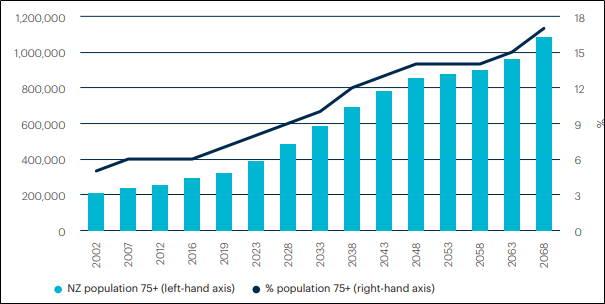
Source: Summerset Annual Report
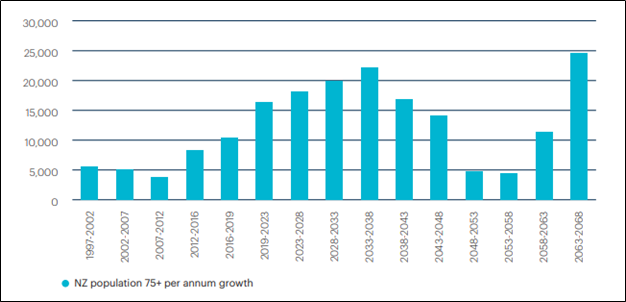
It is estimated that there is a 90 percent chance that there will be 1.32–1.42 million people aged 65+ in 2043, and 1.62–2.06 million in 2068. By 2032, it is expected that 20–22 percent of New Zealanders will be aged 65+, compared with 15 percent in 2016. By 2050, this proportion is expected to reach 21–27 percent and reach 24–33 percent by 2068.
Exhibit 4: New Zealand population growth per annum for 75+ age group
Source: Summerset Annual Report
Major Challenges for NZ’s Health Sector
Most of the hospitals in New Zealand are already highly digitized that are using digital technologies and easier accessible data. This allows the medical staff of the hospital to instantly access patient data and improve the quality of patient care. Digitalization is not only about helping doctors with their tasks, but it also helps improve workflows, enhances security for medical staff and hospitals and provides more transparency for patients.
However, with so many benefits that technology provides to the healthcare sector, there are some major technical challenges that the healthcare sector needs to take into account when ensuring technology issues do not get in the way of the medical staff delivering essential frontline care.
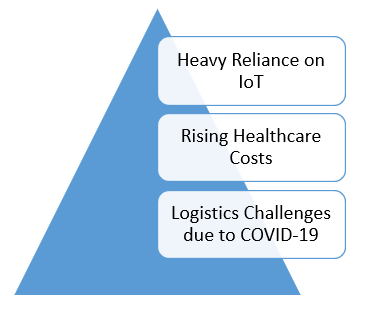
Exhibit 5: Key Challenges
Source: Kalkine Group
Heavy Reliance on IoT: Internet of Things (IoT) devices in healthcare can be used to make hospitals more resourceful, as it aids to provide the doctors with the related patient data instantly, which helps to quicken medical processes and improve medical diagnoses and recommended treatments for patients. However, these devices come with a challenge. There are chances of software crashes or wearables getting disconnected. Healthcare services need to monitor these devices to be able to guarantee a constant flow of reliable body monitoring data.
Rising Healthcare Costs: The rising cost of healthcare directly impacts the revenue of the healthcare companies, as increased cost discourages patients in many ways, from taking lab tests to doing regular follow-ups post visit, which ultimately leads to poor patient outcome.
Logistics Challenges due to COVID-19: In terms of pharmaceuticals and medical technology, the country imports various products from foreign countries, increasing dependency. Since NZ is geographically isolated, closing the borders can impact the broader industry. Notably, the impact can be felt on the medical supplies.
Apart from the sector-specific factors, we have also analyzed four NZX-listed companies operating in the healthcare sector. This report covers their insights, outlook, performance and potential as expected to be delivered in the near to medium term.
1. Blis Technologies Limited (NZX: BLT) (Recommendation: Speculative Buy, Potential Upside: Low Double-Digit), (M-Cap: ~NZ$90.82 Million)
About the Company
Blis Technologies Limited is the creator of the world’s first advanced oral probiotics. The company currently markets two strains of probiotic bacteria- BLIS K12TM and BLIS M18TM.
Outlook
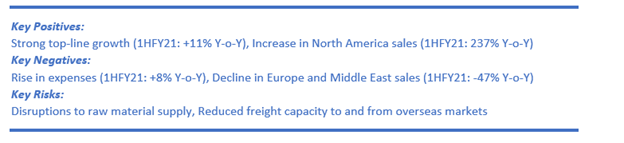
The COVID pandemic affected the company’s business in various ways; however, it was able to maintain growth and continues to progress in both new market and R&D opportunities. Consumer demand remains strong, however, the channel purchase preference has shifted strongly in favour of online. The customer base and its own BLIS® branded finished products are well-positioned for the change in buyer behaviour. Considering the continued growth in product sales, investment into new markets and support of the R&D pipeline, the company has confirmed guidance of sustained profitable growth while maintaining an EBITDA similar to the $2.1 million reported in FY20.
Technical Overview:
Weekly Chart –
Source: Refinitiv (Thomson Reuters)
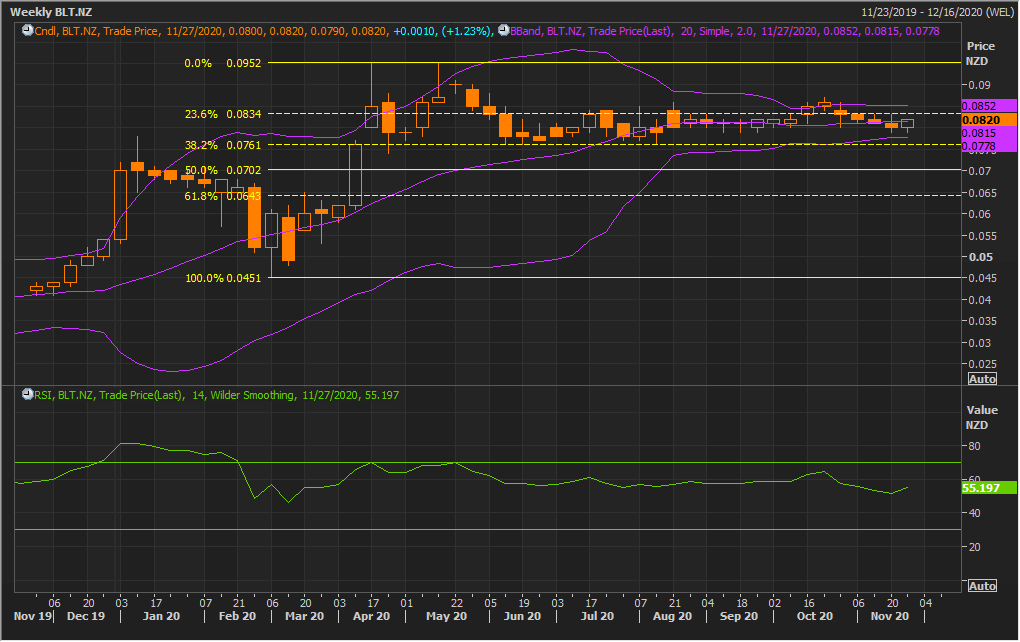
Note: Purple colour lines are Bollinger Bands® with the upper band suggesting overbought status while the lower band oversold status, and yellow lines are Fibonacci retracement lines which measure price rebound and backtrack. https://www.bollingerbands.com/
For multi-weeks, the stock has largely been trading in the range provided by the 23.6% retracement level of $0.083 on the upside and 38.2% retracement level of $0.076 on the downside. While remaining in the range, the stock for the ongoing week has given a stronger close at the peak price of $0.082. The technical indicator RSI with around 55 reading and a curve at the end pointing up, suggests strong bullish momentum for the stock.
Going forward, the stock may have resistance around the previous high of $0.095 whereas support could be around the 23.6% entrancement level of $0.076.
Considering the technical analysis, growth in the top line, and positive outlook we give a “Speculative Buy” recommendation on the stock at the current market price of NZ$0.082 per share, up by 1.23% on November 26, 2020.
2. Arvida Group Limited (NZX: ARV) (Recommendation: Hold, Potential Upside: Low Double-Digit), (M-Cap: ~NZ$949.35 Million, Gross Dividend Yield: 3.305%)
About the Company
Arvida Group Limited is one of New Zealand’s largest aged care providers owning and operating 33 retirement villages located nationally.
Outlook:
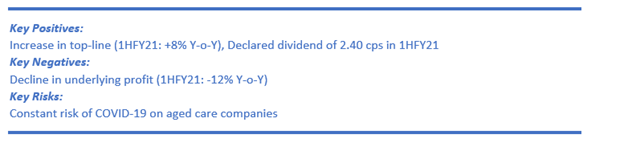
Covid-19 showed various risks for the company and the aged care sector broadly. The company continues to see substantial economic uncertainty in the short term, however, continued buoyancy in the property market, high care occupancy as well as underlying positive organisational culture positions it well for continued financial performance.
Valuation Methodology: P/E Based Relative Valuation (Illustrative)
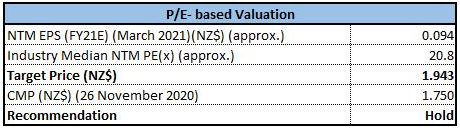
P/E Based Relative Valuation (Source: Refinitiv (Thomson Reuters))
We have applied P/E Based Relative Valuation (on an illustrative basis) and the target price reflects a rise of low double-digit (in % terms).
Considering high care occupancy, growth in top line and expected upside, we give a “Hold” recommendation on the stock at the current price of NZ$1.750 per share, up by 0.57% on November 26, 2020.
3. Green Cross Health Limited (NZX: GXH) (Recommendation: Buy, Potential Upside: High Single Digit), (M-Cap: ~NZ$148.87 Million, Gross Dividend Yield: 4.720%)
About the Company
Green Cross Health Limited is a trusted New Zealand primary health care provider with multidisciplinary health care teams established with the purpose of working together to help healthier communities.
Outlook:
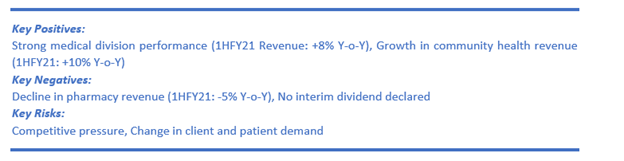
The company is focused on delivering earnings growth whilst refining the operating model to adapt to changing market conditions. The company has worked to maintain a robust balance sheet. In order to safeguard the position as well as to capitalise on the acquisition opportunities that could arise due to economic climate, the company’s Board decided not to declare an interim dividend.
Technical Overview:
Weekly Chart –
Source: Refinitiv (Thomson Reuters)
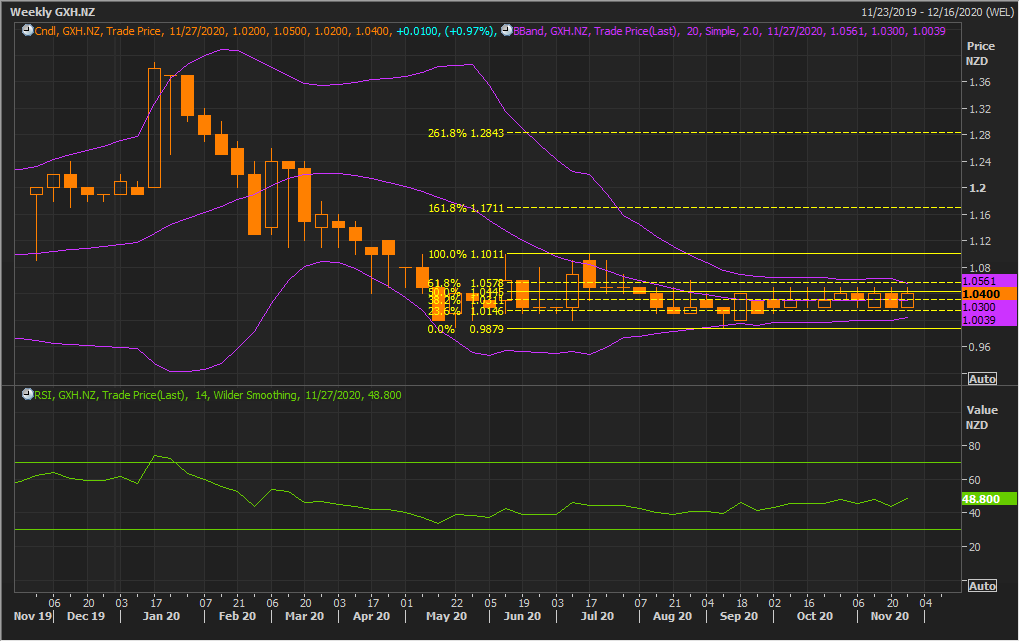
Note: Purple colour lines are Bollinger Bands with the upper band suggesting overbought status while the lower band oversold status, and yellow lines are Fibonacci retracement lines which measure price rebound and backtrack.
The stock has mostly been trading in the range provided by a 61.8% retracement level of $1.057 on the upside and a 23.6% retracement level of $1.014 on the downside for multi-weeks. However, while remaining in the range, the stock has given stronger closing at its peak price suggesting positive sentiment on the stock. The technical indicator RSI with around 49 reading and a curve at the end pointing up, indicates the gaining of bullish momentum.
Going forward, the stock may have resistance around the previous high of $1.10 whereas support could be around the 23.6% retracement level of $1.01.
Considering the technical analysis, performance of medical division and robust balance sheet, we give a “Buy” recommendation on the stock at the current price of NZ$1.040 per share, up by 0.97% on November 26, 2020.
4. EBOS Group Limited (NZX: EBO) (Recommendation: Hold, Potential Upside: High Single Digit), (M-Cap: ~NZ$4.127 Billion, Gross Dividend Yield: 3.418%)
About the Company
EBOS Group Limited is the most diversified and largest marketer, distributor, and wholesaler of pharmaceutical, healthcare, and medical products. It is also a prominent distributor and marketer of acclaimed consumer products and animal care brands.
Outlook:
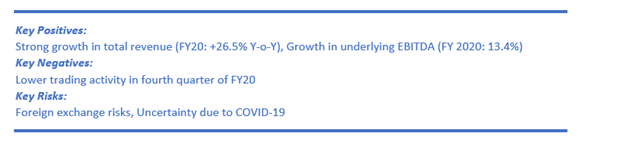
The company reported strong financial performance in FY20 in both the Healthcare and Animal Care segments. The company’s revenue and underlying EBITDA in July 2020 was up by 6.9% Y-o-Y and 6.5% Y-o-Y, respectively which was driven by growth in both Healthcare and Animal Care segments, reflecting an improvement in the trading conditions and the defensive characteristics of the company’s core products and services. Considering the company’s scale as well as market leading positions in the stable industries, as well as robust balance sheet, the company is well-positioned to respond to the challenges.
Valuation Methodology: P/E Based Relative Valuation (Illustrative)
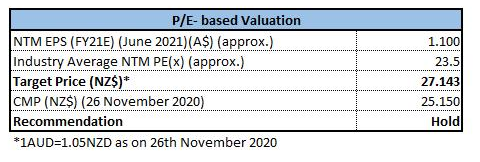
P/E Based Relative Valuation (Source: Refinitiv (Thomson Reuters))
We have applied P/E Based Relative Valuation (on an illustrative basis) and the target price reflects a rise of high single-digit (in % terms).
Considering the current trading levels, strong FY20 performance, and expected upside, we give a “Hold” recommendation on the stock at the current price of NZ$25.150 per share, up by 1.09% on November 26, 2020.
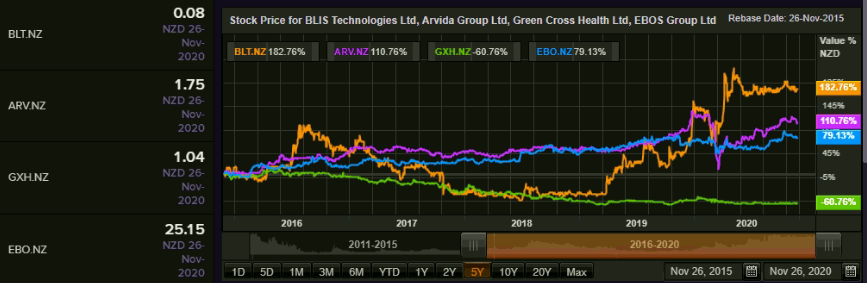
Comparative Price Chart (Source: Refinitiv (Thomson Reuters))
Disclaimer
Kalkine New Zealand Limited is authorised to provide class advice only. The information on this site does not take into account any of your investment objectives, financial situation or needs. Before you make a decision about whether to acquire a financial product, you should obtain the Product Disclosure Statement from the product issuer. You should consider the appropriateness of advice taking into account your own objectives, financial situation and needs and seek independent financial advice before making any financial decisions.
Past performance is not a reliable indicator of future performance.
 Please wait processing your request...