
 AU
AU
 UK
UK
 CA
CA
 US
US
 IND
IND

 NZ
NZ

Overview:
Templeton Emerging Markets Plc (NZX: TEM) is an investment trust company, primarily investing in emerging markets companies that appear to operate with an aim of uplifting capital growth to their shareholder over a prolonged period. Marlin Global Limited (NZX: MLN) is an investment company listed in New Zealand and indulges in investing in growing companies outside Australia and New Zealand.
Kalkine’s Sector Report covers the Key Financial Metrics, Risks, Outlook, Technical Analysis along with the Valuation, Target Price, and Recommendation on the stock.
Data Source: Stats NZ; Analysis by Kalkine Group
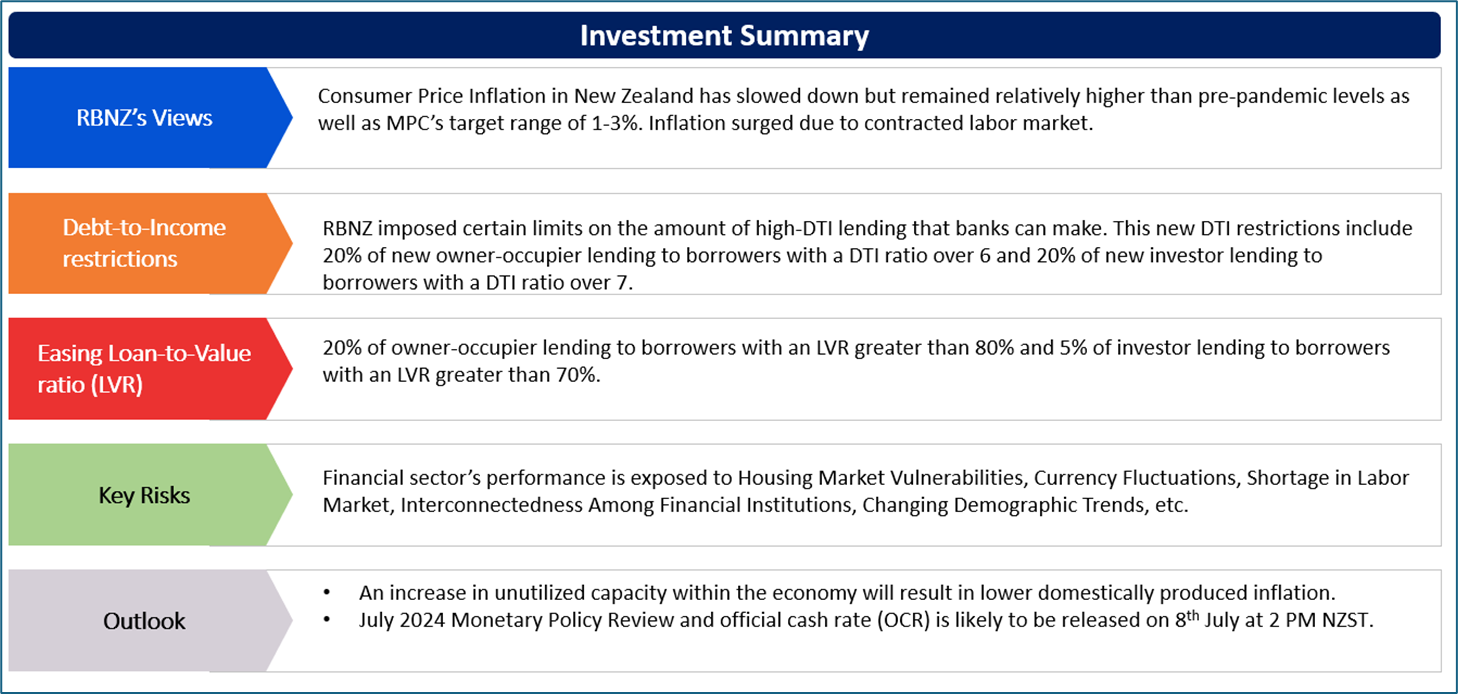
Inflation and Labor Markets continues to be Monitory Policy Research Agenda Themes
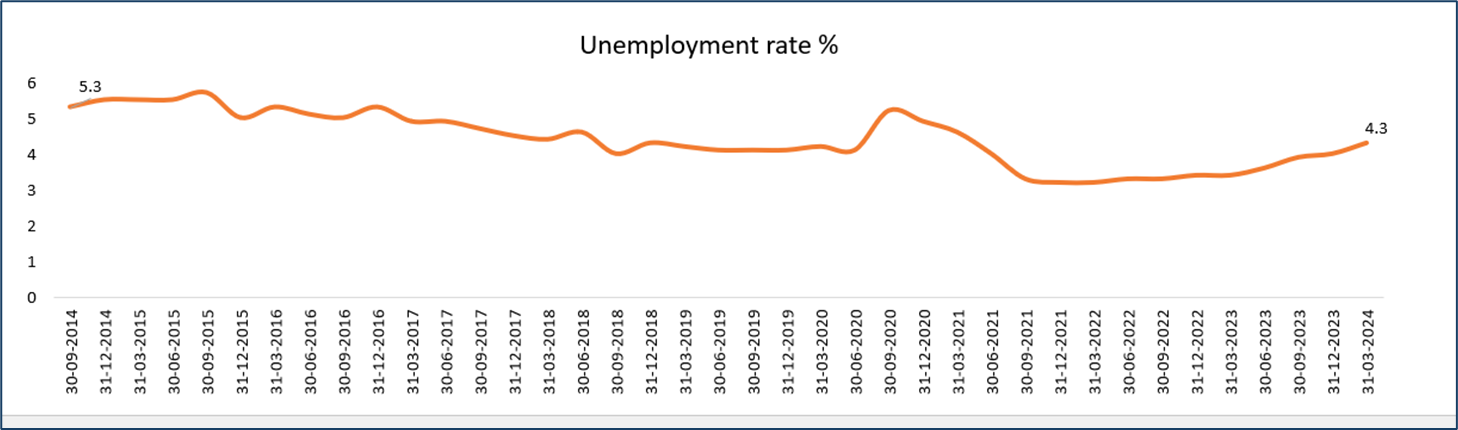
Compared to other countries, inflation in New Zealand spiked amid tightened labor market, ordinarily driven by border closures. Recently, inflation decelerated but remained higher than target range of Monetary Policy Committee. Inflation in New Zealand mounted up on a mix of demand and supply related factors and predominant shortfall of labor and materials.
Phillips curve describing the relationship between economic activity and inflation drifted upwards during the pandemic as compared to lower levels in 2008 and 2019. This highlights stronger significance of inflation on economic activity since 2020. Post-2020 period shows steepened Phillips curve when the labor shortage and job-to-job labor shortfall was observed. Moreover, the supply-driven contributions are more profound than demand-driven contributions to support inflation figures in New Zealand.
Exhibit 1: Unemployment Rate
Data Source: Stats NZ; Analysis by Kalkine Group
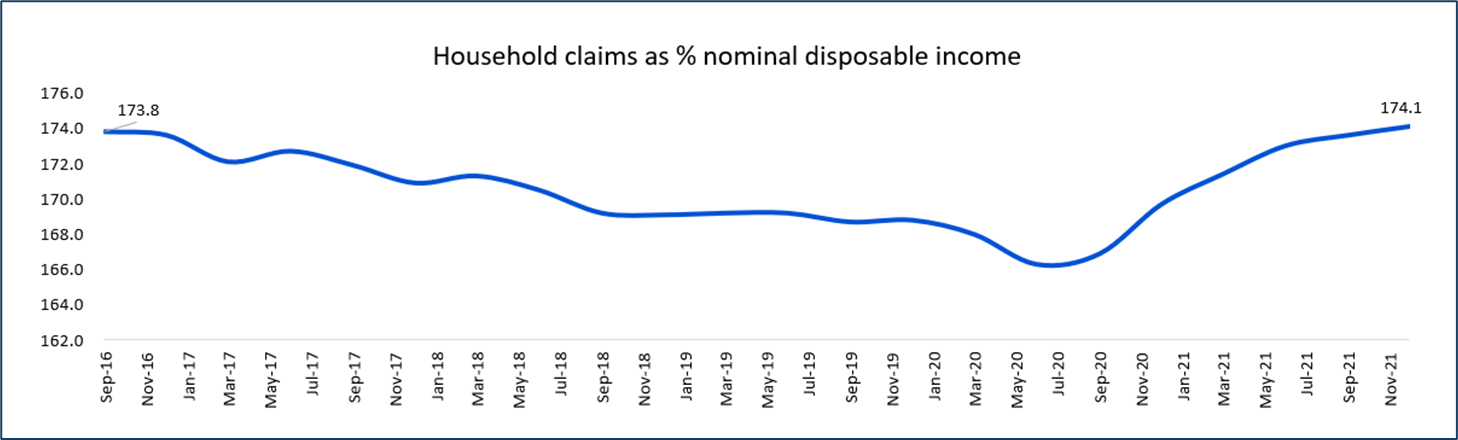
Starting from July 1, 2024, New Zealand has enforced new Debt-to-Income (DTI) and Loan-to-Value Ratio (LVR) restrictions on residential property lending by banks. These measures aim to regulate high-DTI lending, where borrowers have significant debt relative to their pre-tax income, and low-deposit lending, respectively. Banks will have a 20% discretion to lend outside specified DTI and LVR limits, allowing flexibility in managing complex cases. Specifically, banks can allocate 20% of new lending to owner-occupiers with DTI ratios over 6 and 20% to investors with DTI ratios over 7. Additionally, LVR restrictions will permit banks to lend 20% to owner-occupiers with LVRs over 80% and 5% to investors with LVRs over 70%. These changes are designed to mitigate risk in the housing market and were preceded by a 12-month preparation period for banks to adjust their systems accordingly.
Exhibit 2: Household Debt as % Disposable Income
Data Source: Stats NZ; Analysis by Kalkine Group
Outlook
According to the latest research, it is indicated that rising unused capacity in the economy will lead to reduced inflation generated within the country. Reduced expectations of inflation among businesses and households will strengthen further deceleration in inflation estimates, resulting to diminished pressure for price hikes and reduced demands for higher wages. As inflation continues to decline, businesses will find it more challenging to implement significant price increases, thereby contributing to a reduction in inflation persistence.
July 2024 Monetary Policy Review and Official Cash Rate (OCR) is likely to be released on 8th July at 2 PM NZST.
Key Risks and Challenges:
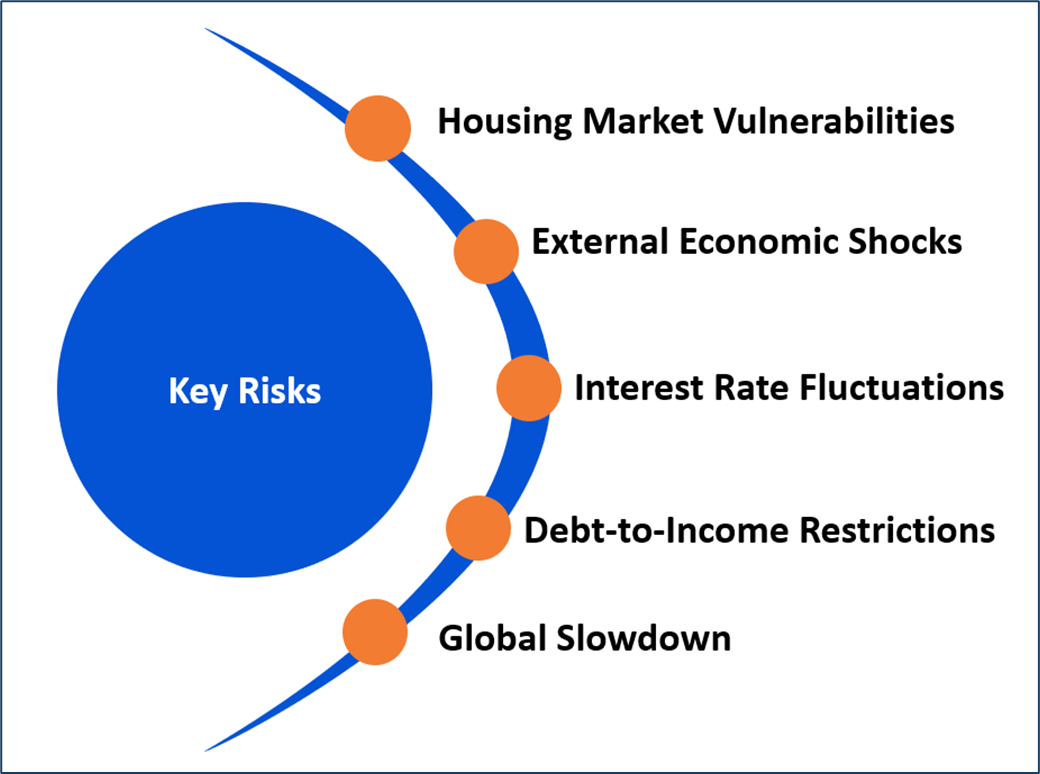
Financial sector’s performance is exposed to Housing Market Vulnerabilities, Currency Fluctuations, Shortage in Labor Market, Interconnectedness Among Financial Institutions, Changing Demographic Trends, etc.
Exhibit 3. Key Risks in Financial Sector:
Source: Analysis by Kalkine Group
Apart from the sector-specific factors, an analysis on 2 NZX-listed companies is provided. This report covers their insights, outlook, performance and potential as expected to be delivered in the near to medium term.
1 ) Marlin Global Limited (Recommendation: Speculative Buy, Potential Upside: Low Double-Digit) (M-Cap: NZD 205.68 million, Annual Dividend Yield (TTM)1: 8.16 %)
Business Description:
Marlin Global Limited (NZX: MLN) is an investment company listed in New Zealand and indulges in investing in growing companies outside Australia and New Zealand.
Outlook:
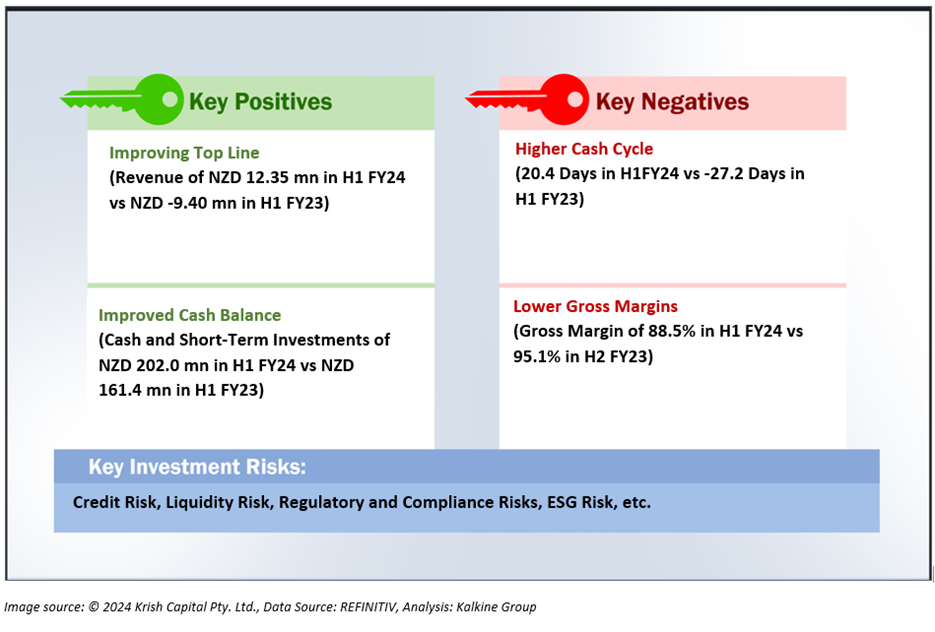
Management attributed the weakness in the quarter to macroeconomic conditions. They noted that deal cycles are taking longer, deal sizes are shrinking, and customers are scrutinizing budgets more closely.
Technical Overview:
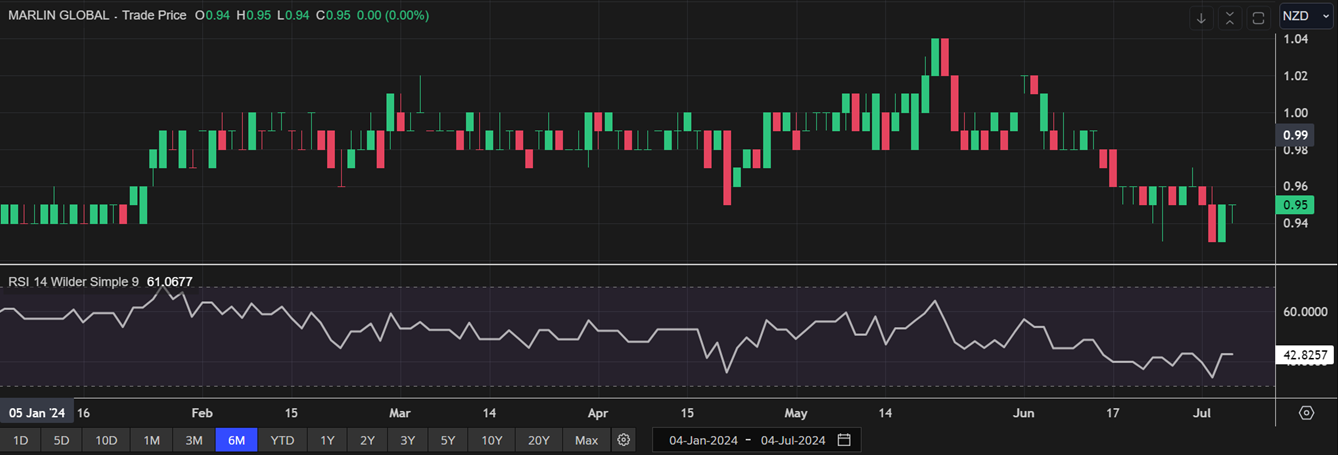
MLN Daily Technical Chart, Data Source: REFINITIV
Technical Commentary
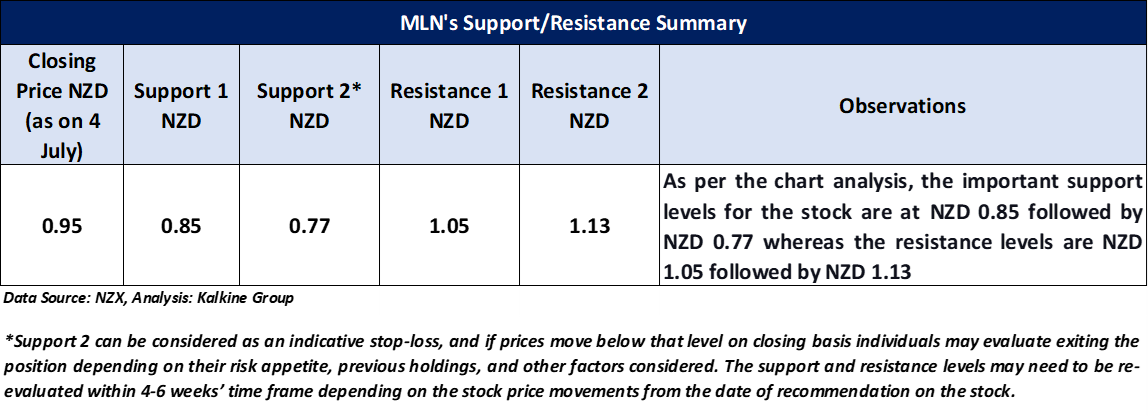
MLN's daily chart displays a bullish candlestick pattern following three consecutive black candles. The RSI (14) indicates a rebound from oversold conditions, hinting at a potential minor rally. Prices remain below the 21-period and 50-period SMAs, which could serve as resistance levels. Key technical levels include support at NZD 0.850 and resistance at NZD 1.05.
Stock Recommendation
Considering the facts above, a ‘Speculative Buy’ recommendation on the stock has been provided at the closing market price of NZD 0.95 per share as on 04 July 2024.
2) Templeton Emerging Markets Plc (Recommendation: Hold, Potential Upside: Low Double-Digit) (M-Cap: NZD 3,692.98 Mn, Annual Dividend Yield (TTM)1: 3.09%)
Business Description:
Templeton Emerging Markets Plc (NZX: TEM) is an investment trust company, primarily investing in emerging markets companies that appear to operate with an aim of uplifting capital growth to their shareholder over a prolonged period.
Outlook:
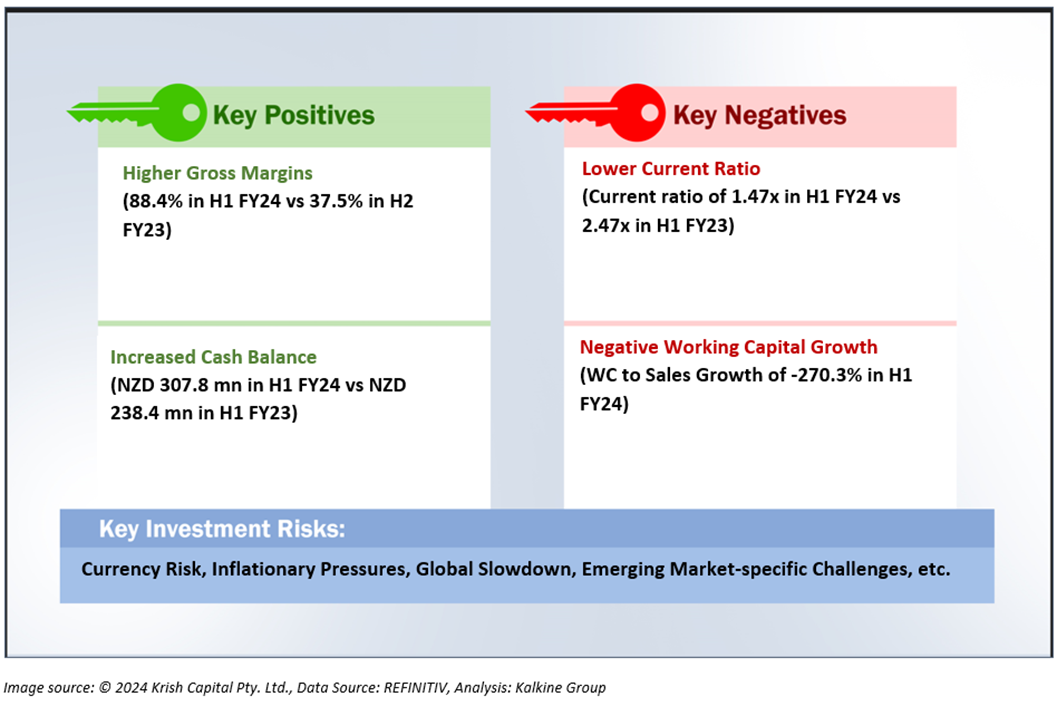
The company has a proposed a dividend declaration of 3.00 pence per Ordinary Share to be payable on 26th July 2024. The dividend distribution is subject to the shareholders’ approval in the AGM that is to be held on 11th July.
Technical Overview:
Technical Commentary
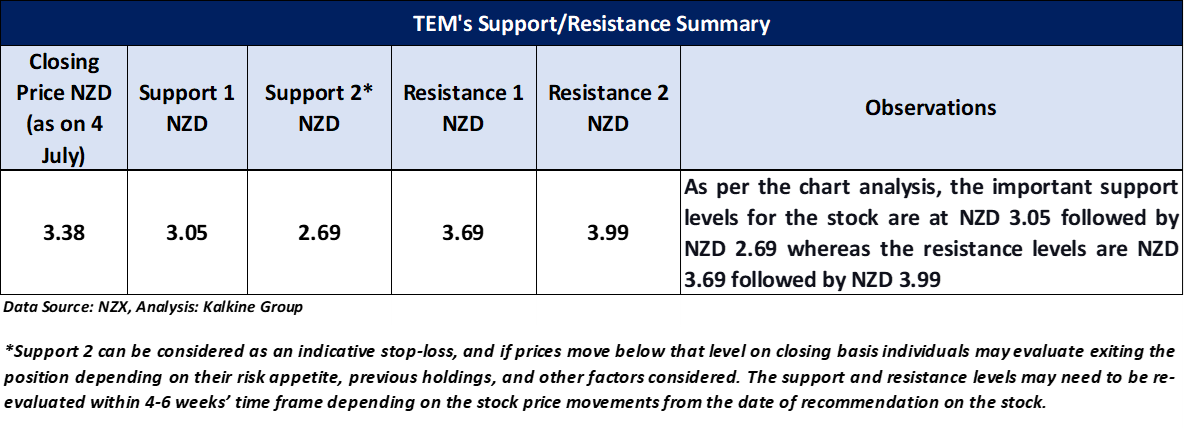
TEM's daily chart shows a bullish candlestick pattern accompanied by a rising trendline, indicating potential upward momentum. The RSI (14) at 57.20 suggests strength and the possibility of an upward rally. Prices are currently above both the 21-period and 50-period SMAs, which act as support levels, further supporting bullish sentiment. Key technical levels to watch include support at NZD 3.05 and NZD 2.69, and resistance at NZD 3.69 and NZD 3.99.
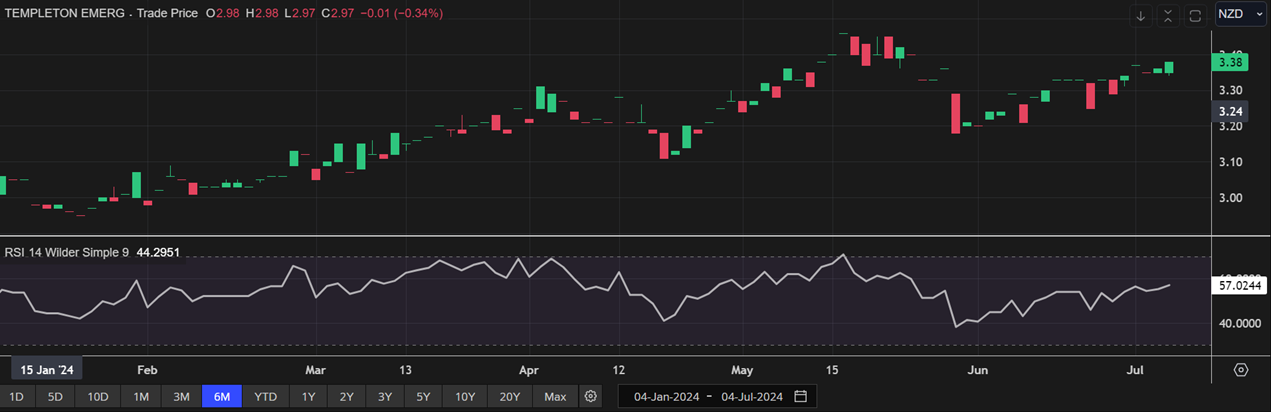
TEM’s Daily Technical Chart, Data Source: REFINITIV
Stock Recommendation
Considering the facts above, a ‘Buy’ recommendation on the stock has been provided at the closing market price of NZD 3.38 per share, as on 4 July 2024.
Note 1: Past performance is not a reliable indicator of future performance.
Note 2: The reference date for all price data, currency, technical indicators, support, and resistance levels is 04 July 2024. The reference data in this report has been partly sourced from REFINITIV.
Note 3: Investment decisions should be made depending on an individual's appetite for upside potential, risks, holding duration, and any previous holdings. An 'Exit' from the stock can be considered if the Target Price mentioned as per the Valuation and or the technical levels provided has been achieved and is subject to the factors discussed above.
Note 4: Annual Dividend Yield is on a Trailing Twelve Month (TTM1) basis and are subject to change based on factors such as company performance, stock price changes, etc.
Technical Indicators Defined: -
Support: A level at which the stock prices tend to find support if they are falling, and a downtrend may take a pause backed by demand or buying interest. Support 1 refers to the nearby support level for the stock and if the price breaches the level, then Support 2 may act as the crucial support level for the stock.
Resistance: A level at which the stock prices tend to find resistance when they are rising, and an uptrend may take a pause due to profit booking or selling interest. Resistance 1 refers to the nearby resistance level for the stock and if the price surpasses the level, then Resistance 2 may act as the crucial resistance level for the stock.
Stop-loss: It is a level to protect further losses in case of unfavourable movement in the stock prices.
Disclaimer This report has been issued by Kalkine New Zealand Limited (FSP691351) (NZBN:9429047678101) (“Kalkine”). Kalkine is a Financial Advice Provider (“FAP”) and is authorised by a Class 1 Financial Advice Provider Licence issued by Financial Markets Authority (“FMA”) to provide financial advice. Kalkine provides only general financial advice through its research reports following a person becoming a member. The reports contain buy/sell/hold and other recommendations in relation to equity securities, managed funds and other managed investment schemes and other financial advice products. The recommendations and opinions in this report and on Kalkine website do not take into account any of your investment objectives, financial situation or needs. Before you make a decision about whether to acquire a financial product, you should obtain the Product Disclosure Statement from the product issuer. You should consider the appropriateness of advice taking into account your own objectives, financial situation and needs and seek independent financial advice before making any financial decisions. If you act on the advice in the research reports, you may have to pay fees, expenses or other amounts (but not to Kalkine). Further information about the complaints and dispute resolution process, as well as information about Kalkine’s duties are available on Kalkine’s website. Please read our Financial Advice Provider (FAP) disclosure statement and Complaints Handling Guide, which are available on the website.
Past performance is not a reliable indicator of future performance.
 Please wait processing your request...