
 AU
AU
 UK
UK
 CA
CA
 US
US
 IND
IND

 NZ
NZ

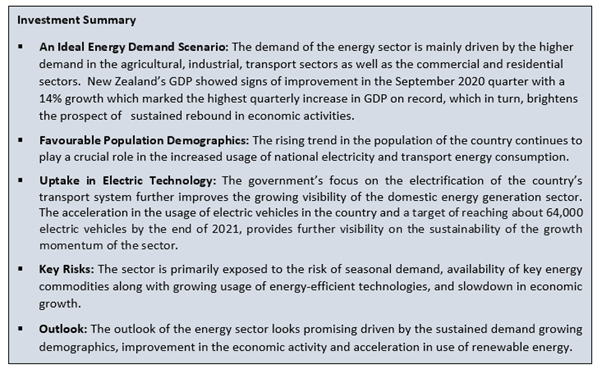
Sector Landscape
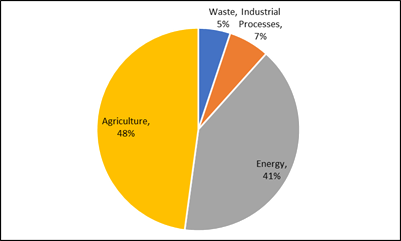
New Zealand Energy Sector is one of the prominent drivers of the economic development of the country. The country has a well-developed energy sector which aids in meeting the daily energy needs of vital industries as well as households. New Zealand generates sufficient energy to meet 75% of its energy requirements. The transportation sector is a major user of energy in New Zealand as it accounts for around 40% of the national energy demand. Almost half of the energy consumed in the country is used on the transport of commodities and people. New Zealand’s energy sector has various advantages like, its reliable distribution system and low-cost base. New Zealand has increased its focus on renewable energy as around 40% of the country’s primary energy supply is met from renewable sources. Also, the country’s energy sector accounted for 40% of the total greenhouse gas emissions which was generated from the usage of energy as reflected in Exhibit 1 below. Notably, New Zealand has the third-highest share of renewable electricity generation in the OECD.
Exhibit 1: New Zealand’s Greenhouse Gas Emissions
Source: Energy Efficiency and Conservation Authority; Analysis by Kalkine Group
Key Growth Drivers
Some of the key growth drivers for the Energy sector have been highlighted below: -
Shift towards Clean Energy
New Zealand generates around 80% of its electricity requirements from clean, renewable sources such as hydro, geothermal, and wind. So, this provides the greatest opportunities for the country to switch to electric technology over coal and oil in order to reduce carbon emissions. In a further step towards this direction, the country is investing resources to boost energy efficiency by way of ensuring maximum use of renewable energy. The government is also encouraging wider usage of clean energy by promoting productive and low-emissions business along with efficient and low-emissions transport and energy-efficient homes.
In the meanwhile, the contribution of renewable energy to the overall electricity generation of the country is expected to reach over 90% and 95% by 2035 and 2050 respectively from 84% in 2018. The increase in electricity demand in the country coupled with the benefits of continued declines in the cost of solar and wind technology, and limited supply of gas, provides robust growth opportunities for electricity generation from renewable sources. Further, the government has earmarked meeting 100% of its electricity generation with renewable sources by 2035 and this is likely to be aided by the country’s flexible and resilient electricity system. To achieve this, the government has set up a $100 million green investment fund along with a $27 million national new energy development centre. Moreover, the government has established multiple renewable energy investments through the $3 billion Provincial Growth Fund to meet the desired target.
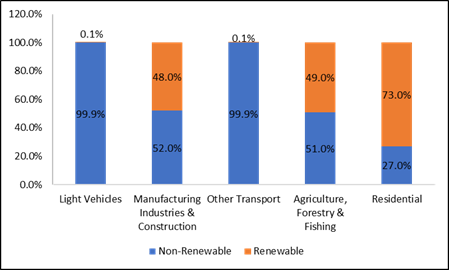
Exhibit 2: Over Two-Thirds of Energy Use in New Zealand Comes from Non-Renewable Energy Sources
Source: Energy Efficiency and Conservation Authority; Analysis by Kalkine Group
Electrification of Transport
The transportation sector currently accounts for around 40% of all energy demand, and 20% of all greenhouse gas emissions. The government has been emphatic on the electrification of the country’s transport system by gradually switching the fleet to low-emissions technology while also focusing on maximum efficiency of the fossil-fuelled vehicles. This could lead to a reduction in carbon emission by 1.6-4.3 million tonnes by 2035. The higher uptake of petrol hybrid and electric vehicles could also contribute in reduction in carbon emission.
The government’s focus on catering to the requirements of the country’s transport with sustainable energy by reducing dependence on imported fuel brightens the prospects of the domestic energy generation sector. The government through its agencies is also promoting innovation in the sector through its low emission vehicles contestable fund.
The usage of electric vehicles that runs on electricity in the country is gaining pace and the government has set a goal of reaching about 64,000 electric vehicles by the end of 2021, thus providing visibility on the sustainability of the growth momentum of the sector, going ahead.
Exhibit 3: Usage of Selected Energy Type by Services Sector
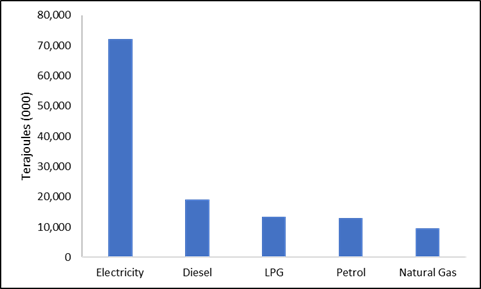
* Figures are of 2018
Source: Stats NZ; Chart Created by Kalkine Group
Rebound in Economic Activities
The demand of the energy sector is mainly driven by the higher demand in the agricultural, industrial, transport sectors as well as the commercial and residential sectors. The rebound in economic growth and resultant growth in employment from the adverse impact of the COVID-19 brightens growth prospect of the sector. New Zealand’s GDP has witnessed a growth of 14% in the September 2020 quarter which marked the highest quarterly increase in GDP on record, this bodes well for the sector.
Moreover, with the rising trend in the population of the country coupled with an incremental shift to electric appliances from wood or coal burners by residential users, as well as by increasing uptake of electric vehicles (EVs) having charging facilities at home, augur well for the growth prospects of the sector. Besides, the demand of energy is expected to grow further driven by the move towards electrification of industrial processes and increased demand for electricity in irrigation.
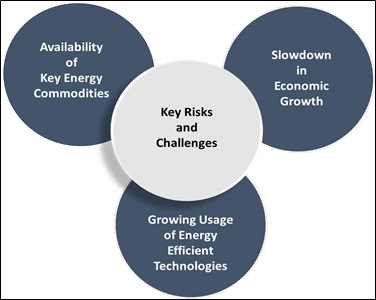
Key Risks and Challenges
Some of the risks attributable to the sector are shown below: -
Exhibit 4: Key Risks and Challenges
Source: Kalkine Group
Outlook
The growth prospects of the country’s energy sector will continue to be driven by the growing population demographics as well as the improvement in economic activity. These factors will dictate the trend of the generation of energy as well as its usage in the country. Besides, the incremental shift to electric technology by residents along with the growing uptake of electric vehicles (EVs) augurs well for the growth prospects of the sector. Moreover, the demand of energy may benefit from the move towards electrification of industrial processes and increased demand for electricity in irrigation. Driven by the country’s benefits of its flexible and resilient electricity system, the government's aim of meeting 100% of its electricity generation through renewable sources by 2035 looks viable.
Apart from the sector-specific factors, we have also analyzed four NZX-listed companies operating in the same sector. This report covers their insights, outlook, performance and potential as expected to be delivered in the near to medium term.
1) Z Energy Ltd (Recommendation: Buy, Potential Upside: Low Double-Digit) (M-Cap: NZ$1.4 billion)
Business Description:
Z Energy Ltd (NZX: ZEL) deals in supplying fuel to retail as well as commercial customers. In addition to this, it provides bitumen to roading contractors.
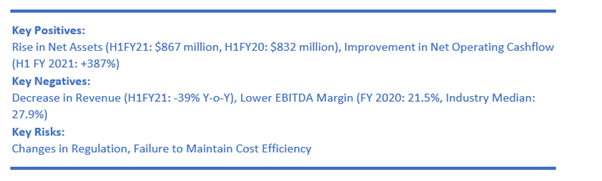
Outlook
The company is estimating RC EBITADF for FY21 to be in the range of $235 million and $265 million. Besides, the company witnessed a positive net operating cashflow of $89 million in H1FY21 as against negative net operating cashflow of $31 million in H1FY20. The company is on track to achieve $48 million in the annual structural cost savings for FY 2021, which is in-line with the guidance.
Valuation Methodology: P/E Based Relative Valuation (Illustrative)
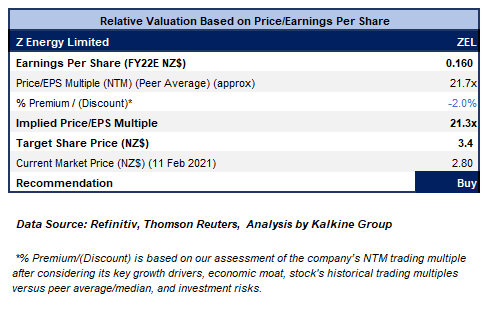
We have applied P/E multiple Based relative valuation (on an illustrative basis) and the target price reflects a rise of low double-digit (in % terms). We have applied a slight discount to the peer average P/E (NTM Trading multiple) driven by its muted revenue outlook and lower EBITDA margin versus peers, while also considering its historical discounted multiple versus peers.
Given its reaffirmation of its FY21 RC EBITADF guidance to be in the range of $235 million to $265 million and its relentless focus on cost optimisation, we give a “Buy” recommendation on the stock at the current market price of $2.800 per share, down by 0.71% on 11th February 2021.
2) New Zealand Oil & Gas Ltd (Recommendation: Speculative Buy, Potential Upside: Low Double-Digit) (M-Cap: NZ$80.571 million)
Business Description:
New Zealand Oil & Gas Ltd (NZX: NZO) possesses a low-cost structure, cash for acquisitions, subsurface expertise, exploration interests in NZ, Australia and Indonesia, as well as a controlling interest in ASX-listed Cue Energy.
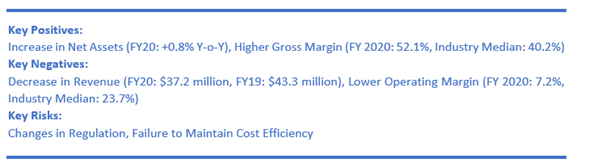
Outlook
The cash balance of the company witnessed an increase to $110.8 million at 30th June 2020, up from $105.6 million.
The COVID-19 pandemic disrupted the global markets but the company’s production facilities were operating. Notably, the revenues remained strong as the portfolio is dominated by gas, connected to pipeline markets with the long-term contracts.
Technical Overview:
Weekly Chart –
Source: Refinitiv (Thomson Reuters)
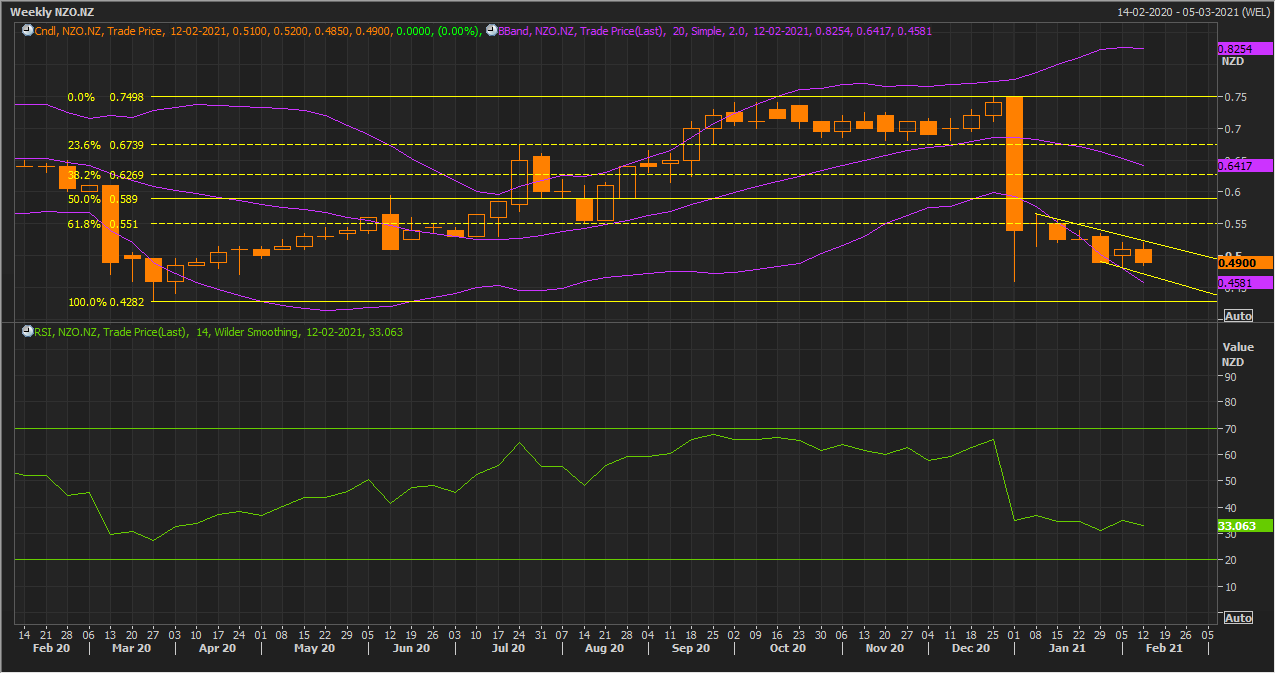
Note: Purple colour lines are Bollinger Bands® with the upper band suggesting overbought status while the lower band oversold status, and yellow lines are Fibonacci retracement lines which measure price rebound and backtrack. https://www.bollingerbands.com/
The stock has been trading in a descending or falling channel for the past 4-5 weeks which is towards confirmation of downtrend for the stock. However, the technical indicator RSI with a reading around 33 suggests that the stock has reached near its oversold zone.
Going forward, the stock may have limited downside due to its oversold status whereas on price rebound, there could be good price appreciation. We believe that the stock may have resistance around the 61.8% retracement level of $0.55 whereas support could be around the lower Bollinger band of $0.45.
3) Contact Energy Limited (Recommendation: Hold, Potential Upside: Low Double-Digit) (M-Cap: NZ$5.4 billion, Gross Dividend Yield: 6.328%)
Business Description:
Contact Energy Limited (NZX: CEN) is involved in providing electricity, natural gas, and liquefied petroleum gas (LPG), along with broadband services. The electricity is generated through thermal, hydro, and geothermal sources.
Outlook:
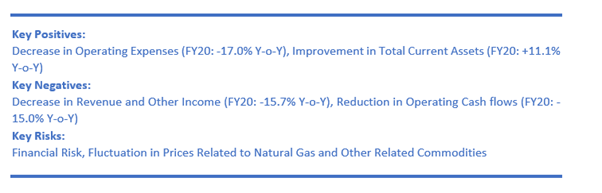
As per 14 January 2021 release, the life of New Zealand’s Aluminium Smelter (‘NZAS’) at Tiwai Point would be extended until at least the end of 2024 while an economic transition for the Southland is developed. As a part of the arrangement, CEN has agreed to supply Meridian Energy with a portion of the electricity required to power the NZAS smelter at Tiwai Point. Contact Energy will provide an average of 100 megawatts of baseload electricity through until the end of 2024.
Valuation Methodology: P/E Based Relative Valuation (Illustrative)
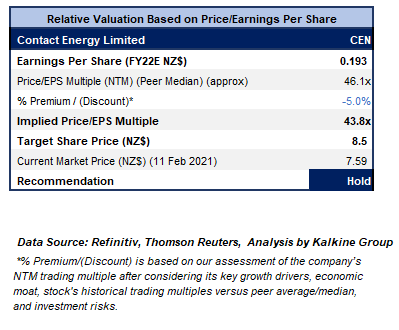
We have applied P/E multiple Based relative valuation (on an illustrative basis) and the target price reflects a rise of low double-digit (in % terms). We have applied a slight discount to the peer median P/E (NTM Trading multiple) driven by its fall in revenue and operating cash flows, uncertainty around the final decision to proceed with $600 million investment, while also taking into consideration its historical discounted multiple versus peer average.
Considering the expected upside and improvement in total current assets, we give a “Hold” recommendation on the stock at the current market price of $7.590 per share, down by 1.43% on 11th February 2021.
4) Genesis Energy Limited (Recommendation: Hold, Potential Upside: Low Double-Digit) (M-Cap: NZ$4.06 billion, Gross Dividend Yield: 5.782%)
Business Description:
Genesis Energy Limited (NZX: GNE) is a New Zealand based diversified energy company, which sells LPG, electricity, and reticulated natural gas via the retail brands of Energy Online and Genesis Energy.
Outlook:
It can be said that the strong and resilient business culture of GNE positions it in the right place for future developments. Besides, the company has witnessed 13% growth as compared to the prior comparable period in total generation in Q2FY21 with 7.3% growth in average generation price in its wholesale segment.
The company has given EBITDAF guidance in a range of $395 million to $415 million for the full year ended 30 June 2021. The company continues to target strategic goal of $400+ million EBITDAF in FY21 and the Capex guidance for FY21 is up to $95 million.
Valuation Methodology: P/E Based Relative Valuation (Illustrative)
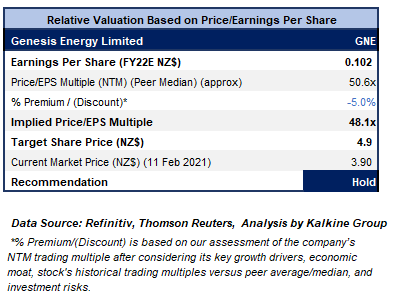
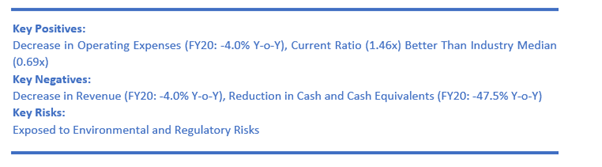
We have applied P/E multiple Based relative valuation (on an illustrative basis) and the target price reflects a rise of low double-digit (in % terms). We have applied a slight discount to the peer median P/E (NTM Trading multiple) considering its fall in revenue and decline in cash and cash equivalents.
Hence, we give a “Hold” recommendation on the stock at the current market price of $3.900 per share on 11th February 2021.
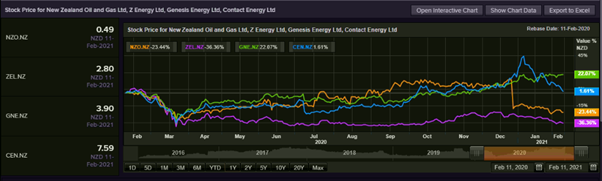
Comparative Price Chart (Source: Refinitiv (Thomson Reuters))
Disclaimer
Kalkine New Zealand Limited is authorised to provide class advice only. The information on this site does not take into account any of your investment objectives, financial situation or needs. Before you make a decision about whether to acquire a financial product, you should obtain the Product Disclosure Statement from the product issuer. You should consider the appropriateness of advice taking into account your own objectives, financial situation and needs and seek independent financial advice before making any financial decisions.
Past performance is not a reliable indicator of future performance.
 Please wait processing your request...