
 AU
AU
 UK
UK
 CA
CA
 US
US
 IND
IND

 NZ
NZ

Summary:
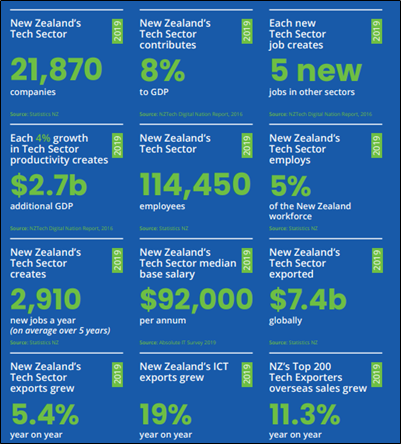
The NZ Tech Sector (Source: NZTech)
Some Major Highlights of 2019
In 2019, the tech sector created 555 new companies in New Zealand and the figure reached 21,870, up by 3% from 2018. 80% of these new tech companies were ICT firms, mostly computer system and design companies. In 2019, it also created 2,148 new jobs in New Zealand, up 2.1% from 2018 and it currently employs 114,450 people. 60% of these new jobs were created by the computer system as well as design companies. The revenues of the largest 200 tech exporters reached $12.1 billion in 2019, creating more than $1 billion, or 10.2% growth from 2018.
The revenues of ICT firms in the top 200 grew by 15.9%. High tech manufacturers revenues increased by 7%, and that of biotech firms increased by 6%. Fintech was the fastest-growing part of the tech sector, and revenue growth stood at 26.9% or $241 million of new revenues in 2019. The international sales of the country’s top 200 tech exporters increased by 11.3% to $8.7 billion, bringing in an additional $882 million in sales in 2019.
ICT Surpassed Wine Exports
As per Stats NZ, export sales of software and services by the information and communication technology (ICT) sector reached $2.1 billion in 2019, reflecting a rise of 47 percent from 2017. The growth in ICT exports was mainly led by increased sales of published software, which reached almost $1 billion in 2019.
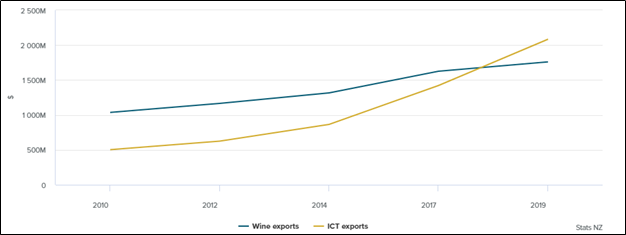
Value of wine and ICT Exports (Source: Stats NZ)
While exports grew significantly, sales to domestic customers dominated ICT sector, at $7.8 billion in 2019. The overall value of domestic and export sales stood at $9.8 billion, a rise of 31% from 2017.
Australia is the Biggest Export Market for NZ Tech Companies
Australia
Australia remained the leading export market for the top 200 NZ tech exporting companies and grew 10.8% in 2018. The Australian market served as a crucial stepping-off point for globally expanding technology companies of New Zealand, as well as providing substantial levels of investment.
Asia
Asia is becoming very attractive market for NZ tech companies, with top 200 companies witnessing growth rate of 9.6% in 2018. Global technology giant, Tencent, made numerous investments in NZ’s gaming sector.
Europe
Europe was fastest-growing export market in 2018, with growth rate of 16.7% complemented by the high number of acquisitions by high growth technology companies of New Zealand in this region.
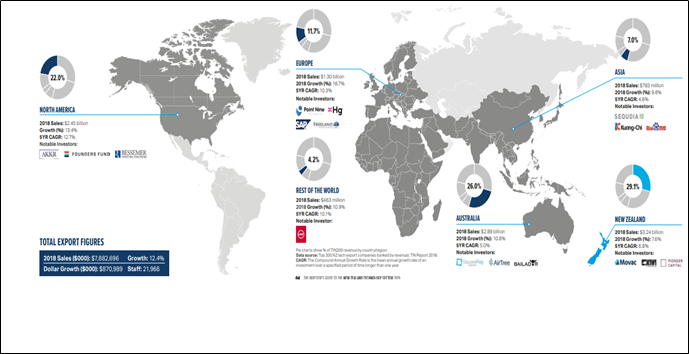
Global Revenue Sources (Source: MBIE)
Significance of Technology Sector in New Zealand
Application of AI technologies in agriculture, manufacturing, services, and the government will ensure the future prosperity of the nation. Besides, Internet of Things (IoT) creates a great future for New Zealand by connecting data, devices, and people to seize opportunities for economic growth.
The significant opportunities that digital technologies are creating especially in areas such as precision healthcare, e-education, and autonomous vehicles are well recognized. New Zealand is making the most of the opportunities that digital technologies are creating. As a matter of fact, digital technology is now part of the very fabric of the economy and society. It is reshaping the nature of the opportunities businesses face both domestically as well as globally. Businesses recognize new opportunities and make the right investments to realize their objectives. Similarly, individuals need to make informed choices about how they react to changes that is taking place in their lives. The government also needs to ensure that the policy formulation and decisions should be keeping in pace with changing business environment, and they are innovation supportive.
New Zealand offers a strong technology ecosystem. It ranks first in the world for ease of doing business, being the least corrupt nation, having a skilled workforce, sound financial markets, and stable political and regulatory environments. The enabling environment has led to the emergence of high growth technology companies with world-leading ambitions. The top 200 tech exporting companies are attracting significant investment from all over the world.
Growing digitization and increased use of information and communication technology across the economy will help generate employment across a range of skill sets, thereby addressing the unemployment concerns.
Impact of COVID-19 on Technology Sector
The tech sector has proven its resilience and is continuing to create growth in employment and exports for New Zealand. As consumers moved to remote working, IT service providers saw work continue, however, there was freeze on big projects as well as forward planning.
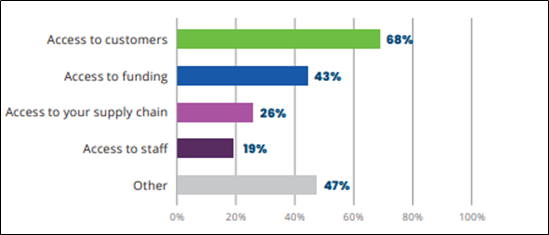
Biggest risk to current business activity (Source: NZTech)
Challenges Faced by Technology Sector
During the lockdown period, the main problem tech companies experienced was access to customers as well as corresponding concern regarding cash flow. For start-up businesses, the main concern was access to funding.
Across the sector, further hiring of employees was stopped, with 15 per cent of firms reducing their staff during April and May. On account of reduced access to capital, growth of many tech companies slowed down from Pre COVID-19 level. Exporting firms, both hi-tech manufacturers and digital, have also faced challenges due to travel constraints and manufacturers are suffering from supply chain challenges.
Since we now have a broad idea of the technology sector, it is important to look at the performance of some companies operating in the same sector.
1. Pushpay Holdings Limited (NZX: PPH) (Recommendation: Buy, Potential Upside: Lower Double-Digit) (M-cap: ~NZ$2.33 Billion)
Business Description: Pushpay Holdings Limited offers donor management system, including finance tools, donor tools and a custom community app, to the non-profit organisations, faith sector and education providers in Canada, the US, New Zealand, and Australia.
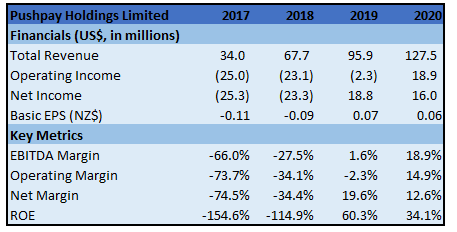
Key Metrics (Source: Refinitiv (Thomson Reuters))
Outlook: For the coming years, the company expects further strong revenue growth as it continues to implement its strategy to gain market share in the medium-term. The company is anticipating registering EBITDAF of about US$48.0 million to US$52.0 million for the full year ending 31 March 2021.
Key Risks: The company is exposed to a number of financial risks including liquidity risk, credit risk and market risk.
Valuation: The company has been evaluating additional potential strategic acquisitions that broaden current proposition as well as add substantial value to current business. We have applied EV/Sales multiple based relative valuation (on an illustrative basis), and the target price reflects a rise of lower double-digit (in % terms).
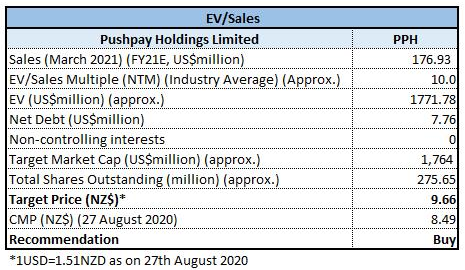
Thus, we give a “Buy” recommendation on the stock at the current price of NZ$8.490 per share, up by 0.71% on August 27, 2020.
2. Plexure Group Limited (NZX: PLX) (Recommendation: Buy, Potential Upside: Lower Double-Digit) (M-cap: ~NZ$195.12 Million)
Business Description: Plexure Group Limited is a mobile engagement software company and the global brands are using the company’s products to engage consumers on the mobile devices.
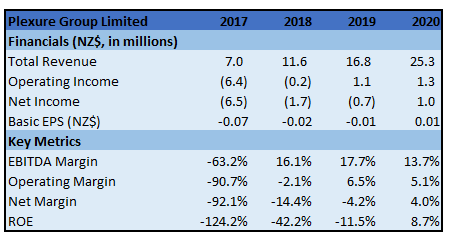
Key Metrics (Source: Refinitiv (Thomson Reuters))
Outlook: With the increased sales and marketing activity in the US, the company’s channel of prospective customers has increased significantly; however, it believes that, in the near-term, sales conversion will be slower in a COVID-19 world. In the month of April 2019, McDonald’s purchased 9.9% equity stake in the company and as a result of that investment, the company’s relationship with McDonald’s strengthened across FY 2020.
Key Risks: The company is exposed to various financial risks, including liquidity risk, credit risk and market risk.
Technical Overview:
Weekly Chart –
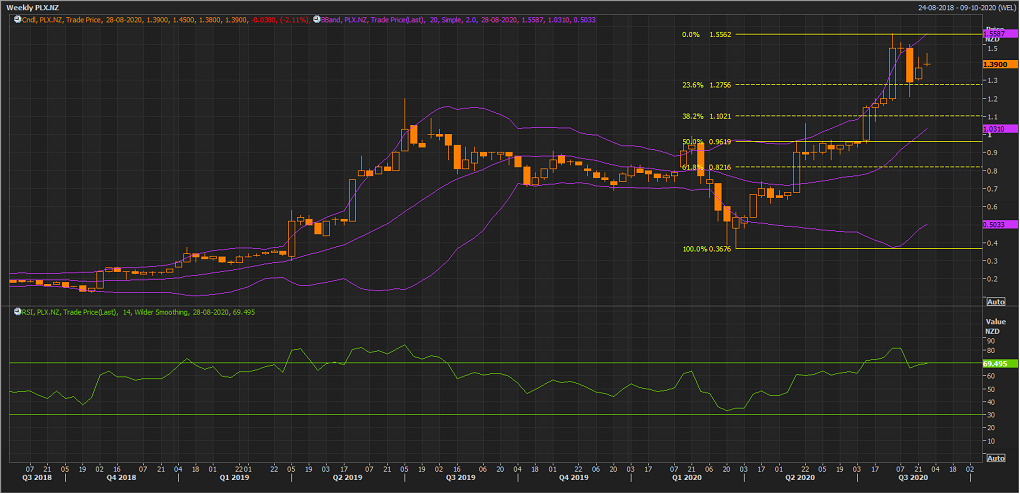
Source: Refinitiv (Thomson Reuters)
Note: Purple colour lines are Bollinger Bands with upper band suggesting overbought status while lower band oversold status, and yellow lines are Fibonacci retracement lines which measure price rebound and backtrack.
The stock has been very resilient for multi-weeks now, barring one week when it backtracked to 23.6% retracement level of $1.27. For the past two weeks including the on-going week, the stock has been giving gap-up opening with higher close thereby exhibiting strength in uptrend. However, even though the stock has given higher close for the on-going week, the closing is with ‘Doji’ candle formed which indicates at indecisiveness on the part of traders. Technical indicator RSI with around 70 reading though suggests strong bullish momentum it also suggests that the stock has entered the overbought zone, needing caution to be exercised.
Going forward, the stock may have resistance around the previous high of $1.56 which is also the upper Bollinger band reading, while support could be around 23.6% retracement level of $1.27.
Thus, we give a “Buy” recommendation on the stock at the current price of NZ$1.390 per share, down by 2.11% on August 27, 2020.
3. Serko Limited (NZX: SKO) (Recommendation: Buy, Potential Upside: Lower Double-Digit) (M-cap: ~NZ$341.32 Million)
Business Description: Serko Limited is a market-leading travel and expense technology solution provider in Australasia.
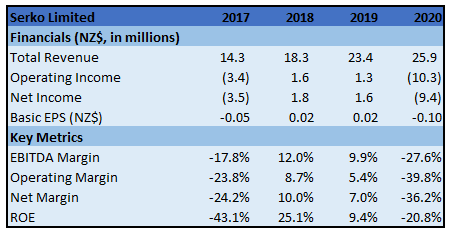
Key Metrics (Source: Refinitiv (Thomson Reuters))
Outlook: The company considers itself to be well-positioned for growth when the travel industry recovers, and trading conditions start to improve. It has a strong hold in Australasia, with its major transactions being domestic and Trans-Tasman in the home markets. It is now mainly concentrating on domestic travel within North America, where it continues to add resellers to its platform and maintain development work to localise content in that region.
Key Risks: The primary risks arising from the company’s financial instruments include foreign currency, interest, credit as well as liquidity risk.
Valuation: The company also has a strong balance sheet and continuing commitment to investment, which will help existing and prospective customers. We have applied EV/Sales multiple based relative valuation (on an illustrative basis), and the target price reflects a rise of lower double-digit (in % terms).
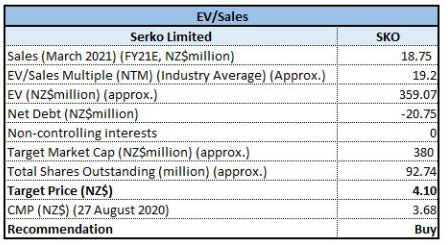
Thus, we give a “Buy” recommendation on the stock at the current price of NZ$3.680 per share on August 27, 2020.
4. Solution Dynamics Limited (NZX: SDL) (Recommendation: Speculative Buy, Potential Upside: Lower Double-Digit) (M-cap: ~NZ$32.94 Million, Gross Dividend Yield: 3.086%)
Business Description: Solution Dynamics Limited (NZX: SDL) provides integrated solutions that are designed to meet the most demanding customer communication needs and for organisations across the world.
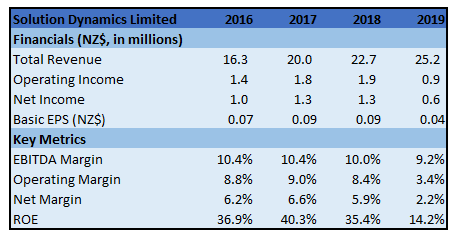
Key Metrics (Source: Refinitiv (Thomson Reuters))
Outlook: The company has provided earnings guidance of $2.0 million to $2.5 million for FY21. This excludes the unrealised FY21 foreign exchange hedge gains of around $0.6 million. The guidance is also after adjustments for a number of customers whose operational expectations have been significantly lowered for FY21 due to COVID-related disruptions. The results are also dependent on the successful timing of onboarding of new customer volumes.
Key Risks: The company’s top five customers (both domestic and international) provided 38.6% of the company’s revenue in FY2019 and largest customer accounted for 12.7% of revenue. Loss of one or more of those customers could cause financial results to differ materially.
Technical Overview:
Weekly Chart –
Source: Refinitiv (Thomson Reuters)
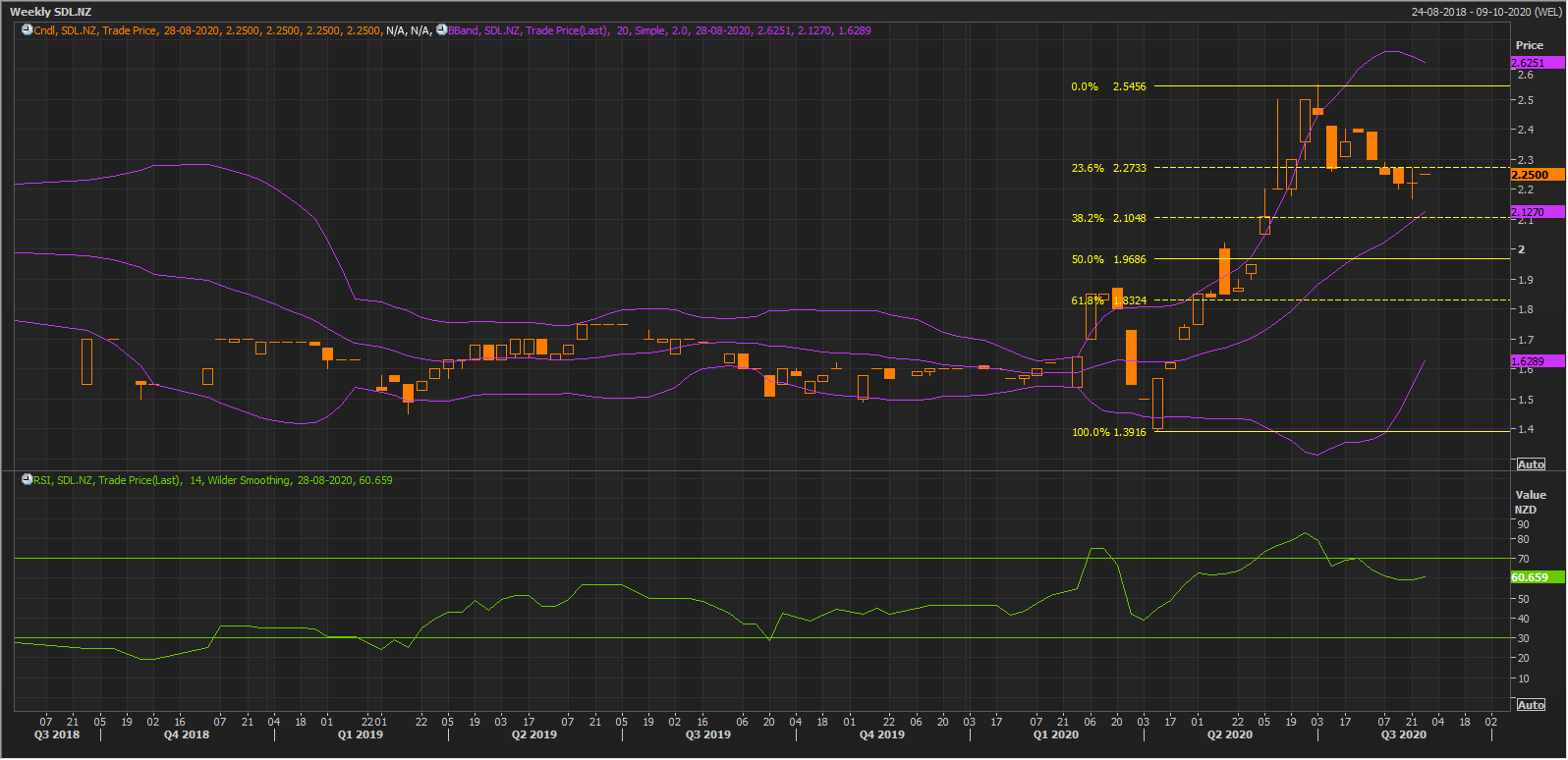
Note: Purple colour lines are Bollinger Bands with upper band suggesting overbought status while lower band oversold status, and yellow lines are Fibonacci retracement lines which measure price rebound and backtrack.
The stock in the previous week has given close forming ‘Doji Candle’ post bearish candle formed in the prior week. For the on-going week, the stock has given flattish close above the previous week close thereby confirming the “Morning Doji Star’ chart pattern which indicates a bullish reversal for the stock. Technical indicator RSI with around 61 reading suggests strong bullish momentum for the stock.
Going forward, the stock may have resistance around $2.45 where the gap on the chart exists while support could be around 20 periods SMA of $2.12.
Valuation: On TTM basis, its EV/EBITDA multiple stood at 12.4x which is lower as compared to industry average of 16.3x. Its P/B multiple stood at 8.2x while industry average is 10.6x.
Thus, we give a “Speculative Buy” recommendation on the stock at the current price of NZ$2.250 per share on August 27, 2020.
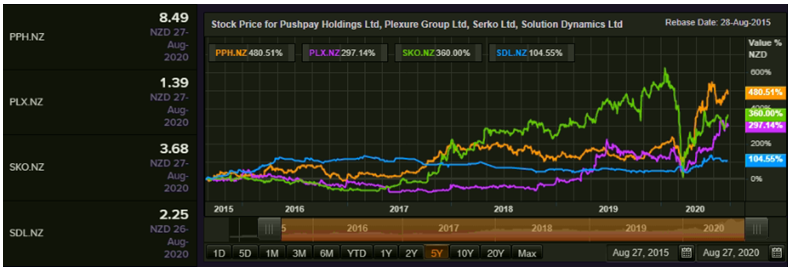
Comparative Price Chart (Source: Refinitiv (Thomson Reuters))
Disclaimer
Kalkine New Zealand Limited is authorised to provide class advice only. The information on this site does not take into account any of your investment objectives, financial situation or needs. Before you make a decision about whether to acquire a financial product, you should obtain the Product Disclosure Statement from the product issuer. You should consider the appropriateness of advice taking into account your own objectives, financial situation and needs and seek independent financial advice before making any financial decisions.
Past performance is not a reliable indicator of future performance.
 Please wait processing your request...